
On this page
Start here
Quick answer
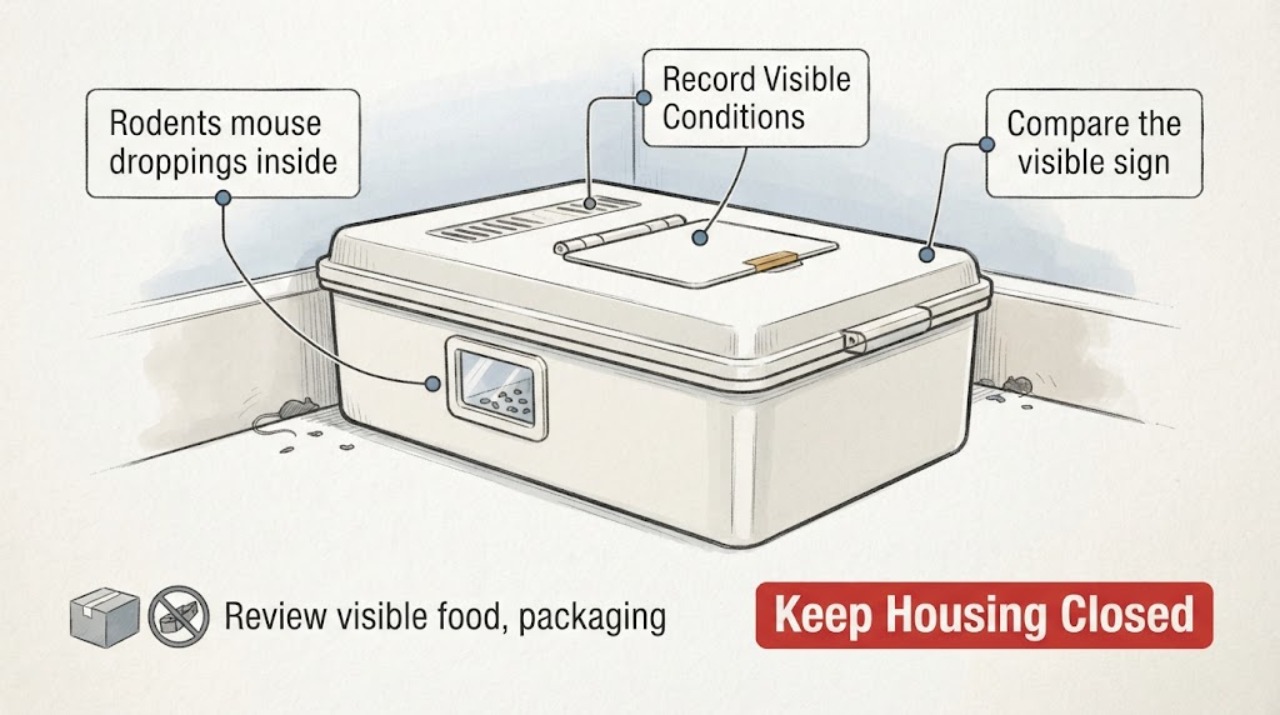
Treat indoor mouse droppings as a safe-cleanup and pest-inspection issue, not as something to sweep or vacuum. From a distance, record where the sign appears, whether similar signs recur, nearby food or packaging damage, moisture or shelter conditions, and visible entry gaps. Do not touch droppings, urine, nesting material, dead rodents, traps, or suspect food; do not open walls or use poison as an improvised fix. Follow current public-health cleanup guidance and request a pest professional when signs are repeated, widespread, fresh-looking, inaccessible, or associated with a live rodent.
Work through in order
Diagnostic checks
Use only checks that match the exact appliance or system and its official guide.
-
Check 1
From a clean, safe distance, record the room and exact visible location of the droppings without touching, moving, or disturbing them.
Expected result: Note whether the sign is on a floor edge, inside a cabinet or drawer that is already open, under a sink, near food storage, beside an appliance, in a garage, or in another room; do not open closed spaces to search.
Next step: Take a photo only from a safe distance if it can be done without entering a contaminated area, and give the room map to a pest professional.
Stop if: Stop if the sign is in a small enclosed space, on a ceiling or wall cavity, near a sleeping area, or in a location that requires moving appliances or stored items.
Why this matters
Why: Location can show a likely travel or food-water route, but it cannot establish the source, species, or hidden extent by itself.
-
Check 2
Compare the visible sign with the same area later using ordinary visual observation, without touching it or trying to clean it as a test.
Expected result: Record no change, additional droppings, nearby gnawing, nesting material, a stale odor, or a live-rodent sighting, without attempting to determine an exact age from color or texture.
Next step: Keep people and pets away from the area and report the pattern and timing to the pest professional or local health authority as appropriate.
Stop if: Stop observing if a live rodent is cornered, a dead rodent is present, material is widespread, or anyone would need to enter or disturb the area.
Why this matters
Why: Repeated or expanding signs support active rodent inspection; one unchanged sign does not prove that activity has stopped or that the material is harmless.
-
Check 3
Review visible food, packaging, and water conditions without handling suspect packages, food, dishes, droppings, or nesting material.
Expected result: Note open food, chewed packaging, crumbs, pet food, uncovered waste, spilled water, a leak, or no obvious food or moisture source.
Next step: Keep people and pets away, tell the pest professional which food or water areas are involved, and follow appropriate food-safety guidance for anything that may have been contacted.
Stop if: Stop if food, dishes, or surfaces may be contaminated or if the area cannot be kept away from children and pets.
Why this matters
Why: Food and water access can support rodent activity, while damaged packaging raises a food-safety concern; these observations do not prove where the rodents entered.
-
Check 4
From a safe standing position, look for visible entry gaps around exterior doors, windows, baseboards, and pipe or utility penetrations without opening walls or removing trim.
Expected result: Record a visible gap, gnawed opening, damaged door sweep or screen, or no obvious opening, and note whether it aligns with the droppings or a travel edge.
Next step: Photograph the opening from a clean distance and ask the pest professional what exclusion work is appropriate after inspection.
Stop if: Stop if checking the opening requires drilling, cutting, removing trim, entering a wall or crawlspace, or contacting wiring or plumbing.
Why this matters
Why: A visible opening may be one access route, but a hidden route or shared-building movement can also be involved; no visible gap does not rule out entry.
-
Check 5
Review the wider activity pattern from accessible, clean areas without moving furniture, appliances, boxes, or stored materials.
Expected result: Record whether signs are isolated to one room, present in several rooms, concentrated along a wall, associated with nighttime sounds, or accompanied by a live sighting.
Next step: Provide the room pattern and any safe audio or photo record to the pest professional, and ask whether adjacent units or shared building areas need review.
Stop if: Stop if investigating would disturb droppings, nesting material, dead rodents, a trap, insulation, or any suspected contaminated surface.
Why this matters
Why: A multi-room or recurring pattern raises the need for professional inspection and exclusion planning; a limited visible area does not prove that hidden spaces are clear.
Use your observations
Decision map
Find the observation that best matches what you see, then follow the next safe action.
-
PATH 01Next step
What you see
There is one isolated visible sign and no repeated activity, food damage, moisture pattern, or live sighting.
Do this next
Keep people and pets away, follow current CDC cleanup guidance or ask a professional to handle the material, and monitor only from a clean distance for recurrence.
-
PATH 02Next step
What you see
Additional signs appear, a live rodent is seen, activity occurs at night, or signs occur in more than one room.
Do this next
Request pest inspection promptly for identification, removal, and entry-exclusion planning; do not handle traps, droppings, or animals.
-
PATH 03Next step
What you see
Droppings or gnawing are around food packages, cupboards, drawers, counters, or pet-food storage.
Do this next
Keep the affected food area out of normal use, avoid handling suspect food or packaging, and request professional and food-safety guidance.
-
PATH 04Next step
What you see
Signs are widespread, in a closed room, in a wall or ceiling area, or near nesting material or a dead rodent.
Do this next
Do not enter or disturb the area; arrange qualified pest cleanup and ask the local health department about site-specific guidance.
-
PATH 05Next step
What you see
A visible exterior or interior gap appears to align with the activity pattern.
Do this next
Document the gap and ask the pest professional to plan exclusion after identifying the activity; do not open the wall or seal blindly around utilities.
Helpful context
Understand the symptom
The location of droppings can help distinguish a kitchen food route, a cabinet or plumbing area, a wall edge, a storage space, or an entry path, but appearance alone cannot prove how old the sign is or identify a species. EPA guidance lists droppings around food packages, drawers, cupboards, and sinks, along with nesting material, chewing, smells, and holes as signs to document.
Do not dry sweep or vacuum rodent droppings, urine, or nesting material. CDC guidance says this can put contaminated particles into the air; use the current CDC cleanup procedure or a qualified professional, especially for heavy, inaccessible, or enclosed contamination. This page does not diagnose an illness and does not replace medical or local-health guidance after an exposure.
Only after diagnosis
Potential parts
- snap trap
Consider this category only after a pest professional confirms that trapping is suitable for the location, occupants, pets, and access conditions.
Use a product and placement plan appropriate to the identified rodent and household safety conditions; do not handle or reset a trap containing an animal. - rodent-proof food storage container
Consider this category when a professional or food-safety plan identifies exposed food storage as a contributing condition.
Confirm that the container closes securely, is suitable for the food, and can be cleaned without contacting contaminated material. - exterior door sweep
Consider this category only after a professional confirms a compatible door gap as an entry route.
Confirm the door, threshold, weather-seal, and egress requirements before ordering; do not block drainage or ventilation paths.
When checks do not resolve it
Need a professional?
Request pest service for repeated or widespread droppings, a live rodent, signs near food or pet supplies, activity in walls or ceilings, gnawing, nesting material, a dead rodent, or an inaccessible or heavy-contamination area. Contact the local health department for site-specific cleanup questions and a healthcare provider after a concerning exposure or illness.
Have this ready
- Provide safe photos, room and surface locations, the first and most recent observation dates, repeated activity or sounds, food or water conditions, visible entry gaps, live or dead animal observations, children or pets in the home, and any prior pest service.
Common questions
FAQ
Can I sweep or vacuum mouse droppings?
No. CDC guidance warns that dry sweeping or vacuuming can put contaminated particles into the air. Keep away from the material and follow current CDC cleanup guidance or use qualified help.
Do droppings prove that mice are still inside?
Not by themselves. A single sign cannot establish its age or whether the animal remains. Repeated signs, live sightings, gnawing, nesting material, sounds, or activity in multiple rooms justify professional inspection.
What if droppings are near food or dishes?
Keep the area and suspect food or packaging out of normal use, do not handle or consume anything that may have been contacted, and request pest and food-safety guidance. Do not try to clean the material by dry sweeping.
Should I seal a visible hole immediately?
Document it and ask a pest professional to plan exclusion after identifying the route. Blindly sealing around unknown wiring, plumbing, or an active animal can create a new hazard or leave the problem unresolved.
Read the exact guide
Official sources
- How to Clean Up After RodentsCenters for Disease Control and Prevention · Supports the instruction not to dry sweep or vacuum rodent material and the recommendation to use current cleanup precautions or qualified help.
- Identify and Prevent Rodent InfestationsU.S. Environmental Protection Agency · Supports observing droppings, nesting material, chewing, odors, entry holes, and food or water sources without claiming certainty from one sign.
Community feedback
Share a repair observation
Share a plain-text repair observation. Accepted observations are published automatically; this page may take a moment to update.