
On this page
Start here
Quick answer
Treat mouse droppings inside a food-storage area as both a contamination and an active-infestation problem. Keep people, pets, and food away from the area; do not sweep or vacuum dry droppings. Throw away food in paper or plastic packaging, gnawed or leaking packages, and any dented, swollen, cracked, punctured, or unsealed can or jar. For a small, accessible hard-surface cleanup, ventilate first, wear gloves, soak the droppings with an EPA-registered disinfectant or fresh bleach solution, wait according to the label or CDC guidance, wipe them up, and wash your hands. Then inspect for fresh droppings, gnawing, and entry gaps, seal food and openings, and arrange pest-control or health-department help for heavy, hidden, recurring, or ventilation-system contamination.
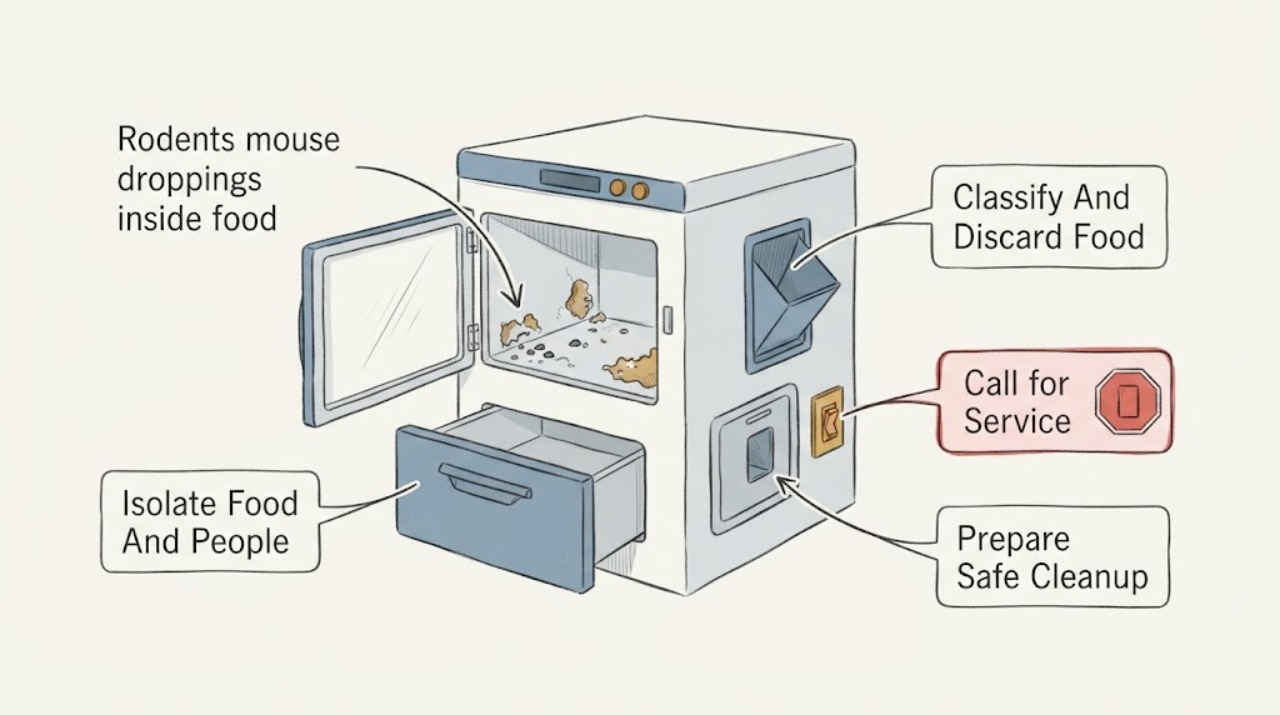
Work through in order
Diagnostic checks
Use only checks that match the exact appliance or system and its official guide.
-
Check 1
Keep children and pets out of the affected pantry, cabinet, room, or storage area. Without touching droppings, move only clearly uncontaminated food away from the area and place suspect packages in a separate closed container or bag; photograph the scene and note where droppings, gnawing, urine staining, and nesting material appear.
Expected result: Record whether contamination is limited to one shelf or cabinet, reaches open food or pet food, includes torn packages or visible food loss, or extends behind appliances, into walls, or into vents.
Next step: Keep all suspect food out of use and proceed to the packaging decision. Arrange pest-control or health-department guidance before disturbing hidden or extensive contamination.
Stop if: Stop handling the area for heavy accumulation, a large nest, a live or dead rodent in a confined space, exposed insulation, suspected HVAC contamination, or anyone with respiratory vulnerability who would be exposed.
Why this matters
Why: A localized accessible spill may permit a careful household cleanup after food is removed. Open or damaged food, hidden voids, repeated fresh signs, or an HVAC/air-duct route raises the health and service scope beyond a simple wipe-down.
-
Check 2
Sort every food, drink, pet-food, bird-seed, or fish-flake package that was in the contaminated area without opening or sampling it. Discard paper, cardboard, plastic, bags, pouches, gnawed or leaking packages, and any food that may have contacted droppings, urine, saliva, or nesting material. Inspect cans and glass jars for dents, swelling, deep rust, cracks, punctures, or broken seals.
Expected result: Separate compromised flexible or porous packages, damaged cans or jars, and intact all-metal cans or hermetically sealed jars; record the product names and lot information before disposal when practical.
Next step: Put discardable food in a covered trash container that prevents people or animals from retrieving it, then wash hands and disinfect the storage area. Follow FDA’s separate wash, rinse, sanitize, and air-dry procedure only for an intact eligible can or jar.
Stop if: Do not donate, serve, feed, or taste exposed food; do not open a swollen, leaking, punctured, or broken-seal can or jar.
Why this matters
Why: The first two groups are not made safe by wiping the exterior and should be discarded. FDA describes a limited sanitation route only for undamaged all-metal cans and hermetically sealed jars containing commercially prepared food or drink.
-
Check 3
For a small, accessible household area only, open doors or windows to ventilate for 30 minutes and leave the area during that time. Before re-entry, put on rubber or plastic gloves and prepare an EPA-registered disinfectant or a fresh bleach solution made according to CDC instructions; keep children, pets, and food away.
Expected result: Confirm that the area is a hard, accessible surface with no large infestation, no exposed insulation, no HVAC opening, and no need to climb or reach into a cavity; otherwise do not begin household cleanup.
Next step: If the area meets the small-cleanup boundary, continue by thoroughly wetting the waste with disinfectant and allowing the label contact time. If it does not, close off the area and arrange qualified pest-control or health-department guidance.
Stop if: Do not start if you cannot ventilate, do not have suitable gloves and disinfectant, are pregnant or medically vulnerable without clinician guidance, or would disturb a large amount of waste or nesting material.
Why this matters
Why: Ventilation, gloves, and a wet disinfecting method reduce exposure during a small cleanup. Dry sweeping or vacuuming can put contaminated particles into the air, and heavy or hidden contamination needs additional protective measures and trained service.
-
Check 4
While wearing gloves, spray the droppings and urine until thoroughly wet with disinfectant and let them soak for 5 minutes or the product label’s required time. Use paper towels to pick up the waste, place them in a covered garbage container, then mop or sponge hard floors, counters, cabinets, and drawers with disinfectant. Wash gloved hands before removing gloves and wash bare hands with soap and warm water afterward.
Expected result: After removal, look for remaining visible waste, stains, nesting fibers, or contamination in cracks, drawer slides, unfinished wood, cardboard, insulation, and other porous materials.
Next step: Discard contaminated cardboard and other items that cannot be safely cleaned; disinfect eligible hard nonporous containers. Do not vacuum or sweep any residue before it has been disinfected.
Stop if: Stop for a strong dust load, contaminated insulation, inaccessible voids, suspected air-duct contamination, illness during cleanup, or any need to use a high-pressure sprayer or dry vacuum.
Why this matters
Why: A visibly clean, disinfected hard surface is suitable for the next inspection once dry. Porous or contaminated materials may need disposal or specialized cleaning; a clean surface with new droppings later indicates the rodent activity was not stopped.
-
Check 5
After the area is dry and safe, inspect inside and outside for fresh droppings, gnaw marks, rub marks, nesting, and gaps around cabinets, appliances, doors, vents, utility lines, foundations, and the floor-wall joint. Put remaining food, pet food, and garbage in thick plastic, metal, or glass containers with tight lids and clean spilled food promptly.
Expected result: A pencil-width gap, damaged door sweep, utility penetration, unsealed vent edge, or fresh signs along one route shows where exclusion or trapping should be focused; no visible gap does not rule out a hidden route.
Next step: Seal small gaps with an appropriate rodent-resistant material and larger gaps with metal mesh, hardware cloth, metal, or cement only where this is safe and does not alter a utility, vent, or fire-rated assembly. Use a qualified professional for concealed or building-envelope work.
Stop if: Do not block a combustion-air opening, dryer or HVAC vent, drain, electrical/gas penetration, or structural joint without confirming the correct method; do not reach into a hole containing an animal.
Why this matters
Why: CDC notes that mice can fit through a hole about the width of a pencil. Sealing an entry and removing food and water sources reduces re-entry pressure, but fresh signs after cleaning indicate an active population that still needs control.
-
Check 6
If evidence continues after cleanup and exclusion, place the correct snap traps only in locations inaccessible to children and pets and follow the trap instructions. Check the cleaned area and nearby routes regularly for new droppings, urine spots, gnawing, or captures; document dates and locations instead of repeatedly disturbing contaminated material.
Expected result: No new signs for a week supports that the immediate rodent activity may have ended; new droppings, urine, or gnawing after a week, continued captures, multiple rooms, or contamination in ducts or walls indicates an unresolved or larger infestation.
Next step: Arrange pest-control service for recurring or concealed activity, ask about exclusion and safe cleanup as well as trapping, and keep suspect food out of use until the affected storage area is cleared. Contact a healthcare provider if illness follows exposure and report the rodent contact.
Stop if: Do not use glue or live traps for this cleanup plan, place poison where children or pets can reach it, or dismantle ducts, walls, appliances, or insulation to chase rodents.
Why this matters
Why: A trap result helps establish activity but does not prove that food or hidden surfaces are safe. Recurring signs, inaccessible contamination, or a ventilation-system route requires professional pest-control assessment and possibly health-department direction.
Use your observations
Decision map
Find the observation that best matches what you see, then follow the next safe action.
-
PATH 01Safety boundary
What you see
Food is open, in paper/cardboard/plastic packaging, gnawed, leaking, stained, or may have contacted droppings, urine, saliva, or nesting material.
Do this next
Discard it in covered trash that prevents retrieval, do not donate or feed it to animals, wash hands, and disinfect the storage area before restocking.
Why this path and its safety boundary
Why it matters: The food cannot be made safe by wiping its package; contamination and package integrity are the deciding factors.
Safety stop: Do not open, taste, smell closely, or salvage a compromised package.
-
PATH 02Safety boundary
What you see
The item is an undamaged all-metal can or hermetically sealed jar with no swelling, puncture, crack, deep rust, or broken seal.
Do this next
Follow the FDA wash, rinse, sanitize, and air-dry procedure for the intact container; discard it if any damage or seal doubt appears.
Why this path and its safety boundary
Why it matters: It fits FDA’s narrow intact-container exception, but its exterior still needs careful sanitation before opening or storing.
Safety stop: Do not extend this exception to bags, boxes, pouches, plastic containers, or questionable seals.
-
PATH 03Safety boundary
What you see
The waste is a small amount on accessible hard surfaces, the room can be ventilated, and there is no exposed insulation, HVAC contamination, large nest, or medically unsafe exposure.
Do this next
Ventilate, wear gloves, wet the waste with disinfectant, wait for the label or CDC contact time, wipe it up, disinfect the hard surface, and wash hands.
Why this path and its safety boundary
Why it matters: A careful wet disinfecting cleanup may be reasonable, but only after the food is removed and protective steps are ready.
Safety stop: Never dry-sweep or vacuum droppings; stop if the material is extensive, hidden, dusty, or enters ducts or insulation.
-
PATH 04Safety boundary
What you see
Fresh droppings return after cleaning, gnawing continues, several rooms are affected, a rodent or nest is inside a wall or duct, or contamination reaches insulation or an air-handling system.
Do this next
Close off the area, keep food out of use, and contact a pest-control specialist; involve the local or state health department for heavy contamination or public-health questions. Use a specialist for rodents in heating or cooling ventilation systems.
Why this path and its safety boundary
Why it matters: The signs make an active or inaccessible infestation more likely than a one-time entry; surface cleaning alone will not solve the exposure route.
Safety stop: Do not open walls or ducts, disturb nests, or attempt a large cleanup without appropriate training and protective equipment.
-
PATH 05Safety boundary
What you see
Food has been handled safely, the area was disinfected, entry and food sources were addressed, and no new droppings, urine, or gnawing appear for at least a week.
Do this next
Keep food in tight-lidded containers, maintain the exclusion work, and check the storage area regularly for renewed evidence.
Why this path and its safety boundary
Why it matters: The immediate rodent activity may have ended, but stored food and the cleaned area still need ongoing inspection because the absence of signs is not proof that every hidden route was sealed.
Safety stop: Escalate if any fresh evidence appears or if anyone becomes ill after exposure.
Helpful context
Understand the symptom
Why droppings plus food damage changes the first step
Droppings, gnaw marks, torn packaging, and nesting material show that rodents have accessed the area, but they do not tell you whether the activity is still active or how far contamination traveled. Do not taste, sniff closely, or try to rescue food by wiping the outside of a damaged package. Set the food aside from people and pets, preserve the package or a photograph for a product or health inquiry, and make the food-safety decision before cleaning the shelf.
Food to discard and the narrow exception
FDA guidance says food products in plastic and paper containers exposed to rodent filth should be thrown away, including pet food and animal feed. Throw away cans or jars that are dented, crushed, swollen, deeply rusted, cracked, punctured, or have a broken seal. Undamaged all-metal cans and hermetically sealed jars are the narrow exception described by FDA, and require careful washing and sanitizing before use; do not apply that exception to cardboard, bags, pouches, or visibly damaged seals.
Cleanup is not the same as rodent control
Disinfecting a cabinet removes the immediate surface hazard but does not stop another mouse from entering. CDC recommends looking around cabinets, appliances, vents, utility lines, foundations, doors, and wall-floor joints for gaps, then sealing them and storing food in thick plastic, metal, or glass containers with tight lids. Traps and continued monitoring are needed when signs remain; poison or a trap should never be placed where a child or pet can reach it.
Safe boundary
Do not sweep or vacuum dry droppings, mix cleaning chemicals, reach into an unknown void, disturb a large nest, or clean contaminated heating and cooling ducts yourself. Heavy infestation, a dead rodent in an inaccessible cavity, exposed insulation, or contamination in an air-handling system calls for qualified pest control and local health-department guidance. If anyone develops illness after exposure, tell a healthcare provider about the rodent contact.
Safety boundary
Stop conditions
- Do not sweep or vacuum dry droppings, urine, or nesting material; wet-disinfect first according to CDC guidance.
- Stop household cleanup for heavy infestation, exposed insulation, inaccessible cavities, HVAC or heating/cooling ducts, a live or dead rodent that cannot be safely contained, or a person who becomes ill during exposure.
- Do not eat, donate, or feed exposed food; do not open damaged, swollen, leaking, punctured, or broken-seal cans or jars.
- Do not place traps or bait where children or pets can reach them, block utility or ventilation openings, or open walls and ducts without qualified service.
Only after diagnosis
Potential parts
- rodent-resistant gap-sealing material
Consider only after the entry gap is located and the opening is not a required vent, drain, utility access, or fire-rated assembly.
Match the material to the gap, substrate, weather exposure, utility clearance, and local building requirements; use a professional for concealed or structural openings. - mouse snap trap
Consider only when fresh signs indicate rodents remain and traps can be placed securely out of reach of children and pets.
Use the correct trap type for the rodent and follow its instructions; trapping does not replace food disposal, cleanup, exclusion, or professional service for hidden infestations. - tight-lidded food storage container
Consider for uncontaminated food that is retained after the affected storage area is cleaned and rodent access is addressed.
Choose a container that closes fully and is suitable for the food, moisture, temperature, and cleaning requirements; do not transfer contaminated food into it. - replacement air filter
Consider only when a qualified professional confirms rodent nesting in an accessible air-intake or filter location and identifies the correct replacement.
Confirm the exact system model, filter dimensions, airflow rating, and manufacturer instructions; duct contamination requires specialist cleaning.
When checks do not resolve it
Need a professional?
Arrange service before cleanup for heavy, recurring, hidden, or ventilation-system contamination; otherwise call when fresh signs return after exclusion and trapping.
Have this ready
- Photos and locations of droppings, gnaw marks, nesting, food damage, and entry gaps
- Dates of cleanup, new signs, captures, and which rooms or storage areas are affected
- Food categories and packages discarded or isolated, without reopening suspect food
- Whether walls, appliances, insulation, heating, or cooling ducts may be involved
- Household details relevant to safety, including children, pets, respiratory vulnerability, or illness after exposure
Common questions
FAQ
Should I throw away food if I find mouse droppings in the pantry?
Yes for open food and products in paper, cardboard, plastic, bags, pouches, or gnawed or leaking packaging, and for any food that may have contacted rodent waste. FDA also says to discard damaged, swollen, punctured, cracked, deeply rusted, or broken-seal cans and jars. Only an undamaged all-metal can or hermetically sealed jar fits the narrow sanitation procedure described by FDA.
Can I vacuum mouse droppings after removing the food?
No. CDC says not to vacuum or sweep dry droppings, urine, or nesting material because contaminated particles can become airborne. Ventilate, wear gloves, wet the material with an EPA-registered disinfectant or bleach solution, wait for the label or CDC contact time, wipe it up, and disinfect the hard surface.
How can I tell whether the mice are still inside?
After safe cleanup, look for new droppings, urine spots, gnawing, rub marks, nesting, or captures. CDC says droppings that return after cleaning indicate active rodent presence; persistent signs after about a week call for continued trapping or professional assessment rather than another dry cleanup.
Where should I look for the entry hole?
Inspect around and behind cabinets and appliances, doors and windows, floor and wall joints, vents, utility lines, foundations, basements, and crawl spaces. CDC notes that mice can fit through a hole about the width of a pencil. Do not seal a required vent or utility opening without confirming the correct repair method.
When is mouse-dropping cleanup too extensive to do myself?
Use professional help for heavy accumulation, hidden wall or appliance contamination, exposed insulation, a nest or carcass you cannot safely contain, or rodents in heating or cooling ducts. Contact your local or state health department for heavy contamination or public-health questions, and tell a healthcare provider about rodent exposure if illness develops.
Read the exact guide
Official sources
- How to Trap Up to Remove RodentsCenters for Disease Control and Prevention · CDC household trapping guidance; local rules and professional pest-control practice govern larger or specialized infestations.
- Controlling Wild Rodent InfestationsCenters for Disease Control and Prevention · CDC overview for household and building rodent exposure; it does not replace medical, health-department, or professional pest-control assessment.
- How to Handle Food Products that Have Been Exposed to FilthU.S. Food and Drug Administration · FDA consumer guidance for food exposed to rodent filth; local waste, recall, and health-department instructions may also apply.
- How to Clean Up After RodentsCenters for Disease Control and Prevention · CDC household rodent-cleanup guidance; heavy infestation, local health requirements, and the conditions of the particular building may require professional service.
- How to Seal Up to Prevent RodentsCenters for Disease Control and Prevention · CDC household rodent-exclusion guidance; utility, ventilation, fire-safety, and building requirements govern particular openings.
Community feedback
Share a repair observation
Share a plain-text repair observation. Accepted observations are published automatically; this page may take a moment to update.