
On this page
Start here
Quick answer
Recurring rodent activity in a crawlspace usually means an entry route, food or water source, shelter, or an unresolved contaminated area remains. From outside or a safe access point, record droppings, gnawing, sounds, gaps, moisture, and recurrence timing; do not crawl into a confined or heavily contaminated space, sweep or vacuum waste, mix chemicals, handle wildlife, or place poison where children, pets, or wildlife can reach it. A pest professional should locate entry routes, assess the crawlspace, control rodents, exclude the structure, and define safe cleanup.
Before you begin
Safety first
- Do not crawl into a confined or contaminated space, sweep or vacuum waste, handle carcasses or wildlife, mix chemicals, seal an occupied route, or place unsecured poison or traps.
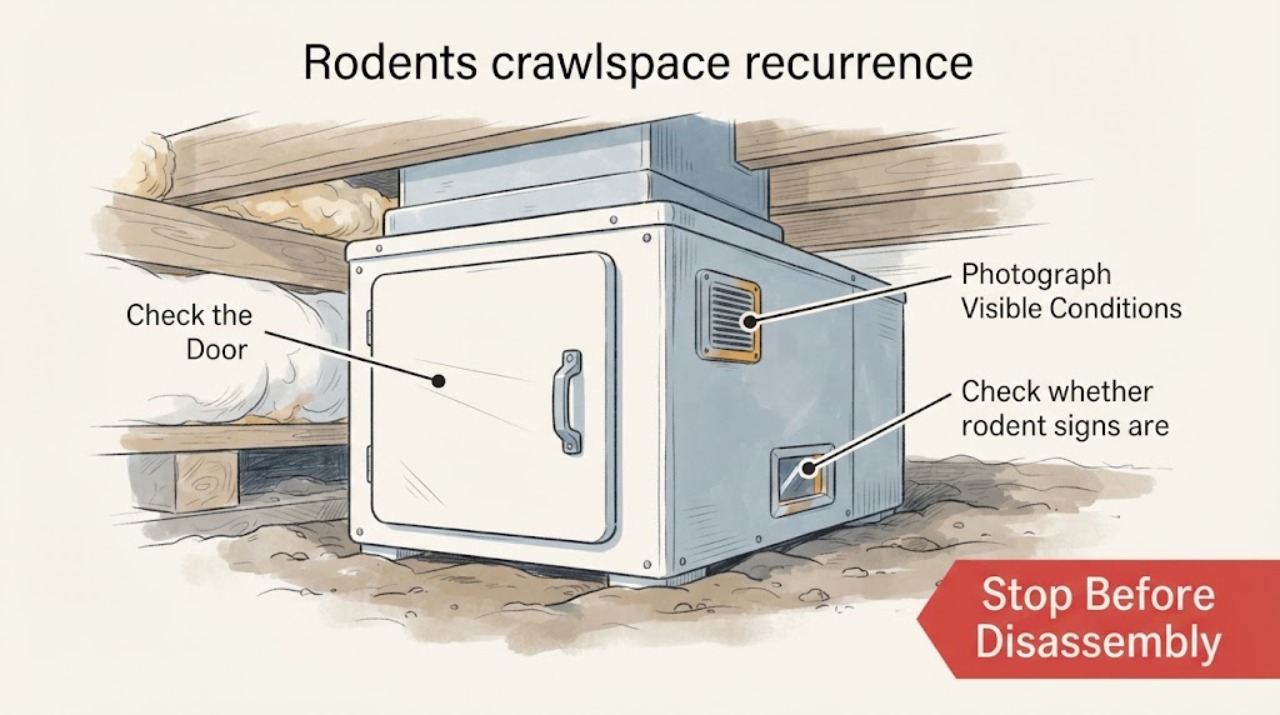
Work through in order
Diagnostic checks
Use only checks that match the exact appliance or system and its official guide.
-
Check 1
From outside and from a safe crawlspace access boundary, photograph signs without entering, touching waste, or moving insulation.
Expected result: Record fresh or old droppings, gnaw marks, tracks, nesting material, odor, scratching, carcasses, and whether signs are light or widespread.
Next step: Keep the access closed to children and pets, save dated photos, and request a pest professional to inspect and scope exclusion and cleanup.
Stop if: Stop for heavy infestation, dead animals, strong odor, confined-space entry, or any need to disturb waste or insulation.
Why this matters
Why: Fresh or repeated signs support active recurrence; widespread waste or contaminated insulation increases health risk and calls for professional assessment rather than routine trapping.
-
Check 2
Inspect the exterior foundation, vents, doors, utility penetrations, drains, and crawlspace access from stable ground without digging or removing covers.
Expected result: Note gaps, damaged screens, loose doors, burrows, vegetation, standing water, food or pet-food storage, or no obvious route.
Next step: Photograph and report each observation and ask for an exclusion plan that accounts for occupancy, species, access, ventilation, and local requirements.
Stop if: Stop near unstable soil, utilities, wildlife burrows, flooding, or a cover that would require confined-space entry.
Why this matters
Why: A route or attractant can explain why activity returns, but a visible gap is not necessarily the only route and should not be sealed while rodents or young may remain inside.
-
Check 3
Check whether rodent signs are near HVAC ducts, air returns, plumbing, electrical runs, or living-space openings without opening the system or wall.
Expected result: Answer yes if signs or odor connect with ventilation or building penetrations; answer no if safely observed elsewhere; use unknown when access is limited.
Next step: Keep HVAC systems and access points in their normal safe state and tell the pest and duct professionals where signs were observed; do not remove covers or run contaminated equipment as a test.
Stop if: Stop for suspected contaminated HVAC, exposed wiring, water, or any requirement to open a duct or cavity.
Why this matters
Why: A yes can spread contamination or odors through the building and requires professional rodent and duct assessment; a no still leaves the crawlspace route unresolved.
-
Check 4
Review food, water, shelter, and prior-control history around the home without moving contaminated items or handling traps or carcasses.
Expected result: Record unsecured food or pet food, leaks, standing water, clutter, vegetation, prior trap locations, entry repairs, and the date activity returned.
Next step: Store uncontaminated food in closed containers, correct accessible leaks when safe, and give the full history to a professional for integrated control.
Stop if: Stop if food or containers are contaminated, a carcass or nest must be handled, or chemical or poison use would be required.
Why this matters
Why: An attractant or incomplete exclusion can sustain recurrence; a failed prior treatment may mean the entry route or cleanup scope was never resolved.
-
Check 5
Maintain a dated activity log from living areas and exterior observation points, without placing yourself in the crawlspace or setting unsafe devices.
Expected result: Record sightings, sounds, fresh signs, weather, time of day, pets or children present, and whether activity changes after a professional visit.
Next step: Request a written follow-up plan with inspection points, device checks, entry repairs, sanitation, and criteria for declaring the recurrence resolved.
Stop if: Stop and escalate for bites, illness, heavy contamination, persistent activity after exclusion, or a hazard that cannot be isolated.
Why this matters
Why: Timing and location help distinguish active entry from residual signs and let the professional verify whether exclusion and control are working.
Use your observations
Decision map
Find the observation that best matches what you see, then follow the next safe action.
-
PATH 01Next step
What you see
Only occasional exterior signs are present and the crawlspace remains inaccessible and clean-looking.
Do this next
Continue the log, secure food and accessible water sources, and arrange professional inspection of entry routes before activity increases.
-
PATH 02Next step
What you see
Fresh or repeated signs are inside the crawlspace or near foundation penetrations.
Do this next
Keep the space closed and request professional rodent control, exclusion, and cleanup; do not crawl in or seal an occupied route yourself.
-
PATH 03Next step
What you see
Droppings, nests, carcasses, or contaminated insulation are widespread or a strong odor is present.
Do this next
Keep occupants away and arrange trained cleanup and health guidance; do not sweep, vacuum, disturb, or bag the material yourself.
-
PATH 04Next step
What you see
Signs or odor involve HVAC ducts, returns, or other building systems.
Do this next
Stop opening the system and contact a professional rodent and duct-cleaning service for contamination assessment before operating suspect equipment.
-
PATH 05Next step
What you see
Children, pets, wildlife, or unprotected food can reach traps or bait locations.
Do this next
Do not place accessible traps or poison. Ask a professional to select and secure a control method and protect non-target animals.
-
PATH 06Next step
What you see
Activity continues after prior trapping or a prior entry repair.
Do this next
Request a renewed inspection of hidden routes, food, water, shelter, and cleanup rather than repeating the same isolated treatment.
Helpful context
Understand the symptom
Recurrence means the cause is still present
Removing one rodent does not explain why activity returns. Rodents may enter through small gaps, follow utility penetrations, or remain where food, water, nesting material, or shelter is available. Crawlspaces add low clearance, poor ventilation, wiring, insulation, and contamination hazards, so observations should stay outside or at a safe access boundary.
Safe observation and cleanup scope
Use photos, a dated log, exterior inspection, and accessible hard-surface observations. Do not disturb droppings, nests, carcasses, or insulation; do not sweep or vacuum rodent waste. Heavy infestations, contaminated insulation, ducts, or confined access need trained professional cleanup.
Stop and call a professional
Arrange prompt help for repeated activity, many droppings, dead rodents, strong odor, contaminated insulation, rodents in ducts, children or pets at risk, bites, or any need to enter the crawlspace. Seek medical advice for illness after rodent exposure and mention that exposure.
Only after diagnosis
Potential parts
- Snap trap
A professional may choose a mechanical trap after identifying the rodent and safe placement; trapping alone does not correct entry or sanitation issues.
Placement, species, access, checking, and protection of children, pets, and non-target wildlife must follow the product label and professional plan. - Rodent-proof mesh
Mesh may be part of an exclusion repair after the professional confirms the opening and that no animals remain inside.
Confirm opening size, corrosion resistance, airflow or drainage function, attachment, and local building requirements before installation. - Storage container
A closed container can reduce an accessible food attractant in clean living areas, but it cannot solve crawlspace entry or contamination.
Use a clean, intact container with a secure lid; discard or professionally assess contaminated packaging.
When checks do not resolve it
Need a professional?
Call promptly for recurring crawlspace signs, heavy contamination, dead rodents, strong odor, contaminated insulation or HVAC ducts, child or pet exposure, bites, illness, or any confined-space entry or exclusion work.
Safety scope: Do not crawl into a confined or contaminated space, sweep or vacuum waste, handle carcasses or wildlife, mix chemicals, seal an occupied route, or place unsecured poison or traps.
Have this ready
- Provide dated photos from safe locations, sign types and freshness, suspected openings, HVAC or utility proximity, food and water sources, prior treatments, activity timeline, and people or pets at risk.
Common questions
FAQ
Why do rodents return after trapping?
A trap may remove one animal while an entry route, food, water, shelter, or contaminated nesting area remains. Request an integrated inspection and exclusion plan.
Can I sweep or vacuum crawlspace droppings?
No. Disturbing dry waste can put contaminated particles into the air. Keep out and arrange professional cleanup for crawlspaces or heavy contamination.
Should I seal the hole immediately?
Do not seal a route until occupancy and timing are assessed. A professional should prevent trapping animals inside and choose a durable, code-compatible exclusion repair.
What if rodents reached the HVAC ducts?
Stop opening or cleaning the system yourself and contact professional rodent and duct specialists. Contamination can affect air distribution and requires a safe assessment.
Are traps safer than poison?
Neither should be placed where children, pets, or wildlife can reach them. Ask a professional to choose and secure a labeled control method and address entry and sanitation.
Read the exact guide
Official sources
- About HantavirusCenters for Disease Control and Prevention · General public-health information; symptoms and case decisions require a healthcare professional.
- How to Clean Up After RodentsCenters for Disease Control and Prevention · General U.S. public-health guidance; local health requirements and professional assessment may add controls.
- Options for Dealing With Rodent InfestationsU.S. Environmental Protection Agency · General U.S. consumer pesticide guidance; follow product labels and local rules.
Community feedback
Share a repair observation
Share a plain-text repair observation. Accepted observations are published automatically; this page may take a moment to update.