
On this page
Start here
Quick answer
Rodent sightings that return as weather turns cold usually mean an entry point, indoor food or water, or a protected nesting place is still available; the cold weather explains the timing but does not identify the route. First record fresh droppings, gnaw marks, urine, nesting material, or sounds without disturbing them. Air out and disinfect contaminated areas using public-health guidance rather than sweeping or vacuuming, then inspect safe, accessible gaps around doors, foundations, vents, roof edges, and utility penetrations. Seal only openings you can repair without touching gas, electrical, HVAC, or structural components; keep food, pet food, trash, bird seed, brush, and firewood from supplying shelter or food. Use traps only where children and pets cannot reach them and exactly as labeled. Persistent activity, inaccessible voids or ducts, heavy contamination, gnawed wiring, or suspected gas or fire damage calls for qualified pest, health, electrical, or utility help.
Before you begin
Safety first
- This article supports safe visual checks, ordinary resource reduction, limited public-health cleanup of accessible hard surfaces, and label-directed trapping only when access and exposure are controlled. Professionals must handle inaccessible voids, ducts, heavy contamination, structural or utility penetrations, wildlife, gas or electrical hazards, and pesticide decisions beyond consumer label directions.
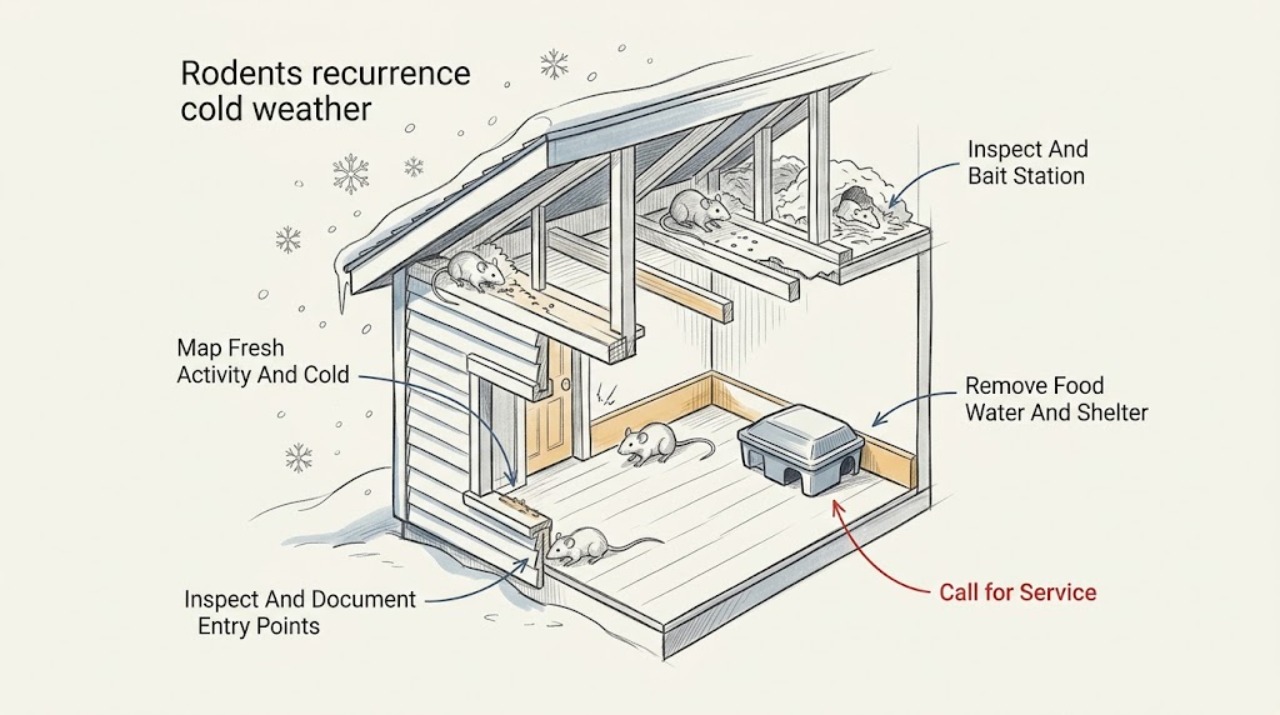
Work through in order
Diagnostic checks
Use only checks that match the exact appliance or system and its official guide.
-
Check 1
Without touching suspected waste, record the date, room or exterior location, and kind of evidence: a live sighting, fresh droppings, gnawing, urine marks, nesting material, food damage, or nighttime sounds; note whether activity increased after a cold spell.
Expected result: Signs are fresh and concentrated near one room or wall, appear at several locations, occur mainly near food or warmth, or are old and dusty with no new evidence.
Next step: Photograph signs from a safe distance and use the location to guide the exclusion, resource, cleanup, and trap checks below. If signs are widespread, activity is heavy, or the animal is unidentified and aggressive, arrange professional inspection.
Stop if: Do not handle live rodents, disturb a nest, put hands into wall or ceiling voids, or move contaminated material before it has been made safe for cleanup.
Why this matters
Why: Fresh, localized signs help identify a route or nesting area, while several locations suggest an open entry or established infestation. Cold-weather timing supports a shelter-seeking pattern but does not distinguish a mouse, rat, or exact entry point. Old signs without new evidence may indicate prior activity rather than recurrence.
-
Check 2
From safe indoor and ground-level outdoor positions, inspect around doors and windows, the foundation, roof edges and soffits, attic and crawl-space vents, garages, and utility penetrations for gaps, chew marks, damaged weather stripping, or disturbed screens; do not remove covers or reach around live utilities.
Expected result: A gap or chewed opening is near fresh signs, weather stripping or a screen is loose, a vent is damaged, or no accessible opening is visible.
Next step: Photograph and measure the condition only if safe. Seal a simple, non-service opening with an appropriate chew-resistant repair; have a pest professional or the relevant trade handle utility penetrations, vents, structural gaps, or an opening that may still contain an animal.
Stop if: Do not drill, cut, foam, or seal around gas lines, electrical wiring, HVAC ducts, combustion vents, plumbing, or a suspected active nest without qualified guidance.
Why this matters
Why: A defect near fresh evidence makes that route more likely, but a hidden wall, roof, crawl-space, or utility chase can still be involved when no opening is visible. A damaged vent or service penetration needs care because sealing it incorrectly can create a ventilation, gas, electrical, or drainage problem.
-
Check 3
Check inside and outside for accessible food, pet bowls, bird seed, open garbage or compost, water, clutter, brush, leaf piles, and firewood near the building; store food and feed in tight containers, remove spills, and clear only ordinary safe clutter.
Expected result: Rodents have access to food or water, nesting material is stored near the building, outdoor cover is dense, bird feeding is close to the house, or attractants are already controlled.
Next step: Remove or secure the identified attractants and keep a dated activity log. Do not move heavy contaminated debris, climb to clear roof or chimney areas, or remove vegetation that could hide utilities without appropriate help.
Stop if: Do not handle contaminated food, dead animals, or heavy infested clutter as ordinary trash; do not disturb a nest or use fire, smoke, or chemicals to drive animals out.
Why this matters
Why: Available food, water, and shelter can sustain rodents after an entry point is sealed and can make recurrence look like a failed repair. If attractants are controlled but fresh signs continue, an inaccessible entry or established nest becomes more likely.
-
Check 4
For a small, accessible hard-surface area, ventilate as appropriate, wear rubber or plastic gloves, wet urine or droppings thoroughly with an EPA-registered disinfectant according to its label, then wipe and dispose of the waste; never sweep or vacuum dry rodent waste.
Expected result: The area is a small hard surface, contamination is widespread or in insulation, waste is inside an air duct or inaccessible void, or anyone exposed is ill.
Next step: Use the CDC cleanup procedure for an accessible small area. Leave heavy or inaccessible contamination undisturbed and arrange qualified remediation or pest service; seek medical advice for illness and mention rodent exposure.
Stop if: Do not vacuum, sweep, dry-brush, pressure-spray, or handle nests, dead rodents, or contaminated insulation without the required precautions and a safe cleanup plan.
Why this matters
Why: Small hard-surface contamination can be cleaned with public-health precautions. Heavy contamination, porous insulation, ductwork, hidden voids, or illness after exposure require professional or health-department guidance because disturbing material can aerosolize contaminants.
-
Check 5
If the animal is inside and the location is safe, use the trap type and placement described by the product label in areas with fresh evidence, keeping every trap and bait inaccessible to children and pets; check it as directed and record captures or new signs.
Expected result: Traps capture rodents, bait disappears without a capture, fresh droppings or gnawing continue, no signs appear after monitoring, or traps cannot be placed safely.
Next step: Continue only according to the trap label and public-health guidance. If activity persists, traps cannot be kept away from children or pets, or the route is inaccessible, call a qualified pest professional. Do not scatter loose poison or use glue or live traps against health guidance.
Stop if: Do not place traps or bait where children, pets, or non-target wildlife can reach them, and do not handle a trapped or dead rodent without disinfecting and bagging precautions.
Why this matters
Why: A capture confirms activity in that area but does not prove the entry is sealed. Continued signs suggest more than one animal, a hidden route, food competition, or unsuitable placement. No new signs over a sustained monitoring period is encouraging but should be interpreted with the exclusion result, not as proof that every void is clear.
-
Check 6
After the first repair and during the next cold-weather period, recheck the same evidence locations and the repaired area from safe positions; look for new droppings, gnawing, drafts, disturbed seal material, or activity in a different room.
Expected result: Activity stops, activity returns at the repair, signs shift to another room or structure, or gnawed wiring, damaged insulation, or a strong odor is found.
Next step: Photograph the new pattern and have a pest professional trace hidden routes and nesting sites. Arrange electrical inspection for gnawed wiring and urgent trade or utility help for damaged gas-related equipment or a combustion vent.
Stop if: Do not keep opening walls, moving appliances, or operating equipment with damaged wiring, gas odor, or a compromised combustion vent to search for rodents.
Why this matters
Why: No new evidence supports a successful combination of exclusion, resource reduction, cleanup, and trapping, though monitoring should continue. Recurrence at or near a repair suggests an incomplete or chewed seal; shifting signs suggest another route or a larger infestation. Wiring damage and strong odors add electrical, fire, or health concerns.
Use your observations
Decision map
Find the observation that best matches what you see, then follow the next safe action.
-
PATH 01Next step
What you see
Fresh droppings or gnawing increase after cold weather and are concentrated near a gap at a door, foundation, vent, roof edge, or utility penetration.
Do this next
Reduce food and shelter, trap residual activity safely, and seal the accessible non-service opening. Use a pest professional for utility penetrations, roof or crawl-space access, or any suspected active nest.
Why this path and its safety boundary
Why it matters: Seasonal shelter-seeking through that opening is more likely, but the route may not be the only entry and an animal may remain inside.
-
PATH 02Next step
What you see
Signs return after a previous repair while pet food, bird seed, garbage, compost, clutter, brush, or firewood remains available near the building.
Do this next
Secure food and water, move or clean up outdoor shelter where safe, then have the building perimeter re-inspected and monitor fresh signs. Do not use poison as a substitute for exclusion.
Why this path and its safety boundary
Why it matters: Food and shelter may be sustaining activity or drawing new rodents to another opening, so a single patch or trap is unlikely to solve the recurrence.
-
PATH 03Next step
What you see
Only old signs are found, no new droppings or gnawing appear during monitoring, attractants are controlled, and the suspected gap remains sealed.
Do this next
Continue periodic checks during cold weather and after storms or building work. Reopen the investigation if fresh signs, sounds, or odors return; do not reopen sealed walls just to search without evidence.
Why this path and its safety boundary
Why it matters: The prior activity may have ended, but clean surfaces and one quiet period cannot prove that every hidden space is empty.
-
PATH 04Next step
What you see
Scratching, odors, droppings, or nesting material points to a wall void, attic, crawl space, heating or cooling duct, or another area that cannot be reached safely.
Do this next
Arrange qualified pest and, where needed, duct, insulation, or remediation service. Keep the area closed off and do not cut into the building or run contaminated ventilation to test it.
Why this path and its safety boundary
Why it matters: The source and contamination extent cannot be established from ordinary surface checks, and opening or cleaning the space can spread contaminants or damage building systems.
-
PATH 05Next step
What you see
There is heavy contamination, illness after exposure, gnawed electrical wiring, a gas odor, damaged combustion equipment, smoke, or a fire risk.
Do this next
Leave the unsafe area as appropriate and contact the health department, emergency services, gas utility, electrician, or qualified pest professional from a safe location. Do not clean, reset, or operate damaged equipment to confirm the source.
Why this path and its safety boundary
Why it matters: The immediate issue is health, electrical, gas, or fire safety rather than routine rodent recurrence.
Helpful context
Understand the symptom
Cold weather changes the timing, not the underlying route
Rats and mice prefer warm places in or near buildings when cold weather reduces outdoor food and shelter. That seasonal pattern can make a previously unnoticed gap suddenly obvious, but it does not prove that the newest sighting came through a particular door, vent, wall, or roof edge. Fresh droppings, gnaw marks, nesting material, and food damage are more useful than a single sighting. Treat recurrence as a combined entry, resource, and removal problem.
Exclusion is more durable than chasing each sighting
Inspect both sides of the building: doors, windows, foundations, roof edges, soffits, crawl-space and attic vents, and places where plumbing, electrical, gas, cable, or HVAC lines pass through. A patch that leaves a service opening, a vent blocked, or a chewable edge exposed may not stop the route. Seal accessible non-service gaps with rodent-resistant materials, but have a professional handle openings that involve utilities, ducts, structural damage, or an animal that may still be inside.
Droppings and nests need a health-protective cleanup
Rodent urine, droppings, nests, and carcasses can contaminate air and surfaces. Do not sweep or vacuum dry waste. Ventilate as appropriate, wear gloves, wet waste with an EPA-registered disinfectant according to its label, wipe it up, and wash hands. Heavy infestations, contaminated insulation, ventilation ducts, illness after exposure, or a nest in an inaccessible space should be handled with professional or public-health guidance.
Safety boundary
Stop conditions
- Do not sweep or vacuum dry droppings, urine, nests, or contaminated insulation; wet and clean small hard-surface contamination only under public-health guidance.
- Do not handle live or dead rodents, nests, or contaminated material with bare hands, and keep children and pets away from traps, bait, and the affected area.
- Do not cut into walls, enter unsafe crawl spaces or attics, or seal a gap around gas, electrical, HVAC, plumbing, or combustion equipment without qualified guidance.
- Stop and obtain professional help for heavy infestation, activity in ducts or inaccessible voids, persistent signs after exclusion and trapping, or suspected illness after exposure.
- For gnawed wiring, gas odor, smoke, fire risk, or damaged combustion equipment, leave the area and contact the appropriate emergency, utility, electrical, or HVAC professional from a safe location.
Only after diagnosis
Potential parts
- rodent-resistant exclusion material
Consider this category only after the entry point is identified and the opening is not part of an active gas, electrical, HVAC, plumbing, or combustion system that requires a qualified trade.
Choose material and repair method for the substrate, opening size, weather exposure, and service clearance; generic foam or caulk may be unsuitable for a chewable or utility-related opening. - species-appropriate snap trap
Consider this category only when fresh activity is confirmed, the trap can be placed where children, pets, and non-target wildlife cannot reach it, and the product instructions fit the suspected rodent.
Follow the complete product label and local rules; use a different size or professional method when the animal is a rat, wildlife, or an infestation cannot be safely monitored. - EPA-registered tamper-resistant bait station
Consider this category only for persistent activity after exclusion and trapping have been evaluated, and only when the exact product label permits the location and protects children, pets, and non-target wildlife.
Use only a legally registered product in its supplied station and follow the label; professional pest control is safer when access, wildlife exposure, carcass retrieval, or species identification is uncertain. - EPA-registered disinfectant and protective cleanup supplies
Consider this category only for a small, accessible hard-surface cleanup that can be ventilated and isolated from occupants; heavy contamination and porous material need professional assessment.
Verify that the product label identifies it as a disinfectant and follow the label, surface, ventilation, and disposal directions; never substitute dry sweeping or vacuuming.
When checks do not resolve it
Need a professional?
Arrange qualified pest-control service when fresh signs continue after safe exclusion, food and shelter reduction, cleanup, and monitored trapping; when rodents are in walls, attics, crawl spaces, ducts, or other inaccessible areas; or when the species and route are unclear. Use professional remediation or public-health guidance for heavy contamination, contaminated insulation, nests, dead rodents, or illness after exposure. Request urgent electrical, gas, HVAC, or emergency help for gnawed wiring, gas odor, smoke, fire risk, damaged combustion equipment, or an unsafe building area.
Safety scope: This article supports safe visual checks, ordinary resource reduction, limited public-health cleanup of accessible hard surfaces, and label-directed trapping only when access and exposure are controlled. Professionals must handle inaccessible voids, ducts, heavy contamination, structural or utility penetrations, wildlife, gas or electrical hazards, and pesticide decisions beyond consumer label directions.
Common questions
FAQ
Why do rodents come back when the weather gets cold?
Cold weather reduces some outdoor food and shelter, so rodents may seek warmth, food, and protected nesting space in or near buildings. Recurrence usually means an entry route or resource remains available, or a new animal found another route; the season alone does not identify the fix.
Should I seal the hole immediately if I hear rodents inside?
Document the opening, but do not blindly seal a gap if an animal may be trapped inside or if it is part of a gas, electrical, HVAC, plumbing, or combustion system. Have a pest professional confirm the route and use an exclusion method that will not trap animals or compromise the building.
Can I vacuum rodent droppings?
No. Dry sweeping or vacuuming can put contaminated particles into the air. For a small accessible hard-surface area, follow public-health cleanup guidance: ventilate as appropriate, wear gloves, wet the waste with an appropriate disinfectant, wipe it up, and wash hands. Heavy or inaccessible contamination needs professional help.
Are traps better than poison for recurring mice?
The choice depends on species, location, occupants, and the reason activity persists. Public-health guidance recommends correctly placed traps and keeping them away from children and pets; EPA warns that rodenticides can harm people, pets, and wildlife if misused and requires label-directed bait-station use for consumer products. Exclusion and resource reduction remain necessary either way.
How do I know whether the problem is still active?
Use a dated log and look for new droppings, gnawing, urine, nesting material, food damage, sounds, or captures in the same locations. A quiet period is encouraging only when the entry route is sealed and attractants are controlled. Fresh signs after monitoring warrant another inspection rather than assuming the first treatment worked.
When should I call a professional for rodent recurrence?
Call when signs persist after safe exclusion and trapping, the route is in a wall, attic, crawl space, or duct, contamination is heavy, a nest or dead rodent is inaccessible, or children, pets, wildlife, or pesticides create a safety concern. Treat gnawed wiring, gas odor, smoke, fire risk, or illness after exposure as urgent.
Read the exact guide
Official sources
- The Changing SeasonsDC Health · Public-health guidance illustrating seasonal rodent behavior; local species, climate, building conditions, and regulations may differ.
- Identify and Prevent Rodent InfestationsU.S. Environmental Protection Agency · General U.S. integrated rodent-prevention guidance; building repairs and pesticide choices must follow local rules and product labels.
- How to Clean Up After RodentsCenters for Disease Control and Prevention · General U.S. public-health cleanup guidance; heavy infestation, contaminated insulation, ducts, illness, and local requirements may require professionals or health-department advice.
- Options for Dealing With Rodent InfestationsU.S. Environmental Protection Agency · General U.S. rodent-control options; professional pest control, product labels, and local law control treatment decisions.
- How to Seal Up to Prevent RodentsCenters for Disease Control and Prevention · General U.S. public-health rodent prevention guidance for homes and outbuildings; utility and structural repairs require appropriate professionals.
- Safely Use Rodent Bait ProductsU.S. Environmental Protection Agency · Current U.S. consumer rodenticide safety guidance; product labels and local requirements control every use.
- How to Trap Up to Remove RodentsCenters for Disease Control and Prevention · General U.S. public-health trapping guidance for home rodent evidence; species, local rules, and professional methods may differ.
Community feedback
Share a repair observation
Share a plain-text repair observation. Accepted observations are published automatically; this page may take a moment to update.