
On this page
Start here
Quick answer
Recurring rodent signs usually mean that an entry path, food or water source, shelter area, or untreated part of the building remains available; a single missed sign does not prove why they returned. From safe living areas and the exterior ground level, document fresh droppings or gnawing without touching them, map the room and time pattern, look for visible gaps or disturbed material without reaching into them, and record accessible food, water, trash, or shelter conditions. Do not handle rodents, droppings, nests, or carcasses, enter an attic or crawl space, mix poison, place hazardous traps, or seal an opening when an animal may still be inside. Keep people and pets away from contaminated or active areas and call a qualified pest professional, with public-health or medical advice for heavy contamination, a bite, possible disease exposure, or persistent recurrence.
Before you begin
Safety first
- The professional must handle animal capture or removal, contaminated cleanup, exclusion when occupancy is uncertain, hazardous control products, and restricted-space inspection. The reader should not touch rodents, droppings, nests, carcasses, or traps; mix poison; enter attics or crawl spaces; or seal an opening that may contain an animal.
Work through in order
Diagnostic checks
Use only checks that match the exact appliance or system and its official guide.
-
Check 1
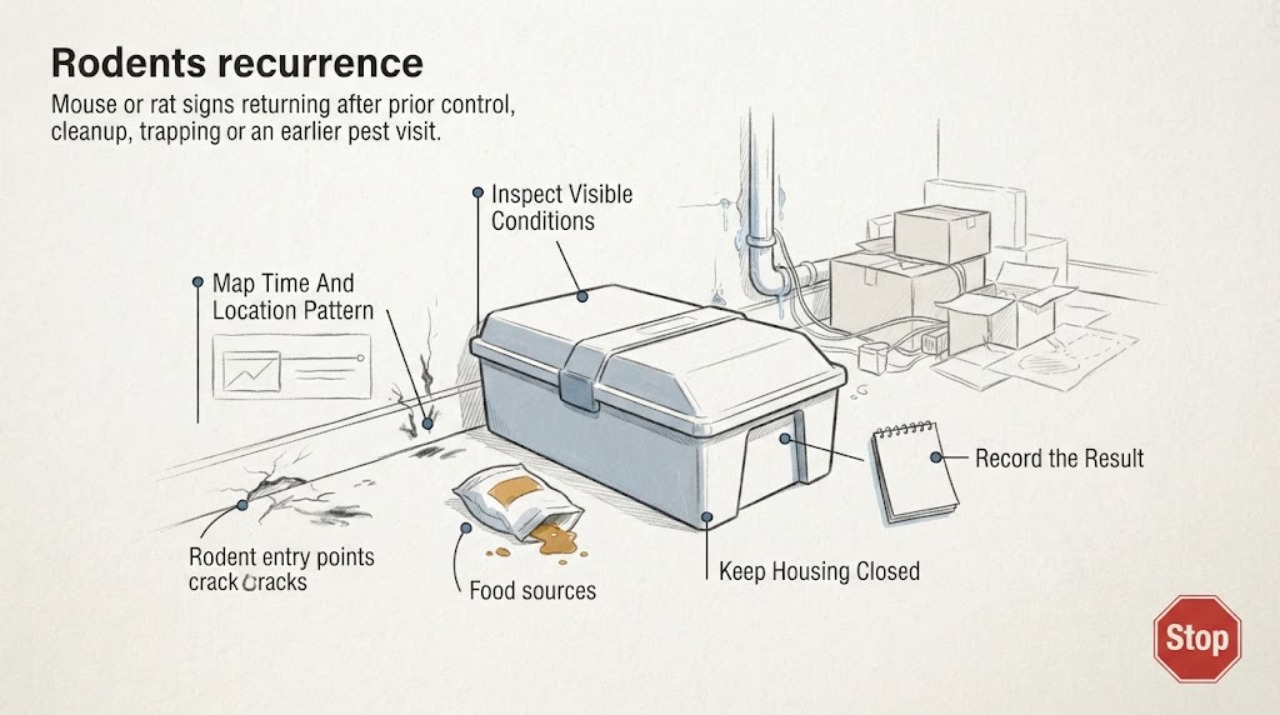
From a safe, well-lit position, visually check accessible floors, cabinet exteriors, corners, and food-storage areas for new droppings, gnaw marks, shredded nesting material, tracks, or a stale odor without touching or disturbing anything.
Expected result: Record which signs look fresh or newly changed, their room and approximate location, and whether there are no new signs; do not pick up waste, handle a nest or carcass, move a trap, or sweep or vacuum.
Next step: Photograph from a safe distance and send the room map and timeline to a qualified pest professional for a recurrence inspection.
Stop if: Stop immediately for a live or dead rodent, a nest, a large accumulation of waste, insects around a carcass, or any material that would need to be touched or disturbed.
Why this matters
Why: New or increasing signs support ongoing activity or access, while an unchanged sign may be old. Appearance alone cannot identify the species, count, or disease risk.
-
Check 2
Compare dated photos, sounds, odor reports, and sightings and mark the affected rooms on a simple floor plan without entering restricted spaces or trying to follow an animal.
Expected result: Note whether signs recur in one room, along a wall or utility boundary, near a kitchen or storage area, in several rooms, or only after a particular time or weather condition.
Next step: Give the map, dates, sounds, and weather or occupancy context to the pest professional and avoid trying to flush, chase, or capture the animal.
Stop if: Stop if following the pattern would require an attic, crawl-space, wall, ceiling, duct, garage void, or other restricted-space entry.
Why this matters
Why: A repeated location or time pattern helps a professional prioritize likely travel routes and access points, but it does not prove where the nest or entry is hidden.
-
Check 3
From ground level and other stable living areas, look at already-visible gaps around doors, windows, utility penetrations, vents, foundation edges, and garage boundaries without reaching into, probing, or opening them.
Expected result: Record a visible gap, gnawing, disturbed seal, daylight, tracks, rub marks, or no apparent opening; note whether the clue is indoors, outdoors, or near a previously treated area.
Next step: Photograph the clue and ask the pest professional to assess the whole connected structure and advise on exclusion; do not seal a suspected opening while an animal may be inside.
Stop if: Stop if the observation would require contact with an animal, contaminated material, electrical or gas service, a roof, an attic, a crawl space, or an unstable structure.
Why this matters
Why: An opening or disturbed boundary can explain recurrence, but a visible gap may not be the active route and hidden access can remain elsewhere.
-
Check 4
From normal household areas and the safe exterior, note accessible food, pet food or water, leaking containers, open trash, bird feed, compost, brush, leaf piles, stored materials, or other sheltered conditions without handling contaminated items.
Expected result: Record what is accessible, where it is located, and whether the condition is new, recurring, or already controlled; do not move a nest, clean waste, handle a carcass, or use poison or a hazardous trap.
Next step: Secure ordinary food and garbage in intact closed containers where safe to do so, keep pets and children away from active signs, and give the full source list to the professional.
Stop if: Stop if securing or moving an item would contact droppings, urine, nesting material, a carcass, a live animal, or a contaminated container.
Why this matters
Why: Available food, water, and shelter can sustain recurrence, while removing one visible source may not address an entry route or a source outside the property.
-
Check 5
Review the prior service or control record and compare it with the current map, noting which rooms, entry points, food sources, and signs were addressed without handling traps or opening treated areas.
Expected result: Record whether signs returned in the same place, appeared in a newly affected area, stopped and then resumed, or were never clearly resolved; note any building, weather, renovation, or occupancy change.
Next step: Give the history to the pest professional and request a follow-up that checks unresolved access, source conditions, and any connected spaces rather than repeating an unverified assumption.
Stop if: Stop and seek urgent advice for a bite, direct contact with saliva or waste, suspected disease exposure, heavy contamination, or a live animal that cannot be safely avoided.
Why this matters
Why: Same-place recurrence can indicate an unresolved route or source, while a new area can indicate a different access path or spread. The record does not establish the cause without inspection.
Use your observations
Decision map
Find the observation that best matches what you see, then follow the next safe action.
-
PATH 01Safety boundary
What you see
A person or pet was bitten, had direct contact with rodent saliva, urine, feces, or a carcass, or there is heavy contamination or a possible disease exposure.
Do this next
Leave the area, avoid further contact, and contact a health professional or local/state public-health authority for situation-specific advice; request professional pest and cleanup support.
Why this path and its safety boundary
Safety stop: Stop all DIY control and cleanup until qualified or public-health guidance is obtained.
-
PATH 02Safety boundary
What you see
A live animal, nest, carcass, or signs are inside an attic, crawl space, wall, ceiling, duct, appliance void, or other area that cannot be safely observed from a living space.
Do this next
Keep people and pets away and call a qualified pest professional; do not enter, chase, capture, or seal the area.
Why this path and its safety boundary
Safety stop: Stop if the animal could be handled, cornered, or disturbed, or if entry would require a ladder or restricted-space access.
-
PATH 03Safety boundary
What you see
Fresh signs recur and a visible gap, food, water, shelter, or repeated room pattern is present.
Do this next
Arrange a professional recurrence inspection and limit ordinary food, water, and trash access where it can be done without contact with contamination.
Why this path and its safety boundary
Safety stop: Do not mix poison, place hazardous traps, handle waste, or seal an opening while an animal may still be inside.
-
PATH 04Safety boundary
What you see
No new signs are visible from safe areas and the prior control record shows no clear recurrence.
Do this next
Continue low-contact observation and keep food, water, garbage, and outdoor shelter conditions controlled without entering restricted spaces.
Why this path and its safety boundary
Safety stop: Stop if monitoring would require touching waste, moving a trap, entering a hidden space, or disturbing a possible nest.
Helpful context
Understand the symptom
Why recurrence is a pattern problem
Rodents can return when an entry gap remains, food or water is accessible, outdoor shelter continues, or only one part of a connected building was addressed. A few signs can also remain after an animal has left, so a dated pattern is more useful than assuming every mark represents a new animal.
Observe without creating exposure
Look from a safe, well-lit location and use photos or notes instead of touching waste, nests, traps, or animals. Do not sweep, vacuum, spray, or disturb contaminated material yourself. If a suspected entry is in an attic, crawl space, wall, ventilation system, or other restricted area, leave it for a professional.
What recurrence information changes the service visit
The most useful handoff is a map of fresh signs, dates and times, rooms affected, food or water observations, visible exterior gaps, and what prior service covered. A pest professional can then decide whether the next visit needs inspection, exclusion, sanitation coordination, or a different control plan.
Only after diagnosis
Potential parts
- snap trap
Consider this category only if a qualified professional confirms that a trap is appropriate for the species, location, occupants, and pets and provides a safe placement plan.
Follow the professional's and product label's safety requirements; do not handle a trap or animal in a contaminated or inaccessible area. - rodent-proof mesh
A durable exclusion material may be relevant only after the active route is identified and a professional confirms that no animal is trapped inside.
The opening, surrounding material, utilities, and building movement determine the suitable method; do not use a material as a substitute for inspection. - storage container
A closed container may help reduce an accessible food source when the item can be moved without contacting contamination.
Choose an intact container appropriate to the food and household use; storage alone will not correct an entry point or hidden infestation.
When checks do not resolve it
Need a professional?
Request a qualified pest professional when signs recur, appear in inaccessible spaces, continue after prior control, or involve an unresolved entry or source. Seek health or public-health advice after a bite or direct exposure, and urgent professional help for heavy contamination, a carcass, or an animal that cannot be safely avoided.
Safety scope: The professional must handle animal capture or removal, contaminated cleanup, exclusion when occupancy is uncertain, hazardous control products, and restricted-space inspection. The reader should not touch rodents, droppings, nests, carcasses, or traps; mix poison; enter attics or crawl spaces; or seal an opening that may contain an animal.
Common questions
FAQ
Why do rodents keep coming back after control?
An entry path, food or water source, shelter, or untreated connected area may remain available, and old signs can be mistaken for new activity. Map fresh evidence and ask for a recurrence inspection.
Can I clean the droppings or move a dead rodent myself?
Do not touch or disturb droppings, nests, carcasses, or traps in this low-contact workflow. Keep people and pets away and ask a qualified pest or cleanup professional, with public-health advice when exposure is possible.
Should I seal the hole immediately?
Do not seal an opening when an animal may still be inside. Photograph it from a safe position and have a professional assess the active route and exclusion plan.
What evidence is most useful for a follow-up visit?
Provide dated photos, the room and time pattern, visible entry clues, accessible food, water and shelter conditions, prior service details, and any bite or exposure information.
Read the exact guide
Official sources
- How to Seal Up to Prevent RodentsCenters for Disease Control and Prevention · Supports checking inside and outside for gaps, securing food and garbage, and contacting a health department or pest specialist when infestation or inaccessible areas are involved.
- Identify and Prevent Rodent InfestationsU.S. Environmental Protection Agency · Supports looking for droppings, nesting material, chewing, holes, and stale smells and addressing food, water, and shelter conditions without claiming that one sign proves the cause.
- Hantavirus PreventionCenters for Disease Control and Prevention · Supports avoiding contact with rodent urine, feces, saliva, and nesting materials, recognizing exposure risk, and escalating safely after contamination or a possible health exposure.
Community feedback
Share a repair observation
Share a plain-text repair observation. Accepted observations are published automatically; this page may take a moment to update.