
On this page
Start here
Quick answer
If rodents return after trapping, a trap usually removed an animal without removing the reason they can keep entering or feeding. First distinguish fresh activity from old droppings or nesting material, then inspect accessible interior and exterior gaps around doors, foundations, roof edges, vents, and utility penetrations. Seal confirmed openings with rodent-resistant materials, remove food, water, garbage, and shelter that attract rodents, and keep traps or any labeled bait inaccessible to children and pets. Clean droppings, nests, or carcasses with wet disinfecting methods rather than sweeping or vacuuming. If signs are heavy, inside ducts or inaccessible voids, near wiring, or continue after exclusion and sanitation, use a licensed pest professional or contact the local health department; do not rely on repeated trapping or improvised poison.
Before you begin
Safety first
- The homeowner scope is limited to safe observation, exclusion of accessible non-hazardous gaps, sanitation using CDC wet-cleaning instructions, and label-compliant trap or bait placement away from children and pets. Do not sweep or vacuum droppings, disturb nests, enter unsafe voids, open ducts, handle carcasses bare-handed, use loose poison, or seal a gap that may contain an animal or utility hazard.
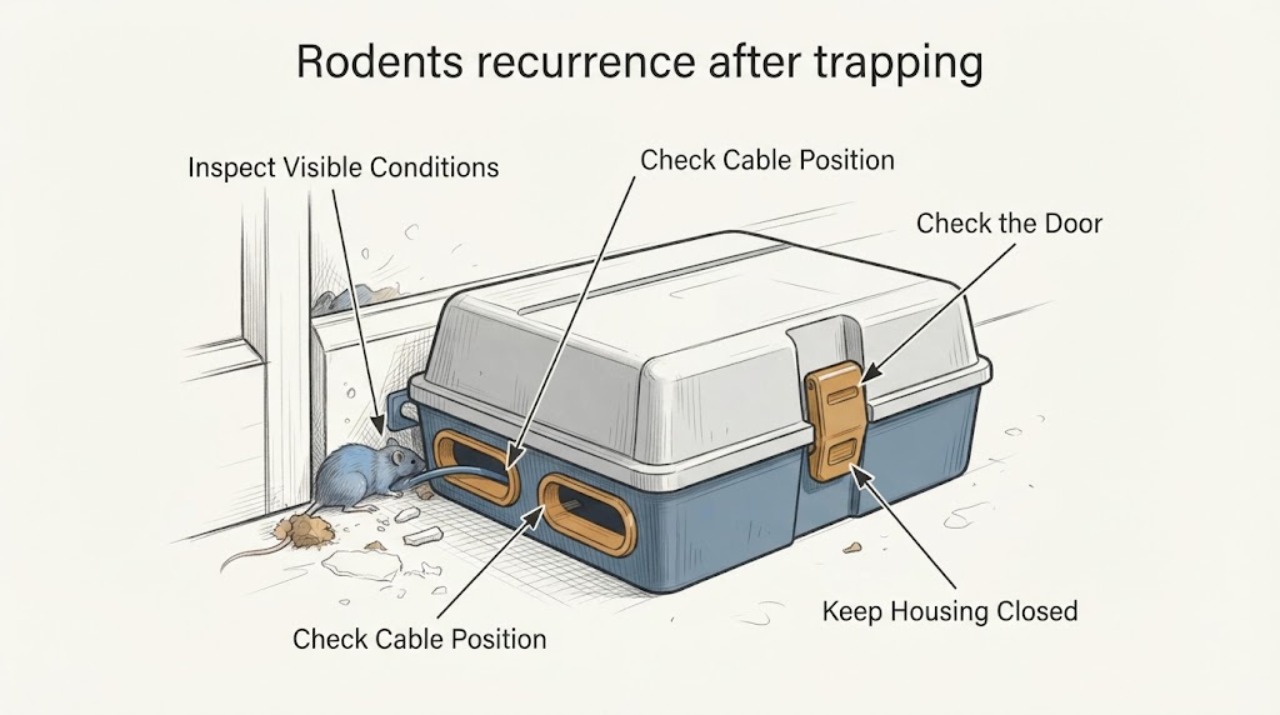
Work through in order
Diagnostic checks
Use only checks that match the exact appliance or system and its official guide.
-
Check 1
Record where and when the newest evidence appeared, using photos from a safe distance. Look for newly formed droppings, fresh gnawing, tracks, nesting, a captured animal, or sounds, and separate those from dry, undisturbed material that may predate the trapping.
Expected result: New evidence appears after the trap was serviced, evidence is concentrated near one room or wall, or no new physical evidence is present.
Next step: Mark the active area on a simple floor plan and use it to guide an entry-point and attractant check. Continue only safe monitoring if no fresh evidence appears.
Stop if: Stop handling evidence if it is wet, extensive, in an enclosed poorly ventilated space, or near a child, pet, or person with health vulnerability; arrange professional or public-health guidance.
Why this matters
Why: New localized evidence helps identify an active route or attractant; no new physical evidence means recurrence is not yet confirmed and smell or an isolated sound should not by itself trigger more poison or traps.
-
Check 2
Inspect accessible interior and exterior boundaries along the active route: beneath and behind cabinets and appliances, around doors and windows, at the foundation, attic or crawl-space vents, floor drains, and openings for plumbing, electrical, gas, cable, or sewer lines. Do not enter a dangerous crawl space or dismantle a wall or appliance.
Expected result: A gap, damaged screen, door gap, utility penetration, vent opening, or disturbed seal lines up with the new evidence, or no accessible opening is found.
Next step: Seal a confirmed accessible opening with a material appropriate to its size and location, following CDC guidance and protecting utility lines. If the opening is structural, high, hidden, or around a service, have it assessed by a qualified professional.
Stop if: Stop before disturbing gas, electrical, water, or sewer lines, removing building materials, entering unsafe areas, or sealing an opening that could trap an animal inside.
Why this matters
Why: A route-aligned opening makes re-entry more likely; no visible opening means the route may be hidden, outside the inspected area, or associated with an unrecognized food or shelter source.
-
Check 3
Check indoor and outdoor attractants without touching contaminated material: open food or feed, spilled food, unsecured garbage, pet food or water left out, leaking plumbing, bird-feeder spill, compost, brush, stored materials, or woodpiles near the building.
Expected result: One or more food, water, or shelter sources remain near the active route, or attractants are controlled but signs continue.
Next step: Secure food and garbage, address accessible leaks, and reduce nearby shelter using the CDC and EPA prevention guidance. Recheck the marked route rather than moving traps randomly.
Stop if: Stop if the source is contaminated with droppings or nesting, requires disturbing a nest, or is in an inaccessible void; use the cleanup boundary or a professional.
Why this matters
Why: An available resource can keep rodents returning even after trapping; persistent signs after sanitation and exclusion make a hidden entry, inaccessible nest, or larger infestation more likely.
-
Check 4
Review the existing trap locations and condition from a safe position. Keep mechanical traps or any bait station on the active route only where children and pets cannot reach them, follow the product or trap instructions, and check them on the stated schedule; do not handle a trapped animal bare-handed.
Expected result: Traps are away from the active route, inaccessible to safe inspection, damaged, repeatedly triggered without a catch, or new signs appear despite correctly placed traps and exclusion work.
Next step: Follow the trap label or manufacturer directions and correct only a clearly safe placement. If children or pets can reach the device, stop using it until it is secured; if activity persists, have a licensed pest professional assess the program.
Stop if: Do not improvise poison, use unlabeled bait, touch a carcass without gloves, or place traps or bait where children or pets can reach them.
Why this matters
Why: Trap results are only useful when the device is suitable, accessible for safe checking, and placed where activity is occurring; repeated activity despite trapping points to an unresolved route, attractant, or infestation scale rather than a guaranteed trap failure.
-
Check 5
If you find droppings, urine, nesting material, or a dead rodent, ventilate an enclosed space as CDC directs, wear rubber or plastic gloves, wet the material thoroughly with a household disinfectant, and wipe it up. Never sweep or vacuum it dry; use professional cleanup for a heavy infestation or contaminated duct or insulation.
Expected result: The material is limited and on a hard, reachable surface, or it is extensive, in insulation or ductwork, or in an area that cannot be ventilated or safely reached.
Next step: Complete only the CDC method that matches the space and material. For heavy or inaccessible contamination, leave the area, keep others out, and contact a pest-control or cleanup professional and the local health department as appropriate.
Stop if: Stop if dust is being stirred, you lack suitable protection, the area is heavily infested, or anyone develops illness after exposure; seek medical advice and mention rodent contact.
Why this matters
Why: Limited hard-surface contamination can follow CDC's wet cleanup procedure; heavy, inaccessible, or duct contamination raises exposure risk and requires specialized precautions.
Use your observations
Decision map
Find the observation that best matches what you see, then follow the next safe action.
-
PATH 01Safety boundary
What you see
Fresh droppings, gnaw marks, or tracks return near the same wall, door, utility penetration, vent, or foundation area after a trap catches a rodent.
Do this next
Prioritize exclusion at the route and inspect both sides of the boundary. Seal an accessible opening with rodent-resistant material only after checking that no animal is trapped inside; use a professional for hidden or service-line openings.
Why this path and its safety boundary
Safety stop: Do not seal, foam, or dismantle an opening blindly if an animal, nest, or utility hazard may be inside.
-
PATH 02Safety boundary
What you see
New activity is concentrated around food, pet feeding, garbage, a leak, bird-feed spill, compost, brush, or stored outdoor material.
Do this next
Remove or secure the attractant, repair the accessible water source, and reduce nearby shelter while continuing safe monitoring and exclusion.
Why this path and its safety boundary
Safety stop: Do not handle contaminated food, nests, or waste as ordinary cleanup; follow CDC wet-cleaning guidance or obtain professional help.
-
PATH 03Safety boundary
What you see
Traps remain active and safely placed, but fresh signs continue in several rooms or new areas after food sources and visible openings are addressed.
Do this next
Treat this as an unresolved or larger infestation and have a licensed pest professional inspect the building, identify species and routes, and design an integrated control plan.
Why this path and its safety boundary
Safety stop: Do not respond by scattering bait, repeatedly moving traps, or using products outside their label.
-
PATH 04Safety boundary
What you see
Activity is inside heating or cooling ducts, behind inaccessible walls, in contaminated insulation, or in a crawl space that cannot be safely reached.
Do this next
Keep people and pets out of the area and contact a qualified pest or cleanup professional; CDC specifically directs professional help for rodents in ventilation systems and heavy contamination.
Why this path and its safety boundary
Safety stop: Do not open ductwork, tear out insulation, disturb nests, or enter an unsafe void without the required equipment and expertise.
-
PATH 05Safety boundary
What you see
Only old, dry evidence remains after trapping and cleaning, with no new droppings, gnawing, tracks, nesting, or captures during monitoring.
Do this next
Keep entry points sealed, food and garbage secured, and the area monitored for fresh evidence. Do not add pesticide solely because an old odor or stain remains.
Why this path and its safety boundary
Safety stop: Escalate if new physical evidence appears or if cleanup reveals heavy contamination.
-
PATH 06Safety boundary
What you see
A child or pet can reach a trap or bait station, or a product has no clear label or safe placement instructions.
Do this next
Stop using or relocate the device only when it can be done safely, keep children and pets away, and follow the product label or consult a licensed professional.
Why this path and its safety boundary
Safety stop: Never use loose poison or unlabeled bait, and never leave traps or bait where children or pets can access them.
Helpful context
Understand the symptom
A trap is not an exclusion repair
Catching one or more rodents does not show that the building is sealed. EPA notes that rodents released from live traps can return unless entry points are sealed, while CDC recommends looking for openings inside and outside, including around doors, foundations, vents, and utility lines. Treat new droppings, fresh gnaw marks, tracks, or new nesting material as evidence to map the route rather than as a reason to keep adding traps at random.
Remove the reasons to come back
Rodents need food, water, and shelter. Store food and animal feed in tight containers, clean spills promptly, secure garbage, put pet food and water away when appropriate, fix leaks, and reduce outdoor clutter or vegetation that provides cover. These measures support trapping and exclusion; they do not prove that a particular species or entry point has been identified.
Clean evidence without making it airborne
Rodent waste and nesting material can carry infection risk when disturbed. CDC advises ventilating an enclosed space before cleanup, wearing gloves, wetting waste with disinfectant, and avoiding sweeping or vacuuming. Heavy infestations, contaminated insulation, or activity in heating and cooling ducts require additional precautions and may need professional cleanup.
Only after diagnosis
Potential parts
- rodent-resistant exclusion material
Consider this category only after an accessible entry gap is identified and the surrounding wall, vent, door, or utility penetration is understood.
Choose a material suited to the opening, weather exposure, movement, and nearby utilities; CDC lists different approaches for small and larger gaps, so do not seal blindly with a single product. - species-appropriate mechanical rodent trap
Consider this category only when active rodent evidence is confirmed and the trap can be placed and checked where children and pets cannot reach it.
Match the trap to the identified rodent and follow its instructions; placement, monitoring, disposal, and sanitation matter more than a generic replacement part. - tamper-resistant rodent bait station
Consider this category only if a licensed professional or the product label establishes that bait is appropriate after exclusion and sanitation measures are addressed.
Use only an EPA-registered, labeled product and the supplied station exactly as directed, protecting children, pets, wildlife, food, and water; never use loose or improvised bait.
When checks do not resolve it
Need a professional?
Escalate for continuing fresh signs, multiple activity zones, inaccessible nests or ducts, heavy contamination, structural entry points, wiring concerns, uncertain species, or any trap or bait exposure risk to children or pets.
Safety scope: The homeowner scope is limited to safe observation, exclusion of accessible non-hazardous gaps, sanitation using CDC wet-cleaning instructions, and label-compliant trap or bait placement away from children and pets. Do not sweep or vacuum droppings, disturb nests, enter unsafe voids, open ducts, handle carcasses bare-handed, use loose poison, or seal a gap that may contain an animal or utility hazard.
Have this ready
- Provide the dates and locations of captures and fresh signs, photos taken without disturbing waste, trap or bait type and placement, entry gaps inspected or sealed, food and water sources found, affected rooms or ducts, evidence of chewing near wiring, and any exposure or illness concern.
Common questions
FAQ
Why do rodents come back after I trap one?
Trapping removes an animal but may leave the entry point, food, water, or shelter available. Inspect the active route, seal accessible openings, secure attractants, and keep monitoring; EPA notes that rodents released outside may return when entry points remain open.
Should I keep adding traps when new droppings appear?
First confirm that the droppings are fresh and map where they appear. Traps can be part of control when used as directed and kept away from children and pets, but recurring signs call for exclusion, sanitation, and possibly a licensed IPM assessment rather than random trap changes.
What should I do with rodent droppings after trapping?
Ventilate an enclosed area, wear rubber or plastic gloves, wet the droppings with disinfectant, and wipe them up. Do not sweep or vacuum them dry. Heavy contamination, nests in insulation, or activity in ducts should be handled with professional precautions.
Where should I look for the opening rodents use?
Check interior and exterior boundaries along the evidence route, including doors, windows, foundations, attic or crawl-space vents, floor drains, utility penetrations, and gaps behind appliances or cabinets. Do not dismantle a wall or disturb a utility line to search.
When should I call a pest professional?
Call when fresh activity continues after safe exclusion and sanitation, signs span several rooms, rodents are in ducts or inaccessible voids, contamination is heavy, wiring may be damaged, or traps and bait cannot be kept away from children and pets. Contact the local health department for public-health questions.
Read the exact guide
Official sources
- Hantavirus PreventionCenters for Disease Control and Prevention · CDC public-health guidance about hantavirus and rodent exposure; it does not identify the species or disease risk for a particular home.
- Smart Pest Control to Protect Your HealthU.S. Environmental Protection Agency · EPA integrated pest-management guidance for household pests; pesticide registration, labels, and state licensing apply in the United States.
- How to Seal Up to Prevent RodentsCenters for Disease Control and Prevention · CDC household rodent-prevention guidance for homes and outbuildings; building conditions and local public-health requirements may vary.
- How to Clean Up After RodentsCenters for Disease Control and Prevention · CDC cleanup guidance for household rodent waste, nests, dead rodents, and contaminated spaces; heavy infestations and specialized spaces require additional precautions.
- Options for Dealing With Rodent InfestationsU.S. Environmental Protection Agency · EPA consumer guidance for rat and mouse infestations in the United States; product labels and local rules control any pesticide use.
Community feedback
Share a repair observation
Share a plain-text repair observation. Accepted observations are published automatically; this page may take a moment to update.