
On this page
Start here
Quick answer
Do not assume that seeing ants proves carpenter-ant damage. From safe, accessible areas, document the ant type and activity, look for coarse debris or smooth openings at existing surfaces, and check for visible moisture or decay nearby. Carpenter ants excavate galleries rather than eating wood, and moisture-damaged wood can be an important clue, but hidden damage cannot be confirmed without a professional inspection. Do not open walls, probe structural wood, mix pesticides, or treat randomly; call a pest-management professional promptly if activity is persistent, winged ants are indoors, coarse debris is recurring, or wood appears weakened.
Work through in order
Diagnostic checks
Use only checks that match the exact appliance or system and its official guide.
-
Check 1
From a safe, accessible position, photograph ants without handling them and note their body color pattern, approximate relative size compared with a familiar household object, whether they have wings, and whether several are following the same route.
Expected result: Repeated large dark ants on one route, especially winged ants indoors, are more concerning than a single stray ant. Other ant species can look similar, so appearance alone is not confirmation of carpenter ants.
Next step: Record the room, entry direction, time of day, and approximate number seen. Continue with the debris and moisture checks without disturbing the route.
Stop if: Stop if ants are near a child, a person with a known sensitivity, food, or an area that would require unsafe access to observe; keep the area clear and request professional guidance.
Why this matters
Why: Species and activity pattern change the next step: a recurring route or indoor winged activity supports a professional identification request, while one stray ant is not proof of an indoor nest.
-
Check 2
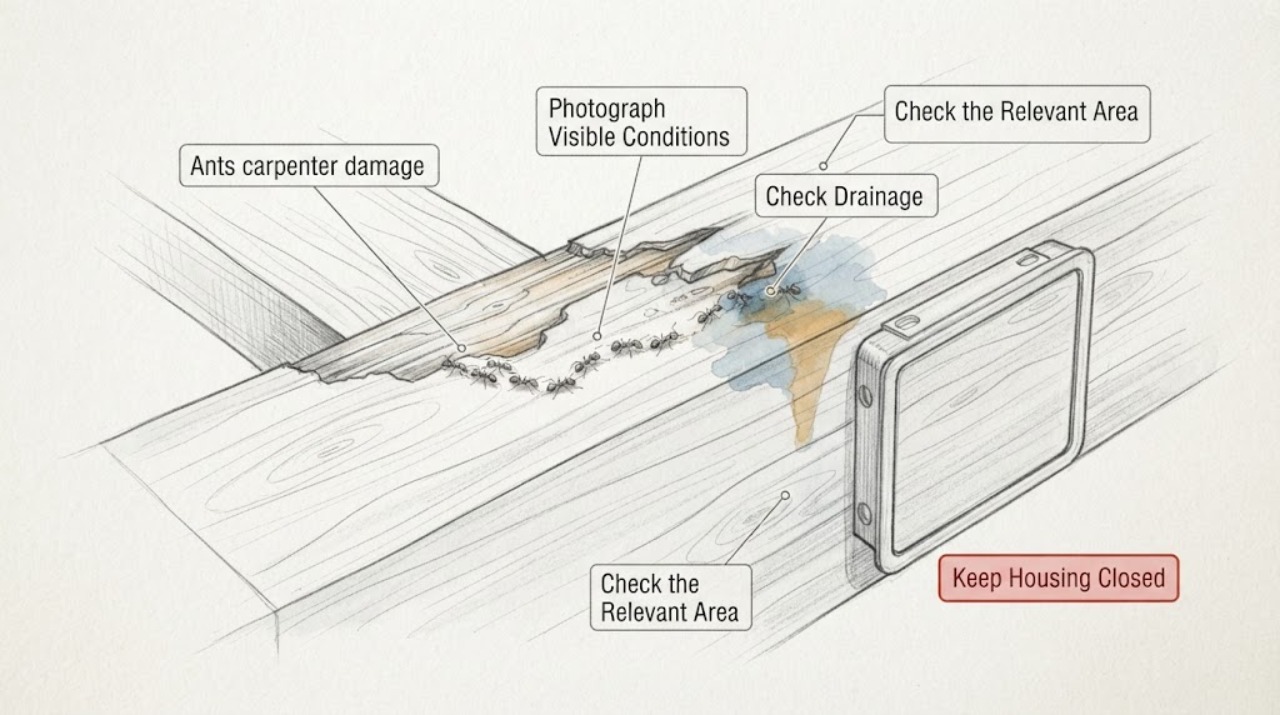
Inspect already exposed, reachable wood surfaces, window or door trim, baseboards, and the floor directly below suspected activity for coarse sawdust-like debris, small existing openings, or smooth visible channels. Photograph what is visible; do not insert a probe or enlarge an opening.
Expected result: Fresh coarse debris recurring below one location or clean, smooth channels in already exposed damaged wood are compatible with carpenter-ant excavation. Dust from drilling, ordinary sawdust, termites, or other insects can look different, so debris alone is not confirmation.
Next step: Leave the surface intact and send close and wide photos to the professional. Do not open a wall, remove trim, or attempt to reach a suspected nest.
Stop if: Stop if the surface bows, crumbles, exposes wiring or plumbing, or would need drilling, cutting, prying, or demolition to inspect further.
Why this matters
Why: A repeated, localized debris trail raises the urgency for a pest inspection and possible moisture or wood-damage assessment. Absence of debris does not rule out a hidden nest because galleries may be concealed.
-
Check 3
Look for visible moisture history around the activity: staining, condensation, a plumbing drip, damp flooring, decayed wood, blocked drainage, or water entry at a window or roof edge. Only view accessible surfaces; do not dismantle a fixture or reach into a wet cavity.
Expected result: Moisture-damaged or decayed wood near ant activity makes carpenter-ant nesting more plausible, while dry, sound surfaces make that explanation less certain. A leak trace may be the primary repair issue even if ants are also present.
Next step: Photograph the moisture trace and note whether it is current or historical. Arrange pest and building or plumbing assessment as indicated before using pesticides or making cosmetic repairs.
Stop if: Stop for active leaking, standing water near electrical equipment, widespread dampness, visible mold, or wood that appears unsafe to touch or support.
Why this matters
Why: Moisture control and wood repair are part of resolving a suspected carpenter-ant problem, but the visible check cannot determine hidden structural condition. An active leak or soft wood should be assessed by the appropriate qualified professional.
-
Check 4
Review the visible location and timeline: note whether activity is indoors or outdoors, whether it returns after surface cleaning, whether winged ants appeared indoors, and whether the same area has had water damage or repairs. Keep the area untreated while collecting this record.
Expected result: Persistent activity from one area, indoor winged ants, recurring coarse debris, or a known moisture problem increases the likelihood that a professional should look for a nest or damaged wood. A short-lived trail tied to food may be a nuisance route rather than carpenter-ant damage.
Next step: Provide the timeline, count estimates, photos, room locations, and moisture history to a pest-management professional; preserve the evidence rather than sealing or spraying it first.
Stop if: Stop if confirmation would require opening a wall, probing a beam, climbing unsafely, or applying a pesticide without a label-directed professional plan.
Why this matters
Why: The pattern determines urgency, but only an inspection can confirm carpenter ants, locate a nest, or assess structural impact. Do not label the building damaged from a photograph alone.
Use your observations
Decision map
Find the observation that best matches what you see, then follow the next safe action.
-
PATH 01Next step
What you see
There are repeated ants from one location, recurring coarse debris, indoor winged ants, or visible smooth channels in exposed damaged wood.
Do this next
Treat the finding as a high-priority inspection lead, not a confirmed diagnosis. Keep the evidence visible and contact a pest-management professional to identify the species and locate the nest without opening the structure yourself.
-
PATH 02Next step
What you see
The activity is beside wet, stained, soft, or decayed wood or an active leak.
Do this next
Arrange qualified pest and moisture or building assessment. Control the water source through the appropriate professional, and do not conceal the area with caulk, paint, or trim before inspection.
-
PATH 03Next step
What you see
A suspected nest or damage can only be reached by probing, drilling, cutting, removing trim, opening a wall, or mixing or applying pesticide.
Do this next
Stop the DIY investigation and call a qualified pest-management professional. Follow only the exact label directions for any product a professional recommends; never mix products or use a product off-label.
Helpful context
Understand the symptom
What counts as evidence
A few dark ants on a counter may be food-foraging ants, not a colony in the building. Stronger clues are repeated activity from the same location, coarse wood-like debris beneath an opening, smooth visible galleries at already exposed damaged wood, and moisture or decay nearby. These clues raise suspicion but do not identify a nest or establish how much structural wood is affected.
Keep the inspection observational
Use a phone camera and flashlight from the floor or another normally accessible position. Do not remove trim, drill, pry, press hard on wood, open a wall, or disturb insulation. A pest professional can combine the visible trail, moisture history, and species identification with equipment and treatment decisions.
Only after diagnosis
Potential parts
- moisture-meter
Consider this category only as an optional non-invasive aid for mapping accessible moisture after a professional or building assessment identifies a relevant area; a reading cannot confirm carpenter ants or structural safety.
Follow the instrument instructions and treat readings as comparative clues, not a diagnosis. Do not press probes into questionable wood or use a meter to justify opening a wall. - ant-bait-station
Consider this category only after species, placement, occupants, pets, and the product label have been reviewed; bait does not repair moisture damage or confirm a carpenter-ant nest.
Use only an unopened, label-directed product appropriate for the intended location, and do not mix it with sprays or place it where children or pets can access it. Professional placement is preferred for suspected carpenter ants. - caulk
Consider this category only after the pest and moisture source are identified and a professional confirms that a fixed, non-structural entry gap—not a hidden nest or damaged structural wood—is what should be sealed.
Do not caulk over active trails, wet or decayed wood, electrical or plumbing penetrations, or a suspected nest. Confirm the surface and product label before sealing.
When checks do not resolve it
Need a professional?
Call a pest-management professional promptly for recurring activity, coarse debris, indoor winged ants, suspected carpenter-ant galleries, or activity near damp or decayed wood. Add a qualified building or plumbing professional when there is a leak, soft structural material, or suspected hidden moisture. Do not open walls, probe structural wood, or mix pesticides.
Have this ready
- Provide photos of ants, trails, debris, and accessible wood; room and exterior locations; dates and approximate counts; whether winged ants were seen; and any history of leaks, condensation, or decayed wood. State what was observed only, without claiming that carpenter ants or structural damage are confirmed.
Common questions
FAQ
Does seeing carpenter-looking ants mean my house has structural damage?
No. Ant appearance alone is not confirmation, and visible activity does not show how much wood is affected. Recurring trails, coarse debris, winged ants indoors, and moisture or decay are inspection clues; a professional must identify the species and assess hidden wood.
Should I drill into the wall to find the nest?
No. Keep the inspection visual and leave walls, trim, insulation, wiring, and plumbing intact. Give photos and the activity route to a pest-management professional who has the equipment and experience to locate a hidden nest safely.
Can I mix or spray pesticides after seeing an ant trail?
Do not mix pesticides or treat randomly. Product choice and placement depend on species, location, occupants, pets, and the label. A professional can select and apply an appropriate treatment; follow the exact label directions for any product used.
Read the exact guide
Official sources
- IPM Update—Ants April 2021U.S. Environmental Protection Agency, Region 7 · The EPA bulletin emphasizes identifying the ant, addressing leaks and moisture-damaged wood, locating nests, and following pesticide label directions without mixing products.
- Carpenter antsUniversity of Minnesota Extension · The extension page distinguishes carpenter ants from other ants, describes galleries and coarse debris, connects indoor activity with moisture or decayed wood, and recommends professional control for hidden nests.
Community feedback
Share a repair observation
Share a plain-text repair observation. Accepted observations are published automatically; this page may take a moment to update.