
On this page
Start here
Quick answer
When ants return after a prior treatment, look for the reason the colony still has access: a food or water source, an unsealed entry route, an outdoor nest or moisture-damaged wood, or a treatment that did not match the ant species. Follow one trail to its entry point, clean away food and pheromone residue, correct leaks and vegetation contact, and seal accessible cracks. If you use bait, choose a product labeled for the ants and location, keep it away from children and pets, and follow that label exactly. Repeated activity, carpenter-ant signs, inaccessible nests, or activity near wiring and wall voids are good reasons to call a licensed pest professional.
Work through in order
Diagnostic checks
Use only checks that match the exact appliance or system and its official guide.
-
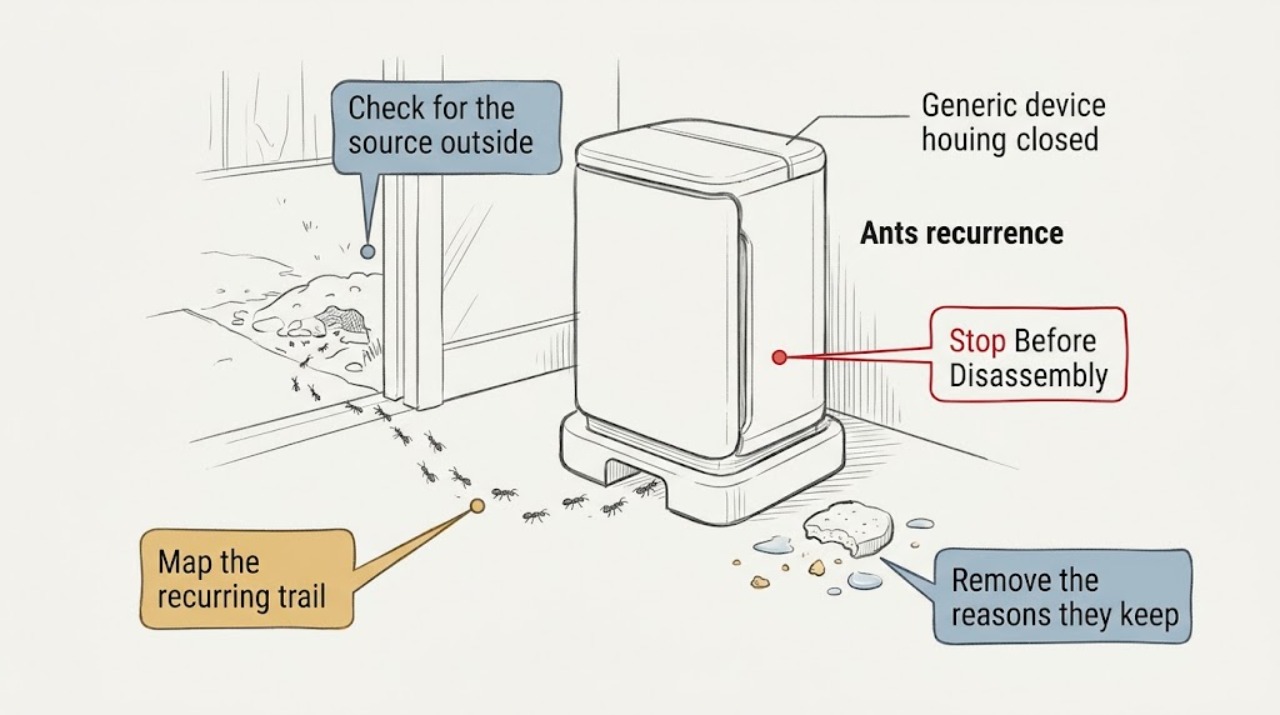
Map the recurring trail
Watch the ants from a distance for several minutes and note the room, time of day, direction of travel, and whether the line follows a baseboard, pipe, window, door, cabinet edge, or utility opening.
Expected result: The trail ends at food, water, a crack, a plant or branch, a door/window edge, or disappears into a wall, cabinet, or floor gap.
Stop if: Do not open electrical boxes, wall cavities, or structural finishes to follow ants; stop and arrange professional inspection when the route is inaccessible.
Why this matters
Why: An ending at food or water identifies an attractant to remove. A line that follows a construction joint or utility opening points to an entry route. A trail that disappears into an inaccessible void may lead to a nest that is not a safe do-it-yourself target.
-
Check for the source outside and under fixtures
Inspect the matching indoor and outdoor area for damp wood, leaking pipes, clogged gutters, standing water, firewood or mulch against the structure, and branches or shrubs touching the wall; look for a nest or repeated traffic rather than disturbing it.
Expected result: You find moisture or damaged wood, vegetation touching the building, an outdoor trail entering at a gap, or no clear source.
Stop if: If wood is structurally damaged, ants are emerging from a wall or ceiling, or the suspected nest is high, underground, or otherwise inaccessible, stop and call a pest professional.
Why this matters
Why: Correcting moisture and removing direct travel bridges can reduce recurrence, while a nest or damaged wood changes the job from simple exclusion to species and nest identification. If no source is visible, continue with sanitation and entry-point checks rather than assuming the first treatment failed.
-
Remove the reasons they keep visiting
Wipe visible trails with soapy water, clean crumbs and sweet spills, store food and pet food in sealed containers, empty trash and recycling, dry wet counters, and repair accessible leaks before resealing the route.
Expected result: Ant traffic drops, moves to another route, or remains concentrated at the same opening after the attractants are removed.
Next step: If the traffic drops, keep the area dry and clean while monitoring the original entry point for a new trail.
Stop if: If ants continue at the same gap, proceed to exclusion and species-aware treatment rather than repeatedly spraying the visible line.
Why this matters
Why: A drop or route change suggests the original food, water, or trail residue was supporting the recurrence. Continued traffic at one opening means the entry path or nest still needs attention; do not treat the symptom as resolved just because one line disappeared.
-
Exclude the route and decide whether bait is appropriate
After the trail is documented and surfaces are clean and dry, seal an accessible non-structural crack or gap with a material suitable for that surface, repair a door or window seal if it is visibly loose, and compare any bait option with its label for the ant type and placement.
Expected result: The gap closes and traffic stops, ants reroute around the repair, or activity persists despite exclusion.
Stop if: Do not mix pesticides, combine products at a bait placement, or place bait where children, pets, food, or wildlife can reach it. Use only the label-approved product and placement, or call a professional.
Why this matters
Why: A stopped trail supports the entry-gap diagnosis. Rerouting means there is another opening to trace. Persistent activity suggests an unlocated nest, a different species, an ongoing attractant, or a treatment mismatch; it is time for a professional assessment rather than more unlabelled pesticide use.
Use your observations
Decision map
Find the observation that best matches what you see, then follow the next safe action.
-
PATH 01Next step
What you see
Ants stop after food, moisture, or trail residue is removed
Do this next
Maintain the sanitation and drying routine, seal the accessible entry gap, and monitor for a new route.
-
PATH 02Next step
What you see
Ants repeatedly emerge from damp wood, wall voids, or a structural opening
Do this next
Do not open the structure or apply unlabelled pesticide; arrange a pest inspection that includes species and nest identification.
-
PATH 03Next step
What you see
Activity persists after exclusion or the ants are not identified
Do this next
Use only a product whose label covers the identified pest and location, or call a licensed professional with photos, trail location, moisture findings, and prior-treatment details.
Helpful context
Understand the symptom
Why ants can come back
A visible line is usually a foraging route, not proof that the nest is at the first place you see ants. Different species use different foods and nesting sites, so a treatment aimed at one ant may not fit another. Recurrence often means the route, food or moisture source, nest, or entry gap was left in place. Treat the repeat appearance as a tracing problem before reaching for another chemical.
Monitor the result
Take a dated photo of the trail and entry area before making changes, then recheck the same locations after cleaning, repairs, and any label-directed bait placement. A temporary reduction is not proof that the colony or route is gone. If activity returns at a new point, map that point instead of repeating the same treatment. Keep the product label and any photos available if a pest professional needs to identify the species or explain what was already tried.
Only after diagnosis
Potential parts
- exterior-caulk
Only for an accessible, non-structural exterior crack or joint that is confirmed as an ant entry route.
Choose a sealant suitable for the surface and exposure; do not seal over an active moisture problem or a structural defect. - ant-bait-station
Only when the label covers the ant type and intended indoor or outdoor placement, and the station can be kept away from children, pets, food, and wildlife.
Bait choice is species- and label-dependent; do not combine bait with other pesticides at the same placement. - weatherstrip
When a visibly loose or damaged door or window seal is the mapped entry route.
Match the replacement profile to the opening and confirm the door or window still closes and latches normally.
When checks do not resolve it
Need a professional?
Call before using more pesticide if the ant species is unknown, activity is near wiring or structural wood, children or pets could reach treatment areas, or a previous treatment caused ants to reroute rather than stop.
Common questions
FAQ
Why do ants come back after I clean or spray them?
Cleaning may remove the visible workers without removing the food, moisture, nest, or entry route. A spray can also leave another route untouched. Follow the trail, correct attractants, seal accessible gaps, and identify the ant before choosing a label-approved treatment.
Should I spray ants before placing bait?
Do not combine products at the same placement unless the product label specifically allows it. Sprays or other chemicals can interfere with bait, and repeated treatment without finding the route can make the trail harder to interpret. Follow the label or ask a professional.
When is recurring ant activity a carpenter-ant concern?
Recurring activity near damp or damaged wood, wall or ceiling voids, or structural openings deserves an inspection. Do not assume every large ant is a carpenter ant, and do not open the structure yourself; species identification and moisture correction determine the next step.
Can I seal the crack where ants enter?
You can seal an accessible, non-structural gap after documenting the route and correcting moisture. If ants reroute, the seal found one path but not necessarily the nest or every entry. Do not seal over water damage, an active leak, or a structural opening that needs professional repair.
Read the exact guide
Official sources
- Do you really need to use a pesticide?United States Environmental Protection Agency · EPA guidance recommends removing food and water access, sealing cracks and openings, and keeping bait stations inaccessible to children and pets before relying on pesticides.
- US EPA, Pesticide Product Label, ANT-FIXUnited States Environmental Protection Agency · The EPA-accepted label illustrates that bait placement, covered ant species, food-area restrictions, child and pet access, and product combinations are label-specific; it is not a universal instruction for every bait.
- AntsNational Pesticide Information Center, Oregon State University and U.S. EPA cooperative agreement · The ant-specific guidance covers sealing cracks, removing trail residue and food, trimming vegetation, correcting moisture, finding nests, identifying species, and following pesticide labels.
Community feedback
Share a repair observation
Share a plain-text repair observation. Accepted observations are published automatically; this page may take a moment to update.