
On this page
Start here
Quick answer
When ants keep returning through a crack, first map the trail and the exact entry point, then record whether activity follows food, moisture, weather, or a repeatable time of day. A crack may be only an access route, while recurring activity can also reflect an outdoor nest, a hidden indoor nest, or moisture-damaged wood. Observe from safe, accessible positions and keep food and water sources clean, but do not inject an unknown void, mix pesticides, spray over bait, or touch electrical areas. Large or repeated activity, winged ants, coarse sawdust, suspected wood damage, stinging risk, or an inaccessible entry point warrants professional pest inspection.
Before you begin
Safety first
- User checks are low-risk observation and ordinary sanitation only. Do not mix pesticides, spray or fog indiscriminately, inject unknown voids, disturb nests or wood, touch electrical areas, or seal wet, damaged, or structural cracks.
Work through in order
Diagnostic checks
Use only checks that match the exact appliance or system and its official guide.
-
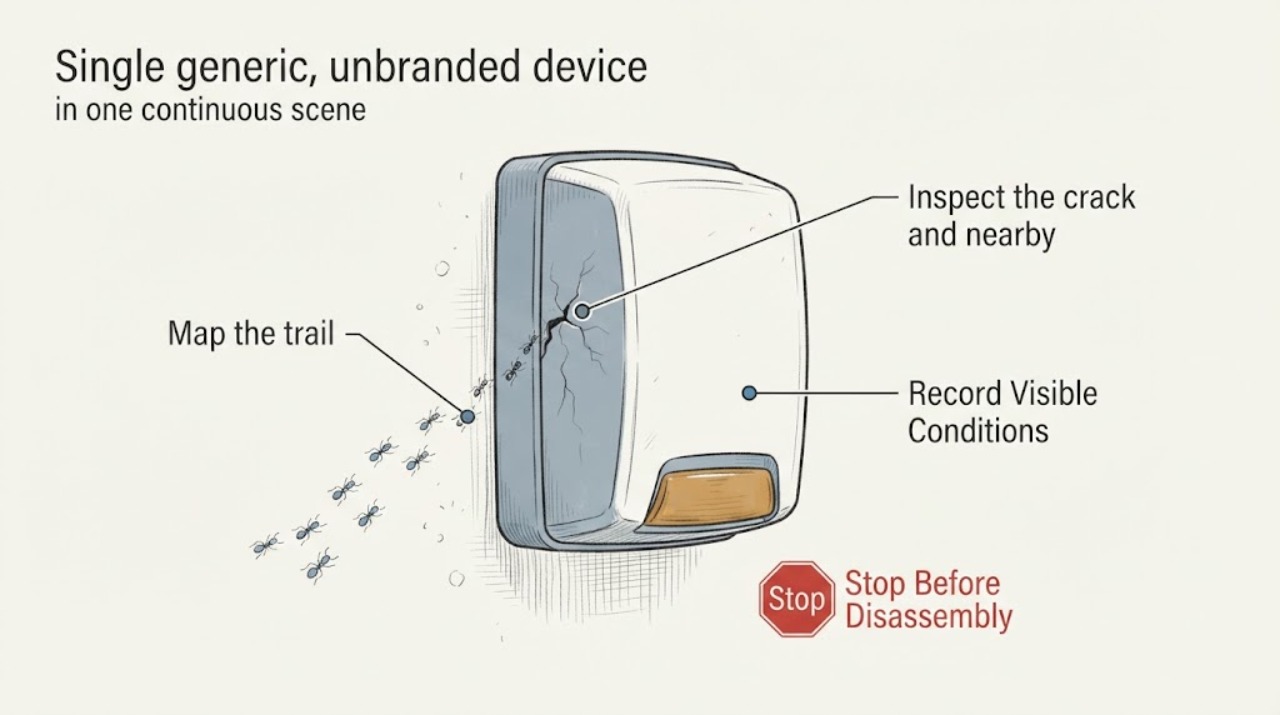
Map the trail to the entry crack
From a safe standing position, observe ants indoors and outdoors where accessible and follow the visible route with your eyes or a camera. Note the wall, sill, baseboard, foundation, door, window, or utility-penetration location without touching or probing the crack.
Expected result: Record whether the trail repeatedly ends at one crack, branches to several points, disappears into a wall or trim, or returns from vegetation, soil, stored wood, or another visible area.
Next step: Photograph the trail and mark the location on a simple room or wall sketch. Keep the crack accessible for professional inspection and do not fill, drill, or inject it.
Stop if: Stop if the trail enters an electrical box, appliance, inaccessible void, unstable area, or location that requires climbing, moving heavy objects, or disturbing the structure.
Why this matters
Why: A repeatable endpoint identifies a useful entry clue, but multiple routes or an unseen continuation may indicate a nest or alternate entry that a surface seal will not address. The route does not identify the ant species by itself.
-
Record recurrence timing and conditions
For safe observations, record when the ants return and whether activity follows rain, damp weather, indoor cleaning, a spill, cooking, pet food, trash, or a change in temperature. Do not deliberately place food, water, or pesticide to draw ants out.
Expected result: Note the date or approximate time, weather, room activity, moisture conditions, and whether activity returns at the same crack after the area appears quiet.
Next step: Share the timeline with pest control and address only visible food or water sources safely. Do not use repeated sprays or mixed products to test the hypothesis.
Stop if: Stop for contaminated water, active leakage, electrical moisture, a strong chemical odor, or any need to open a wall, floor, cabinet, or concealed space.
Why this matters
Why: A rain- or moisture-linked pattern supports checking for moisture and shelter; a food-linked pattern points to sanitation and access; activity at a consistent time may help a professional locate the route or nest. Timing alone cannot establish the species or source.
-
Inspect the crack and nearby moisture visually
Use room lighting or a camera zoom to inspect the accessible crack, adjacent finish, baseboard, sill, and nearby wall or foundation area. Look without scraping, widening, sealing, or pressing on the material.
Expected result: Record an open or failed seal, staining, dampness, swelling, peeling finish, soft-looking wood, or no visible defect; note whether moisture is near plumbing, a window, a door, or a foundation edge.
Next step: Keep the area dry and visible, document the condition, and arrange pest or moisture service when the defect recurs or material is affected. Do not caulk over wet, damaged, or suspected biologically affected material.
Stop if: Stop for active water, mold-like growth, soft or unstable material, exposed wiring, or any need to probe, remove trim, or access a void.
Why this matters
Why: A failed joint can be an entry route, while damp or deteriorated material can provide shelter or signal a larger building issue. Softness, staining, or moisture raises the need for professional assessment rather than a cosmetic seal.
-
Look for food and water contributors
From accessible areas, inspect around sinks, pet bowls, counters, trash, recycling, pantry edges, plants, and exterior foundation edges for crumbs, sweet residue, dampness, mulch, leaf litter, or stored wood. Clean or relocate only ordinary accessible food debris and water containers; do not disturb active ants or apply chemicals.
Expected result: Note whether the recurrence is beside food, water, vegetation touching the building, damp soil, stored wood, or no visible attractant.
Next step: Remove accessible crumbs and standing water, keep food sealed, and report the location and source clues to a professional. Do not use home remedies, mixed pesticides, or a spray on an active trail as a substitute for inspection.
Stop if: Stop for stinging or biting risk, contaminated material, electrical equipment, suspected structural wood damage, or any need to handle a nest, rotting wood, or pesticide.
Why this matters
Why: A nearby food or moisture source can sustain foraging even after a prior treatment; no visible source keeps a hidden nest or alternate route in consideration. Carpenter ants are particularly associated with moisture-damaged or decaying wood, but appearance alone is not identification.
-
Estimate extent and possible species clues
From a safe distance, record the approximate number and appearance of ants without handling them. Note whether they are tiny or large, winged or wingless, solitary or in a dense trail, and whether coarse sawdust-like debris appears nearby; do not tap walls, open trim, or collect insects by hand.
Expected result: Record isolated scouts, repeated trails, many workers, winged ants indoors, or debris near wood, and note the rooms or exterior areas involved.
Next step: Provide photos, counts, room locations, and timing to a pest professional for identification and nest assessment. Keep children and pets away from active areas and do not disturb the suspected nest.
Stop if: Stop immediately for a swarm, stinging insects, allergic reaction risk, large or rapidly spreading activity, suspected structural damage, or any need to disturb wood or a concealed nest.
Why this matters
Why: Repeated trails or many ants suggest an established route; winged ants indoors or coarse sawdust can be important clues for an indoor carpenter-ant nest, but they are not conclusive without identification. More than one nest or route may exist.
Use your observations
Decision map
Find the observation that best matches what you see, then follow the next safe action.
-
PATH 01Next step
What you see
A small recurring trail follows one visible crack, with no moisture, wood damage, electrical contact, or stinging risk.
Do this next
Document the route and source clues and arrange pest service to identify the entry and appropriate treatment. Do not seal the crack before the professional assesses it.
-
PATH 02Next step
What you see
Activity follows moisture, damp soil, plumbing, a spill, vegetation, mulch, or stored wood.
Do this next
Correct only obvious accessible food or water contributors safely, document the condition, and request pest or moisture assessment if recurrence continues.
-
PATH 03Next step
What you see
Winged ants appear indoors, coarse sawdust is visible, or wood looks damp, soft, or decayed.
Do this next
Stop disturbing the area and arrange prompt pest and building-moisture inspection; possible wood damage is not a DIY treatment or structural repair task.
-
PATH 04Next step
What you see
Multiple trails, many ants, repeated recurrence after prior treatment, or no clear entry point is present.
Do this next
Request professional species identification and nest-location assessment rather than mixing products or spraying every visible trail.
-
PATH 05Next step
What you see
Ants enter an electrical area, a concealed void, contaminated material, or a location that is unsafe to access, or a person has a sting/allergic reaction risk.
Do this next
Keep people and pets away and seek qualified pest, electrical, medical, or emergency assistance as appropriate. Do not touch the area or inject anything into it.
Helpful context
Understand the symptom
Recurrence means the route or source remains
Ants often follow repeatable routes between food, water, shelter, and a nest. University of Minnesota Extension notes that different species use different nesting sites, some enter through cracks, and some are associated with decaying or moisture-damaged wood. A crack is therefore an observation target, not proof that sealing it alone will solve the recurrence.
Start with observation and source control
Record where and when ants appear before changing the area. Remove accessible crumbs, spills, and standing water using ordinary household cleaning, keep food in closed containers, and correct only obvious low-risk moisture sources. Do not mix products, spray an unidentified trail, inject a wall void, or disturb suspected nests.
Know when a professional is needed
A recurring trail may require species identification, moisture assessment, nest location, or coordinated treatment. The EPA advises reading and following each pesticide label, and Extension guidance says hidden nests and carpenter-ant control are often best handled by experienced pest professionals.
Only after diagnosis
Potential parts
- exterior-caulk
Consider only after a professional confirms that the visible crack is an appropriate, dry, stable entry point and that sealing will not hide moisture or damage.
Confirm the substrate, movement, exposure, and joint requirements; do not seal wet, deteriorated, structural, or electrical-adjacent areas. - ant-bait-station
Consider only after the ant type, location, occupants, and product label are reviewed; bait selection and placement are not a substitute for finding moisture or a hidden nest.
Use only a legally labeled product for the identified pest and site, keep it inaccessible to children and pets as directed, and never mix it with sprays or other chemicals. - weatherstrip
Consider only when a professional confirms that the recurring route is through a movable door or window perimeter rather than a wall, foundation, or moisture-damaged joint.
Match the opening and existing profile without impairing operation, ventilation, or emergency egress; do not use it to conceal damaged framing.
When checks do not resolve it
Need a professional?
Arrange pest control service for recurring trails, multiple entry routes, large or persistent activity, winged ants indoors, coarse sawdust, suspected moisture-damaged wood, an unknown or concealed entry crack, or activity that returns after prior treatment.
Safety scope: User checks are low-risk observation and ordinary sanitation only. Do not mix pesticides, spray or fog indiscriminately, inject unknown voids, disturb nests or wood, touch electrical areas, or seal wet, damaged, or structural cracks.
Have this ready
- Provide ant photos from a safe distance, trail and crack locations, timing and weather, food or moisture clues, approximate counts, rooms affected, prior treatment history, winged-ant or sawdust observations, and any child, pet, electrical, or allergy concern.
Common questions
FAQ
Why do ants keep coming back through the same crack?
The crack may remain a route to food, water, shelter, or a nest, and a surface seal may not address the source. Map the trail, timing, moisture, and nearby attractants before professional treatment.
Should I spray or seal the crack immediately?
Do not spray randomly or seal over an active, wet, damaged, or unknown joint. Document the route and have the ant and building conditions assessed; pesticide use, if appropriate, must follow the product label.
When could recurring ants indicate wood damage?
Winged ants indoors, coarse sawdust, damp or soft-looking wood, and persistent activity near moisture can justify prompt professional pest and moisture inspection. These clues do not identify the species or confirm structural damage by themselves.
Read the exact guide
Official sources
- Carpenter antsUniversity of Minnesota Extension · Species-specific context used conditionally; seeing ants does not establish that they are carpenter ants.
- IPM Update—AntsU.S. Environmental Protection Agency · General integrated pest management guidance; used here for observation and safe source-control boundaries.
- Pesticide LabelsU.S. Environmental Protection Agency · General regulatory labeling guidance; no product or pesticide application recipe is provided in this article.
- AntsUniversity of Minnesota Extension · General household ant observation and integrated pest management guidance; not a product-specific treatment instruction.
Community feedback
Share a repair observation
Share a plain-text repair observation. Accepted observations are published automatically; this page may take a moment to update.