
On this page
Start here
Quick answer
When ants keep returning at a foundation joint, first observe the trail, entry location, timing, moisture, food or shelter conditions, and any visible wood or foundation damage from a safe ground-level position. Recurrence often means the entry path or a moisture and shelter condition remains, not that stronger pesticide is automatically needed. Do not mix pesticides, inject an unknown joint or cavity, disturb electrical equipment, or dig against the foundation. Broad recurrence, stinging or allergic reactions, suspected structural damage, or uncertainty about pesticide safety calls for qualified pest-control or building service.
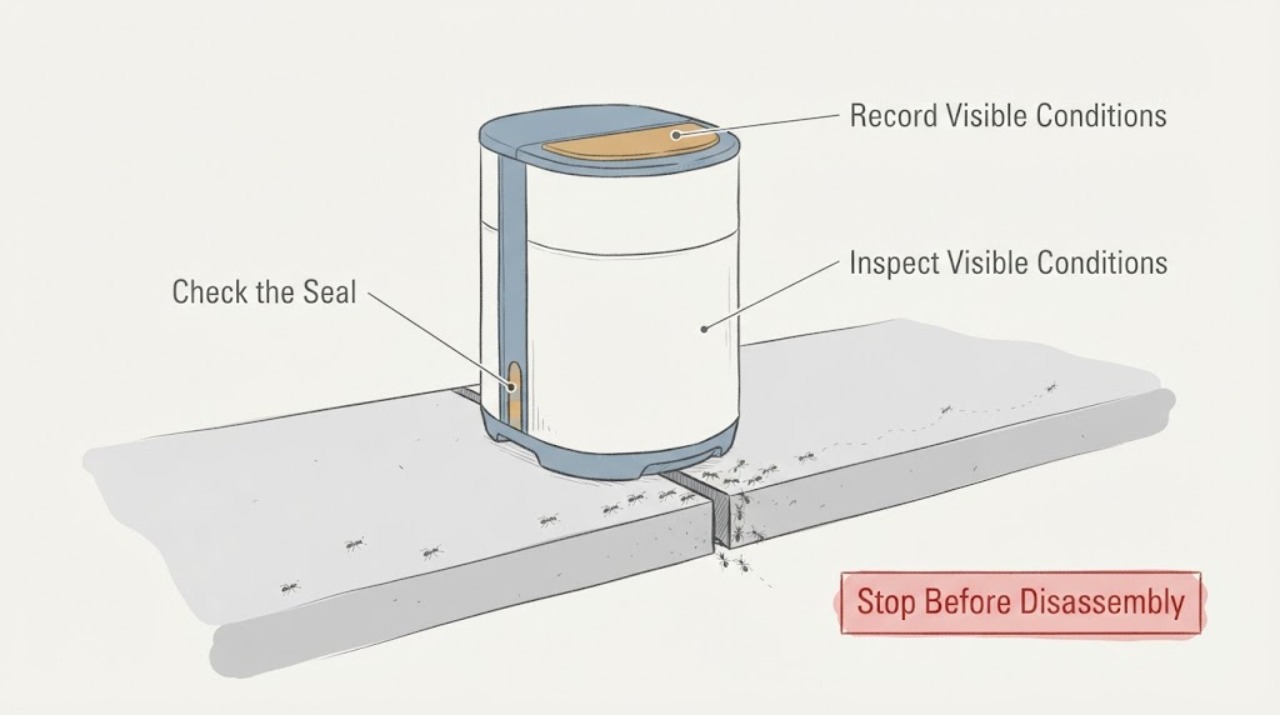
Work through in order
Diagnostic checks
Use only checks that match the exact appliance or system and its official guide.
-
Check 1
From a stable ground-level position, watch the visible trail at the foundation joint without touching or blocking it. Note where ants enter, whether the trail goes indoors or along the wall, the time of day, and whether several trails converge at one seam.
Expected result: A short trail that ends at one exterior joint differs from repeated traffic into the interior, multiple entry points, or a trail that persists throughout the day.
Next step: Photograph or sketch the path from a safe distance and record the time. Leave the trail undisturbed for the pest professional's inspection.
Stop if: Stop if observation requires kneeling in an unsafe area, touching insects, disturbing the joint, or approaching stinging insects or electrical equipment.
Why this matters
Why: Trail direction and timing help the professional decide whether to investigate an entry path, a nearby nest, indoor food or water, or a concealed building space; they do not identify species by themselves.
-
Check 2
Look around the foundation joint, sill, doorway, and nearby wall from outside without digging, drilling, or opening the joint. Note visible gaps, crumbling material, staining, dampness, condensation, soil contact, or a route that follows a utility penetration.
Expected result: A clean, dry, stable seam differs from a damp crack, recurring stain, eroded joint, or opening that connects to a wall, sill, or utility route.
Next step: Document the location and arrange pest-control or building service as appropriate. Do not fill an unknown cavity or alter the foundation based only on appearance.
Stop if: Stop for loose masonry, a widening crack, soil movement, active water, suspected utility damage, or any need to dig or probe the foundation.
Why this matters
Why: Moisture and building-condition clues can explain recurrence and may require building or water-source assessment before pest treatment or sealing.
-
Check 3
From safe locations, review recent conditions around the joint: rain, irrigation, leaks, mulch or vegetation contact, stored wood or cardboard, pet food, crumbs, trash, and other accessible food or shelter. Observe without moving heavy materials or disturbing a nest.
Expected result: Ant activity that rises after moisture or follows a food source is different from activity that continues with no visible attractant or appears near damp wood and wall materials.
Next step: Record the correlation and remove only ordinary, loose food residue or accessible waste without approaching the trail or using chemicals. Ask the professional to assess persistent moisture, wood, or hidden shelter.
Stop if: Stop if cleanup would disturb ants in a wall, expose you to pesticide residue, require moving heavy materials, or bring you near electrical equipment or unstable surfaces.
Why this matters
Why: Food, water, and shelter observations support an integrated assessment and may reveal a preventable condition, but they do not establish the correct pesticide or nest location.
-
Check 4
Observe any already visible wood, trim, or foundation-adjacent material for softening, staining, small debris, galleries, or damage without pressing, scraping, or removing finishes. Note whether the condition is limited to an exterior surface or continues toward the structure.
Expected result: A normal, dry surface is different from damp or softened wood, recurring debris, hollow-looking damage, or a foundation joint that is visibly separating or deteriorating.
Next step: Photograph the condition and limit disturbance near it. Request building assessment if damage appears to involve load-bearing or structural material.
Stop if: Stop for movement, collapse risk, extensive damage, suspected structural loss, or any need to cut, pry, drill, or remove material.
Why this matters
Why: These clues may indicate a moisture or structural issue beyond routine ant entry and should be reviewed by a qualified pest or building professional.
-
Check 5
Record the response history without applying another treatment: dates of previous service or bait use, where it was placed, how long activity decreased, and when ants returned. Note whether children, pets, or sensitive occupants can reach the area.
Expected result: A temporary reduction followed by recurrence differs from no response, activity at a new location, or a treatment area accessible to children or pets.
Next step: Provide the history and access conditions to the pest professional. Keep any existing product in its original labeled container and do not combine or transfer products.
Stop if: Stop if there has been a spill, unknown pesticide exposure, a child or pet contact, breathing difficulty, or an allergic reaction; seek appropriate medical or poison-control guidance.
Why this matters
Why: The response pattern can indicate an unresolved entry or moisture condition, an incorrect identification, or an application-safety concern that needs professional review.
Use your observations
Decision map
Find the observation that best matches what you see, then follow the next safe action.
-
PATH 01Safety boundary
What you see
Ants recur at one foundation joint with a visible trail but no apparent structural damage or exposure hazard.
Do this next
Arrange a pest-control inspection using the trail map, timing, and nearby food, water, and shelter observations; use an integrated plan rather than escalating chemicals blindly.
Why this path and its safety boundary
Safety stop: Do not inject the joint, mix pesticides, or seal an unknown cavity before the source and species are assessed.
-
PATH 02Safety boundary
What you see
Activity follows dampness, leaks, irrigation, wet wood, or a recurring foundation stain.
Do this next
Request pest and building or moisture assessment so the water condition and ant entry are addressed together.
Why this path and its safety boundary
Safety stop: Do not dig against the foundation, probe the joint, or cover active water with a sealant.
-
PATH 03Safety boundary
What you see
The joint, adjacent wood, or foundation appears to be separating, soft, crumbling, or otherwise structurally damaged.
Do this next
Keep people away from the affected area and arrange qualified building inspection along with pest service.
Why this path and its safety boundary
Safety stop: Do not pry, drill, cut, excavate, or load the affected structure.
-
PATH 04Safety boundary
What you see
Stinging insects, an allergic reaction, broad recurrence, unknown pesticide exposure, or activity near electrical equipment is present.
Do this next
Stop the observation, keep occupants away, and seek qualified pest, medical, poison-control, or electrical help as appropriate.
Why this path and its safety boundary
Safety stop: Do not touch insects, pesticide residue, or electrical equipment, and do not continue treatment experiments.
Helpful context
Understand the symptom
Ants at a foundation joint can be using a crack, construction seam, utility penetration, vegetation contact, damp material, or an indoor food and water source. A recurring trail is evidence to map and identify, not proof that the joint itself is the nest. The first useful decision is whether this is a limited entry trail or part of a broader moisture, wood, or building condition.
Keep the assessment low risk and ground-level. Do not inject a joint, drill, excavate, mix pesticide products, spray indiscriminately, or reach around electrical equipment. Do not seal a path before a professional has considered whether ants are active inside a wall or whether water needs to drain through the area.
EPA's integrated pest-management guidance starts with monitoring and identification, then prevention, and selects control methods according to effectiveness and hazard. Its household guidance emphasizes food, water, shelter, and entry cracks as useful clues before using pesticides.
Record what changes after rain, watering, food cleanup, or a weather shift. This gives a pest professional a more reliable starting point than a single count of ants and helps separate an exterior trail from a hidden nest or building-moisture problem.
Only after diagnosis
Potential parts
- exterior-caulk
Consider this category only after a professional confirms that the joint is a stable, non-draining exterior gap and that sealing will not trap moisture or insects inside the structure.
Confirm the joint material, movement, water-management role, and surface condition before selecting a sealant. - ant-bait-station
Consider this category only after the ant type and placement risk are assessed and a product label permits the intended use.
Keep bait inaccessible to children and pets, follow the exact label, and never mix or transfer pesticide products. - weatherstrip
Consider this only if the trail reaches a movable exterior door and inspection confirms that a worn seal, rather than the foundation joint or a hidden cavity, is the entry path.
Confirm the door profile, closure, drainage, and escape function before selecting a seal.
When checks do not resolve it
Need a professional?
Arrange pest-control inspection for recurring ants, multiple trails, uncertain species, or activity that continues after ordinary prevention. Add building or moisture assessment for dampness, wood damage, crumbling or separating foundation material, and broad recurrence. Seek medical or poison-control guidance for allergic symptoms or pesticide exposure.
Have this ready
- Provide the trail map, entry location, timing, weather and moisture correlation, food and shelter context, visible foundation or wood condition, prior treatment history, and access by children or pets. Explain that no joint injection, pesticide mixing, excavation, or electrical contact was attempted.
Common questions
FAQ
Why do ants keep returning at the same foundation joint?
The joint may remain an entry path, or nearby moisture, food, shelter, vegetation, or hidden nesting conditions may remain. Map the trail and timing and have a professional identify the species and source before sealing or treating.
Should I inject pesticide into the foundation joint?
No. Do not inject an unknown cavity or mix pesticides. A professional should identify the ant and determine whether the joint is safe to seal, drains water, or connects to a hidden space.
Can I seal the crack to stop the ants?
Only after the entry and moisture conditions are understood. Sealing an active or unknown cavity can trap moisture or insects and may hide a building problem; ask a professional to confirm the repair approach.
When should I call a professional?
Arrange service for broad recurrence, uncertain species, stinging or allergy concerns, dampness, wood or foundation damage, pesticide exposure, or activity near electrical equipment. Keep people away from the hazard and do not continue treatment experiments.
Read the exact guide
Official sources
- Addressing Indoor Environmental Concerns During RemodelingU.S. Environmental Protection Agency · Supports checking moisture and foundation conditions and recognizing that dampness and open joints can contribute to pest and building problems; no excavation or structural work is instructed here.
- Do you really need to use a pesticide?U.S. Environmental Protection Agency · Supports observing and reducing accessible food, water, shelter, and cracks before escalating pesticide use; it does not authorize treatment of an unknown foundation cavity.
- Integrated Pest Management (IPM) PrinciplesU.S. Environmental Protection Agency · Supports mapping and identifying recurring ants before choosing a control and using targeted methods according to effectiveness and hazard.
Community feedback
Share a repair observation
Share a plain-text repair observation. Accepted observations are published automatically; this page may take a moment to update.