
On this page
Start here
Quick answer
When ants appear in several rooms or keep returning, map the trails and document the extent before applying anything. From safe, accessible areas, record where ants enter, where they travel, whether they are winged or worker ants, whether there is coarse wood debris, and whether the activity follows damp or decayed wood, leaks, food, or outdoor vegetation. Do not open walls, mix pesticides, use a product off-label, or assume all ants are the same species. A large or recurring infestation—especially with winged ants, wood damage, or moisture—needs a qualified pest-management professional to identify the species and locate the nest or moisture source.
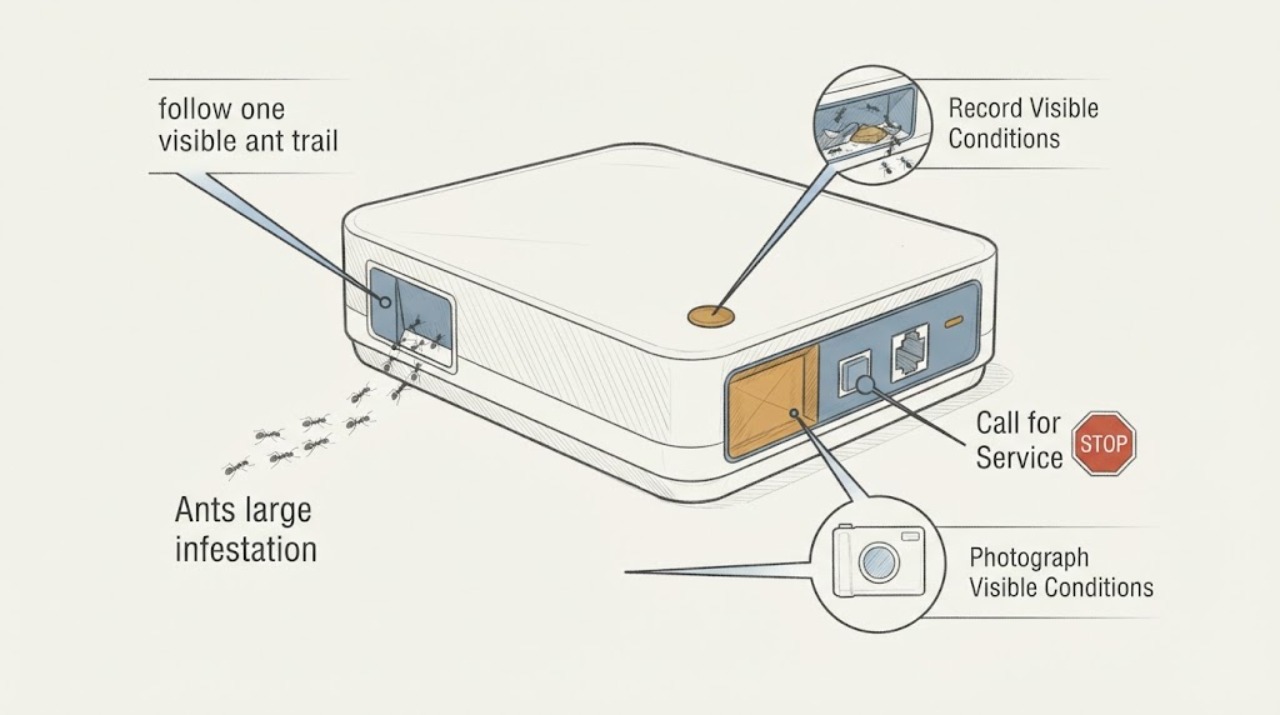
Work through in order
Diagnostic checks
Use only checks that match the exact appliance or system and its official guide.
-
Check 1
From safe accessible areas, follow one visible ant trail with your eyes or a camera without touching the ants, opening a wall, or disturbing a suspected nest.
Expected result: Record the entry point, travel direction, rooms connected by the trail, and whether the trail leads toward a window, foundation, plumbing area, food, damp material, firewood, or vegetation outside.
Next step: Mark each route on a room sketch and photograph the entry and exit points from a safe position; do not seal the trail or spray it before the professional can assess it unless a label specifically directs that use.
Stop if: Stop following the trail if it requires moving appliances, opening trim or walls, entering a confined space, or touching contaminated or treated material.
Why this matters
Why: A connected path helps the professional distinguish an exterior foraging route from possible hidden indoor nesting, but the endpoint of a trail is not necessarily the nest.
-
Check 2
Document the infestation's extent by recording which rooms, floors, exterior walls, and outbuildings show activity during the same observation period.
Expected result: Note isolated sightings, repeated trails in multiple rooms, concentrated activity near one wet area, activity around an exterior foundation, or winged ants appearing indoors.
Next step: Provide the room map, dates, photos, and whether activity is day or night to a qualified pest-management professional rather than treating each room independently.
Stop if: Stop observing and restrict access if activity is in a child's or pet's area, near food preparation, or near a pesticide already placed there.
Why this matters
Why: Multiple rooms, repeated activity, or indoor winged ants raise the need for a professional nest and structure assessment; a single outdoor trail may have a different source.
-
Check 3
Use zoomed photographs or a safe close visual view to describe ant appearance without collecting, crushing, or handling insects.
Expected result: Record approximate relative size, body color, waist shape if visible, presence or absence of wings, and whether the ants are carrying food; do not make a species claim from one unclear photo.
Next step: Send the clearest images and the location and season to the professional for identification; keep the article's diagnosis provisional until the species is confirmed.
Stop if: Stop if identification would require capturing insects, disturbing a nest, or applying a chemical to obtain a closer view.
Why this matters
Why: Winged ants, varying worker sizes, or features that do not match a common house ant can change the professional's identification and treatment plan; termites and ants require different responses.
-
Check 4
Inspect accessible, dry surfaces near the trails for moisture and wood-condition clues without probing, drilling, opening walls, or removing materials.
Expected result: Record a leak or condensation history, damp or decayed wood, staining, swelling, coarse sawdust-like debris, a soft finish, or activity around sinks, tubs, windows, foundations, roof penetrations, firewood, or stumps.
Next step: Photograph the condition and arrange pest and moisture assessment; do not cut into the wall or promise that a bait or spray will correct the building condition.
Stop if: Stop if the surface is wet, unstable, near electrical equipment, or would need probing or demolition to investigate.
Why this matters
Why: Moist or decayed wood can support carpenter-ant nesting and may need correction alongside pest treatment; debris and dampness are clues, not proof of a nest or structural damage.
-
Check 5
Review any pesticide or bait already present by reading its original label from a safe position and recording the product name, pest/site claims, application date, and visible warning or exposure instructions.
Expected result: Note whether the product is still identifiable and labeled for ants at that site, whether children or pets can reach it, and whether more than one product or an improvised mixture was used; do not mix, transfer, or reapply it while investigating.
Next step: Keep people and pets away, preserve the label or container information, and contact a qualified pest professional or poison-control/emergency resource as the exposure requires.
Stop if: Stop handling the product immediately for skin, eye, inhalation, or ingestion exposure and follow the product label's first-aid and emergency instructions.
Why this matters
Why: An unlabeled, off-label, accessible, leaking, or combined pesticide is a safety and professional-handoff issue, not an invitation to add another treatment.
Use your observations
Decision map
Find the observation that best matches what you see, then follow the next safe action.
-
PATH 01Next step
What you see
Ant activity is present in multiple rooms, repeatedly returns, includes indoor winged ants, or is associated with wood debris or moisture.
Do this next
Arrange qualified pest-management service for species identification, nest location, moisture assessment, and a treatment plan; do not open the wall or treat each trail independently.
-
PATH 02Next step
What you see
The ants appear confined to a single outdoor trail with no indoor activity or building damage clues.
Do this next
Document the route and remove accessible food or moisture attractants without disturbing a nest; seek professional help if the trail enters the building or persists.
-
PATH 03Next step
What you see
Moisture, decayed wood, leaks, or condensation are present near the activity.
Do this next
Prioritize a professional pest and moisture-source assessment; correcting moisture may be necessary but does not replace locating and treating a hidden nest.
-
PATH 04Next step
What you see
A pesticide or bait is unlabeled, off-label, mixed with another product, leaking, or accessible to a child or pet.
Do this next
Keep people and pets away, do not handle or add chemicals, and follow the label's emergency guidance or contact an appropriate poison-control or professional resource.
-
PATH 05Next step
What you see
The species, nest location, or extent cannot be determined safely from accessible observations.
Do this next
Keep the evidence and photos, avoid DIY structural access or pesticide experiments, and request a qualified inspection.
Helpful context
Understand the symptom
Why species and trail evidence matter
Different ants can use different foods, nesting sites, and control approaches. Carpenter ants are associated with moist or decayed wood and may travel between a parent nest and hidden satellite nests, but the presence of ants indoors alone does not prove a nest is inside. A clear photo, trail map, and description of winged or worker ants gives the professional better evidence than a guessed species name.
Look for the conditions supporting the infestation
Count rooms and zones rather than trying to count every ant. Note trails near sinks, plumbing, windows, foundations, roof or wall penetrations, firewood, stumps, overhanging branches, and damp or decayed wood. Moisture correction may be part of the solution, but finding the nest and selecting treatment still require a professional assessment for a large infestation.
Use pesticide labels as a hard boundary
If a professional or label permits a consumer product, use only an EPA-registered product whose label covers the pest, site, and application, and follow every label precaution. Do not combine products or improvise a stronger mixture. Keep bait or pesticide away from children, pets, food, and water, and stop handling it if there is exposure or a label warning.
Only after diagnosis
Potential parts
- ant-bait-station
Only consider a bait station if its current label covers the identified ant, location, and use pattern, and the station can be kept inaccessible to children, pets, food, and water; a large infestation still warrants professional assessment.
Follow the complete product label and local requirements; do not mix bait with sprays or transfer it to another container, and do not assume a bait station locates or removes a hidden nest. - moisture-meter
Consider only as a professional assessment aid after visible moisture or wood-condition clues are found; a reading cannot identify ant species or prove a nest location.
Readings depend on wood species, depth, instrument, and calibration; do not probe, drill, or open a wall to obtain one.
When checks do not resolve it
Need a professional?
Arrange high-priority pest-management service for ants in multiple rooms, repeated activity, winged ants indoors, possible carpenter ants, wood debris, moisture-linked activity, or any infestation that is not safely identifiable or contained.
Have this ready
- Provide the room and exterior trail map, dated photos, ant appearance, winged-ant observations, activity times, moisture or wood clues, product labels already used, child or pet access concerns, and any prior treatment history.
Common questions
FAQ
Do ants in several rooms mean there is a nest inside the wall?
Not necessarily, but multiple rooms, repeated trails, indoor winged ants, wood debris, or moisture raise the need for a professional assessment. Ants can forage from an exterior nest or use hidden satellite nests, so do not open the wall to find out.
Can I spray every trail or mix products to stop a large infestation?
No. Do not mix pesticides or use any product off-label. Read the complete label for any product already present, keep it away from people, pets, food, and water, and ask a qualified pest professional to plan treatment.
Why does moisture matter for carpenter ants?
Carpenter ants commonly use moist or decayed wood for nesting, but moisture evidence does not by itself identify the species or nest. Report leaks, condensation, damp wood, and trail locations so pest and moisture sources can be assessed together.
Read the exact guide
Official sources
- Pesticide LabelsU.S. Environmental Protection Agency · EPA directs users to read pesticide labels because labels communicate how to manage pesticide risk; the article uses the label as the boundary for any conditional bait discussion.
- Labeling RequirementsU.S. Environmental Protection Agency · EPA explains that labels provide critical information for safe pesticide use and avoiding harm to people and the environment; no off-label or improvised treatment is recommended here.
- AntsNational Pesticide Information Center · NPIC provides an official ant information page and links to integrated pest-management resources, supporting identification and source-focused control rather than improvised chemical use.
- Carpenter antsUniversity of Minnesota Extension · The extension guidance distinguishes carpenter ants from other ants, describes indoor activity, moisture and decayed-wood associations, trail and debris clues, and recommends experienced pest-management professionals for complex infestations.
Community feedback
Share a repair observation
Share a plain-text repair observation. Accepted observations are published automatically; this page may take a moment to update.