
On this page
Start here
Quick answer
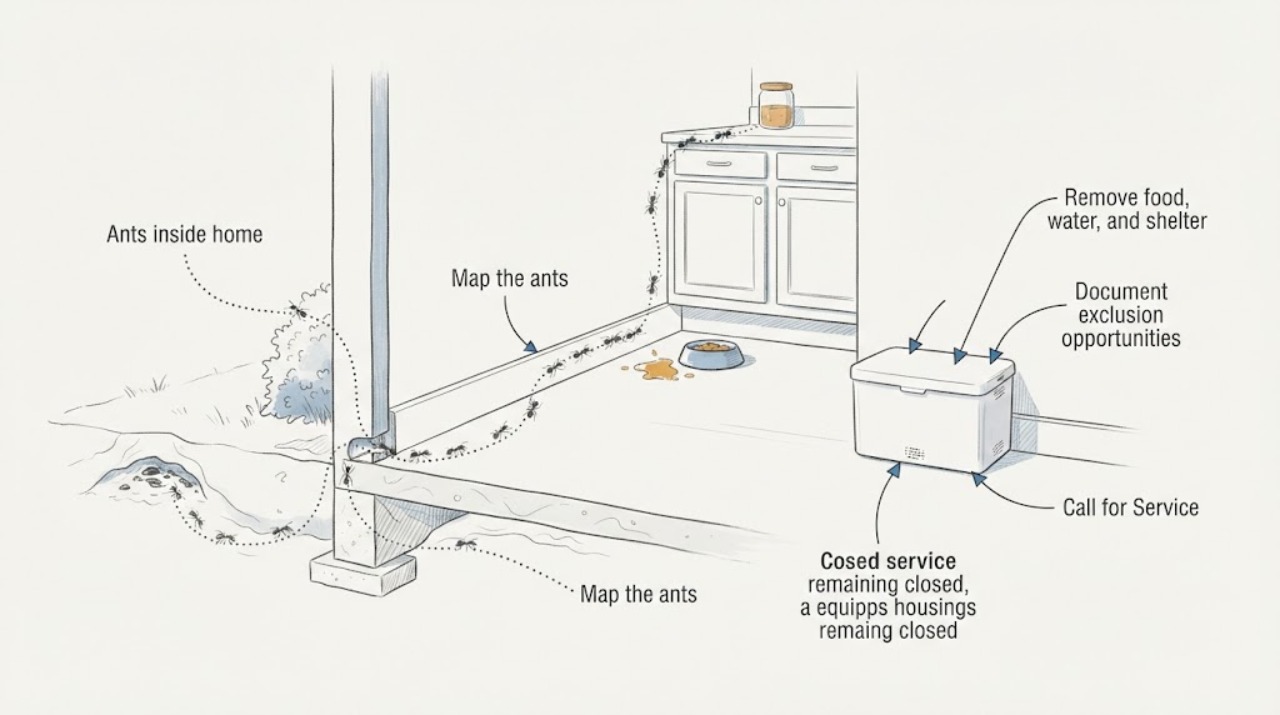
Start by finding the trail and removing the food, water, or shelter that is making the home attractive; do not begin by spraying every ant you see. Take photos of the trail and entry area, clean crumbs and spills, store food and pet food in closed containers, address accessible moisture, and document cracks or gaps. If you choose a pesticide, use only a product whose label covers the target ant and indoor location, follow that label exactly, and keep children, pets, toys, food, and dishes away as the label requires. Do not mix products, move pesticide into another container, place bait where a child or pet can reach it, or spray over bait. Repeated trails, winged ants, sawdust-like debris, moisture-damaged wood, or activity from wall voids are good reasons to arrange a pest inspection rather than guessing at a species or treatment.
Work through in order
Diagnostic checks
Use only checks that match the exact appliance or system and its official guide.
-
1. Map the ants and the entry path
From a safe position, watch the ants briefly without touching them or applying a product. Photograph the trail, note the room and time, and follow it only as far as it remains visible and safe to inspect. Record whether ants enter at a window, door, pipe opening, baseboard, cabinet, or wall gap, and whether there are winged ants or sawdust-like debris.
Expected result: A short trail to a food or moisture source differs from a persistent trail into a wall, repeated activity in multiple rooms, winged ants indoors, or debris near wood.
Next step: Keep the photos and route notes for a pest professional, and continue with nonchemical food, moisture, and entry-point checks.
Stop if: Stop opening trim, drilling, cutting into walls, or disturbing damp or damaged wood to look for a nest.
Why this matters
Why: The pattern helps distinguish a likely foraging route from a possible indoor nest or moisture-damaged structure, but a photo alone cannot identify every ant species.
-
2. Remove food, water, and shelter attractants
Clean visible crumbs and sweet or greasy spills, rinse recyclable food containers, empty and wash accessible trash or recycling bins, store human and pet food in tightly closed containers, and wipe accessible standing water. Note leaks, condensation, damp wood, clutter, firewood, or vegetation touching the home without dismantling anything.
Expected result: Activity may decline after a food or water source is removed, or it may continue on a fixed trail despite clean surfaces and closed food.
Next step: Keep the area clean and dry, photograph any leak or moisture-damaged material, and include the result in a professional inspection request if the trail continues.
Stop if: Do not use bleach, solvents, or pesticide mixtures to clean the trail, and do not disturb suspected nest material in a wall or wet structure.
Why this matters
Why: A change after sanitation supports an attractant-driven route; persistent activity suggests an entry, nesting, or moisture condition that needs further assessment.
-
3. Document exclusion opportunities
From accessible areas, photograph cracks and openings along baseboards, behind sinks, around pipes and windows, door gaps, damaged screens, and branches or shrubs touching the structure. Note whether the trail disappears into one gap or reappears elsewhere; do not seal a gap that contains wiring, plumbing, ventilation, or an active unknown nest.
Expected result: One visible, non-service opening at a door or trim differs from a hidden wall void, several entry points, or a gap associated with plumbing, wiring, or moisture damage.
Next step: Give the photos and locations to a pest professional or appropriate home-repair professional, and ask which opening should be sealed after the pest route is understood.
Stop if: Do not caulk, foam, or open a concealed gap until its contents, moisture condition, and treatment plan are understood.
Why this matters
Why: A confirmed, accessible exclusion point may be part of a low-risk prevention plan; concealed or service-related openings need a professional to avoid hiding damage or blocking a required path.
-
4. Screen any pesticide decision against the label and household risk
Before buying or using a bait or spray, read the complete product label and confirm that the product is labeled for the ant or pest category, the indoor location, and the application method. Check the label's child, pet, food, ventilation, storage, re-entry, and first-aid directions; keep the original container and do not mix products or transfer them to another container.
Expected result: The label may allow a specific indoor use with access restrictions, or it may exclude the ant, location, or method you had in mind.
Next step: If every required label condition can be met, follow the label exactly and keep people and animals away for the stated period. If not, do not use the product; ask a pest professional to identify the ant and treatment route.
Stop if: Stop and seek product-specific help if there is a spill, exposure, illness, an unreadable label, or any uncertainty about child, pet, food, or re-entry precautions.
Why this matters
Why: The label controls safe use. A product that is available in a store is not automatically suitable for an unidentified ant, a wall void, a kitchen surface, a home with pets, or a space used by children.
Use your observations
Decision map
Find the observation that best matches what you see, then follow the next safe action.
-
PATH 01Safety boundary
What you see
Ants stop after food, water, and trail sanitation, with no repeated route or structural sign.
Do this next
Continue prevention, monitor the same entry area, and seal only a confirmed accessible opening after it is safe to do so.
Why this path and its safety boundary
Safety stop: Do not escalate to broad indoor pesticide use just to remove a few remaining foragers.
-
PATH 02Safety boundary
What you see
A trail persists, returns from a wall or void, appears in several rooms, or is paired with moisture-damaged wood or sawdust-like debris.
Do this next
Arrange a pest inspection and disclose moisture, plumbing, roofing, or wood-damage observations.
Why this path and its safety boundary
Safety stop: Do not open walls, remove trim, or treat concealed spaces yourself.
-
PATH 03Safety boundary
What you see
Winged ants appear indoors or the ant type is uncertain and control has failed.
Do this next
Save clear photos or a specimen only if it can be done without pesticide contact, and ask a pest professional for identification and an IPM plan.
Why this path and its safety boundary
Safety stop: Do not assume all ants respond to the same bait or spray.
-
PATH 04Safety boundary
What you see
A pesticide label does not cover the ant, location, or method, or children, pets, food, or re-entry precautions cannot be controlled.
Do this next
Do not use that product; use sanitation and exclusion while arranging professional guidance.
Why this path and its safety boundary
Safety stop: Never mix products, over-apply, transfer pesticide containers, or place bait where a child or pet can reach it.
-
PATH 05Safety boundary
What you see
A person or pet may have been exposed to pesticide, or a spill or adverse reaction occurs.
Do this next
Move people and animals away, keep the original label, and contact appropriate poison, medical, veterinary, or emergency resources.
Why this path and its safety boundary
Safety stop: Do not clean an exposure by applying another chemical or by guessing at first aid.
Helpful context
Understand the symptom
Why trail-first control works better
Ants inside usually reflect a combination of access and an attractant: food, water, shelter, or a route from outside. EPA's ant IPM guidance starts with identification, sanitation, exclusion, and locating the nest, then treats pesticides as a label-directed control choice rather than a substitute for those steps. Wiping an accessible trail with soapy water may remove its scent route, but it does not prove that the nest or entry condition has been solved.
Children, pets, and pesticide labels
Never use a home remedy that mixes chemicals or improvise a pesticide dose. EPA advises reading the label first, keeping children, toys, and pets away for the label-directed period, storing products in original containers out of reach, and keeping bait away from children and animals. The pet-safety guidance also warns against placing products near food or water dishes. If a label is unreadable or its indoor, species, placement, or re-entry directions do not fit the home, do not use that product.
When to stop and call a professional
Arrange pest inspection when trails persist after sanitation, ants emerge from wall or structural voids, winged ants appear indoors, or moisture-damaged wood or sawdust-like debris is present. Ask the professional to identify the ant, locate the nest or entry route, check for moisture or structural contributors, and state exactly which products and re-entry precautions apply. A child, pet, food area, or sensitive occupant should be part of that treatment plan from the beginning.
Only after diagnosis
Potential parts
- ant-bait-station
Only consider a bait station if the product label covers the identified or listed household ant and indoor placement, and the station can remain inaccessible to children and pets.
Confirm the label, application location, species or pest category, and household access restrictions before use; do not assume one bait fits every ant. - caulk
Only consider caulk after a specific, accessible entry crack is confirmed and its contents, moisture condition, and service connections are understood.
Choose a product appropriate to the actual stationary surface and follow its label; do not seal concealed wiring, plumbing, ventilation, or active moisture damage. - door-sweep
Only consider a door sweep if the documented trail enters beneath an exterior door and the sweep can close the gap without interfering with the door or required drainage.
Measure the specific door and threshold and confirm fitment; a sweep does not address a wall-void nest or another entry route.
When checks do not resolve it
Need a professional?
Call a pest-control professional for persistent or recurring trails, suspected indoor nests, winged ants, carpenter-ant indicators, activity in wall voids, multiple rooms, or uncertainty about species or pesticide labels. Involve a home-repair professional when leaks, damp wood, roof or gutter problems, or entry gaps are contributing.
Common questions
FAQ
Should I spray every ant I see inside?
Not automatically. First map the trail and remove food, water, and shelter attractants. Spraying can miss the nest and can interfere with a bait strategy. If you use a pesticide, the product label must cover the ant, location, method, and household safety conditions.
Can I use ant bait if I have children or pets?
Only if the exact product label permits that indoor placement and you can keep children and pets from accessing the bait and treated area for the required period. Never place bait where a child or pet can reach it, and keep it away from food and water dishes.
Why do ants keep returning after I clean them up?
Cleaning the visible trail may not remove the entry route, nest, moisture source, or food source. Photograph where the trail begins and ends, check for leaks or gaps, and arrange inspection if the route returns or disappears into a wall or other concealed space.
Do winged ants inside mean there is a nest?
Winged ants indoors are a reason to document the event and request identification, especially if they recur. Do not open walls to search. A pest professional can determine whether the pattern suggests an indoor nest or an outside swarm entering through a gap.
Can I seal the crack where ants enter?
Only after confirming it is an accessible, stationary entry gap with no wiring, plumbing, ventilation, or active moisture damage. A professional may need to treat or identify the route first; sealing one gap will not solve a concealed nest or another entry point.
Read the exact guide
Official sources
- Ten Tips to Protect Children from Pesticides and Lead PoisoningU.S. Environmental Protection Agency · General U.S. household pesticide-safety guidance; follow each product label and local requirements.
- IPM Update—Ants April 2021U.S. Environmental Protection Agency, Region 7 · General ant IPM information; species, product labels, and local conditions vary.
- Do you really need to use a pesticide?U.S. Environmental Protection Agency · General U.S. household pest-control guidance; product labels and local requirements control any pesticide use.
- Read the Label First: Protect Your PetsU.S. Environmental Protection Agency · General U.S. pet pesticide-safety guidance; product labels determine the required precautions.
Community feedback
Share a repair observation
Share a plain-text repair observation. Accepted observations are published automatically; this page may take a moment to update.