
On this page
Start here
Quick answer
If an American Standard faucet has cold water but no hot water, first determine whether hot water is missing at this faucet only or throughout the home. Check that the hot stop valve is open, the hot supply hose is not kinked, and the faucet's hot side has flow; a single-handle cartridge or hot-limit stop can then become a plausible cause. American Standard uses different cartridge and temperature-control designs across faucet and shower families, so do not order a cartridge by appearance or force the handle. Shut off water before any cartridge work, protect against scalding, and call a qualified plumber when the hot supply is absent, the cartridge is seized, a leak starts, the faucet is a concealed valve, or the exact model and replacement procedure are not confirmed.
Before you begin
Safety first
- Do not work on a pressurized supply, force a seized cartridge, defeat a hot-limit stop, open a concealed valve, or continue testing an active leak or scalding discharge.
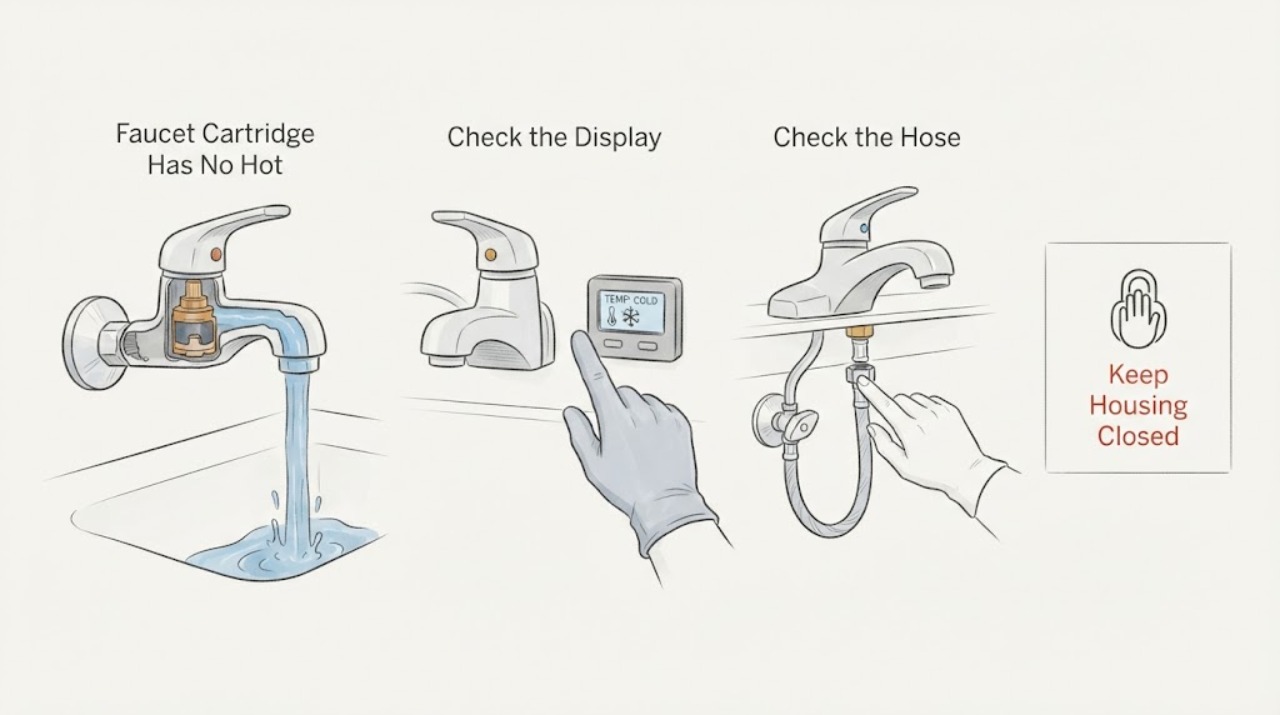
Work through in order
Diagnostic checks
Use only checks that match the exact appliance or system and its official guide.
-
Check 1
Test the same hot-water fixture elsewhere, then test the American Standard faucet with the handle or temperature control moved gradually toward hot. Note whether this faucet has cold flow only, reduced flow on the hot side, or no water at all, and whether other fixtures receive hot water.
Expected result: Other fixtures are also cold, other fixtures are hot but this faucet is cold-only, both hot and cold flow at this faucet are weak, or cold flow is normal while hot flow is absent.
Next step: If hot water is absent everywhere, use plumbing or water-heater service. If only this faucet is affected, continue with the accessible hot-supply checks without opening the faucet body.
Why this matters
Why: A whole-home absence points upstream to the water heater, supply, or plumbing rather than this cartridge. A single-faucet symptom keeps the hot stop, hose, inlet, cartridge, or temperature limiter in the decision path.
-
Check 2
With the faucet off, look under the sink or at the accessible valve location for the hot stop valve and flexible hot-water supply. Confirm the valve is in its normal open position and the hose is not kinked, crushed, disconnected, or visibly leaking; do not loosen a pressurized connection.
Expected result: The hot stop is closed or partly closed, the hose is kinked or disconnected, a connection is leaking, or the valve and hose appear open and intact.
Next step: Correct only an obvious valve-position issue if it moves normally and there is no leak, then test once. Stop for a leak, seized valve, damaged hose, or uncertainty about which valve is hot and arrange qualified plumbing service.
Why this matters
Why: A closed valve or restricted supply can remove hot flow before water reaches the cartridge. A sound-looking supply path makes the cartridge inlet, hot-limit stop, valve orientation, or an upstream restriction more plausible.
-
Check 3
Read the American Standard model number and identify whether the fitting is a single-handle lavatory or kitchen faucet, a two-handle faucet, or a tub/shower valve. Compare its parts diagram and temperature-control description with the installed handle and trim; do not assume a bathroom faucet cartridge matches a shower cartridge.
Expected result: The model documentation identifies a ceramic disc cartridge with a hot-limit stop, a pressure-balancing or thermostatic cartridge, a two-handle valve, or no matching manual/parts diagram is available.
Next step: Save the model and parts-diagram information. If the design or model is unclear, stop before removing the handle or trim and arrange a plumber or manufacturer-supported diagnosis.
Why this matters
Why: Different American Standard designs mix temperature in different ways. The correct next check depends on the model's cartridge, hot-limit stop, balancing spool, check valves, or separate hot and cold valves; an unknown design cannot be diagnosed safely by appearance.
-
Check 4
For a model that explicitly provides an accessible hot-limit stop, inspect its position only as the exact instructions describe, with care to avoid scalding. Do not force the handle past a stop, defeat the stop, or change a temperature setting when the faucet is a concealed shower valve or the model procedure is not confirmed.
Expected result: The handle is mechanically limited before the expected hot range, the hot-limit stop was recently changed, the limit is not present, or the handle reaches its normal range but the water remains cold.
Next step: Use only the model's documented, scald-safe adjustment if available. If there is no change, the stop is damaged, or the control is concealed, leave it for qualified service and continue no further disassembly.
Why this matters
Why: American Standard says an adjustable hot-limit stop restricts handle rotation and limits hot water mixing on applicable models. A stop can explain limited hot temperature, but it does not explain a missing hot supply or prove that the cartridge is failed.
-
Check 5
If the hot supply is open and the model procedure permits cartridge service, shut off both hot and cold supplies before removing any handle or cartridge, and follow the exact installation or parts guide. Inspect only for an obvious blocked inlet, damaged seal, or cartridge orientation issue; do not pry a seized cartridge, substitute a part, or work with water still pressurized.
Expected result: The inlet is visibly obstructed, the cartridge is seized or damaged, the seal or orientation does not match the guide, or the cartridge and inlet appear normal but hot water is still absent.
Next step: Clean or replace only as the exact model guide permits and restore supplies slowly while checking for leaks. Stop and arrange service for a seized cartridge, damaged valve body, concealed valve, persistent no-hot-water condition, or any leak.
Why this matters
Why: American Standard documents that clogged cartridge inlets can reduce flow on the hot or cold side in some models and that installation orientation and sealing are model-specific. A normal-looking cartridge does not exclude a hidden upstream or valve-body problem.
-
Check 6
After one safe correction or cartridge service, test temperature and flow gradually while watching the connections. Record whether hot flow returns, remains weak, is still cold-only, fluctuates when another fixture runs, or creates a drip at the handle, spout, supply connection, or wall trim.
Expected result: Hot water returns normally, hot flow remains restricted, temperature fluctuates, the faucet begins leaking, or no hot water returns despite an open supply and model-correct cartridge work.
Next step: Stop using the faucet for an active leak or scalding temperature and arrange qualified plumbing service. Provide the model, supply observations, cartridge details, and test result rather than repeating disassembly.
Why this matters
Why: Restored hot flow supports a supply, inlet, limiter, or cartridge contribution but does not establish that another restriction will not recur. Persistent no-hot water, fluctuation, or leakage points to a valve, balancing/check-valve, supply, or installation fault needing diagnosis.
Use your observations
Decision map
Find the observation that best matches what you see, then follow the next safe action.
-
PATH 01Next step
What you see
Hot water is absent at multiple fixtures, not just the American Standard faucet.
Do this next
Stop cartridge work and arrange water-heater or plumbing diagnosis. Keep the faucet's hot stop and cartridge undisturbed until the upstream supply is confirmed.
Why this path and its safety boundary
Why it matters: The problem is upstream of this cartridge, such as the water heater, main hot-water piping, or building supply.
-
PATH 02Next step
What you see
Other fixtures have hot water, but this faucet has normal cold flow and no hot flow; the hot stop is closed, the hose is kinked, or the inlet is restricted.
Do this next
Correct only an obvious accessible valve or hose issue without loosening a pressurized connection. Arrange service for a blocked inlet, seized valve, leak, or persistent restriction.
Why this path and its safety boundary
Why it matters: The faucet's hot supply path is more likely than a failed cartridge alone.
-
PATH 03Next step
What you see
The model has an adjustable hot-limit stop and the handle cannot rotate into the expected hot range, especially after trim or handle work.
Do this next
Use only the exact model's scald-safe hot-limit procedure. Do not defeat the stop; call a plumber if the stop is damaged, inaccessible, or does not change the temperature.
Why this path and its safety boundary
Why it matters: The hot-limit setting may be restricting handle travel on that model, rather than the cartridge being proven defective.
-
PATH 04Next step
What you see
The hot stop and hose are open, the handle has its normal range, and the exact model identifies a ceramic or pressure-balancing cartridge, but the faucet remains cold-only.
Do this next
Shut off both supplies before any model-approved cartridge work. If the cartridge is seized, the valve is concealed, or the procedure is unclear, arrange qualified plumbing service.
Why this path and its safety boundary
Why it matters: A blocked cartridge inlet, incorrectly oriented cartridge, failed cartridge, check-valve or valve-body issue is possible; the model description alone cannot select the failed part.
-
PATH 05Next step
What you see
Hot water returns after a model-correct inlet clean, hot-limit adjustment, or cartridge service but a leak or temperature fluctuation appears.
Do this next
Stop using the faucet for an active leak or unsafe temperature and have a plumber inspect the assembly. Do not tighten or disassemble repeatedly under pressure.
Why this path and its safety boundary
Why it matters: The original restriction may have contributed, but a seal, valve-body, balancing/check-valve, or installation problem remains possible.
-
PATH 06Next step
What you see
A cartridge is seized, the wall trim or valve body leaks, water cannot be shut off, or the faucet is concealed and no model procedure is available.
Do this next
Stop, close the local water supply or main only if safe, keep clear of hot water, and arrange qualified plumbing service. Do not pry the cartridge or open the wall.
Why this path and its safety boundary
Why it matters: This exceeds a safe user cartridge check and may cause water damage or scalding if forced.
Helpful context
Understand the symptom
Do not blame the cartridge too early
A cartridge can control how hot and cold water mix, but it cannot produce hot water when the building's hot supply is off or the faucet's hot stop is closed. A kinked hose, blocked inlet, reversed connection, or a hot-limit setting can also make a working faucet seem cold-only. Start with the scope of the symptom and the accessible supply path before considering cartridge replacement.
American Standard models are not interchangeable
American Standard documents several cartridge families: single-handle lavatory faucets may use a ceramic disc cartridge and hot-limit stop, while tub and shower products may use pressure-balancing or thermostatic cartridges with different temperature controls. Use the exact model number, installation guide, and parts diagram. A similar-looking cartridge is not evidence of fit or of the correct hot and cold orientation.
Safety boundary
Stop conditions
- Do not remove a cartridge or supply connection while water is pressurized, force a seized handle or cartridge, open a concealed wall valve, defeat a hot-limit safety stop, or use a cartridge from another American Standard model.
- Stop immediately for an active leak, scalding or unexpectedly hot discharge, water that cannot be shut off, a damaged valve body or hose, or water entering the wall or cabinet. Close the supply only if safe and arrange qualified plumbing help.
- If other fixtures also have no hot water, or if the faucet remains cold-only after the exact model's safe supply and cartridge checks, stop replacing parts and arrange water-heater or plumbing diagnosis.
Only after diagnosis
Potential parts
- American Standard faucet cartridge
Consider only after the hot supply is confirmed, the exact faucet model is identified, and qualified or model-guided diagnosis confirms a blocked, damaged, or failed cartridge.
American Standard cartridge size, orientation, and temperature-control design vary by faucet and valve family. Confirm the exact model and parts diagram before selecting one. - hot-limit stop or temperature-control component
Consider only when the exact model uses a hot-limit stop and inspection confirms the stop is damaged or no longer controls temperature after a safe documented adjustment.
Hot-limit components differ across American Standard faucet families and are intended to reduce scald risk. Confirm the model and installation instructions first. - faucet hot supply valve, hose, or check-valve component
Consider only when qualified diagnosis confirms that the accessible supply path, check valve, or valve-body component is restricting hot flow after the building hot supply is verified.
Supply and valve components vary by installation and model. Confirm shutoff compatibility, exact fit, and safe installation requirements before selecting a part.
When checks do not resolve it
Need a professional?
Arrange qualified plumbing service when hot water is absent throughout the home, the faucet's hot supply cannot be confirmed, a stop valve or cartridge is seized, the valve is concealed, the exact model procedure is unavailable, or no hot water returns after a model-correct supply, hot-limit, and cartridge check. Treat active leaks, scalding or uncontrolled temperature, a damaged valve body or hose, and water entering a wall or cabinet as urgent plumbing issues.
Safety scope: Do not work on a pressurized supply, force a seized cartridge, defeat a hot-limit stop, open a concealed valve, or continue testing an active leak or scalding discharge.
Common questions
FAQ
Can an American Standard faucet cartridge cause no hot water?
Yes, a blocked, damaged, or incorrectly installed cartridge can restrict or misdirect hot flow, but first confirm that other fixtures have hot water and that this faucet's hot stop and hose are open. Use the exact model guide before considering cartridge service.
Why is my American Standard faucet cold-only when other fixtures are hot?
A closed hot stop, kinked supply hose, blocked cartridge inlet, hot-limit setting, valve orientation, or cartridge/valve fault is possible. Check only accessible supply conditions without loosening a pressurized connection, then use the exact model procedure or call a plumber.
What does the hot-limit stop do on an American Standard faucet?
On applicable models, it restricts handle rotation and limits how much hot water mixes with cold to reduce scald risk. It can limit the maximum temperature, but it cannot restore hot water when the supply is closed or blocked.
Are American Standard lavatory and shower cartridges interchangeable?
No assumption is safe. American Standard documents ceramic disc cartridges for some lavatory faucets and pressure-balancing or thermostatic designs for shower products. Confirm the exact model, parts diagram, and valve family before selecting a cartridge.
When should I call a plumber for an American Standard faucet with no hot water?
Call when hot water is absent throughout the home, a stop or cartridge is seized, the valve is concealed, the exact model procedure is unclear, no hot water returns after safe checks, or the faucet leaks or produces unsafe temperatures. Do not force the cartridge or open a wall.
Read the exact guide
Official sources
- Serin® Single Hole Single-Handle Vessel Sink Faucet 1.2 gpm/4.5 L/minAmerican Standard · American Standard Serin model-specific product page; used to show that another faucet family also uses a ceramic cartridge and adjustable hot-limit stop.
- Colony® Soft 4-Inch Centerset Single-Handle Bathroom Faucet 1.2 gpm/4.5 L/min With Lever HandleAmerican Standard · American Standard model 2175503.002 product page; this is an example of a model-specific ceramic cartridge and hot-limit design.
- INSTALL FAUCET COLONY SOFT SINGLE CONTROL LAVATORY FAUCET WITH SPEED CONNECT® DRAIN INSTALLATION INSTRUCTIONSAmerican Standard · Colony Soft 2175.503 installation guide; supply orientation and cartridge details are model-specific.
- Townsend® 1.75gpm/6.6 L/min Tub and Shower Trim Kit With Water-Saving Showerhead, Double Ceramic Pressure Balance Cartridge With Lever HandleAmerican Standard · American Standard TU353508 tub/shower trim product page; pressure-balancing shower cartridges are not interchangeable with lavatory faucet cartridges.
Community feedback
Share a repair observation
Share a plain-text repair observation. Accepted observations are published automatically; this page may take a moment to update.