
On this page
Start here
Quick answer
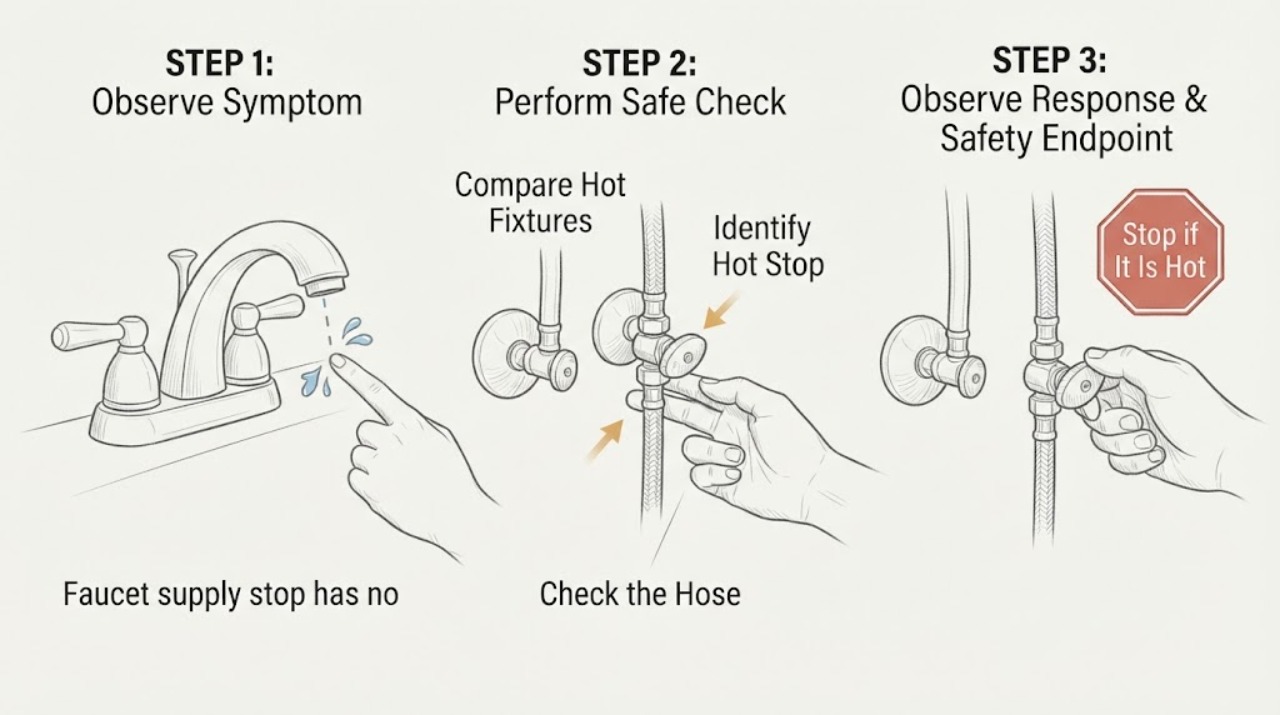
If an American Standard faucet has normal cold water but no hot water, first compare another nearby faucet and verify that the hot supply stop under the sink is open and the hot flexible hose is connected without a kink. American Standard installation instructions identify separate hot and cold supplies and warn that the water supplies should be off before installation; the exact hose colors and arrangement can vary by model. Do not force a seized stop, loosen a pressurized connection, or adjust the faucet's hot-limit safety stop as a substitute for restoring supply. If hot water is absent at other fixtures, the water heater or upstream plumbing is more likely; if only this faucet is affected after the stop and hose are confirmed, a screen, cartridge, blocked line, or faucet-specific fault needs qualified plumbing diagnosis. Stop for a leak, scalding water, damaged valve, or any connection that will not shut off.
Before you begin
Safety first
- This article supports fixture comparison and ordinary-access visual checks only. A qualified plumber must handle disconnected supply lines, seized stops, cartridge work, hidden plumbing, water-heater work, and any repair without a reliable shutoff.
Work through in order
Diagnostic checks
Use only checks that match the exact appliance or system and its official guide.
-
Check 1
At a safe temperature, run the affected American Standard faucet on cold and then hot, and compare it with another nearby faucet on hot and cold without removing the aerator or any supply connection.
Expected result: Cold flow is normal at both fixtures, hot water is absent only at this faucet, hot water is absent at several fixtures, or both hot and cold flow are weak.
Next step: If only this faucet lacks hot water, continue with the visible hot-stop and hose check. If several fixtures lack hot water, stop changing the faucet and arrange water-heater or plumbing diagnosis.
Stop if: Stop if the water is scalding, a fixture leaks, the faucet handle is unsafe to operate, or a comparison requires opening a wall or disturbing a heater connection.
Why this matters
Why: A problem isolated to one faucet supports a local supply stop, hose, inlet, cartridge, or faucet fault. Hot water absent across fixtures points upstream to the water heater or household plumbing; weak hot and cold flow can indicate a broader supply issue.
-
Check 2
With the faucet off and the cabinet clear, identify the hot supply stop under the sink by following the hot line from the wall toward the faucet; use the faucet's model instructions where available and do not rely on color alone.
Expected result: The hot stop is clearly identified and fully open, partly closed, closed, corroded, wet, missing, or impossible to identify without moving the faucet or pipe.
Next step: If the stop is clearly accessible and turns normally, open it gently according to its valve style, then retest without forcing it. If it is stuck, leaking, damaged, or uncertain, leave it alone and request qualified plumbing service.
Stop if: Do not use pliers for extra force, remove the stop, or continue turning after resistance, seepage, or valve-body movement appears.
Why this matters
Why: A closed or partly closed local valve can stop or restrict hot flow to one faucet. A wet or corroded stop may not be safe to operate, and an uncertain connection creates a risk of opening the wrong valve or causing a leak.
-
Check 3
Visually inspect the accessible hot flexible supply hose from the stop to the American Standard faucet for a sharp kink, compression, twisting, disconnected end, wet fitting, or obvious damage; do not loosen the fittings.
Expected result: The hot hose is relaxed and dry, kinked or compressed, disconnected, wet at a fitting, or hidden behind cabinetry.
Next step: If the hose is visibly kinked but dry and can be repositioned without moving a fitting, restore a gentle bend and retest. For a wet, damaged, disconnected, or hidden connection, close the accessible stop only if it operates normally and arrange plumbing service.
Stop if: Do not disconnect, cut, straighten under tension, overtighten, or reuse a damaged supply hose, and do not operate a leaking connection.
Why this matters
Why: A kink or disconnected line can prevent hot flow to one faucet. Moisture at a fitting can indicate a leak, while a hidden line cannot be judged safely from the cabinet opening.
-
Check 4
If the hot stop is open and the hose is visibly sound, check the faucet's exact American Standard care or installation guide for an accessible inlet screen or aerator cleaning procedure; clean only an approved removable screen with the water isolated as instructed.
Expected result: The approved screen or aerator is visibly blocked, clean, damaged, or not user-serviceable; hot flow improves, remains absent, or begins leaking after reassembly.
Next step: Restore only the parts and seals specified by the exact guide and retest gently. If hot flow remains absent or a leak appears, stop disassembly and request qualified diagnosis.
Stop if: Do not pry a fixed screen, enlarge openings, substitute a seal, remove the cartridge, or alter the hot-limit safety stop as a flow repair.
Why this matters
Why: Debris at a user-serviceable inlet can cause a faucet-specific restriction, but a clean screen with no hot flow points toward the stop, hose, cartridge, faucet body, or upstream hot supply. A new leak indicates a sealing or reassembly problem.
-
Check 5
Record whether hot water is available elsewhere, whether the hot stop was open, the hose condition, any screen result, and any recent plumbing or water-heater work; do not disconnect the supply to perform a pressure test yourself.
Expected result: The faucet remains the only fixture without hot water, several fixtures are affected, the water heater shows a leak or failure sign, or the stop cannot be operated safely.
Next step: Arrange qualified plumbing service and provide the comparison, photos, valve and hose observations, faucet model, and water-heater symptoms. Keep the affected faucet unused if a leak or uncertain shutoff remains.
Stop if: Do not adjust water-heater gas controls, electrical parts, temperature settings, pressure regulators, or hidden valves as a faucet test.
Why this matters
Why: A single-fixture pattern supports local faucet plumbing, while several affected fixtures or water-heater symptoms support an upstream problem. A stop that cannot isolate the branch raises leak risk during further work.
Use your observations
Decision map
Find the observation that best matches what you see, then follow the next safe action.
-
PATH 01Safety boundary
What you see
Cold flow is normal, other fixtures have hot water, and the affected faucet's hot supply stop is visibly closed or partly closed but operates gently without leaking.
Do this next
Open the stop gently according to its style, retest the faucet, and monitor the valve and hose for leaks; request service if the stop will not operate normally or hot flow remains absent.
Why this path and its safety boundary
Why it matters: A local supply restriction is plausible and is more likely than a whole-house water-heater failure.
Safety stop: Do not force the handle, use pliers, or continue if the valve body moves, leaks, or will not shut off.
-
PATH 02Safety boundary
What you see
Only this faucet lacks hot water and its hot supply hose is kinked, compressed, disconnected, wet, or visibly damaged.
Do this next
Do not disconnect the hose; isolate the branch only if the stop works normally and request qualified replacement or reconnection, then verify leak-free operation.
Why this path and its safety boundary
Why it matters: The branch connection can restrict flow or leak independently of the American Standard valve cartridge.
Safety stop: Stop immediately for active leakage, a damaged connector, or a stop that cannot isolate the water.
-
PATH 03Safety boundary
What you see
The hot stop is open and dry, the hose looks sound, and an exact-model-approved inlet screen or aerator is visibly blocked; flow improves after approved cleaning.
Do this next
Restore the screen and seals exactly as instructed, check for leaks, and monitor hot flow; arrange service if restriction or leakage returns.
Why this path and its safety boundary
Why it matters: A faucet-specific debris restriction likely contributed, but the result does not justify altering the cartridge or hot-limit stop.
Safety stop: Do not drill, enlarge, pry fixed parts, or substitute an unverified screen or seal.
-
PATH 04Safety boundary
What you see
Other fixtures have hot water, the local stop is open, the hose is dry and sound, and approved screen cleaning does not restore hot flow.
Do this next
Stop user disassembly and request an American Standard model-specific or qualified plumbing diagnosis with the model, photos, and test results.
Why this path and its safety boundary
Why it matters: A cartridge, inlet passage, internal check component, or faucet-body fault becomes more likely than a closed supply stop, but the exact part is not proven.
Safety stop: Do not adjust the hot-limit safety stop, remove the cartridge, or order an internal part from a generic faucet description alone.
-
PATH 05Safety boundary
What you see
Hot water is absent at several faucets, hot flow is weak throughout the home, or the water heater has a leak or other failure sign.
Do this next
Stop changing this faucet and arrange qualified plumbing or water-heater service; keep clear of leaking, hot, gas, or energized equipment.
Why this path and its safety boundary
Why it matters: The supply stop at this American Standard faucet is unlikely to be the sole cause; the water heater, hot-water distribution, or upstream plumbing needs assessment.
Safety stop: Do not open the water heater, adjust gas controls, touch electrical parts, or drain a hot tank as a faucet troubleshooting step.
-
PATH 06Safety boundary
What you see
The supply stop is seized, corroded, wet, moving at the pipe, unable to shut off, or a connection leaks when touched.
Do this next
Stop handling the connection, protect the area from water, and contact a qualified plumber; use the main shutoff only if needed and safe to do so.
Why this path and its safety boundary
Why it matters: Further faucet work could turn a localized problem into uncontrolled water damage because the branch cannot be safely isolated.
Safety stop: Do not force, remove, cap, or disconnect the stop or hose, and do not leave an active leak unattended.
Helpful context
Understand the symptom
Start at the hot supply path, not the handle limit
A faucet can have a working cold side while hot water is blocked before it reaches the body. The local hot supply stop may be closed or partly closed, the flexible hose may be kinked, or debris may restrict the inlet. American Standard faucets also use model-specific valve and hot-limit arrangements. A hot-limit stop controls how much hot water mixes with cold; it does not restore a closed or blocked supply.
Compare fixtures before opening a connection
Run another nearby faucet on hot, then compare the cold side at both fixtures. If other fixtures also lack hot water, investigate the water heater or upstream plumbing instead of replacing this faucet's supply stop. If only this faucet is affected, the under-sink hot stop, hose, inlet screen, cartridge, or faucet body becomes the focused path.
Treat the stop as a water-control valve
Only inspect and operate an accessible stop gently, with a towel or container ready and the faucet off. Do not disconnect a supply hose just to prove flow, and do not keep turning a valve that is stuck, corroded, leaking, or unable to shut off. A plumber can isolate the branch and test the stop, hose, cartridge, and upstream hot-water source safely.
Safety boundary
Stop conditions
- Do not disconnect a pressurized hot supply hose, remove the stop, or loosen fittings as a user flow test.
- Do not force a seized or corroded valve, use pliers for extra torque, or continue when the valve body or pipe moves.
- Do not adjust the faucet's hot-limit safety stop, remove a cartridge, or alter an inlet opening to compensate for missing hot supply.
- Stop for active leakage, scalding water, a damaged connector, water near electrical equipment, a gas or water-heater hazard, or a shutoff that will not isolate the branch.
- Do not treat hot water absent at several fixtures as an American Standard faucet fault; arrange qualified water-heater or plumbing assessment.
Only after diagnosis
Potential parts
- fixture supply stop
Consider only if the plumber confirms the local hot stop is seized, leaking, damaged, or unable to pass or isolate water.
Confirm pipe, outlet, inlet, connection, material, and local plumbing requirements before replacement; do not select by appearance alone. - flexible faucet supply hose
Consider only if the hot hose is kinked beyond recovery, leaking, disconnected with damaged threads, or otherwise confirmed defective.
Match the exact American Standard faucet and connection details; use a qualified plumber when the stop cannot isolate the branch. - faucet cartridge or inlet screen
Consider only after the stop and hose are confirmed sound and a qualified diagnosis identifies an internal restriction or cartridge fault.
Confirm exact model, valve type, seals, flow arrangement, and hot-limit configuration before ordering or installing.
When checks do not resolve it
Need a professional?
Arrange qualified plumbing service when the hot supply stop is stuck, leaking, damaged, or cannot isolate the branch; the hot hose is wet, disconnected, or damaged; approved inlet cleaning does not restore flow; the faucet is the only fixture without hot water after the stop and hose checks; or several fixtures and the water heater are affected. Stop use and seek urgent help for active leakage, scalding water, water near electrical equipment, gas or water-heater danger, or an uncontrolled shutoff.
Safety scope: This article supports fixture comparison and ordinary-access visual checks only. A qualified plumber must handle disconnected supply lines, seized stops, cartridge work, hidden plumbing, water-heater work, and any repair without a reliable shutoff.
Common questions
FAQ
How can I tell whether the American Standard faucet or the water heater is the problem?
Run another nearby faucet on hot and cold. If other fixtures also lack hot water, the water heater or upstream plumbing is more likely. If only this faucet is affected and cold flow is normal, inspect the local hot stop and hose from safe access, then request faucet-specific diagnosis if those checks are normal.
Can I turn the hot supply stop under the sink?
Only operate a clearly identified, accessible stop gently if it turns normally and is dry. Stop for resistance, corrosion, seepage, pipe movement, or uncertainty, and do not use pliers or disconnect the hose.
Will adjusting the faucet hot-limit stop restore hot water?
No. A hot-limit safety stop limits how much hot water mixes with cold; it does not open a closed supply stop or clear a blocked hot hose. Do not alter it to compensate for missing hot supply.
Read the exact guide
Official sources
- Reliant 3 4-Inch Centerset Single-Handle Bathroom Faucet 0.5 gpm/1.9 L/min With Lever HandleAmerican Standard · Opened American Standard product page used for model variation and safety-stop context; it does not identify the assigned faucet model.
- Troubleshooting water pressure and flowPortland Water Bureau · Municipal household plumbing guidance used for diagnostic comparison; local plumbing conditions and a qualified plumber control the repair.
- How to fix a faucet leakPortland Water Bureau · Municipal faucet-maintenance guidance used for shutoff and leak boundaries, not as a substitute for the American Standard model guide.
- Installation Instructions: Reliant 3 Single Control Centerset Lavatory Faucet with SpeedConnect DrainAmerican Standard · Opened American Standard installation guide for Reliant 3 model family; exact faucet model instructions control where details differ.
- Water Pressure HelpEast Valley Water District · Water-utility troubleshooting guidance used to separate a faucet branch issue from whole-house pressure or supply conditions.
Community feedback
Share a repair observation
Share a plain-text repair observation. Accepted observations are published automatically; this page may take a moment to update.