
On this page
Start here
Quick answer
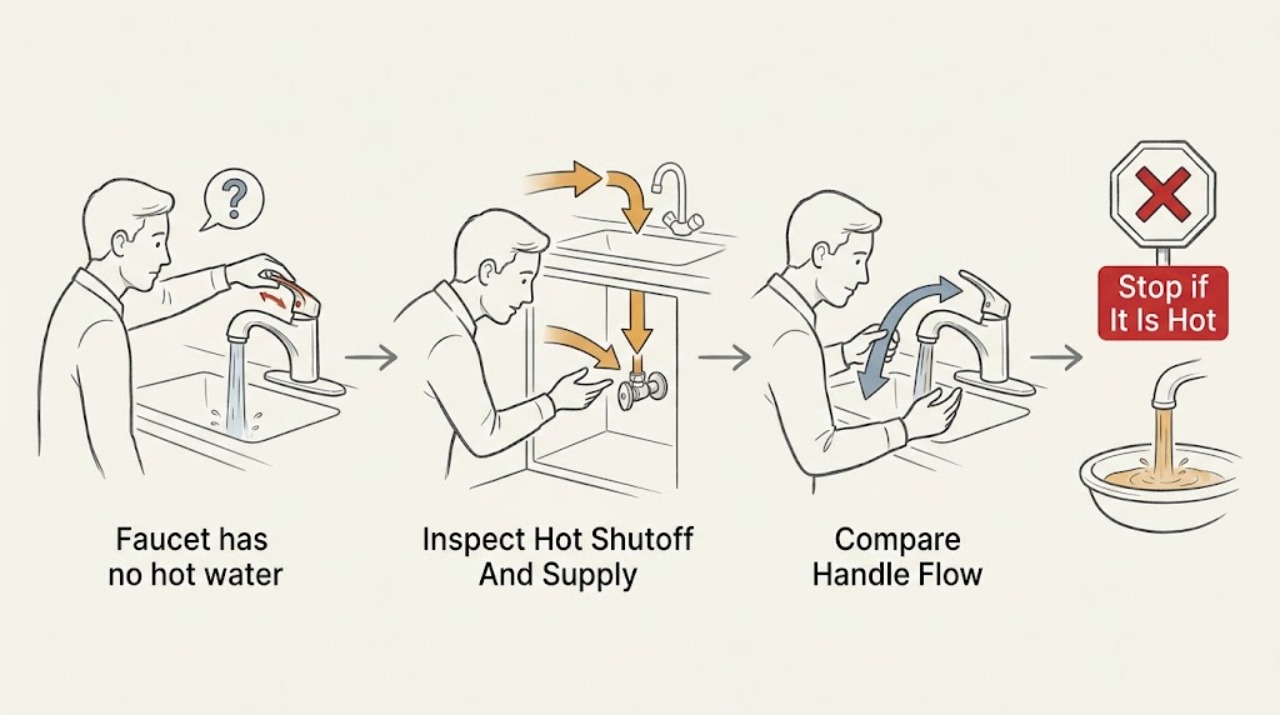
If an American Standard faucet has no hot water, first determine whether the problem is at that faucet or affects the hot-water system. Run a nearby faucet on hot and compare the flow, then check that the faucet's hot-side shutoff and supply connection are visibly open and not kinked. On a single-handle faucet, move the handle through its documented hot range without forcing it; an adjustable hot-limit stop or cartridge can limit how much hot water mixes. On a two-handle faucet, compare hot-side flow with cold-side flow. American Standard products use different cartridge and pressure-balancing designs, so do not assume one repair procedure fits every model. If every fixture lacks hot water, the issue is upstream at the water heater, circulation, or building supply. If only this faucet is affected, a closed/restricted supply, cartridge, hot-limit setting, blocked inlet, or valve fault is more likely. Stop for a leak, scalding water, damaged tubing, or any repair that requires opening a wall or working on energized equipment; shut off the local water supplies and call qualified plumbing service when the cause is not clear.
Work through in order
Diagnostic checks
Use only checks that match the exact appliance or system and its official guide.
-
Check 1
Run a nearby faucet or fixture on its normal hot setting briefly, then compare its hot-water flow with the affected American Standard faucet; avoid repeatedly cycling the handles or touching hot metal.
Expected result: Record whether hot water is normal nearby, absent nearby, delayed everywhere, or present nearby but absent only at this faucet.
Next step: Use the result to choose the local faucet checks or an upstream water-heating service call; do not replace the faucet cartridge based on a whole-house symptom.
Stop if: Stop for steam, scalding water, a leak, unusual odor, or a water-heater safety concern.
Why this matters
Why: Hot water absent at multiple fixtures points upstream toward the water heater, circulation, shutoff, or building plumbing. Hot water normal nearby makes a local faucet supply, cartridge, hot-limit, or valve issue more likely.
-
Check 2
From safe, ordinary access beneath the sink or at the exposed faucet connections, visually check that the hot-side shutoff is not closed, the flexible supply line is not kinked or crushed, and the connection is not visibly leaking; do not loosen a fitting.
Expected result: Classify the hot supply as visibly open and intact, closed or partly closed, kinked/compressed, leaking, or inaccessible without moving the fixture or opening a wall.
Next step: Only correct an obvious handle position according to the valve design and recheck for leaks; arrange plumbing service for a stiff valve, damaged line, leak, or uncertain piping.
Stop if: Do not force a shutoff, disconnect a pressurized hose, move the faucet to reach a connection, or continue if water is spraying or entering a cabinet or electrical area.
Why this matters
Why: A closed or restricted hot supply can remove hot water at one faucet while nearby fixtures remain normal. A leak or damaged line needs repair before further testing. An inaccessible or uncertain shutoff is not a reason to force a valve or fitting.
-
Check 3
With the faucet assembled, compare flow from cold to hot using the normal handle travel: on a single handle, move gradually toward hot; on a two-handle faucet, open the hot handle separately without forcing it.
Expected result: Record normal cold flow with no hot flow, weak hot flow, cold water from both positions, normal flow that remains lukewarm, or no flow from either side.
Next step: Photograph the handle and record the pattern; use the exact model manual before any cartridge or stop access, and call a plumber if the handle binds or the valve is behind the wall.
Stop if: Do not force the handle past a stop, remove trim, or open a valve body while water supplies remain on.
Why this matters
Why: Normal cold with no hot flow supports a hot-side supply restriction, hot passage, cartridge, stem, or hot-limit issue. Cold from both positions supports a mixing or cartridge-orientation problem. Normal flow that is only lukewarm keeps the hot-limit stop, pressure balance, cross-connection, or upstream temperature in consideration. No flow on both sides points away from a hot-only diagnosis.
-
Check 4
Read the faucet or trim model marking and its manual to determine whether it uses a ceramic disc cartridge, separate hot-side valve, or pressure-balancing cartridge with a hot-limit safety stop; do not substitute a part based only on appearance.
Expected result: Record the faucet style, model identity, documented cartridge/valve type, whether a hot-limit stop is shown, and whether the manual authorizes user adjustment or service access.
Next step: Follow only the manual's documented user adjustment, or provide the model information to a qualified plumber or manufacturer support; leave an unknown stop or cartridge undisturbed.
Stop if: Do not remove a cartridge, defeat a hot-limit stop, reverse hot and cold by trial, or open the valve without first shutting off both supplies as instructed for the exact model.
Why this matters
Why: Different American Standard designs can use different cartridges and safety components. A documented hot-limit stop can explain warm-but-not-hot water, while a separate hot-side cartridge can explain hot-only loss. An unknown model or undocumented access procedure leaves compatibility and scald-protection questions unresolved.
-
Check 5
If multiple fixtures lack hot water, observe the water-heating system only from normal user access for a visible status alert, shutoff condition, leak, or obvious loss of power; do not open the heater or alter gas, electrical, temperature, or relief controls.
Expected result: Record whether the whole home has no hot water, only one branch is affected, a water-heater alert is visible, or the heater appears normal while one faucet remains cold.
Next step: Call qualified water-heater or plumbing service for a whole-home problem or heater warning; return to the faucet's local evidence only when nearby hot water is confirmed normal.
Stop if: Do not open a water heater, relight or service gas equipment, reset a recurring electrical fault, or touch a relief-valve discharge or hot pipe.
Why this matters
Why: A whole-home symptom is unlikely to be fixed by the faucet cartridge and may involve the heater, circulation, hot-water shutoff, or building plumbing. A normal hot-water supply elsewhere keeps the local faucet or branch as the focused diagnosis. A heater alert, leak, or relief discharge requires appliance service.
-
Check 6
Prepare the faucet model or trim name, handle style, nearby-fixture comparison, hot and cold flow observations, shutoff and supply-line photos, and any recent installation or plumbing changes for a qualified plumber.
Expected result: Confirm that the handoff states whether the problem is no hot flow, cold-only flow, lukewarm water, a leak, or a whole-house hot-water failure and whether a hot-limit or pressure-balancing component is present.
Next step: Request diagnosis and compatible-part confirmation before approving replacement; keep the faucet off if a leak or unsafe temperature condition is present.
Stop if: Do not continue troubleshooting when the valve is behind a wall, the shutoffs do not close, or service would require opening pressurized or energized equipment.
Why this matters
Why: A complete symptom record helps distinguish supply, cartridge, hot-limit, pressure-balance, cross-connection, and water-heater causes. It prevents an unverified cartridge or generic part from being installed in a model-specific valve.
Use your observations
Decision map
Find the observation that best matches what you see, then follow the next safe action.
-
PATH 01Next step
What you see
Nearby fixtures also have no hot water or the water-heating system shows an alert, leak, or obvious loss of service.
Do this next
The issue is more likely upstream at the water heater, circulation, hot-water shutoff, or building plumbing than in the American Standard faucet. Stop at user-level observation and arrange qualified water-heater or plumbing service.
-
PATH 02Next step
What you see
Nearby hot water is normal, the affected faucet has normal cold flow, and the hot-side shutoff or supply line is closed, kinked, damaged, or leaking.
Do this next
A local supply restriction is more likely than a failed cartridge. Correct only an obvious accessible handle position without forcing it; repair a damaged or leaking line through qualified plumbing service.
-
PATH 03Next step
What you see
Nearby hot water and the faucet supply are normal, but this faucet has cold-only or lukewarm water with a documented single-handle cartridge or hot-limit stop.
Do this next
The cartridge, hot-limit setting, inlet passage, or handle orientation becomes more likely. Use only the exact model's documented user adjustment; otherwise have a plumber diagnose and confirm the compatible cartridge without defeating scald protection.
-
PATH 04Next step
What you see
A two-handle faucet has normal cold flow but little or no flow from the hot handle while nearby hot water is normal.
Do this next
The hot-side shutoff, supply line, stem, cartridge, or inlet passage is more likely than the water heater. Close the local supplies before any model-documented service and call a plumber if the valve or part identity is uncertain.
-
PATH 05Next step
What you see
The faucet leaks, the handle or cartridge is seized, hot water is scalding or uncontrolled, a shutoff will not close, or the suspected valve is behind the wall.
Do this next
Stop using the faucet, shut off the nearest safe water supply if possible, protect the area from water damage, and arrange qualified plumbing service. Do not force the cartridge, defeat a hot-limit stop, or open the wall.
Helpful context
Understand the symptom
First decide whether the faucet or the hot-water system is at fault
A faucet with no hot water can be isolated to one fixture, or it can be reporting a whole-house hot-water problem. Test a nearby fixture briefly under normal conditions. If nearby fixtures also have no hot water, a faucet cartridge is unlikely to be the first place to work; check the water-heating system and upstream plumbing instead. If nearby fixtures have hot water but this faucet does not, compare the hot and cold sides at this fixture and continue with the local supply and control checks.
Identify the faucet design before touching a part
A single-handle faucet usually mixes hot and cold through one cartridge or valve assembly. A two-handle faucet can have a separate hot-side stem or cartridge. Bath and shower controls may add pressure-balancing or temperature-control components. American Standard's published product information shows both ceramic disc cartridges and pressure-balancing designs, including adjustable hot-limit stops on some products. The model number and installation manual matter: a replacement cartridge or adjustment from a different faucet may not fit or may change scald protection.
Use flow and temperature together as clues
No hot water with normal cold flow suggests that the hot-side supply, cartridge passage, hot-limit stop, or valve may be restricting or misdirecting hot water. Little or no flow on both sides points more toward an aerator, outlet, general supply, or flow problem than a hot-only control. Cold water coming from both handle directions can occur when a mixing cartridge is not admitting hot water or when hot and cold paths are reversed or cross-connected. These are diagnostic patterns, not proof of a failed part; do not remove the cartridge until the documented shutoff and access procedure is available.
Do not treat a hot-limit stop as a broken cartridge
Some American Standard handles use an adjustable hot-limit safety stop that restricts handle travel and limits hot-water mixing to reduce scald risk. If the faucet reaches only warm water but has normal flow, a limit-stop setting, cartridge orientation, pressure-balancing component, or upstream hot supply may be involved. The correct setting is model-specific and should remain within the manufacturer's safety design. Never remove the stop, rotate a cartridge by guesswork, or force the handle past a hard stop.
Prepare the right service handoff
Record the faucet style, model or trim name, whether nearby fixtures have hot water, hot-side and cold-side flow, handle position, any recent plumbing work, and whether the issue is no flow, cold-only flow, or merely lukewarm water. Photograph the faucet and accessible shutoffs without exposing personal information. A plumber can then distinguish a local supply restriction from a cartridge, pressure-balancing valve, cross-connection, water-heater, or circulation problem and select a compatible part only after diagnosis.
Safety boundary
Stop conditions
- A leak, spray, uncontrolled hot water, scalding surface, or water entering a cabinet or electrical area.
- A shutoff will not close, a fitting is seized, or the faucet valve is behind the wall.
- The model-specific manual is unavailable or does not authorize the proposed cartridge, hot-limit, or valve procedure.
- Any need to open pressurized plumbing, remove a wall, work on energized equipment, or service a gas or electric water heater.
- A repeated water-heater alert, relief discharge, burning smell, smoke, or other appliance safety concern.
Only after diagnosis
Potential parts
- Confirm connection type, routing, and local plumbing requirements; do not substitute a hose or valve by appearance.
- Match the exact American Standard model and valve design; similar-looking cartridges are not interchangeable by assumption.
- Preserve scald protection and use the model-specific component; do not remove or defeat the stop.
- Part fit and flow direction depend on the exact faucet or rough-in valve; confirm before ordering or opening the valve.
When checks do not resolve it
Need a professional?
Call a qualified plumber when hot water is normal at nearby fixtures but absent at the American Standard faucet after the visible supply check, when the hot-side flow is weak, a cartridge or valve needs access, the hot-limit or pressure-balancing component is uncertain, or any leak appears. Call water-heater service for a whole-home loss of hot water or a heater warning. Stop immediately for uncontrolled hot water, active leaks, smoke, burning odor, or any condition requiring wall, gas, electrical, or pressurized-equipment work.
Common questions
FAQ
Why does my American Standard faucet have cold water but no hot water?
If nearby fixtures have hot water, check the local hot-side shutoff and supply line for an obvious closed position, kink, or leak. If those are normal, a cartridge, hot-limit stop, inlet, or valve issue is possible; the exact American Standard model determines the safe service procedure.
Could the faucet cartridge cause no hot water?
Yes, a cartridge or hot-side valve can restrict or fail to admit hot water, but no-hot-water is not proof that the cartridge has failed. First compare nearby fixtures and local supply flow, then use the exact model documentation or qualified diagnosis before ordering a part.
What if the water is only lukewarm rather than completely cold?
Normal flow with lukewarm water can involve a hot-limit stop, pressure-balancing component, reversed or cross-connected supplies, or an upstream temperature issue. Do not defeat the hot-limit safety stop; have the model and valve checked.
When should I call a plumber for this problem?
Call when nearby hot water is normal but the faucet remains cold, a shutoff or supply line is damaged, a cartridge or valve needs access, the handle is seized, the faucet leaks, or the valve is behind the wall. Seek appropriate urgent help for uncontrolled hot water or a water-heater safety concern.
Read the exact guide
Official sources
- Serin Pressure Balancing Bath and Shower Trim Kit Installation InstructionsAmerican Standard · American Standard Serin pressure-balancing valve installation and service instructions
- Serin Valve Only Trim Kit With Double Ceramic Pressure Balance CartridgeAmerican Standard · American Standard pressure-balancing bath and shower valve components
- Reliant 3 4-Inch Centerset Single-Handle Bathroom Faucet With Lever HandleAmerican Standard · American Standard single-handle bathroom faucet design and component identification
Community feedback
Share a repair observation
Share a plain-text repair observation. Accepted observations are published automatically; this page may take a moment to update.