
On this page
Start here
Quick answer
First determine whether the faucet has normal cold flow but no hot flow, or whether water flows from the hot handle but stays cold. Check the hot-water temperature at another nearby fixture, then visually confirm that the accessible hot-side shutoff under the sink is open and that the supply hose is not kinked; do not force a valve or dismantle the faucet. If only this faucet is affected, a restricted hot supply, shutoff, cartridge, or mixing valve is more likely. If several fixtures have no hot water, check only the water heater's external status and model instructions—do not open gas, electrical, burner, heating, or pressure components. Hot water can scald. Arrange a plumber promptly for a persistent one-fixture fault, a leak, or any water-heater issue, and stop immediately for gas odor, leaking equipment, exposed wiring, or dangerously hot water.
Before you begin
Safety first
- The user-level scope is limited to cautious temperature comparison and visual checks of accessible shutoffs, hoses, and external heater status. A qualified professional must handle faucet disassembly, pressurized connections, concealed piping, gas controls, electrical parts, heating components, mixing-valve replacement, and pressure-relief equipment.
Work through in order
Diagnostic checks
Use only checks that match the exact appliance or system and its official guide.
-
Check 1
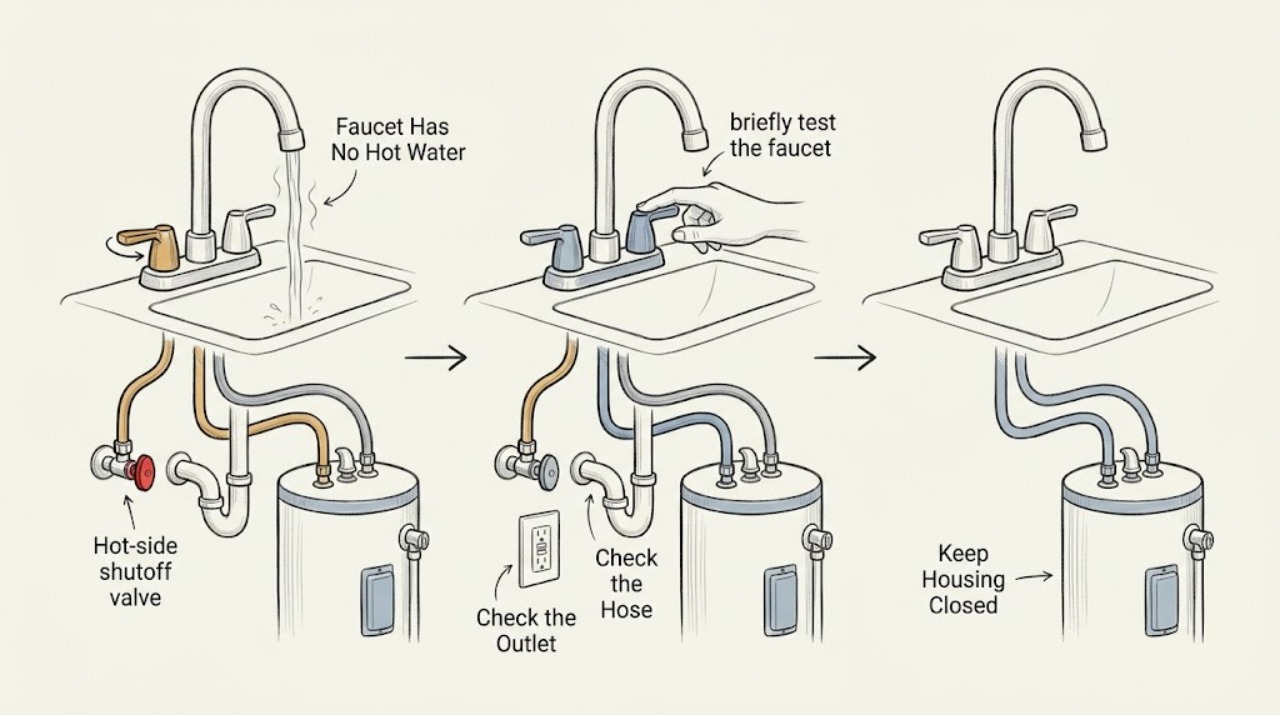
From a safe position, briefly test the faucet with the cold side first and then the hot handle partially open, keeping hands and face away from the stream; note whether the hot side has no flow, normal flow that stays cold, weak flow, or unexpectedly hot water.
Expected result: Cold water flows normally while the hot side has no flow, the hot side flows cold, the hot stream is weak, or the water is dangerously hot.
Next step: Use the matching branch below. Stop the test for scalding heat, steam, splashing, or any leak and arrange qualified help.
Stop if: Do not continue if water is dangerously hot, a hose or fitting sprays, or the faucet cannot be controlled without reaching through hot water.
Why this matters
Why: No hot flow points toward the hot shutoff, supply hose, cartridge, or valve path. Normal cold flow from the hot side shifts attention toward the water-heater or hot-water branch. Weak hot-only flow suggests restriction. Dangerously hot water is a scald hazard, not a temperature-setting experiment.
-
Check 2
Cautiously check a second hot-water outlet, such as another sink or tub, from a safe position and compare both flow and temperature; do not run multiple fixtures long enough to exhaust the supply or touch water that may scald.
Expected result: The second fixture has hot water, both fixtures are cold, the second fixture has hot water but the affected faucet has none, or the temperatures vary widely.
Next step: For a local symptom, continue with only visible under-sink checks. For a whole-house symptom, record the heater status and arrange plumbing or water-heater service without opening the heater.
Stop if: Stop for gas odor, water-heater leakage, exposed wiring, severe pressure or temperature symptoms, or water near electrical equipment.
Why this matters
Why: Hot water elsewhere makes a local faucet, shutoff, supply line, cartridge, or mixing valve issue more likely. No hot water at several outlets shifts attention to the water heater, hot-water branch, a leak, or a whole-house mixing device.
-
Check 3
If other fixtures have hot water, look beneath the affected fixture for the clearly identified hot-side shutoff and its flexible supply hose; confirm only that the valve is not visibly closed and the hose is not kinked, crushed, leaking, or disconnected. Do not force, loosen, or remove a valve or connection.
Expected result: The hot shutoff is visibly closed, the hose is kinked or damaged, a fitting is wet, or the valve and hose look open and sound.
Next step: If the valve position is clearly identifiable and moves normally, follow the fixture's model instructions for an ordinary open position without force; otherwise leave it alone and call a plumber. Do not use a wrench or disconnect the hose as a test.
Stop if: Stop for a seized valve, active leak, corroded fitting, water near electrical equipment, or uncertainty about which line is hot.
Why this matters
Why: A closed valve or restricted hose can stop or reduce hot-side flow to one faucet. A wet or damaged connection is a leak repair, while a sound visible supply shifts suspicion toward the faucet cartridge, valve body, or concealed piping.
-
Check 4
With the supply connections untouched, compare the hot-side stream with the cold-side stream and note whether the hot side alone is weak or absent; identify whether the faucet is a one-handle mixer, two-handle faucet, or a fixture with a thermostatic mixing valve. Do not remove the cartridge, aerator, hoses, or valve body as a generic test.
Expected result: Only hot flow is restricted, both sides are restricted, the handle moves abnormally, temperature changes do not track handle movement, or the faucet type is uncertain.
Next step: Photograph the faucet and supply layout, record the model if readable, and request a plumber to isolate the cartridge, valve body, or concealed line. Do not order a cartridge by appearance alone.
Stop if: Stop for a loose handle, uncontrolled flow, cracked body, corroded connection, or any need to open the faucet or work under a pressurized line.
Why this matters
Why: Hot-only restriction supports a hot supply or cartridge/valve obstruction; both-side restriction may be a broader fixture or supply issue. Abnormal mixing behavior can involve the cartridge or thermostatic valve. Uncertain design makes a generic replacement unsafe.
-
Check 5
If several fixtures lack hot water, observe the water heater from outside its enclosure and record whether the display or status light is normal, blank, or showing an exact code, plus the fuel type and any visible leak; do not remove panels, reset internal safeties, relight gas, probe wiring, or touch the pressure-relief assembly.
Expected result: The heater has no visible status, an exact error code, a visible leak, gas odor, scorch marks, or a normal-looking status with no hot water at multiple fixtures.
Next step: Record the model and code for a qualified plumber or the manufacturer's service process. For gas odor or a significant leak, leave the area and follow local emergency or gas guidance; do not continue troubleshooting.
Stop if: Stop immediately for gas odor, hissing, smoke, burning smell, exposed electrical parts, a large leak, very hot discharge, or any need to open the heater.
Why this matters
Why: A blank or fault status may indicate a heater, power, fuel, or control issue. A leak or gas odor is a safety event. A normal external status does not rule out a mixing valve, hot-water leak, reversed connection, or internal failure.
-
Check 6
Arrange qualified plumbing service when the hot side remains dry or cold after the safe comparison and visible checks, when multiple fixtures are affected, or when a cartridge, mixing valve, concealed pipe, water heater, or leak is suspected; provide the faucet type, model if known, symptom pattern, photos, and heater observations.
Expected result: The issue persists, returns after a temporary change, affects more than one fixture, or involves a leak, abnormal temperature, heater code, or uncertain supply path.
Next step: Leave the faucet or heater in a safe state and give the plumber the comparison results and what was not opened or changed. Protect the area from leaks without touching hot, electrical, or gas equipment.
Stop if: Do not keep cycling valves, dismantling the faucet, resetting heater safeties, relighting gas, or opening electrical or pressure components.
Why this matters
Why: The remaining causes require pressure, temperature, concealed-pipe, cartridge, mixing-valve, fuel, electrical, or water-heater diagnosis that cannot be safely established from a generic faucet check.
Use your observations
Decision map
Find the observation that best matches what you see, then follow the next safe action.
-
PATH 01Next step
What you see
The affected faucet has normal cold flow, no hot flow, and another fixture has hot water.
Do this next
Perform only the visible shutoff and hose check, then arrange a plumber if the cause is not obvious. Do not disconnect the line or remove the cartridge as a test.
Why this path and its safety boundary
Why it matters: The problem is localized downstream of the water heater; a closed or restricted hot shutoff, supply hose, faucet cartridge, valve body, or mixing valve is more likely than a heater-wide failure.
-
PATH 02Next step
What you see
The hot handle produces normal flow, but the water stays cold at this faucet and at several other fixtures.
Do this next
Record the heater's external status, model, code, fuel type, and any leak without opening it, then arrange qualified plumbing or water-heater service.
Why this path and its safety boundary
Why it matters: The symptom is house-wide and points toward the water heater, hot-water branch, an open hot-water leak, reversed connections, or a mixing device rather than this handle alone.
-
PATH 03Next step
What you see
Hot water is available at other fixtures, but the affected faucet has weak hot flow, an abnormal handle, or hot-only flow loss.
Do this next
Keep the supply connections intact, photograph the layout and model marking, and have a plumber diagnose the faucet-side path.
Why this path and its safety boundary
Why it matters: A local restriction in the hot shutoff, hose, cartridge, valve body, or concealed branch is more likely. The exact part cannot be identified by symptom alone.
-
PATH 04Next step
What you see
Only one shower or faucet has an unexpected temperature while the water heater supplies hot water elsewhere.
Do this next
Do not adjust a temperature stop or open a valve body without the exact fixture instructions; arrange a plumber for model-specific mixing-valve diagnosis.
Why this path and its safety boundary
Why it matters: A thermostatic or pressure-balancing mixing valve, cartridge, reversed connection, or fixture-side restriction may be blending or limiting hot water locally.
-
PATH 05Next step
What you see
There is gas odor, smoke, a large water-heater leak, exposed wiring, water near electricity, scalding discharge, or an uncontrolled faucet leak.
Do this next
Leave the hazard area, keep others away, and contact the appropriate emergency, gas, electrical, or plumbing professional from a safe location. Do not touch the equipment or continue testing.
Why this path and its safety boundary
Why it matters: This is a gas, fire, electrical, pressure, scald, or water-damage hazard rather than a routine no-hot-water check.
Helpful context
Understand the symptom
The hot handle being open is not proof that hot water is reaching the faucet
A faucet can have a normal cold stream but no hot stream because the hot shutoff is closed, a hose or valve is restricted, or the cartridge is not admitting hot water. It can also have hot-side flow that is simply cold because the water heater, hot-water branch, or a mixing valve is involved. Note which behavior you have before choosing a repair path.
Use a second fixture to locate the boundary
A second sink, tub, or shower separates a faucet-specific fault from a house-wide hot-water problem. Make only a cautious temperature check from a safe position; hot water can scald. If several fixtures are cold, the faucet is unlikely to be the only cause. If other fixtures are hot, keep the investigation limited to this faucet's visible supply and arrange service if the issue persists.
Keep the water-heater check external
For a whole-house symptom, record the water-heater type, brand, model, display or status light, and any visible leak without removing panels or touching controls. Do not open a gas control, burner compartment, electrical cover, heating element, temperature sensor, or pressure-relief assembly. Use the exact owner manual or a qualified plumber for model-specific diagnosis.
Safety boundary
Stop conditions
- Do not touch or adjust gas controls, burner assemblies, electrical wiring, heating elements, temperature sensors, pressure-relief valves, or internal water-heater panels.
- Do not disconnect a hot-water hose, remove a faucet cartridge, open a valve body, or loosen a pressurized fitting as a diagnostic test.
- Stop for gas odor, hissing, smoke, burning smell, exposed wiring, water near electricity, a large leak, or a pressure-relief discharge.
- Keep hands and face away from a hot stream; stop a temperature check if water is scalding, steaming, splashing, or unexpectedly hotter than normal.
- Do not repeatedly cycle shutoffs, reset heater safeties, relight gas, or guess at a replacement part; arrange qualified service when the cause is not clear.
Only after diagnosis
Potential parts
- faucet cartridge or mixing valve
Consider only if other fixtures have hot water and a plumber confirms that the faucet-side cartridge or mixing valve is restricting or misrouting hot water.
Confirm the exact faucet brand, model, valve family, handle style, and installation configuration before ordering; visual similarity does not establish fit. - hot-water supply hose or shutoff valve
Consider only if the local hot-side hose or shutoff is visibly damaged or a plumber confirms it is restricting flow and replacement is appropriate.
Connection size, material, valve type, and local code must be confirmed in place; do not disconnect a pressurized line to identify a part. - thermostatic mixing valve
Consider only after testing at multiple fixtures shows hot water exists upstream and a qualified professional confirms a mixing valve is limiting the affected outlet or system.
Mixing-valve location and temperature-control requirements vary by fixture and water-heater system; confirm the exact assembly and safe settings before purchase.
When checks do not resolve it
Need a professional?
Arrange plumbing service when one faucet remains without hot water after a safe visual check, when several fixtures are cold, when the hot-side flow is weak, or when a cartridge, mixing valve, concealed pipe, leak, or water heater is suspected. Seek urgent help for gas odor, smoke, exposed wiring, water near electricity, a large water-heater leak, scalding discharge, an uncontrolled leak, or a ceiling or wall showing active water damage.
Safety scope: The user-level scope is limited to cautious temperature comparison and visual checks of accessible shutoffs, hoses, and external heater status. A qualified professional must handle faucet disassembly, pressurized connections, concealed piping, gas controls, electrical parts, heating components, mixing-valve replacement, and pressure-relief equipment.
Common questions
FAQ
Why is there no hot water from one faucet but hot water elsewhere?
That pattern makes a local closed or restricted hot shutoff, supply hose, cartridge, valve body, mixing valve, or concealed branch more likely than a whole-house heater failure. Check only the visible valve and hose without force, then call a plumber if the cause is not obvious.
What if water flows from the hot handle but it stays cold?
Compare another fixture. If several outlets are cold, the water heater, hot-water branch, open leak, reversed connection, or mixing device may be involved. If other fixtures are hot, the affected faucet's mixing path remains more likely.
Should I remove the faucet cartridge to see if it is blocked?
Not as a generic test. Cartridge removal requires isolating a pressurized water connection and depends on the exact faucet. Photograph the model and visible connections and have a plumber diagnose or replace it.
Could a closed shutoff under the sink cause no hot water?
Yes. A closed or restricted hot-side shutoff or supply line can prevent or reduce hot flow at one faucet. Look only for an obvious closed position or kink; do not force a seized valve or loosen the connection.
Do I need to check the water heater when only one faucet is cold?
Start by checking another hot-water outlet. Hot water elsewhere points toward the faucet-side path. A whole-house symptom justifies observing the heater's external status, model, and code, but do not open gas, electrical, heating, or pressure components.
When is no hot water an emergency?
Get urgent help for gas odor, hissing, smoke, exposed wiring, water near electrical equipment, a large water-heater leak, scalding discharge, an uncontrolled leak, or active water damage. Leave the hazard area and do not continue testing.
Read the exact guide
Official sources
- Is Your Hot Water Not Getting Hot? Common Causes & What To Do About ThemA. O. Smith · General A. O. Smith homeowner guidance; the actual heater model, fuel, installation, and local requirements control any service work.
- Residential Gas Water Heater Use and Care GuideA. O. Smith · General gas water-heater guide used for diagnostic distinctions and safety boundaries; it is not a model-specific repair instruction for an unbranded installation.
- Low water flow from spout- ONLY hot or cold water on sink faucetsMoen Solutions · Moen sink-faucet troubleshooting guidance; the exact faucet design and installation control the repair, and the article limits the reader to safe visual checks.
Community feedback
Share a repair observation
Share a plain-text repair observation. Accepted observations are published automatically; this page may take a moment to update.