
On this page
Start here
Quick answer
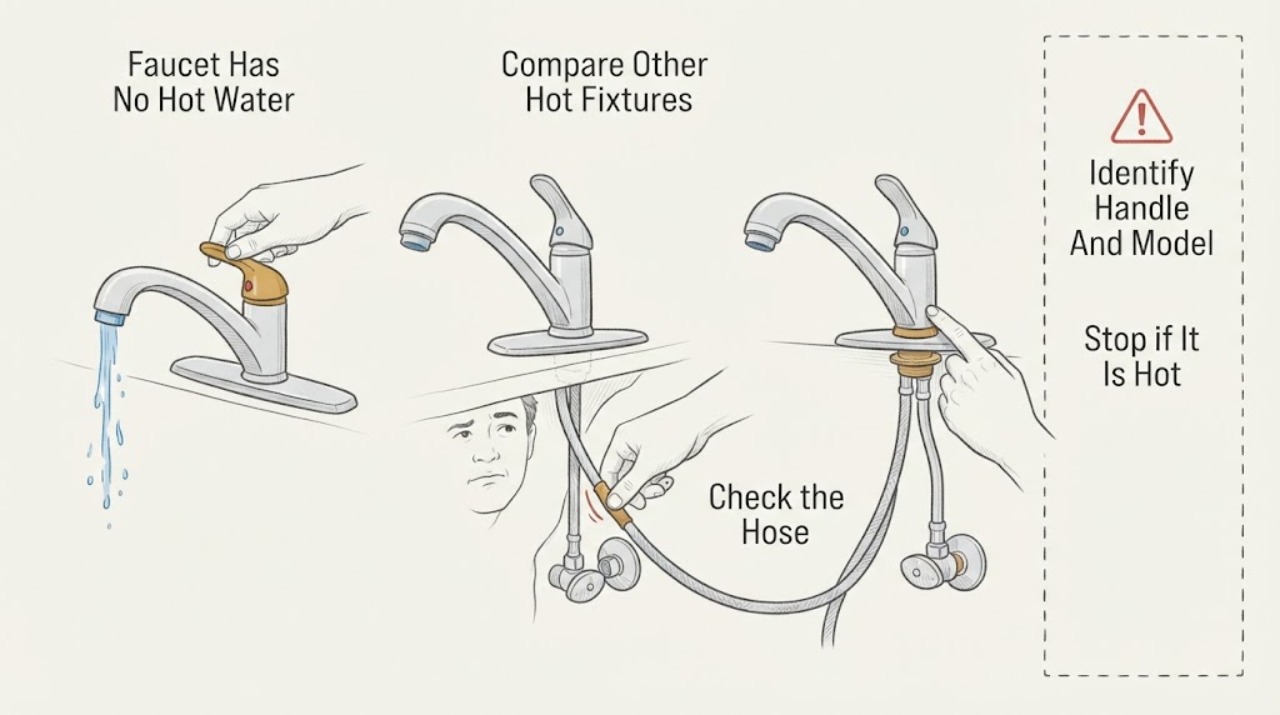
If a Delta faucet has no hot water, first check whether other fixtures still receive hot water. If other fixtures are hot, the problem is local to this faucet: a closed or failed hot-side shutoff, kinked or obstructed supply hose, wrong hot/cold connection, or a cartridge or valve that is not admitting hot water. Check the hot shutoff and hose from a dry position, identify whether the faucet is single- or two-handle, and use Delta's model-specific parts diagram before opening the valve. Close the hot and cold supplies and release pressure before any cartridge work; Delta parts guidance shows that cartridges differ by faucet type and model. If the whole home lacks hot water, the faucet is probably not the source. Stop for a seized shutoff, a pressurized leak, corroded connection, scalding water, a cracked faucet body, or no hot water after a confirmed supply and model-directed valve check, and arrange plumbing service.
Work through in order
Diagnostic checks
Use only checks that match the exact appliance or system and its official guide.
-
Check 1
Open the hot side at another fixture briefly, then test the Delta faucet's hot position without touching any connection. Note whether hot water is available elsewhere, whether this faucet produces only cold water, and whether hot flow is absent or merely lukewarm.
Expected result: Other fixtures are also cold; other fixtures are hot but this faucet is cold; this faucet has weak hot flow; or the water is lukewarm at every fixture.
Next step: If only this faucet is affected, continue with the local supply and faucet checks. If all fixtures are affected, stop faucet disassembly and arrange water-heater or plumbing diagnosis.
Stop if: Do not continue testing if the water is dangerously hot, a leak appears, or a water-heater or gas safety issue is suspected.
Why this matters
Why: Hot water missing throughout the home points to the water-heating or building supply system. Hot water elsewhere isolates the problem to this faucet, its hot supply, or its valve. Weak or lukewarm flow can indicate a restriction, mixing issue, or temperature problem rather than a completely closed supply.
-
Check 2
From a dry position under the sink, inspect the Delta faucet's hot-side shutoff, flexible hose, and threaded connections. Confirm the hot shutoff is visibly in its normal open position, the hose is not kinked or crushed, and there is no moisture, corrosion, or movement at the fittings.
Expected result: The hot shutoff is closed, the handle spins or will not move, the hose is kinked, the connection is wet or corroded, or the supply path appears open and dry.
Next step: Open only an obviously closed, reliable shutoff slowly and watch for leaks. Do not force a seized valve or disconnect the hose. If the supply path is open and dry, identify the faucet model and continue with a model-directed valve check.
Stop if: Do not use pliers on a seized shutoff, twist a braided hose, loosen a compression fitting under pressure, or continue if water sprays or pools in the cabinet.
Why this matters
Why: A closed or failed shutoff or kinked hose can prevent hot water before it reaches the faucet. Moisture, corrosion, or movement indicates a pressurized plumbing problem. An open, dry path keeps a valve, cartridge, inlet screen, or internal cross-connection possible.
-
Check 3
Record the Delta faucet model from its documentation or product identification marking and determine whether it has one handle or two. Compare the handle, cartridge, valve, and hot-side orientation with Delta's official parts finder and model diagram before removing trim.
Expected result: The faucet is single-handle, two-handle, a touch or electronic model, the model number is missing, the parts diagram shows a cartridge, or the model uses a different valve or stem arrangement.
Next step: Use the exact model guide for a cartridge or stem check. If the model cannot be identified, stop before ordering parts or opening the valve and ask Delta or a plumber to identify the assembly.
Stop if: Do not infer the model from appearance, assume a cartridge is universal, alter a handle limit stop to create more hot water, or remove trim without a documented procedure.
Why this matters
Why: The valve path and replacement procedure depend on faucet style and model. Delta's parts resources list separate single- and two-handle cartridges and advise using the product model to reach the correct parts; a missing model identity makes part selection uncertain.
-
Check 4
Close both faucet shutoffs and open the faucet briefly to release residual pressure. Following only the exact Delta model instructions, inspect the accessible hot inlet, screen, cartridge or stem area for debris, incorrect orientation, damaged seals, or a component that does not seat; keep all removed parts organized.
Expected result: The hot inlet is obstructed, the cartridge or stem is damaged or misoriented, debris is present, the component is stuck, or no defect is visible.
Next step: Clean only a loose, accessible obstruction that the model guide permits and reinstall the confirmed component in the documented orientation. For a stuck component, damaged valve body, or uncertain procedure, keep supplies off and call a plumber.
Stop if: Do not open the valve while pressurized, force a cartridge, scrape sealing surfaces, drill retaining hardware, or use a chemical flush inside the faucet.
Why this matters
Why: An inlet restriction or valve component that cannot open the hot passage can leave cold water available while hot water is absent. A stuck part, corroded retainer, or clean-looking assembly can still hide a body or supply fault and is not a reason to force the repair.
-
Check 5
If the model diagram confirms a failed cartridge, stem, or seal and both supplies are isolated, install only the matching Delta component using the documented retaining hardware, orientation, and seal procedure. Do not change the hot-limit setting as a substitute for a missing supply.
Expected result: The replacement matches the model diagram and seats correctly; the old component is damaged; the new part does not fit; the retaining hardware is seized; or all parts are reassembled but hot water is still absent.
Next step: Reassemble fully, reopen the shutoffs slowly, and test for hot water and leaks. If the part does not fit, the retainer cannot be removed, or hot water remains absent, close the supplies and arrange service rather than substituting another cartridge.
Stop if: Do not force the component, mix parts from different Delta families, bypass a temperature limiter, or leave the faucet pressurized with an incomplete assembly.
Why this matters
Why: A correctly identified valve component can restore the hot passage, but an incorrect fit, seized hardware, or persistent no-hot condition points to a supply, valve-body, connection, or upstream plumbing fault.
-
Check 6
After complete model-directed reassembly, reopen the hot and cold supplies gradually while watching the cartridge, handle, spout, hoses, and shutoffs. Operate the handle normally and record whether hot water returns, the hot flow is weak, water crosses into the cold side, or any joint leaks.
Expected result: Hot water returns with normal flow; hot remains absent; flow is weak; the handle produces only cold or lukewarm water; hot and cold cross-connect; or a leak appears.
Next step: Close the supplies again for any leak or uncontrolled symptom. Give a plumber the model, handle style, supply observations, component findings, and test result; if all fixtures lack hot water, request water-heater or building-supply service.
Stop if: Do not keep cycling a leaking faucet, leave an open cabinet unattended, operate with a loose hose, or continue after water reaches electrical equipment.
Why this matters
Why: Normal hot flow supports a successful valve or supply correction. Persistent no-hot or weak hot flow keeps an inlet restriction, cartridge orientation, valve-body, hose, shutoff, or upstream hot-water issue possible. Cross-connection and leakage need professional diagnosis.
Use your observations
Decision map
Find the observation that best matches what you see, then follow the next safe action.
-
PATH 01Next step
What you see
The Delta faucet and other fixtures all produce cold or lukewarm water.
Do this next
Stop faucet disassembly and arrange water-heater or plumbing diagnosis. Provide whether the loss is total or partial and any heater alert, leak, gas, or electrical symptom.
Why this path and its safety boundary
Why it matters: The water heater, hot-water circulation, building supply, or a central mixing device is more likely than the faucet valve.
-
PATH 02Next step
What you see
Other fixtures have hot water, but the Delta faucet's hot shutoff is closed, its hose is kinked, or the connection is wet or corroded.
Do this next
Open only a reliable, obviously closed shutoff slowly and correct only a visible hose position issue. For a failed valve, corroded fitting, or leak, leave the water isolated and call a plumber.
Why this path and its safety boundary
Why it matters: A local supply restriction or connection fault is more likely than a cartridge failure.
-
PATH 03Next step
What you see
Other fixtures are hot, the Delta faucet is two-handle, the cold side flows, and the hot supply is confirmed open and dry.
Do this next
Use the exact model parts diagram to inspect or replace the hot-side component with supplies isolated. Stop for seized hardware or an uncertain part and arrange service.
Why this path and its safety boundary
Why it matters: The hot-side stem, cartridge, inlet, or seat is more likely than the cold side or water heater.
-
PATH 04Next step
What you see
Other fixtures are hot, the Delta faucet is single-handle, the hot supply is open, and the faucet produces cold or lukewarm water across the handle range.
Do this next
Identify the model and follow its cartridge procedure; do not alter a safety stop or install a generic cartridge. Arrange service if hot water remains absent after a confirmed model-directed repair.
Why this path and its safety boundary
Why it matters: The single cartridge or valve assembly, its hot inlet, orientation, or a model-specific temperature limiter is more likely than a whole-home hot-water problem.
-
PATH 05Next step
What you see
Hot water remains absent after supply and model-directed valve checks, the cartridge is stuck, the body is cracked, a fitting leaks, the shutoff will not hold, or the cause is uncertain.
Do this next
Close the faucet supplies or the building supply if safely accessible, protect the cabinet from water, and arrange a licensed plumber. Do not keep replacing parts or operate an incomplete or leaking faucet.
Why this path and its safety boundary
Why it matters: A hidden restriction, valve-body fault, cross-connection, upstream plumbing issue, or unsafe pressurized condition remains possible.
Helpful context
Understand the symptom
First decide whether the problem is the faucet or the hot-water supply
Run the hot side at another nearby fixture briefly. If it is also cold, investigate the water heater, building supply, recirculation system, or a broader hot-water interruption. If other fixtures are hot, focus on the Delta faucet's hot shutoff, supply hose, connections, and valve. This split prevents replacing a faucet cartridge when the fixture is not receiving hot water.
Single-handle and two-handle Delta faucets use different valve paths
A two-handle faucet can lose hot water on one side while cold remains available. A single-handle faucet uses one cartridge or valve assembly to meter and mix the supplies, and Delta's parts resources list different cartridge families and model diagrams. Do not assume a cartridge is universal or reverse it without the exact faucet documentation.
Do not turn a hot-water complaint into a pressurized plumbing leak
Before removing a handle, bonnet, cartridge, or hose, close both faucet shutoffs and confirm that water stops. Hot water can scald, and a seized shutoff or corroded fitting can fail when disturbed. If the shutoffs do not hold, leave the faucet untouched and have a plumber isolate and repair the supply.
Safety boundary
Stop conditions
- Stop before disassembly if the faucet cannot be isolated, a shutoff is seized or leaking, a hose or fitting is corroded, hot water is scalding, the faucet body is cracked, water sprays or reaches electrical equipment, or the model and component are uncertain. Do not open a pressurized valve, force a cartridge, bypass a temperature limiter, mix Delta parts, or keep testing after a leak. A whole-home loss of hot water requires water-heater or building-supply diagnosis.
Only after diagnosis
Potential parts
- single-handle faucet cartridge
Consider this only when other fixtures have hot water, the faucet hot supply is open and dry, and the exact Delta model diagram identifies a failed single-handle cartridge or valve assembly.
Delta cartridge families, stems, orientations, and temperature-limit features vary by model; confirm the exact faucet model and official parts diagram before selection. - two-handle hot-side stem or cartridge
Consider this only when a two-handle faucet has hot water elsewhere, the hot shutoff and hose are open and dry, and the hot-side valve is confirmed not to open or seal correctly.
Stem, cartridge, seat, spring, and hot/cold orientation depend on the Delta faucet model; verify the official diagram and installation procedure. - faucet hot-water supply hose or shutoff valve
Consider this only when the leak, restriction, or failed isolation is confirmed at the hot supply path and a plumber identifies the hose or shutoff as the defective component.
Connection type, length, valve style, and local plumbing requirements must match the sink installation; do not select this from a no-hot symptom alone. - faucet inlet screen or aerator
Consider this only when the model documentation identifies a removable inlet screen or aerator and inspection confirms damage or a restriction after the hot supply is verified.
Screens and aerators vary by faucet model and flow design; confirm the exact part and do not assume an aerator is the cause of a hot-only failure.
When checks do not resolve it
Need a professional?
Call a licensed plumber when hot water is absent at the faucet despite a confirmed hot supply, the shutoff or hose is unreliable, the cartridge or stem is seized, a body or connection leaks, the model part is uncertain, hot and cold cross-connect, or the faucet remains cold after a model-directed valve repair. Call water-heater service when all fixtures lack hot water. Use urgent service for an uncontrolled leak, scalding discharge, flooding, or water near electrical equipment.
Have this ready
- Provide the Delta faucet model or collection, single- or two-handle style, fixture locations tested, hot and cold flow comparison, shutoff and hose observations, cartridge or stem findings, whether the issue is no flow or lukewarm flow, photos from a dry position, and any leak or water-heater symptoms.
Common questions
FAQ
Why does my Delta faucet have cold water but no hot water?
If other fixtures have hot water, check this faucet's hot shutoff and hose first, then its single- or two-handle valve path. A closed or failed supply, kinked hose, blocked inlet, or cartridge or stem that does not admit hot water can leave cold water available. If every fixture is cold, investigate the water heater or building supply instead.
How can I tell whether the Delta faucet or water heater is the problem?
Test the hot side at another fixture briefly. Hot water elsewhere points to the Delta faucet, its hot shutoff, hose, or valve. No hot water anywhere points to the water heater, central mixing, recirculation, or building supply. Do not remove the faucet cartridge to diagnose a whole-home hot-water loss.
Should I shut off the water before checking a Delta cartridge?
Yes. Close both faucet supplies and open the faucet briefly to release residual pressure before removing a handle, bonnet, cartridge, stem, or seal. If a shutoff does not hold, is corroded, or starts leaking, stop and have a plumber isolate the faucet.
Can I use any Delta cartridge if my faucet has no hot water?
No. Delta lists different single-handle and two-handle cartridge families and advises identifying the faucet model and parts diagram. Cartridge orientation, stem, valve type, and temperature-limit features vary. Confirm the exact model before ordering or removing a component.
What if a Delta single-handle faucet only produces lukewarm water?
Confirm hot water is hot at another fixture and that the faucet's hot shutoff and hose are open and dry. A single cartridge or valve can restrict or misdirect hot water, but a temperature-limit feature or cross-connection may also affect mixing. Do not alter a safety stop as a substitute for diagnosis; use the model procedure or call a plumber.
What if replacing the Delta cartridge does not restore hot water?
Close the supplies again and verify the component was the exact model part, correctly oriented, fully seated, and reassembled with its retaining hardware. If the hot supply is confirmed but hot water remains absent, a blocked inlet, valve-body problem, cross-connection, or upstream plumbing fault remains possible. Do not keep substituting cartridges; arrange service.
When should I call a plumber for a Delta faucet with no hot water?
Call when the faucet cannot be isolated, the shutoff or hose is seized or leaking, the body is cracked, the cartridge is stuck, the model part is uncertain, hot water crosses into the cold side, or hot water remains absent after a model-directed valve check. Call water-heater service when no fixture has hot water.
Read the exact guide
Official sources
- Valve, Euro, Short Stem w/ Screw (Recertified) RP73000-RDelta Faucet · Official Delta product page describing a single-handle valve cartridge, its use in kitchen and lavatory faucets, the valve construction, and the need to use the maintenance and installation sheet for the applicable model.
- Find Parts and Identify Your ProductDelta Faucet · Official Delta parts resource directing users to identify the product model and listing separate single-handle and two-handle cartridge paths, hot-side and cold-side components, and model-specific diagrams.
- Valve CartridgeDelta Faucet · Official Delta product page identifying a single-handle ceramic valve cartridge and stating that this category addresses spout or under-handle leaks, with model-specific installation guidance in customer responses.
Community feedback
Share a repair observation
Share a plain-text repair observation. Accepted observations are published automatically; this page may take a moment to update.