
On this page
Start here
Quick answer
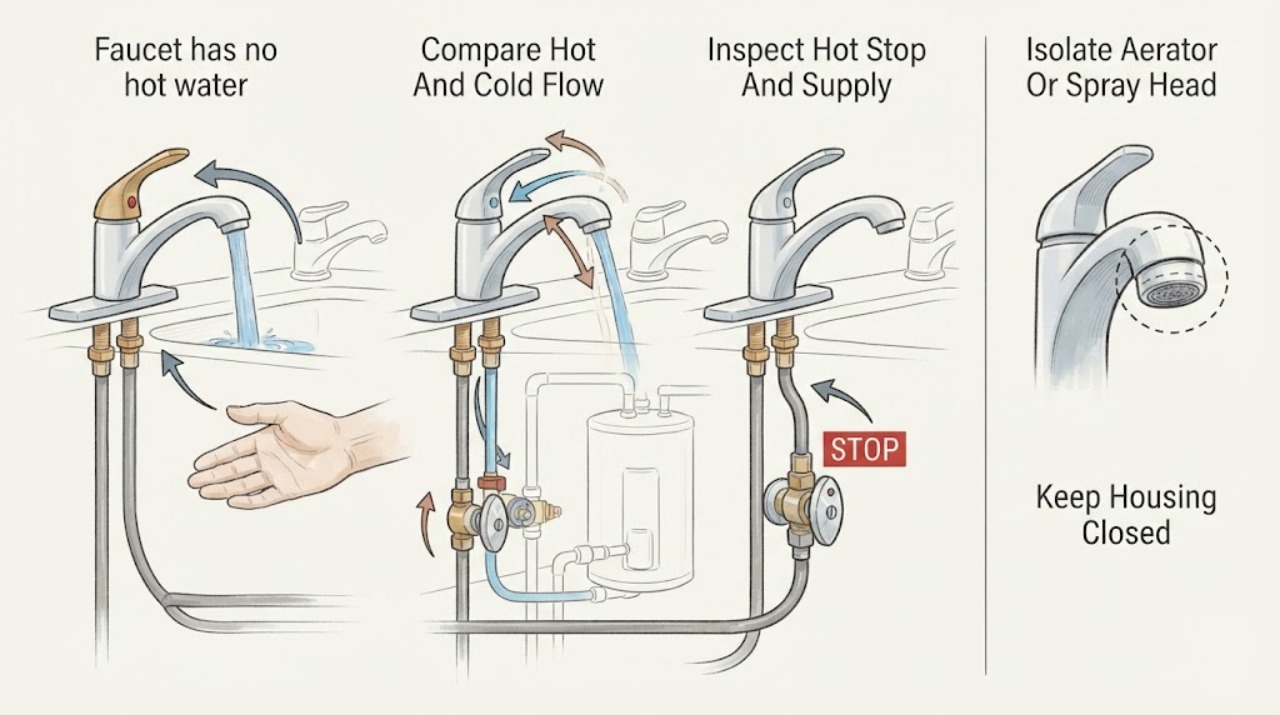
If other fixtures deliver hot water but one faucet does not, the water heater is less likely to be the immediate fault. First distinguish no hot-water flow from water that flows but stays cold: a closed or restricted hot stop valve, kinked supply line, debris in the inlet or cartridge, a clogged spray head or aerator, or a faucet mixing or balancing valve can affect one outlet. Check the handle position and compare hot and cold flow, then inspect only accessible shutoff valves and hoses without forcing a stuck valve. Use the faucet's exact model instructions before removing a cartridge or valve; do not raise the water-heater temperature as a guess because hot water at the outlet can scald. If several fixtures lose hot water, the heater or whole-house hot-water system needs its own diagnosis.
Before you begin
Safety first
- This article supports comparison testing, visual checks and model-directed cleaning of an accessible outlet only. Do not force valves, disconnect pressurized lines, defeat anti-scald controls, open walls or handle energized gas or electrical heater components.
Work through in order
Diagnostic checks
Use only checks that match the exact appliance or system and its official guide.
-
Check 1
With the faucet directed into the sink or tub, run the cold side briefly, then move the handle to hot without touching the heater; compare flow, temperature change and time to warm with a nearby fixture that has hot water.
Expected result: Record whether hot has no flow, weak flow, normal flow but cold water, or water that becomes warm only after a longer wait. Note whether the nearby fixture remains hot.
Next step: Continue to the local hot-valve and hose check when the symptom is limited to this faucet. If multiple fixtures are affected, stop local faucet disassembly and consult the water-heater manual or a qualified plumbing professional.
Stop if: Do not increase the water-heater temperature, run a faucet unattended, or put hands under unexpectedly hot water while comparing outlets.
Why this matters
Why: Hot-only weak or absent flow suggests the local hot supply, valve or inlet is restricted. Normal flow that stays cold suggests a cartridge, balancing or thermostatic mixing problem. If all fixtures lose hot water, the local-faucet assumption no longer fits.
-
Check 2
From under the sink or at the accessible faucet supply, visually inspect the hot shutoff valve and hot flexible line; if a normal hand-operated valve is clearly partly closed, open it gently according to its design, without forcing it.
Expected result: Look for a valve turned off or partly open, a kinked or crushed hot hose, a leak, corrosion, a swollen hose, or a hot line not connected to the faucet's hot inlet. Compare hot and cold connections without disconnecting them.
Next step: If a simple valve-position or hose-routing issue is confirmed and no leak is present, correct only what the fixture instructions permit and retest. If the valve will not move, leaks, or the line must be disconnected, shut off water safely and call a plumber.
Stop if: Do not force a seized stop valve, use pliers on a fragile handle, disconnect a pressurized hose, or continue if water begins leaking under the cabinet.
Why this matters
Why: A closed valve or kink can remove hot flow at one faucet while other fixtures remain normal. A leaking, corroded or stuck valve needs replacement, and a recent installation with crossed connections can make the hot position deliver cold water.
-
Check 3
If the faucet has a removable aerator or pull-out/pull-down spray head, use the exact faucet instructions to remove only that outlet piece, keep the hose from retracting, and briefly test flow into the sink; skip it if the part is fixed, seized or the model procedure is unknown.
Expected result: Compare the stream with the aerator or spray head installed and removed. Look for mineral scale or debris and note whether hot flow is normal from the hose or spout with the end piece removed.
Next step: Clean the removable outlet only with the manufacturer's approved method and reinstall it, then retest. If restriction remains upstream, stop and identify the faucet model before opening its valve or cartridge.
Stop if: Do not poke jets with metal, lose a pull-out hose inside the faucet, use harsh chemicals, or remove a spray head while hot water is splashing.
Why this matters
Why: Normal hot flow with the outlet piece removed makes a clogged aerator or spray head likely. Poor hot flow even with it removed points toward the hot supply, inlet, cartridge or valve.
-
Check 4
Identify the faucet type and model from its markings or documentation, then consult that model's instructions for a hot-side cartridge, pressure-balancing spool, thermostatic cartridge, inlet screen or rotational temperature limit; do not remove the valve by guesswork.
Expected result: Determine whether it is a single-handle sink or lavatory faucet, two-handle faucet, tub/shower mixing valve or electronic faucet, and whether cold flow is normal while hot is absent or merely limited.
Next step: Follow only the exact model procedure for accessible cleaning or cartridge service, with water isolated and hot surfaces avoided. If the valve is concealed, seized, behind a wall or requires specialized tools, arrange qualified plumbing service.
Stop if: Do not substitute a cartridge by appearance, reverse a cartridge without model instructions, defeat an anti-scald limit, open a wall valve or leave the faucet partly disassembled with water available.
Why this matters
Why: A sink faucet may have a blocked or failed cartridge or valve body. A tub/shower unit may have debris in a balancing spool, closed check stops or a model-specific calibration. Electronic fixtures may have control or power behavior that cannot be inferred from a standard mechanical faucet.
-
Check 5
Retest the faucet alongside a known-hot fixture, then check whether the water heater has a separate alarm, leak, pilot, power or diagnostic indication without opening panels or changing settings.
Expected result: Record whether only the original faucet remains cold, whether other outlets have also become cold, whether water is too hot, and whether the heater shows a fault, leak or loss of power or fuel.
Next step: Use the water-heater manual for model-specific user-level checks only. Have a qualified plumber or water-heater technician diagnose heating, gas, electrical, recirculation or concealed-piping faults.
Stop if: Do not remove heater covers, test energized terminals, relight gas equipment outside its manual procedure, bypass safety controls or raise the setpoint to mask a faucet problem.
Why this matters
Why: A remaining one-faucet symptom supports a local valve, supply or faucet-body diagnosis. Loss of hot water at multiple fixtures shifts the fault upstream to the heater, recirculation or main hot-water piping. Excessively hot water is a scald condition.
Use your observations
Decision map
Find the observation that best matches what you see, then follow the next safe action.
-
PATH 01Safety boundary
What you see
The affected faucet has normal cold flow but no or very weak flow on hot, while another fixture still has hot water; the hot stop or hose is closed, kinked, leaking or restricted.
Do this next
Correct a plainly visible valve position or hose kink only if safe. Otherwise isolate water and have a plumber inspect the stop, supply line, inlet screen and connection.
Why this path and its safety boundary
Why it matters: The local hot supply path is more likely than the water heater. A damaged or seized stop valve should not be forced.
Safety stop: Do not disconnect a pressurized line, use force on a corroded valve or continue after a leak begins.
-
PATH 02Safety boundary
What you see
The faucet delivers a normal stream in the hot position, the nearby fixture remains hot, but this faucet stays cold.
Do this next
Identify the model and follow its manufacturer troubleshooting path. Arrange qualified service if the valve is concealed, seized, behind a wall or requires calibration.
Why this path and its safety boundary
Why it matters: A cartridge, balancing spool, thermostatic valve, reversed connection or temperature-limit setting is more likely than a heater failure. The correct component depends on the faucet model.
Safety stop: Do not increase heater temperature, defeat anti-scald protection or replace a valve based only on brand or appearance.
-
PATH 03Safety boundary
What you see
Hot flow becomes normal when a removable aerator or spray head is removed, and scale or debris is visible at that piece.
Do this next
Clean or replace the outlet piece according to the faucet manufacturer's instructions, reinstall it and check for normal flow and leaks.
Why this path and its safety boundary
Why it matters: The restriction is at the faucet outlet rather than in the home's hot-water supply or heater.
Safety stop: Do not use harsh cleaners, damage spray jets or operate a pull-out hose without preventing it from retracting.
-
PATH 04Safety boundary
What you see
The faucet lost hot water immediately after installation, supply work or cartridge service, or the hot and cold hoses appear crossed.
Do this next
Turn off water as needed and compare connections with the exact installation instructions. Have a plumber correct concealed, pressurized or model-specific connections.
Why this path and its safety boundary
Why it matters: A closed stop, kinked line, service debris or reversed connection is more likely than a suddenly failed water heater.
Safety stop: Do not reverse hoses or cartridge orientation from memory, overtighten fittings or open a wall without a shutoff plan.
-
PATH 05Safety boundary
What you see
The affected faucet and other fixtures no longer produce hot water, or the heater shows loss of power, fuel, a leak or a diagnostic indication.
Do this next
Follow only the water-heater owner's manual for basic visual checks and arrange qualified water-heater or plumbing service for electrical, gas, heating-element, thermostat, recirculation or concealed-piping diagnosis.
Why this path and its safety boundary
Why it matters: The fault is no longer isolated to the faucet; the water heater, recirculation system or main hot-water piping is more likely.
Safety stop: Do not open energized panels, bypass high-temperature or gas safety controls or keep operating a leaking heater.
Helpful context
Understand the symptom
Start with flow, not temperature
Turn the affected faucet to hot and compare the amount of water with its cold position. No water or a weak stream on hot is a supply-path problem until proven otherwise. Normal flow that stays cold points farther inside the faucet, where a cartridge, balancing valve or thermostatic limit may be stopping or mixing the hot side. If the hot stream is merely slow to arrive, the run may be long; compare it with a nearby fixture before disassembling anything.
One-faucet symptoms change the diagnostic boundary
When a nearby sink or shower still produces hot water, do not begin by resetting the heater or changing its thermostat. Inspect the affected outlet's hot stop, flexible line, inlet screen, aerator or spray head and faucet valve in that order. A tub or shower valve may have a pressure-balancing spool or thermostatic cartridge that needs its model-specific procedure; a kitchen or lavatory faucet usually has a cartridge or restricted hot supply path.
Temperature adjustments are not a shortcut
A warmer water-heater setting cannot clear a closed stop valve, kinked hose, blocked inlet or failed faucet cartridge. EPA warns that hot water at an outlet can scald and recommends appropriate thermostatic controls and manufacturer instructions. Keep the heater at its existing safe setting while the symptom is local; call a qualified plumber for a valve replacement, hidden restriction, reversed connection or appliance work.
Safety boundary
Stop conditions
- Do not raise the water-heater setpoint to compensate for one cold faucet; hot water at the outlet can scald.
- Stop and shut off water safely for a leaking, cracked, corroded or seized stop valve, supply hose, faucet body or concealed connection; do not force the fitting.
- Do not remove a cartridge, balancing spool or wall valve without the exact model procedure, water isolation and a plan to contain hot water; never substitute parts by appearance alone.
- Do not open energized water-heater panels, test gas or electrical components, bypass safety controls or operate a heater with an active leak, gas odor or damaged venting.
- Call a qualified plumber or water-heater technician when multiple fixtures lose hot water, the local cause remains uncertain, the valve is concealed or seized, or the repair requires opening a wall or appliance.
Only after diagnosis
Potential parts
- faucet cartridge, balancing spool or thermostatic valve
Consider this only when model-specific diagnosis shows normal hot supply reaches the faucet but the valve does not pass or mix it correctly.
Match the exact faucet or shower-valve model, cartridge orientation, trim family, pressure-balancing or thermostatic design and temperature-limit procedure. - hot-water stop valve or faucet supply line
Consider this only when the local hot supply is confirmed restricted, leaking, seized or damaged rather than a cartridge or heater fault.
Confirm connection type, tubing, valve arrangement, access and building shutoff requirements before selecting a replacement. - faucet aerator, spray head or inlet screen
Consider this only if flow improves with the outlet piece removed or the model instructions identify a blocked inlet screen or outlet restriction.
Match the exact model, thread, flow design and hose connection; do not substitute a restrictive screen or damage a pull-out assembly. - water-heater heating, control or mixing component
Consider this only if multiple fixtures lose hot water or a qualified diagnosis identifies a heater, recirculation or whole-house mixing fault.
Match heater fuel type, model, voltage or gas controls, sensors and safety requirements; heater repairs should follow the manual and professional procedures.
When checks do not resolve it
Need a professional?
Call a qualified plumber when the faucet still has no hot water after a safe valve, hose and outlet check; when a cartridge, balancing or thermostatic valve must be removed; when a stop valve leaks or will not turn; or when the symptom spreads to multiple fixtures. Call water-heater service for a heater fault, gas odor, active leak, electrical issue or loss of hot water throughout the home. Keep the heater setting unchanged while an isolated faucet problem is diagnosed.
Safety scope: This article supports comparison testing, visual checks and model-directed cleaning of an accessible outlet only. Do not force valves, disconnect pressurized lines, defeat anti-scald controls, open walls or handle energized gas or electrical heater components.
Common questions
FAQ
Why does one faucet have no hot water while other faucets do?
The heater is less likely to be the immediate cause when other fixtures are hot. Check the affected faucet's hot stop valve and supply line, then isolate a clogged aerator or spray head and consider a model-specific cartridge, balancing or thermostatic valve issue.
What if the faucet has cold water but no hot-water flow?
Normal cold flow with weak or absent hot flow points toward a closed or restricted hot stop, kinked supply hose, inlet obstruction or faucet valve. Inspect accessible parts without forcing the valve or disconnecting a pressurized line, then call a plumber if the restriction is not obvious.
Can a clogged aerator cause no hot water?
A clogged aerator or spray head can restrict the outlet enough to make the hot side appear absent. If the model instructions allow it, compare flow with that removable piece taken off and directed into the sink. Normal flow with it removed supports cleaning or replacement of the outlet piece.
Could the cartridge be the reason water stays cold in the hot position?
Yes. When flow is normal but temperature stays cold at one faucet, a cartridge, balancing spool, thermostatic valve, reversed connection or temperature-limit setting is possible. Identify the exact model before any valve or cartridge work.
Should I turn up my water-heater temperature for one cold faucet?
No. If other fixtures have hot water, raising the heater setting will not open a local stop valve or clear a faucet restriction and can create a scald hazard. Leave the setting unchanged while the faucet and local hot-water path are diagnosed.
When is the water heater more likely to be the problem?
When multiple fixtures lose hot water, the heater shows a power, fuel, pilot, leak or diagnostic problem, or hot water does not return anywhere, the fault is more likely upstream. Use the heater manual for basic checks and arrange qualified service for gas, electrical, heating-element, control or recirculation work.
Read the exact guide
Official sources
- No COLD (just hot) or No HOT (just cold) water on tub shower unitsMoen Solutions · Moen tub/shower guidance used to explain balancing and thermostatic branches; it does not identify the valve in an unbranded faucet.
- Low water flow from spout- ONLY hot or cold water on sink faucetsMoen Solutions · Moen sink-faucet troubleshooting used for general local-faucet principles; the exact installed model controls parts and disassembly.
- Water Heater Repair: Things to ConsiderA. O. Smith · Water-heater manufacturer guidance; it supports the boundary between a local faucet issue and heater service without diagnosing an unknown heater model.
- Low Flow from Hot and Cold WaterKohler Assist · Kohler kitchen-faucet troubleshooting used for general isolation of outlet versus upstream restrictions; exact model instructions are required.
- When to Repair or Replace Your Water HeaterA. O. Smith · A. O. Smith water-heater guidance used only for the upstream branch when multiple fixtures are affected; exact heater instructions control.
- Legionella in the Indoor EnvironmentU.S. Environmental Protection Agency · EPA household water-temperature and fixture safety guidance; it is not a diagnosis of an individual faucet.
Community feedback
Share a repair observation
Share a plain-text repair observation. Accepted observations are published automatically; this page may take a moment to update.