
On this page
Start here
Quick answer
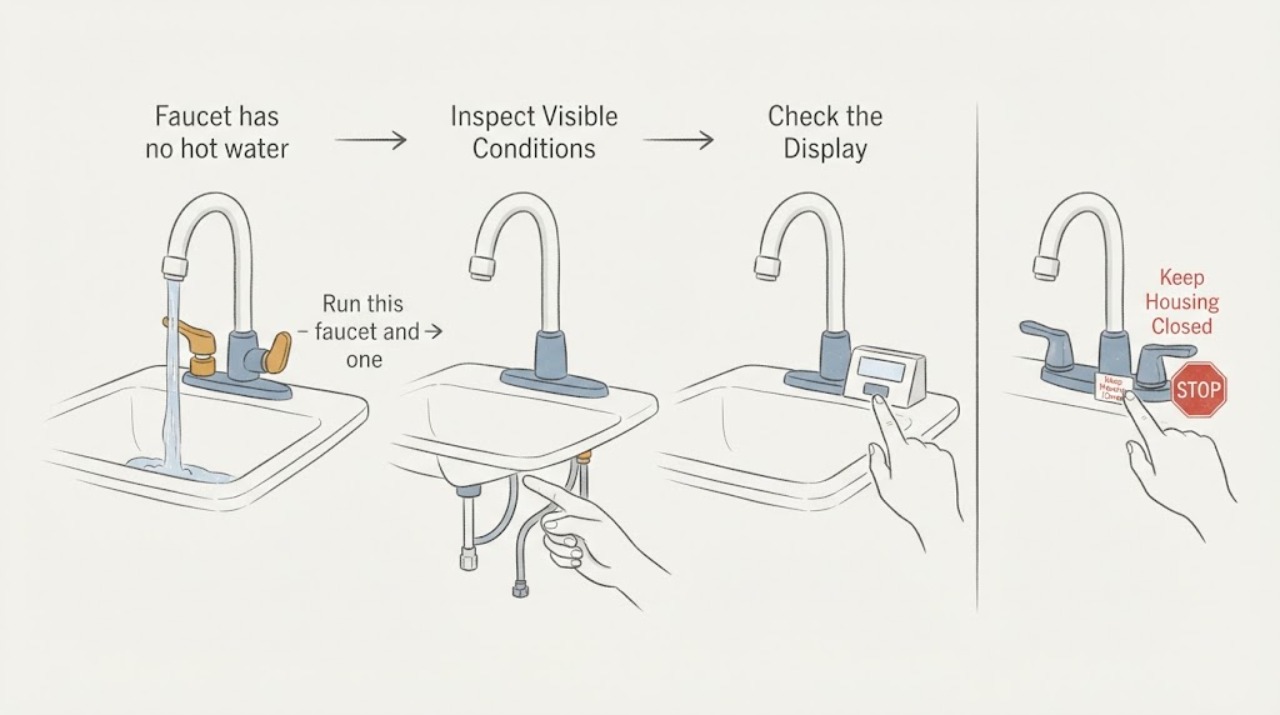
First compare this faucet with another fixture that normally supplies hot water. If other fixtures have hot water and cold water is strong at this faucet, the problem is probably local: a closed or restricted hot-side stop, a kinked hot supply line, or a faucet cartridge or mixing assembly that is not admitting hot water. Check those conditions by observation without forcing a valve or opening the faucet body. If several fixtures also have no hot water, look only at the water heater's normal user-facing indicators and arrange service for the upstream hot-water system. A faucet with a leak, a stop that will not isolate the line, water near electrical equipment, or an unknown model should be left for a plumber.
Before you begin
Safety first
- Do not force a valve, disconnect a pressurized line, open the faucet body with unverified isolation, open water-heater panels, adjust gas or electrical controls, or operate wet electrical equipment.
Work through in order
Diagnostic checks
Use only checks that match the exact appliance or system and its official guide.
-
Check 1
Run this faucet and one other nearby fixture that normally produces hot water, using each fixture's normal hot setting; compare temperature and flow without removing any parts.
Expected result: Hot water is normal elsewhere, hot water is absent or weak at both fixtures, or the comparison fixture is not known to have a hot supply.
Next step: For a local-only symptom, continue with the faucet supply checks. For a multi-fixture symptom, check only normal user-facing water-heater indicators and arrange water-heater or plumbing service rather than replacing a faucet part.
Why this matters
Why: Normal hot water elsewhere makes a local faucet, hot stop, or hot supply-line issue more likely. No hot water at multiple fixtures shifts suspicion to the water heater or upstream hot-water distribution.
-
Check 2
Look under the sink or at the accessible faucet connections and identify the hot and cold supply stops; compare their visible positions and look for a sharply kinked, crushed, wet, or disconnected hot flexible line. Do not use pliers or a wrench on a stiff stop.
Expected result: The hot stop is closed or partly open, the hot line is kinked or visibly damaged, a stop or connection is wet, or both stops and lines look normal.
Next step: If the stop moves normally, follow the fixture's manufacturer instructions for its normal open position without forcing it and recheck flow. If it is stuck, leaking, or the line is damaged, leave the connection undisturbed and call a plumber.
Why this matters
Why: A closed stop or restricted line can remove hot flow while leaving cold flow normal. Wetness or a damaged line adds a leak risk. Normal visible supply conditions make a faucet-internal restriction more likely but do not prove it.
-
Check 3
Move the faucet control through its normal range and briefly hold it at the full-hot position, then compare hot-side flow with the full-cold position; keep hands away from wet connections and do not remove the handle or cartridge.
Expected result: Cold flow is strong but hot flow is absent, hot flow is only a weak trickle, or flow is normal but the water remains cold while another fixture has hot water.
Next step: Record the pattern and faucet type. Do not pry out or clean an internal part based on appearance; use the exact model instructions or a plumber for cartridge, stem, or mixing-valve diagnosis.
Why this matters
Why: A cold-strong/hot-absent pattern supports a hot-side supply restriction or a faucet mixing assembly that is not opening. A weak hot trickle is consistent with partial restriction. Normal flow with cold temperature makes a mixing-control or upstream temperature issue more likely than a simple flow blockage.
-
Check 4
Identify whether the faucet is single-handle, two-handle, or part of a pressure-balance or thermostatic control, and record the visible make, model, and any temperature-limit or cartridge markings without disassembling it.
Expected result: The model and control type are known, or the model is unknown and the control has a specialized pressure-balancing or thermostatic design.
Next step: Use the manufacturer's model-specific parts and service information or provide the identification to a plumber. If the model cannot be identified, do not order a cartridge by appearance alone.
Why this matters
Why: The internal cartridge, stem, spool, and temperature-control arrangement varies by model. A specialized control may restrict or mix the hot side differently from a basic two-handle faucet, so a generic replacement or cleaning assumption is unsafe.
-
Check 5
If more than one fixture lacks hot water, inspect only the water heater's normal user-facing display, status light, or control indication and note any visible fault indication; do not open panels, adjust gas controls, or change electrical wiring.
Expected result: The heater appears to have a normal status, shows a fault or no-power indication, or the water heater status is not accessible or not understood.
Next step: Record the indicator exactly and arrange qualified water-heater or plumbing service. Keep the faucet diagnosis local only when another fixture confirms that hot water is available elsewhere.
Why this matters
Why: A visible fault or no-power indication with no hot water at multiple fixtures supports an upstream water-heater or distribution problem. A normal-looking indicator does not rule out a plumbing or heating fault.
-
Check 6
Check the cabinet, faucet base, supply stops, and visible hot line for fresh moisture, staining, swelling, or water near an outlet or appliance; use a dry paper towel only for a non-contact location check.
Expected result: The area is dry, or water is present at a stop, hose, fitting, faucet base, cabinet floor, or nearby electrical equipment.
Next step: If a reliable local stop can be closed without force, leave the affected supply isolated; otherwise use the known main shutoff only if safe and call a plumber. Keep away from wet electrical equipment and do not operate it.
Why this matters
Why: A leak can restrict or interrupt the hot-side path and can cause property damage even when cold flow remains normal. Water near electrical equipment adds a shock hazard and is no longer a parts-selection problem.
Use your observations
Decision map
Find the observation that best matches what you see, then follow the next safe action.
-
PATH 01Next step
What you see
Another fixture has normal hot water, this faucet has strong cold flow but no hot flow, and the visible hot stop or line is closed, kinked, or restricted.
Do this next
Correct only a plainly accessible stop position according to the manufacturer's normal guidance and without force. Leave a stuck, leaking, or damaged stop or line for a plumber.
Why this path and its safety boundary
Why it matters: The hot-side supply path is more likely than a whole-home heater failure.
-
PATH 02Next step
What you see
Another fixture has normal hot water, both visible supply paths look available, and this faucet remains cold-only or has a weak hot trickle.
Do this next
Use the exact faucet model and control type to obtain model-specific diagnosis or plumbing service. Do not guess a universal cartridge or open the body without verified safe isolation.
Why this path and its safety boundary
Why it matters: A faucet cartridge, stem, mixing valve, or applicable pressure-balancing component becomes more likely than an upstream supply problem.
-
PATH 03Next step
What you see
Several fixtures have no hot water, while cold water remains available at those fixtures.
Do this next
Record the water heater's normal status indication and arrange qualified water-heater or plumbing service. Do not start by replacing this faucet's internal parts.
Why this path and its safety boundary
Why it matters: The shared hot-water source or distribution is more likely than this faucet alone, even if this faucet also has a local restriction.
-
PATH 04Next step
What you see
Hot-side flow is normal but the water stays cold at this faucet, and another fixture confirms that hot water is available.
Do this next
Document the faucet or valve model and have a plumber or the manufacturer identify the correct diagnostic procedure; do not adjust an unknown temperature limiter or dismantle the control.
Why this path and its safety boundary
Why it matters: A mixing or temperature-control problem, cross-connection, or model-specific anti-scald or pressure-balance issue is more plausible than a closed hot supply.
-
PATH 05Next step
What you see
A hot stop or supply connection is wet, will not close, spins, or requires force, or water reaches the cabinet floor or electrical equipment.
Do this next
Keep clear of wet electrical equipment, isolate water only through a known safe shutoff, contain water without disconnecting the line, and call a plumber promptly.
Why this path and its safety boundary
Why it matters: The immediate risk is an uncontrolled plumbing leak or water damage, and internal faucet troubleshooting should stop.
Helpful context
Understand the symptom
Separate a faucet problem from a whole-home hot-water problem
Cold water flowing proves that the fixture has a cold-water path; it does not prove that the hot stop, hot supply line, or faucet mixing assembly is working. Run another nearby hot-water fixture briefly and compare the result. Hot water elsewhere points toward this faucet's hot-side path. No hot water anywhere points upstream toward the water heater or the home's hot-water distribution, so do not start by ordering a faucet cartridge.
A single cold-only faucet often has a restricted hot path
For a sink faucet, the first visible checks are the hot supply stop and the flexible hot line. A stop that is closed or only partly open, a line bent sharply behind the cabinet, or an obstruction can leave cold flow normal while hot flow is absent or weak. Look for position, kinks, wetness, or a valve that will not move normally; do not force a stiff stop or disconnect a pressurized line.
Internal mixing parts are model-specific
If both supply paths appear available but the faucet still delivers only cold water, the cartridge, stem, or mixing valve may not be opening the hot side. Mineral deposits can affect pressure-balancing or mixing components in applicable faucet and shower-valve designs, but the correct part and procedure depend on the exact model. Record the make and model and have internal work performed only after the water can be safely isolated.
Safety boundary
Stop conditions
- Do not remove a faucet handle, cartridge, stem, hose, or supply stop unless the water source is reliably isolated and a model-specific procedure is available.
- Do not force, clamp, or disconnect a stuck, corroded, or leaking hot-side stop or pressurized flexible line.
- Do not open water-heater panels or adjust gas, electrical, or temperature controls as part of this faucet check.
- Stop and seek prompt help for an uncontrolled stream, cabinet flooding, water near electrical equipment, scalding water, gas odor, or a carbon-monoxide alarm.
Only after diagnosis
Potential parts
- faucet cartridge
Consider this only when hot water is confirmed at another fixture, the faucet's hot supply path is available, and the exact model-specific diagnosis points to a cartridge or mixing assembly.
Confirm the exact faucet make, model, control type, cartridge revision, and manufacturer fit information before ordering; similar-looking cartridges may not interchange. - angle stop valve
Consider this only when a plumber confirms that the hot supply stop is closed by failure, restricted, or leaking and that the connection requires valve replacement.
Match the connection, outlet, inlet, material, and installation requirements to the existing plumbing; do not remove a pressurized stop or assume a generic valve fits. - flexible faucet supply line
Consider this only when the hot line is visibly kinked, damaged, restricted, or leaking and a plumber confirms that replacement is appropriate.
Confirm length, end fittings, thread or compression type, rated use, and connection compatibility before ordering; do not disconnect a line until water is safely isolated.
When checks do not resolve it
Need a professional?
Request plumbing or qualified water-heater service for a failed or leaking stop, a damaged hot supply line, no hot water at multiple fixtures, a faucet-internal restriction that requires disassembly, or any water damage.
Safety scope: Do not force a valve, disconnect a pressurized line, open the faucet body with unverified isolation, open water-heater panels, adjust gas or electrical controls, or operate wet electrical equipment.
Have this ready
- Provide the faucet make and model, single- or two-handle or specialized control type, whether cold flow is strong, whether hot water works at another fixture, the visible hot-stop and line condition, the exact water-heater indicator if several fixtures are affected, and photos of any wet area.
Common questions
FAQ
Why does my faucet have cold water but no hot water?
Cold flow confirms the cold path, not the hot path. If hot water works at another fixture, check the hot supply stop and visible hot line, then have the exact faucet cartridge or mixing assembly diagnosed if those look normal.
How can I tell whether the water heater is the problem?
Test another fixture that normally supplies hot water. If several fixtures are cold-only, the water heater or shared hot-water distribution is more likely; check only normal user-facing indicators and arrange qualified service.
Should I replace the faucet cartridge when only hot water is missing?
Not immediately. First confirm that hot water is available elsewhere and that the faucet's hot stop and line are visibly available and dry. A cartridge is conditional on the exact faucet model and a diagnosis that points to its mixing assembly.
Can I force the hot angle stop open?
No. A stiff, leaking, or spinning stop can fail or release water if forced. Leave it undisturbed and call a plumber, especially if you cannot safely isolate the line upstream.
What if the faucet has normal flow but the water is still cold?
If another fixture has hot water, normal flow with cold temperature points toward a mixing or temperature-control issue rather than a simple blockage. Record the faucet model and have the control checked without adjusting an unknown limiter or dismantling it.
Read the exact guide
Official sources
- Find Parts and Identify Your ProductDelta Faucet · Manufacturer parts guidance used to keep a cartridge, stop, or supply-line choice conditional on exact product and connection identification.
- What do I do about water dripping from the spout of my two-handle lavatory faucet?Delta Faucet · Manufacturer guidance used only for the boundary that two-handle faucet internal parts and service procedures are model-specific and require the water supply to be shut off first.
- The water in the shower is either hot or cold; I cannot get any temperature in between. What is wrong?Delta Faucet · Manufacturer guidance relevant to pressure-balance or mixing controls where mineral deposits or missing hot/cold supply can affect temperature control; it is not a universal diagnosis for every faucet.
- No Water from tub/shower unitsMoen · Manufacturer guidance used for the distinction between local valve symptoms and missing hot or cold supply, especially for controls that require both supplies.
- Low water flow from spout- ONLY hot or cold water on sink faucetsMoen · Manufacturer guidance for a sink faucet that has low or absent flow on only the hot or cold side.
Community feedback
Share a repair observation
Share a plain-text repair observation. Accepted observations are published automatically; this page may take a moment to update.