
On this page
Start here
Quick answer
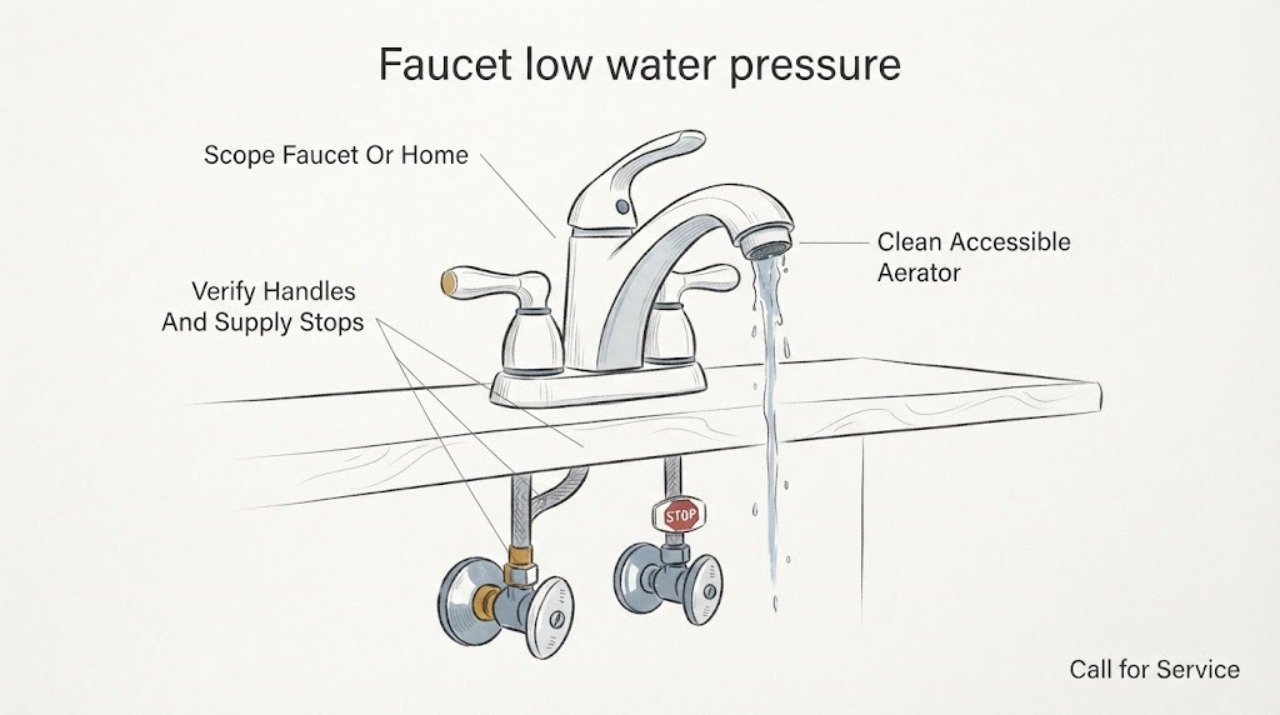
First determine whether low flow affects only the American Standard faucet, only its hot or cold side, or several fixtures in the home. Confirm the handle is fully open and the two under-sink supply stops are open without forcing them, then inspect for a kinked hose or leak. If the faucet has a removable aerator, close the faucet, protect the drain, remove it gently, rinse away debris, and briefly compare flow with the aerator removed; reinstall it if the flow improves. American Standard documents that debris can accumulate in an aerator and cause reduced flow, and its faucet products use model-specific pressure-compensating aerators and cartridges, so do not assume every model takes the same part. If both sides remain weak, the flow is weak with the aerator removed, multiple fixtures are affected, a valve or pipe may be restricted, or there is leaking, flooding, or unsafe plumbing, stop and call a licensed plumber.
Before you begin
Safety first
- Owner checks are limited to normal handle operation, visual supply-stop and hose inspection, a gentle accessible aerator rinse, a brief controlled flow comparison, and a safe spray-path observation. A licensed plumber must handle pressurized disconnections, stuck or leaking valves, cartridge or valve-body work, main supply, pressure-control, pipe, meter, and utility-side service.
Work through in order
Diagnostic checks
Use only checks that match the exact appliance or system and its official guide.
-
Check 1
Run the faucet briefly and compare it with one nearby faucet, without removing parts. Test hot and cold separately if the faucet allows it, and note whether the restriction is at the main spout or only a side spray.
Expected result: Only this faucet is weak, only hot or cold is weak, only the spray head is weak, or several fixtures are weak on both sides.
Next step: Follow the matching local check below. If several fixtures have low flow, avoid disassembling this faucet and arrange plumbing diagnosis for the supply system.
Stop if: Stop for active leaking, flooding, water near electrical equipment, a burst hose, or any fixture that cannot be shut off safely.
Why this matters
Why: A local aerator, supply stop, hose, spray path, or cartridge is more likely when one outlet is affected. A multi-fixture or both-side problem may be upstream of the faucet.
-
Check 2
Set the handle or handles fully open in the normal operating direction, then look under the sink for each faucet supply stop and flexible hose. Confirm a stop is not visibly closed or a hose sharply kinked; turn a stop only gently if it is designed for normal hand operation and there is no leak.
Expected result: A stop is closed or partly closed, a hose is kinked or wet, both stops appear open and dry, or the stops are stuck or inaccessible.
Next step: Correct only an obvious safe setting and observe the faucet once. Do not force a stop or disconnect a hose; call a licensed plumber for leakage, corrosion, a seized valve, or persistent low flow.
Stop if: Stop for dripping or spraying connections, a swollen hose, corrosion, a stop that turns without changing flow, or any need to loosen a pressurized connection.
Why this matters
Why: A local valve setting or hose restriction can reduce one side or both sides. A wet, stuck, corroded, or inaccessible stop needs plumbing attention rather than force.
-
Check 3
Close the faucet, cover the drain, and gently unscrew the removable aerator at the spout using only a suitable hand grip. Keep the small screen and sealing pieces together, rinse the aerator with clear water, and do not force a seized or hidden insert.
Expected result: The screen contains grit or scale, it is clean, the aerator will not loosen without force, or a seal or insert is damaged or missing.
Next step: Reinstall the cleaned parts in their original order and observe flow once. If the part is seized, damaged, or the flow remains weak, stop and use the exact model parts diagram or call a plumber.
Stop if: Stop for a damaged spout, sharp edges, a missing seal, a seized insert, or any need to apply excessive force, heat, chemical cleaner, or penetrating product near drinking water.
Why this matters
Why: Debris in the aerator can restrict the outlet, while a clean or damaged aerator makes it less likely that cleaning alone will restore flow. A seized insert can damage the finish or spout.
-
Check 4
With the aerator removed and the drain covered, briefly run the faucet into the basin while keeping the stream controlled. Do not leave the faucet unattended, splash water toward electrical equipment, or operate it if a connection leaks.
Expected result: Flow is strong without the aerator, flow is still weak, flow is strong on one side only, or water leaks from the spout or an under-sink connection.
Next step: If flow improves, clean or model-match the aerator and reinstall it. If flow stays weak or a leak appears, turn the faucet and affected stop off if safe and call a licensed plumber; do not open the cartridge by guesswork.
Stop if: Stop for leaking connections, uncontrolled spray, water near electrical equipment, a damaged spout, or any need to dismantle the valve body.
Why this matters
Why: Strong flow without the aerator supports a clogged, damaged, or incorrect aerator. Weak flow without it shifts attention toward the supply stop, hose, cartridge, valve body, upstream supply, or a side-specific restriction.
-
Check 5
For a pull-out or pull-down faucet, compare the main spout stream with the spray setting. From above the basin, look for a blocked spray face, a hose that catches under the cabinet, or a kink; do not pull hard on the hose or open a diverter housing.
Expected result: Only spray mode is weak, both modes are weak, the hose is kinked or snagged, the spray face is dirty, or the spray path appears clear.
Next step: Clear only a loose, visible hose snag and rinse an accessible spray face with clear water. If the hose, diverter, or internal screen needs removal, call a plumber with the exact model information.
Stop if: Stop for a leaking pull-out hose, a hose that will not retract, a cracked spray head, water inside the cabinet, or any need to disconnect pressurized fittings.
Why this matters
Why: A spray-head screen, hose routing, or diverter can restrict one outlet while the main faucet remains normal. Weakness in both modes points back to the supply, aerator, cartridge, or upstream plumbing.
-
Check 6
If multiple fixtures are weak, compare hot and cold at another fixture and look only at an accessible main shutoff or pressure-control area for an obvious closed position, leak, or recent plumbing work. Do not adjust a pressure regulator, break a seal, or remove a water meter component.
Expected result: Only one branch is weak, hot and cold are weak throughout the home, the problem began after plumbing work or a utility event, or a main valve or regulator is leaking or inaccessible.
Next step: Leave fixture parts intact and call a licensed plumber or the water utility as appropriate. Do not increase pressure by adjusting an unknown regulator or force a main valve.
Stop if: Stop for a main-line leak, flooding, contaminated water, a stuck valve, a pressure-control device that is damaged, or any need to disturb utility equipment.
Why this matters
Why: Whole-home, both-side low flow is unlikely to be fixed by an American Standard aerator. A main valve, pressure-control device, service line, filter, or utility-side issue may need testing.
-
Check 7
Record the faucet model if already visible, fixture type, affected side or outlet, whether flow changes with the aerator removed, supply-stop and hose observations, other-fixture results, leaks, and any recent work. Do not remove trim or disassemble the faucet just to find a number.
Expected result: Cleaning restores flow, the symptom persists with a clean or removed aerator, the model cannot be confirmed, or water and supply symptoms extend beyond the faucet.
Next step: Use the exact American Standard repair-parts diagram only after the model is confirmed. Otherwise provide the record to a licensed plumber and leave the faucet or affected supply off when leakage is present.
Stop if: Stop after the handle, supply-stop, aerator, spray-path, and comparison checks; do not continue into cartridge removal, valve-body work, soldering, or pressure adjustment as an owner guess.
Why this matters
Why: A restored stream supports an outlet restriction. Persistent low flow with no model identity or broader supply symptoms needs model-specific or plumbing diagnosis, not a guessed cartridge or aerator.
Use your observations
Decision map
Find the observation that best matches what you see, then follow the next safe action.
-
PATH 01Next step
What you see
Only this faucet is weak, the supply stops are open and dry, and flow becomes strong when the aerator is removed or the screen contains debris.
Do this next
Rinse and reinstall the original aerator, or match a replacement to the exact model and documented flow design. If flow falls again, call a plumber rather than repeatedly forcing or enlarging the screen.
-
PATH 02Next step
What you see
Only one side or faucet is weak, the aerator is clean or removed, and a supply stop is partly closed or a flexible hose is kinked, wet, or damaged.
Do this next
Correct only an obvious safe stop position without force. Leave a leaking, corroded, stuck, or damaged connection alone and call a licensed plumber.
-
PATH 03Next step
What you see
The main spout has normal flow but the pull-out or pull-down spray mode is weak, or the spray hose catches under the sink.
Do this next
Rinse only an accessible spray face and clear a loose visible hose snag. Request model-specific service for an internal diverter, hose replacement, or pressurized connection.
-
PATH 04Next step
What you see
Both sides at one faucet remain weak with the aerator removed and supply stops open, while another nearby fixture has normal flow.
Do this next
Keep the faucet usable only if there is no leak and call a plumber or use the exact model manual for a supported repair. Do not pull a cartridge or disturb seals without a safe shutoff and model-specific procedure.
-
PATH 05Next step
What you see
Several fixtures have weak hot and cold flow, the issue began after utility or plumbing work, or an accessible main valve or pressure-control area shows a problem.
Do this next
Call a licensed plumber or water utility as appropriate. Do not adjust an unknown regulator, force a main valve, or disturb a meter or sealed equipment.
-
PATH 06Next step
What you see
Low flow is accompanied by a wet supply hose, active leak, flooding, contaminated water, a burst connection, or water near electrical equipment.
Do this next
Stop using the faucet, close the nearest safe shutoff without force if possible, keep clear of electrical hazards, and obtain urgent qualified plumbing help.
Helpful context
Understand the symptom
Start by separating a faucet problem from a water-supply problem
A single weak faucet often points to a local restriction such as the aerator, supply stop, hose, spray head, or cartridge. Weak flow at several fixtures, or on both hot and cold sides at once, shifts attention toward a partially closed main valve, pressure-reducing equipment, a building supply issue, or a pipe restriction. Compare another nearby faucet without changing the plumbing so you do not replace a faucet part for a whole-home problem.
The aerator is a high-value, low-risk check
American Standard's faucet service instructions say an aerator can accumulate dirt and cause reduced or distorted water flow, and recommend removing it and rinsing it clean. Flow rates and aerator designs vary between American Standard models, so preserve the pieces, avoid forcing a seized part, and confirm the exact model before ordering a replacement. A clean aerator does not explain weak flow with the aerator removed.
Hot-only, cold-only, and spray-side clues change the branch
If only hot or only cold flow is weak, compare the other side and inspect the corresponding supply stop and flexible hose for a kink or leak. If the main spout is acceptable but a pull-out spray head is weak, the spray head, hose, or diverter becomes more relevant. If both sides are weak at the spout even after the aerator check, the restriction may be inside the faucet or upstream. Do not dismantle the cartridge or valve unless the exact manual and safe shutoff procedure support it.
Model identity matters before parts
American Standard lists different aerators and cartridges on different faucet product pages, including pressure-compensating aerators with different rated flows and model-specific cartridge references. Those examples do not establish fit for an unknown faucet. Photograph or record the model information that is already visible, use the matching repair-parts diagram, and stop part selection when the model or symptom does not support a specific diagnosis.
Safety boundary
Stop conditions
- Stop immediately for active leaking, flooding, a burst or swollen hose, contaminated water, water near electrical equipment, a stuck main valve, or any unsafe condition; close a safe shutoff without force and obtain urgent qualified help.
- Do not force a supply stop, loosen a pressurized connection, remove a cartridge or valve body by guesswork, apply heat or chemicals near drinking-water parts, adjust an unknown pressure regulator, or disturb a water meter or sealed utility equipment.
- Do not assume every American Standard faucet uses the same aerator, cartridge, flow rate, or connection. Confirm the exact model and repair-parts information before ordering or installing a part.
- Stop owner troubleshooting after the comparison, supply-stop and hose observation, accessible aerator rinse, and safe spray-path checks. Persistent low flow with the aerator removed or a multi-fixture problem needs licensed plumbing diagnosis.
Only after diagnosis
Potential parts
- faucet aerator
Relevant only when the aerator screen is blocked or damaged, or flow improves with the aerator removed, and the exact faucet model confirms the replacement design.
Confirm the faucet model, thread or insert style, sealing pieces, finish, and documented flow specification; do not substitute a restrictive or unverified aerator. - faucet cartridge
Relevant only when a qualified diagnosis finds an internal cartridge or valve-passage restriction after the aerator, supply stops, hoses, and upstream flow are checked.
Match the exact faucet model, handle configuration, cartridge revision, seals, and manufacturer parts diagram; cartridge work requires safe water shutoff and careful reassembly. - faucet supply hose
Relevant only when a hose is kinked, leaking, collapsed, or confirmed unsuitable by a plumber, rather than when the faucet simply has low flow.
Confirm connection ends, length, seal type, routing, and faucet model; do not loosen a pressurized fitting or reuse a damaged sealing washer. - pull-out spray head or hose
Relevant only when the main spout is normal but spray mode remains weak or the spray hose is damaged after a safe screen and routing check.
Confirm the exact faucet model, spray connection, hose length, diverter arrangement, and seal requirements; do not force or disconnect a leaking under-sink connection. - supply stop valve
Relevant only when a licensed plumber confirms a stuck, leaking, or restricted local supply stop after the faucet and hose are safely isolated.
Match pipe connection, outlet connection, material, shutoff orientation, and local plumbing requirements; replacement is pressurized plumbing work and is not inferred from low flow alone.
When checks do not resolve it
Need a professional?
Call a licensed plumber when flow remains weak with the aerator removed, both hot and cold sides are affected, more than one fixture is weak, a supply stop or hose is leaking or stuck, the cartridge or valve body may be restricted, the model cannot be confirmed, or any pressurized connection, main valve, pressure-control, or utility equipment needs service.
Safety scope: Owner checks are limited to normal handle operation, visual supply-stop and hose inspection, a gentle accessible aerator rinse, a brief controlled flow comparison, and a safe spray-path observation. A licensed plumber must handle pressurized disconnections, stuck or leaking valves, cartridge or valve-body work, main supply, pressure-control, pipe, meter, and utility-side service.
Have this ready
- Provide the faucet type, exact model if already visible, affected hot or cold side and outlet, whether flow improves with the aerator removed, aerator debris, supply-stop and hose observations, spray-head behavior, other-fixture results, leak location, recent plumbing work or utility event, and clear photos taken without disconnecting parts.
Common questions
FAQ
Why does my American Standard faucet have low water pressure?
If only this faucet is weak, check its handle, supply stops, hose, and aerator first. American Standard says debris can collect in an aerator and reduce flow. If flow is still weak with the aerator removed, or several fixtures are affected, the restriction may be in the faucet valve or home supply and needs plumbing diagnosis.
Can a dirty aerator cause low flow on an American Standard faucet?
Yes. American Standard's faucet service guidance identifies aerator debris as a cause of distorted or reduced flow. Close the faucet, protect the drain, gently remove an accessible aerator, rinse it with clear water, and reinstall it. Do not force a seized insert or assume every model uses the same aerator.
How can I tell if the faucet aerator is the problem?
With the aerator removed, briefly run the faucet into the basin. Strong flow without it supports an aerator restriction; weak flow without it shifts attention to the supply stop, hose, cartridge, valve body, or upstream plumbing. Stop if a connection leaks or the aerator cannot be removed gently.
Why is only the hot or cold side of my American Standard faucet weak?
A partly closed or restricted supply stop, kinked hose, or side-specific faucet passage can affect one side. Compare the other side, inspect the corresponding stop and hose without disconnecting them, and call a plumber for a stuck valve, leak, or persistent restriction.
Why is my American Standard pull-down spray weak but the faucet spout is fine?
A spray-head screen, hose routing issue, or diverter may restrict only spray mode. Rinse an accessible spray face and clear a loose hose snag without pulling hard. Internal diverter or hose work should be model-specific and handled by a plumber if a connection must be disconnected.
Why are all faucets in my home low flow?
Low flow at several fixtures on both hot and cold sides points away from one American Standard aerator. A main valve, pressure-control device, house filter, service line, or utility condition may be involved. Call a plumber or water utility as appropriate and do not adjust an unknown regulator.
Should I replace the American Standard cartridge for low flow?
Not from low flow alone. First compare fixtures, check the accessible supply path, and test the aerator safely. A cartridge is conditional only when model-specific diagnosis supports an internal restriction; American Standard cartridges vary by faucet model, so verify the exact parts diagram before any repair.
Can I use any American Standard aerator as a replacement?
No. American Standard product pages list model-specific aerators and different documented flow designs. Confirm the exact faucet model, insert or thread style, seals, and flow specification before ordering. A brand match alone does not prove fit.
What if the faucet has low flow and a leak under the sink?
Stop using the faucet, close the nearest safe shutoff without force if possible, and keep water away from electrical equipment. Do not loosen a wet or pressurized connection. Call a licensed plumber, urgently if water is spreading or the shutoff will not control it.
What information should I give the plumber?
Share the faucet type and model if already visible, affected side and outlet, aerator condition and no-aerator flow result, supply-stop and hose observations, other-fixture comparison, spray behavior, leak location, recent work, and safe photos. Do not disassemble the faucet solely to find more information.
Read the exact guide
Official sources
- Berwick 2-Handle Wall Mount Faucet 1.2 gpm/4.5 L/min With Lever HandlesAmerican Standard · Manufacturer product page showing that another faucet family has its own valve construction, aerator, supply configuration, and flow specification
- Culinaire faucet installation and service instructionsAmerican Standard · Manufacturer knowledge-base document describing aerator removal, flushing water supplies, leak checks, and debris causing distorted or reduced water flow
- Pc Aerator 55/64 FemaleAmerican Standard · Manufacturer product page showing an aerator's model association, pressure-compensating design, and documented flow specification
- Studio S Single Hole Single-Handle Bathroom Faucet 1.2 gpm/4.5 L/min With Lever HandleAmerican Standard · Manufacturer product page demonstrating that a specific faucet model lists its own cartridge, aerator, supply configuration, and flow specification
- Monterrey Single-Handle Gooseneck Kitchen Faucet 1.5 gpm/5.7 LpmAmerican Standard · Manufacturer product page showing a model with spray-related configuration, pressure-compensating aerator, ceramic cartridge, and model-specific flow information
Community feedback
Share a repair observation
Share a plain-text repair observation. Accepted observations are published automatically; this page may take a moment to update.