
On this page
Start here
Quick answer
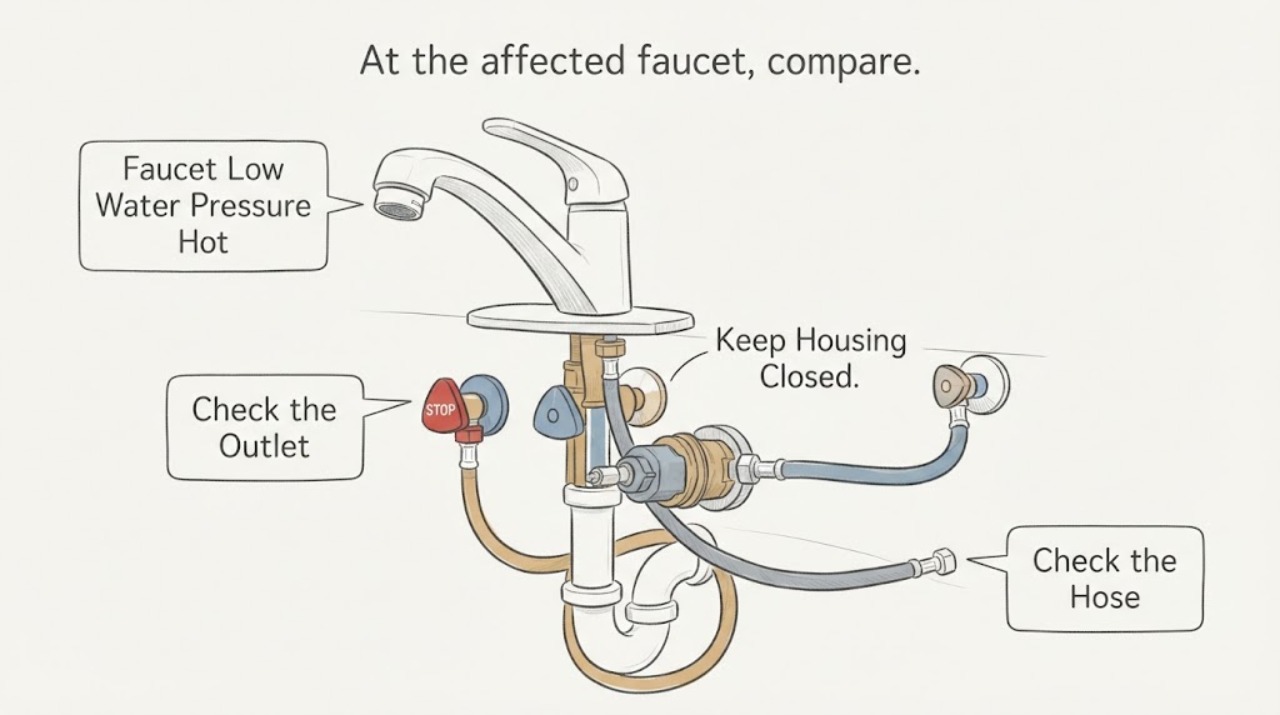
First compare the faucet with another fixture and compare hot flow with cold flow at the same faucet. Low flow on only one side points toward that side's shutoff, supply hose, cartridge, valve, or a localized obstruction; low flow on both sides points more toward the aerator, faucet body, common supply, or house pressure. Visually check that accessible shutoff valves are not partly closed and that hoses are not kinked, without forcing a valve or loosening a connection. If the aerator can be removed safely according to the exact faucet instructions, clean it; otherwise leave it in place. Persistent one-sided or whole-house low flow needs a plumber, especially with leaks, corrosion, sudden loss, or water near electricity.
Before you begin
Safety first
- User checks are limited to controlled flow comparison, visual inspection, and model-approved cleaning of an accessible outlet screen. A qualified plumber must handle pressurized connections, cartridge or valve disassembly, concealed lines, pressure regulators, supply flushing, and leak repair.
Work through in order
Diagnostic checks
Use only checks that match the exact appliance or system and its official guide.
-
Check 1
Run the affected faucet briefly and compare its flow with another nearby faucet or fixture, using a safe, controlled stream; note whether the low flow affects one outlet or several and whether both hot and cold sides are affected.
Expected result: Only one faucet is weak, several fixtures are weak, only one side is weak at multiple fixtures, or the whole home has a pressure change.
Next step: Follow the local or whole-system branch. Stop using the fixture if water is spraying, leaking, discolored unexpectedly, or reaching electricity.
Stop if: Stop for flooding, a burst hose, a failed shutoff, water near electrical equipment, or any inability to control the stream.
Why this matters
Why: A single-faucet symptom points toward the fixture, its shutoffs, hoses, or local branch. Several fixtures shift attention to a common supply, service pressure, shutoff, filter, or plumbing restriction. A hot-only or cold-only pattern remains useful even when more than one fixture is involved.
-
Check 2
At the affected faucet, compare the hot and cold sides separately and note normal flow, weak flow, or no flow; use only a modest stream and avoid assuming the handle's color or direction proves which supply is connected.
Expected result: Hot is weak while cold is normal, cold is weak while hot is normal, both are weak, or the sides are reversed or uncertain.
Next step: Photograph the faucet and visible supply layout and continue only with visual checks. Do not remove hoses or open the faucet body to prove the side.
Stop if: Stop if the water is dangerously hot, a fitting sprays, the handle is loose or stuck, or the supply identity cannot be established safely.
Why this matters
Why: One-sided reduction supports a side-specific shutoff, hose, inlet screen, cartridge, or valve restriction. Both-sided reduction keeps the aerator, faucet body, common supply, and building pressure in focus. Reversed or uncertain connections require model-specific assessment.
-
Check 3
Look beneath the sink for the hot and cold shutoff valves and their hoses; check visually for a partly closed valve, kink, crush, twist, corrosion, wetness, or unsupported hose, without forcing the valve or loosening a connection.
Expected result: The weak side has a visibly restricted valve or kinked hose, a connection is wet or corroded, or both visible supply paths look open and sound.
Next step: If a valve's normal open position is obvious and it moves without force, follow the exact fixture instructions; otherwise leave it alone and call a plumber. Do not use a wrench or disconnect the hose as a test.
Stop if: Stop for a seized valve, active leak, damaged hose, corrosion, water near an outlet, or uncertainty about which valve serves the faucet.
Why this matters
Why: A side-specific valve or hose restriction can reduce that side's pressure. Wet or corroded connections are leak hazards. Sound visible supplies move suspicion toward the faucet inlet, cartridge, aerator, concealed line, or upstream supply.
-
Check 4
Inspect the faucet outlet, aerator, or sprayhead for visible scale, sediment, or a blocked screen; remove and clean it only if it is hand-accessible and the exact faucet instructions permit that step, keeping small parts contained.
Expected result: Debris is visible at the outlet, both hot and cold flows are reduced equally, the sprayhead behaves differently from the faucet hose, or the outlet appears clear.
Next step: Clean and reinstall only according to the model instructions, then perform one controlled comparison. If flow remains low, do not flush or disconnect supply lines without the exact guide; arrange service.
Stop if: Stop for a seized aerator, damaged threads, a hidden screen that requires disassembly, a leak, or any need to use tools on a pressurized connection.
Why this matters
Why: A clogged outlet or flow restrictor can reduce both sides, while a clear outlet with one-sided loss points farther upstream. A pull-out or pull-down design may have a separate spray hose or screen restriction.
-
Check 5
Record the faucet brand, exact model if safely readable, one- or two-handle design, pull-out or pull-down style, and whether the low flow began after installation, a water shutoff, plumbing work, or a supply interruption.
Expected result: The model and recent trigger are clear, the issue started after plumbing work, or the model and timing are unknown.
Next step: Give the model and timing to a plumber or use the exact manufacturer's guide. Preserve uncertainty when the model is unknown; do not copy a procedure from a similar faucet.
Stop if: Stop if identification requires removing trim, a handle, a hose, or a pressurized fitting.
Why this matters
Why: Debris introduced during installation or a water interruption can affect the supply path, while a long-term one-sided decline can involve a cartridge, valve, hose, or mineral restriction. Unknown identity prevents safe part selection or flushing assumptions.
-
Check 6
Arrange qualified plumbing service when low flow persists after safe visual checks, affects multiple fixtures, returns after cleaning, or involves a cartridge, valve, concealed pipe, building pressure, or supply-line restriction; provide the comparison results and photos.
Expected result: The low flow remains one-sided, remains on both sides, affects the home, recurs quickly, or appears with a leak, corrosion, noise, or discoloration.
Next step: Leave the fixture in a safe state, isolate it only with a normally operating shutoff if needed to prevent damage, and have the plumber identify the restriction before selecting a part or altering house pressure.
Stop if: Do not repeatedly cycle shutoffs, disconnect hoses, remove the cartridge, alter pressure regulators, or flush an unknown plumbing path.
Why this matters
Why: Persistent or broad low flow requires pressure measurement or faucet, supply, cartridge, valve, filter, or concealed-pipe diagnosis that cannot be established from an external check.
Use your observations
Decision map
Find the observation that best matches what you see, then follow the next safe action.
-
PATH 01Next step
What you see
Only hot flow is weak while cold flow is normal at one faucet, and other fixtures have normal pressure.
Do this next
Inspect the hot valve and hose without force, then arrange faucet-side plumbing service if the restriction is not obvious. Do not disconnect the hot hose to flush it.
Why this path and its safety boundary
Why it matters: A hot-side shutoff, supply hose, inlet screen, cartridge, valve, or localized hot-water restriction is more likely than a common aerator or house-pressure problem.
-
PATH 02Next step
What you see
Only cold flow is weak while hot flow is normal at one faucet, and other fixtures are normal.
Do this next
Check only the visible cold valve and hose for an obvious restriction, record the model, and call a plumber if flow does not return without force.
Why this path and its safety boundary
Why it matters: A cold-side shutoff, supply hose, inlet screen, cartridge, valve, or localized cold-water obstruction is more likely.
-
PATH 03Next step
What you see
Both hot and cold sides are weak at the same faucet, especially after plumbing work or a water interruption.
Do this next
Clean an accessible outlet screen only as the exact manual permits and perform one comparison. If flow remains low, arrange service for flushing or faucet diagnosis.
Why this path and its safety boundary
Why it matters: A clogged aerator or sprayhead, debris in the common faucet body or supply, or a shared upstream restriction is more plausible than a single hot or cold shutoff.
-
PATH 04Next step
What you see
Several fixtures have low flow on both sides, or the whole home changed at once.
Do this next
Do not alter the pressure regulator or main plumbing as a user test. Check only for an obvious visible service interruption and arrange a plumber or water utility assessment.
Why this path and its safety boundary
Why it matters: The restriction may be at a main shutoff, filter, pressure-control device, service supply, or building plumbing rather than the faucet.
-
PATH 05Next step
What you see
Flow is low with a leak, wet or corroded connection, sudden loss, unusual noise, discolored water, or water near electrical equipment.
Do this next
Keep people away, isolate the fixture or main supply only if the valve can be reached safely and operates normally, and obtain prompt plumbing help. Do not touch wet electrical equipment.
Why this path and its safety boundary
Why it matters: This is an active plumbing or property-damage concern, not a routine aerator check.
Helpful context
Understand the symptom
The hot-versus-cold comparison is the useful first split
If cold flow is normal but hot flow is weak, a hot-side shutoff, hose, or faucet valve is more likely than a common aerator. If both sides are weak, the restriction may be at the aerator, sprayhead, faucet body, common supply, or house pressure. A second fixture shows whether the change is local or building-wide. The pattern narrows the path but does not identify a part by itself.
Start with external, low-force checks
Look under the sink for the hot and cold supply stops and hoses. A valve that is partly closed or a kinked hose can reduce one side, but corroded or seized connections should be left alone. Check the faucet outlet or sprayhead for visible mineral debris only when the model instructions permit removal. Do not pull on a pressurized hose, probe a valve, or open the cartridge as a first test.
A sudden change needs a different level of caution
A gradual reduction after plumbing work can involve debris, while a sudden loss with a wet cabinet, burst hose, corrosion, or whole-house pressure change needs prompt service. Record the faucet model, fixture comparison, hot/cold difference, and visible hose or valve condition. Model-specific cartridges, sprayheads, and supply components are not interchangeable by appearance.
Safety boundary
Stop conditions
- Do not force or wrench a shutoff, disconnect a supply hose, open a pressurized connection, or remove a cartridge as a generic flow test.
- Do not alter a main pressure regulator, bypass a filter, flush an unknown plumbing path, or copy a faucet procedure from another model.
- Stop for spraying water, a burst or corroded hose, flooding, water near electricity, discolored water with a strong odor, or a failed shutoff.
- Do not use a tool on a seized aerator or screen; stop if cleaning would damage threads, seals, or the faucet body.
- Keep the faucet isolated if safe and arrange qualified service for persistent one-sided, both-sided, or whole-house low flow.
Only after diagnosis
Potential parts
- faucet aerator or sprayhead screen
Consider only if both sides are reduced and inspection identifies a clogged or damaged outlet screen or sprayhead that cleaning does not resolve.
Confirm the exact faucet model, outlet thread, flow design, and manufacturer requirements; a visually similar aerator may change performance or not fit. - hot or cold supply hose
Consider only if a plumber confirms a kinked, crushed, leaking, corroded, or internally restricted side-specific hose.
Connection type, length, material, and local requirements must be verified in place; do not disconnect a pressurized hose as a test. - faucet cartridge or valve
Consider only after visible supply and outlet checks show that one side remains restricted and a professional or exact model guide identifies the cartridge or valve.
Cartridges and valves are model-specific and may not be interchangeable across a brand or handle style; confirm fit before ordering.
When checks do not resolve it
Need a professional?
Arrange plumbing service when one side remains weak after an obvious visual restriction is addressed, both sides remain low after an accessible outlet check, several fixtures are affected, or the symptom recurs after cleaning. Seek prompt help for a leak, corroded or failed connection, sudden whole-home pressure loss, discolored water, unusual noise, or water near electrical equipment.
Safety scope: User checks are limited to controlled flow comparison, visual inspection, and model-approved cleaning of an accessible outlet screen. A qualified plumber must handle pressurized connections, cartridge or valve disassembly, concealed lines, pressure regulators, supply flushing, and leak repair.
Common questions
FAQ
Why is only the hot side of my faucet low pressure?
A hot-side shutoff, supply hose, inlet screen, cartridge, valve, or localized hot-water restriction may be limiting flow. Compare another fixture and inspect only the visible hot valve and hose without force.
Why are both hot and cold sides low at one faucet?
A clogged aerator or sprayhead, debris in the common faucet body or supply, or a local branch restriction is more likely. Clean an accessible screen only as the model permits; persistent low flow needs service.
Can a kinked hose cause low flow on one side?
Yes. Manufacturer guidance identifies a kinked or restricted hot or cold supply hose as a possible cause. Look for a visible kink, but do not pull, disconnect, or straighten a pressurized hose by force.
Should I remove the aerator to test low pressure?
Only when the exact faucet instructions permit a safe, hand-accessible removal. Keep small parts contained and stop for seized threads or a leak. Do not assume an aerator is the cause when only one side is weak.
What if low pressure affects every faucet?
The problem may be at a main shutoff, filter, pressure-control device, service supply, or building plumbing. Do not adjust the regulator as a user experiment; arrange a plumber or water utility assessment.
When is low faucet pressure urgent?
Get prompt help for a leak, burst or corroded hose, sudden whole-home loss, flooding, discolored water with a strong odor, unusual noise, a failed shutoff, or water near electrical equipment. Do not continue testing a hazardous fixture.
Read the exact guide
Official sources
- Why does my faucet have low water pressure?Delta Faucet · General Delta faucet guidance; the exact faucet, installation, and safe access determine whether any outlet cleaning or flushing applies.
- Low water flow from spout- ONLY hot or cold water on sink faucetsMoen Solutions · Moen sink-faucet troubleshooting guidance; the exact faucet and plumbing installation control any repair.
- Low Flow from Hot and Cold Water | Kitchen Faucets | Kohler AssistKohler Assist · Kohler kitchen-faucet guidance used for general flow-path distinctions; the exact faucet design and manual control service steps.
Community feedback
Share a repair observation
Share a plain-text repair observation. Accepted observations are published automatically; this page may take a moment to update.