
On this page
Start here
Quick answer
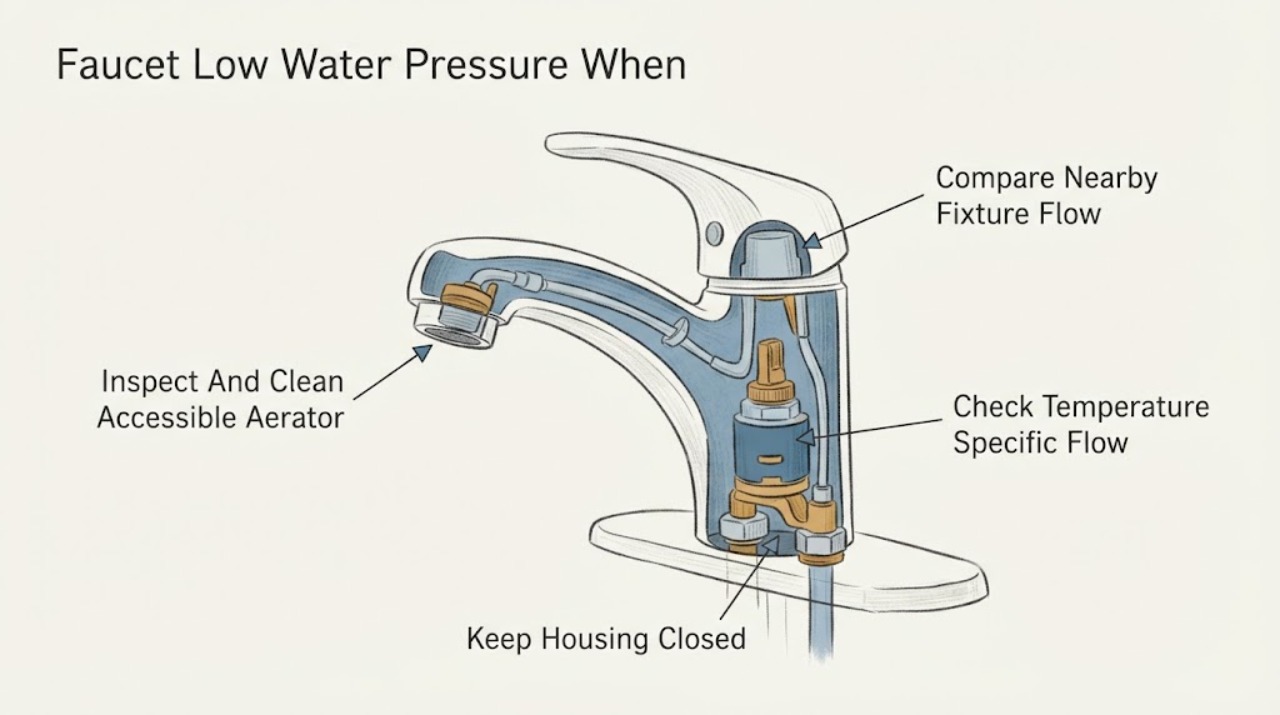
When only one faucet has low flow, the restriction is more likely local to that fixture than to the home's main supply, but compare another nearby faucet before assuming that. With the water running normally, note whether both hot and cold sides are weak or only one temperature is weak. A clogged aerator or flow restrictor is a common first check for low flow at one spout; a side sprayer or pull-down wand can have its own screen or diverter path. Confirm that the two fixture shutoff valves are fully open and not visibly leaking or corroded, but do not force them. If removing and rinsing an accessible aerator does not restore flow, or if the problem is temperature-specific, model-specific, under-sink, or accompanied by leaking, a cartridge, inlet screen, hose, diverter, valve, or supply issue may need professional diagnosis. Do not open a pressurized faucet, disconnect supply lines, or order a cartridge by appearance alone.
Before you begin
Safety first
- The plumber should determine whether the restriction is at the aerator, flow restrictor, wand or hose screen, diverter, cartridge, inlet screen, fixture shutoff, supply line, valve body, or a wider plumbing branch before selecting parts.
Work through in order
Diagnostic checks
Use only checks that match the exact appliance or system and its official guide.
-
Check 1
Run the affected faucet normally and compare its hot and cold flow with a nearby faucet supplied by the same property, without changing the main shutoff or using a pressure gauge.
Expected result: Only this faucet is weak, several fixtures are weak, the issue affects one temperature, or the comparison cannot be made safely.
Next step: If only this faucet is weak, continue with local spout, shutoff, hose, and model checks; arrange plumbing service for multi-fixture loss or an unclear comparison.
Stop if: Do not adjust the building's main valve, disturb a pressure regulator, or enter a wet or unstable cabinet to make the comparison.
Why this matters
Why: One affected fixture keeps the restriction local to the faucet, fixture shutoffs, or its short supply path. Several fixtures being weak changes the problem toward a branch or whole-property supply issue.
-
Check 2
Operate the faucet normally and note whether the hot side, cold side, or both sides have reduced flow; do not force a stiff handle or repeatedly cycle a damaged control.
Expected result: Only hot is weak, only cold is weak, both are weak, flow changes with handle position, or the handle is stiff or loose.
Next step: Record the affected side and handle behavior before cleaning or ordering parts; request service for a stiff, loose, leaking, or damaged control.
Stop if: Do not force or remove the handle, open the valve body, or touch hot supply hardware while the cause is uncertain.
Why this matters
Why: Temperature-specific reduction keeps that side's cartridge, valve path, or supply connection in focus. Low flow on both sides makes an aerator, inlet, diverter, screen, cartridge, or shared supply restriction more plausible.
-
Check 3
If the spout aerator or flow restrictor is clearly accessible and can be removed by the manufacturer's normal hand procedure without force, remove it, rinse visible debris, and reinstall it correctly; otherwise inspect it in place and stop.
Expected result: Scale or debris is visible, the aerator is clean, flow improves after rinsing, flow remains low, or the aerator is concealed, seized, damaged, or missing.
Next step: Use the exact model instructions for a replacement aerator if cleaning fails; arrange service when access is difficult, the part is damaged, or flow remains low.
Stop if: Do not use pliers or excessive force on a seized aerator, remove a concealed flow device without the proper tool, or leave parts out of the faucet.
Why this matters
Why: Debris at the spout end can restrict flow and improvement after cleaning supports a local aerator blockage. Persistent low flow points to an inlet screen, cartridge, diverter, hose, valve, or supply path instead.
-
Check 4
From a dry, stable position under the sink, look at both fixture shutoff valves and supply lines for a partly closed valve, kink, corrosion, moisture, or a damaged connection; turn a clearly identified valve only if it moves normally and no leak or hazard is present.
Expected result: A valve is partly closed, both valves are open, a supply line is kinked or wet, a shutoff is corroded or seized, or the under-sink area cannot be accessed safely.
Next step: Restore a clearly partly closed valve only with normal gentle movement; otherwise leave it as found, photograph the condition, and request plumbing service.
Stop if: Do not force a shutoff, disconnect a supply line, tighten a wet connection, enter standing water, or touch hot or corroded hardware.
Why this matters
Why: A partly closed valve or kink can limit flow at one fixture. Moisture, corrosion, or a seized valve changes the task to a plumbing repair and can turn a low-flow check into a leak risk.
-
Check 5
On a pull-down, pull-out, or side-sprayer faucet, compare the main spout and sprayer only through normal operation and inspect the visible hose or wand screen for kinks or debris; do not disconnect pressurized lines.
Expected result: The sprayer has good flow while the spout is weak, both are weak, the hose is kinked, a screen is visibly blocked, or the faucet has no sprayer or the path cannot be checked.
Next step: Clean only an accessible screen according to the manufacturer's instructions; if the hose path remains weak or a diverter or cartridge is suspected, arrange model-specific service.
Stop if: Do not pull hard on a hose, disconnect a supply or wand under pressure, force a diverter, or operate a leaking sprayer.
Why this matters
Why: Good flow at the sprayer with weak spout can keep a diverter, spout aerator, or spout-end path in focus. Low flow from both paths makes a cartridge, inlet restriction, or supply issue more plausible.
-
Check 6
Photograph the full faucet, handle arrangement, aerator or sprayer, visible brand or model marking, shutoff valves, and the flow pattern before ordering any part or opening the faucet body.
Expected result: The exact model is known, only the brand or style is known, the faucet is damaged or leaking, or low flow persists after a safe aerator and valve check.
Next step: Use the manufacturer's product and parts information or provide the record to a qualified plumber; request service for persistent, temperature-specific, or unresolved low flow.
Stop if: Do not order a cartridge or valve by appearance, open the pressurized body, or continue operating a faucet with a leak or unsafe cabinet condition.
Why this matters
Why: Model identity lets the manufacturer distinguish cartridge, diverter, screen, wand, aerator, and valve parts. Brand-only identification or persistent low flow cannot establish a compatible repair.
Use your observations
Decision map
Find the observation that best matches what you see, then follow the next safe action.
-
PATH 01Next step
What you see
Other nearby fixtures have normal flow, both temperatures are weak at this faucet, debris or scale is visible at an accessible aerator, and flow improves after a correct rinse and reinstall.
Do this next
Monitor the faucet, use the exact model aerator if replacement is needed, and request service if low flow returns or the aerator cannot be safely serviced.
Why this path and its safety boundary
Why it matters: A local spout-end blockage is more likely than a property-wide pressure problem, although recurrence can indicate debris entering the faucet or another restriction.
-
PATH 02Next step
What you see
Only hot or only cold flow is weak, or flow changes with one handle or side while the other temperature remains normal.
Do this next
Record the affected side and model, avoid disassembly, and arrange model-specific plumbing service if a normal shutoff and aerator check do not resolve it.
Why this path and its safety boundary
Why it matters: The affected temperature path's cartridge, valve, supply shutoff, or inlet restriction is more likely than an aerator that serves both temperatures.
-
PATH 03Next step
What you see
A pull-down wand or side sprayer has different flow from the main spout, or the hose screen or diverter path is visibly restricted.
Do this next
Clean only an accessible screen under the manufacturer's instructions and request service for a diverter, cartridge, hose, or persistent restriction.
Why this path and its safety boundary
Why it matters: A wand screen, hose, diverter, or spout path is more likely than a whole-property pressure fault; the correct component depends on the faucet model.
-
PATH 04Next step
What you see
The affected fixture's valve is partly closed, a supply line is kinked or wet, or the shutoff is corroded, seized, or inaccessible.
Do this next
Use gentle normal movement only for a clearly partly closed valve; otherwise leave it alone and arrange plumbing service for the valve, line, or cabinet condition.
Why this path and its safety boundary
Why it matters: A local supply restriction or plumbing defect can reduce flow before water reaches the faucet and may worsen into a leak.
-
PATH 05Next step
What you see
Only one faucet remains weak after a safe aerator, sprayer, and shutoff check, or the model, component, or restriction cannot be confirmed.
Do this next
Provide the model and flow record to a qualified plumber and avoid opening or flushing the faucet body as a guess.
Why this path and its safety boundary
Why it matters: A cartridge, inlet screen, valve body, diverter, hose, hidden supply issue, or another model-specific restriction remains possible; flow symptoms alone do not identify the part.
Helpful context
Understand the symptom
One affected fixture usually means a local restriction
If other faucets have normal flow, start at the affected faucet rather than adjusting the home's main supply. Compare hot and cold flow, then inspect the spout aerator, screen, wand, and fixture shutoffs from safe access. A blockage at the spout can reduce flow while the home's supply remains normal.
The faucet design determines the next branch
A single-handle faucet may use one cartridge, while a two-handle faucet can have separate hot and cold paths. Pull-down or pull-out faucets and side sprayers can add screens, hoses, or diverters. Low flow on one temperature, low flow from the hose, and low flow only at the wand do not point to the same component.
Use a safe cleaning boundary and identify the model
An accessible aerator can often be removed and rinsed according to the faucet manufacturer's instructions. Stop if it is concealed, seized, damaged, or requires force. Photograph the faucet and model information before considering a cartridge, valve, hose, or diverter; manufacturer parts are design- and model-dependent.
Safety boundary
Stop conditions
- Do not force fixture shutoff valves, stiff handles, seized aerators, or concealed flow devices; stop for any leak, spray, wet cabinet, hot-water hazard, or standing water.
- Do not disconnect supply lines, open a cartridge or valve body under pressure, flush internal parts without model instructions, or use improvised tools that can damage the faucet.
- Do not order a cartridge, diverter, valve, wand, hose, or aerator by appearance alone; model and handle design determine the correct part family.
- Arrange qualified plumbing service for persistent or temperature-specific low flow, a corroded or inaccessible shutoff, wet supply lines, unresolved one-fixture restriction, or any condition that cannot be checked safely.
Only after diagnosis
Potential parts
- faucet aerator or spout-end flow restrictor
Consider this category only when other fixtures have normal flow, both faucet temperatures are weak, and the accessible aerator or restrictor is visibly scaled, blocked, damaged, or missing after confirming the model.
Confirm the faucet model, aerator attachment, flow requirements, and manufacturer parts information; aerators and restrictors are not universal. - faucet cartridge, inlet screen, diverter, or wand screen assembly
Consider this broader category only after a safe aerator, sprayer, and fixture-shutoff check leaves temperature-specific flow loss, low flow from the hose, or persistent one-faucet restriction.
Do not order from appearance; confirm the exact faucet model, handle and sprayer design, affected side, and manufacturer fit information first.
When checks do not resolve it
Need a professional?
Use prompt service for persistent or temperature-specific low flow, a wet or corroded shutoff or supply line, a faucet that cannot be safely disassembled, or low flow that returns after aerator cleaning. Treat uncontrolled water, a spray, hot-water hazard, or electrical exposure as urgent.
Safety scope: The plumber should determine whether the restriction is at the aerator, flow restrictor, wand or hose screen, diverter, cartridge, inlet screen, fixture shutoff, supply line, valve body, or a wider plumbing branch before selecting parts.
Have this ready
- Photos of the faucet, handle arrangement, aerator or sprayer, model marking, shutoff valves, and any wet or corroded supply area
- Whether nearby fixtures have normal flow and whether the affected faucet is weak on hot, cold, or both sides
- Whether the faucet has a pull-down, pull-out, or side sprayer and how flow compares between the spout and sprayer
- The aerator, screen, filter, or shutoff checks performed and whether flow changed afterward
- Any leaking, kinked hose, prior repair, water shutoff, plumbing work, or recurring debris history
Common questions
FAQ
Why does only one faucet have low water pressure?
When nearby fixtures have normal flow, the restriction is more likely at that faucet's aerator, flow restrictor, cartridge, inlet screen, diverter, sprayer, shutoff, or short supply line. Compare hot and cold flow and check the local components before investigating the whole property.
Should I clean the faucet aerator first?
If the aerator is accessible and can be removed using the manufacturer's normal procedure without force, rinsing visible scale or debris is a reasonable first check. Stop for a seized or concealed aerator and arrange service if flow remains low.
What if only the hot or cold side has low flow?
Temperature-specific loss keeps that side's cartridge, valve path, inlet, or fixture shutoff in focus rather than an aerator serving both temperatures. Record the affected side and model; do not disassemble a pressurized control as a guess.
Can a pull-down sprayer cause low flow at one faucet?
Yes. A wand screen, hose, diverter, or spout path can affect a pull-down, pull-out, or side-sprayer faucet. Compare flow at the spout and sprayer through normal operation, clean only an accessible screen under the exact instructions, and call a plumber for persistent restriction.
When should I call a plumber for one faucet with low flow?
Request service when a safe aerator and fixture-shutoff check does not restore flow, when only one temperature is affected, the shutoff or supply line is wet or corroded, the model is unknown, or a cartridge, diverter, inlet screen, or valve body may be involved.
Read the exact guide
Official sources
- Bathroom FaucetsU.S. Environmental Protection Agency · EPA explains that faucet accessories such as aerators affect flow and performance and describes WaterSense flow criteria for private bathroom sink faucets.
- Kitchen Faucet: Low FlowMoen Incorporated · Moen recommends checking fixture shutoff valves and distinguishes temperature-specific low flow from overall low flow, aerator, diverter, spray-wand, and cartridge paths.
- Why does my faucet have low water pressure?Delta Faucet Company · Delta explains that clogged aerator flow restrictors can reduce flow and provides manufacturer-specific flushing guidance while distinguishing internal component work.
- Low water flow from spout- BOTH hot and cold water on sink faucetsMoen Incorporated · Moen identifies model-dependent debris, aerator, cartridge, diverter, wand, and supply-line paths for low flow affecting both hot and cold water.
- Find Parts and Identify Your ProductDelta Faucet Company · Delta directs users to enter a model number for product-specific parts and distinguishes single-handle and two-handle cartridge categories.
Community feedback
Share a repair observation
Share a plain-text repair observation. Accepted observations are published automatically; this page may take a moment to update.