
On this page
Start here
Quick answer
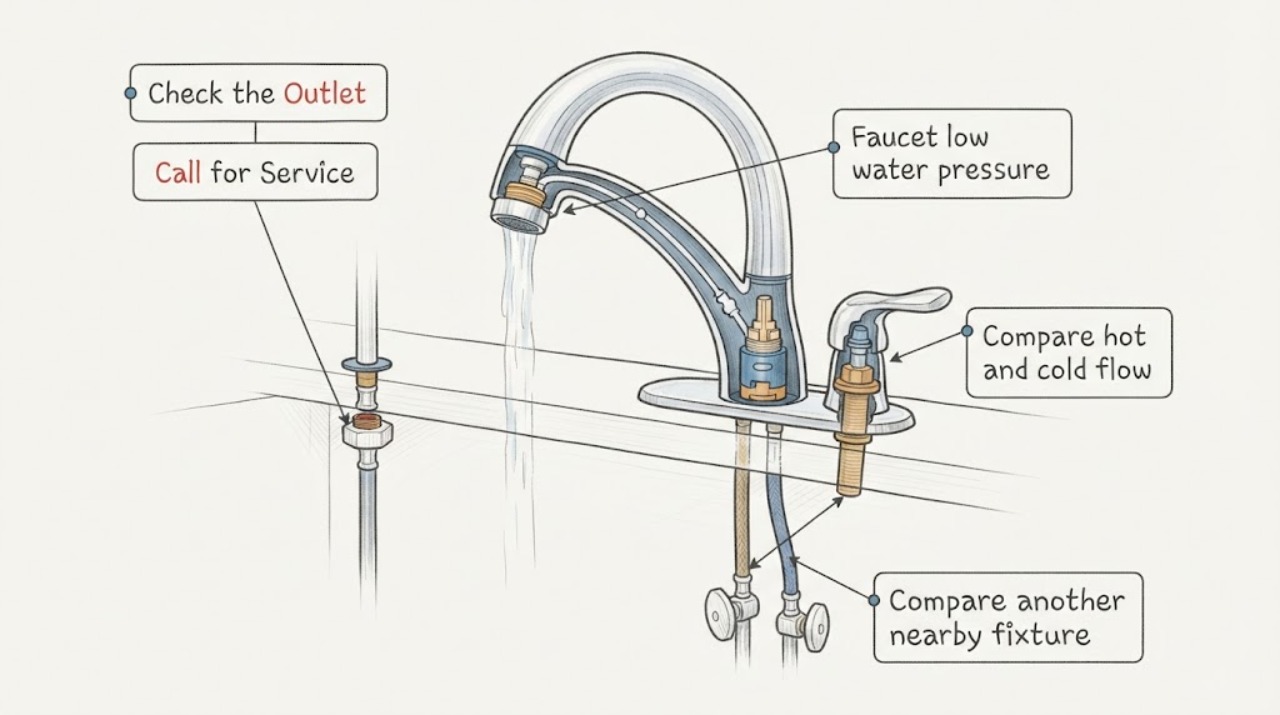
Start by comparing the faucet's hot and cold flow, then compare another nearby fixture and inspect only visible outlet, hose, and valve conditions. Weak flow from one side often points toward that side's supply or cartridge; weak flow from both sides can involve the aerator, cartridge, diverter, supply, or a broader water problem. Do not force a valve, loosen a pressurized connection, or disassemble the faucet under pressure. If the problem is sudden, affects several fixtures, comes with a leak, discoloration, unusual noise, or cannot be isolated safely, arrange a plumber.
Work through in order
Diagnostic checks
Use only checks that match the exact appliance or system and its official guide.
-
Compare hot and cold flow at the same faucet
Using the faucet's normal handles without forcing them, compare the hot-only, cold-only, and mixed positions while watching the stream and the exposed connections for leaks.
Expected result: Cold may be weak while hot is normal, hot may be weak while cold is normal, both may be weak, or the flow may pulse or change as the handle moves.
Next step: Record which comparison occurred and stop using the affected side if operating it produces leaking or unusual noise. Do not remove the handle or cartridge to investigate further.
Stop if: Stop if a handle is stiff, a connection leaks, water sprays unexpectedly, or a valve would need to be forced.
Why this matters
Why: A difference between hot and cold points toward one supply path, inlet screen, or cartridge passage; weakness on both sides makes an outlet restriction, cartridge, diverter, or broader supply issue more plausible. Pulsing or a leak changes the priority toward professional inspection.
-
Compare another nearby fixture
Use one nearby faucet or fixture that is already safe and normally accessible, then compare its flow with the affected faucet without changing supply valves or creating a new load on the plumbing.
Expected result: The other fixture may have normal flow, similarly weak flow, or a different hot/cold pattern.
Next step: Give the comparison to a plumber or building maintenance contact. If several fixtures are suddenly weak, check only for an already-visible service interruption notice or leak and arrange prompt assessment.
Stop if: Stop if another fixture shows flooding, discolored water, a sewage concern, or any unsafe condition; do not continue comparisons.
Why this matters
Why: Normal flow elsewhere makes a local faucet outlet, cartridge, hose, or visible supply issue more likely. Similar weakness at several fixtures points toward a shared supply, shutoff, pressure, or building problem rather than just the affected spout.
-
Inspect the visible outlet and spray screen
With the faucet off, look at the exposed aerator or spray-head screen and any visible side-spray outlet for mineral buildup, debris, a distorted spray pattern, or an obstruction; do not unscrew or pull parts from a pressurized faucet.
Expected result: The outlet may look clear, show visible scale or debris, have an irregular spray, or have no accessible screen because the model uses a concealed or in-line filter.
Next step: Photograph the visible condition and identify the faucet model if possible. Have a plumber or the model's documented service procedure handle any removal or cleaning that requires pressure isolation.
Stop if: Stop if the part is stuck, the spout or hose begins to twist, the connection is wet, or removal would require tools or pressurized disassembly.
Why this matters
Why: A visible obstruction can explain a local low-flow symptom, while a clear outlet or inaccessible filter leaves the cartridge, supply path, or broader plumbing as possible causes. Aerator designs and flow rates vary by model.
-
Look at exposed supply and shutoff conditions
From outside the cabinet, observe the accessible supply hoses, pipes, and shutoff valves for kinks, dampness, corrosion, or an obviously closed handle; do not turn a stiff valve, disconnect a line, or reach into pooled water.
Expected result: The lines may look dry and open, one line may appear kinked or damp, or the shutoff state may be unclear.
Next step: Keep the cabinet area accessible and provide photographs to a plumber. If there is active leaking, protect nearby contents without manipulating the connection and request prompt service.
Stop if: Stop immediately for active leaking, corrosion that may fail when touched, pooled water near electrical equipment, or any need to force a valve or fitting.
Why this matters
Why: A visible kink or leak can restrict flow or require prompt repair, while an unclear or stiff valve should not be treated as a user adjustment. A normal visible supply condition shifts attention back to the faucet outlet or internal components.
Use your observations
Decision map
Find the observation that best matches what you see, then follow the next safe action.
-
PATH 01Next step
What you see
A supply connection, valve, hose, or faucet body is actively leaking, spraying, or worsening.
Do this next
Stop the observation, keep clear of the connection, protect the area from water damage if safe, and request prompt plumbing service; do not force a shutoff or disconnect a pressurized line.
-
PATH 02Next step
What you see
Only hot or only cold flow is weak at the affected faucet.
Do this next
Record the affected side and visible supply condition. Arrange a plumber to assess that supply path, inlet, or cartridge without homeowner disassembly.
-
PATH 03Next step
What you see
The affected faucet is weak but another nearby fixture has normal flow, with no leak.
Do this next
A local aerator, screen, hose, cartridge, or diverter is more likely. Provide the visible outlet condition and model information to a plumber or use only the model's pressure-isolated maintenance procedure.
-
PATH 04Next step
What you see
Several fixtures have similarly weak flow or the change was sudden across the property.
Do this next
Treat it as a shared supply, building, or service issue and contact building maintenance, the water provider, or a plumber; do not try to increase pressure by forcing valves.
-
PATH 05Next step
What you see
Comparisons are inconclusive, the outlet is concealed, or the faucet still has low flow after visible conditions are normal.
Do this next
Stop taking the faucet apart and arrange a plumber with the recorded hot/cold and fixture comparisons.
Helpful context
Understand the symptom
Use comparisons before taking anything apart
Low flow is easier to localize by comparing hot with cold and the affected faucet with another fixture that is already safe to use. A restricted aerator or screen can affect only one outlet, while a supply or building issue may affect several fixtures. Manufacturer guidance also notes that faucet models use different aerator designs and flow rates, so do not assume a universal part or removal method.
Keep the checks observation-only
Look at exposed parts and use normal faucet handles without forcing them. Do not disconnect a hose, remove a cartridge, loosen a supply line, or turn a stiff shutoff valve while the line is pressurized. If a connection is wet or actively leaking, stop and protect the area from water damage while arranging plumbing help.
What a plumber needs to know
Record whether the weakness affects hot, cold, or both; whether another nearby fixture has normal flow; whether the faucet has a pull-out spray or side spray; and whether the visible aerator, hose, or shutoff area shows debris, kinks, dampness, or corrosion. Include the faucet model if it is already known.
Only after diagnosis
Potential parts
- faucet aerator
Consider an aerator only if a plumber or the model's documented, pressure-isolated procedure confirms a restricted or failed outlet screen.
Aerators vary in thread, shape, flow rate, and installation method; match the exact faucet model and do not force a concealed part. - faucet cartridge
A cartridge is conditional on the hot/cold comparison and professional diagnosis indicating an internal flow restriction or cartridge fault after the outlet and supply are considered.
Confirm faucet model, handle configuration, and cartridge revision before a pressure-isolated professional replacement. - faucet supply hose
Consider a supply hose only if its visible condition or a plumber's inspection identifies a kink, leak, blockage, or failed connection.
Match connection type, length, and material to the faucet and shutoff; do not disconnect a pressurized hose as a diagnostic test.
When checks do not resolve it
Need a professional?
Call promptly for an active leak, sudden property-wide change, water near electrical equipment, damaged or corroded connections, or flow that is rapidly worsening. Otherwise schedule service when the faucet remains weak or the cause cannot be isolated safely.
Common questions
FAQ
Why is only one faucet weak?
A local aerator or screen, cartridge, diverter, hose, or supply path is more likely when another nearby fixture has normal flow. Compare hot and cold first, then arrange service if the cause is not visible and safe to isolate.
What if hot water is weak but cold water is normal?
That pattern points toward the hot-side supply path, inlet, or cartridge passage, but it does not identify the failed part. Record the comparison and have a plumber inspect it without forcing valves or disconnecting a pressurized line.
Can I remove the faucet aerator to check it?
Do not unscrew or pull an aerator from a pressurized faucet as a quick test. Aerator designs vary; use only a model-specific, pressure-isolated procedure or have a plumber handle it.
When does low faucet pressure indicate a broader plumbing problem?
If several fixtures weaken at once, or the change is sudden across the property, a shared supply or building issue becomes more likely. Contact building maintenance, the water provider, or a plumber rather than forcing shutoff valves.
Read the exact guide
Official sources
- Faucet Aerator CleaningMoen Solutions · Visible or concealed faucet aerator and screen observations
- Low water flow from spout - BOTH hot and cold water on sink faucetsMoen Solutions · Sink faucet with weak flow from both hot and cold sides
- Why does my faucet have low water pressure?Delta Faucet Company · Low flow at a faucet outlet where an aerator or flow restrictor may be involved
Community feedback
Share a repair observation
Share a plain-text repair observation. Accepted observations are published automatically; this page may take a moment to update.