
On this page
Start here
Quick answer
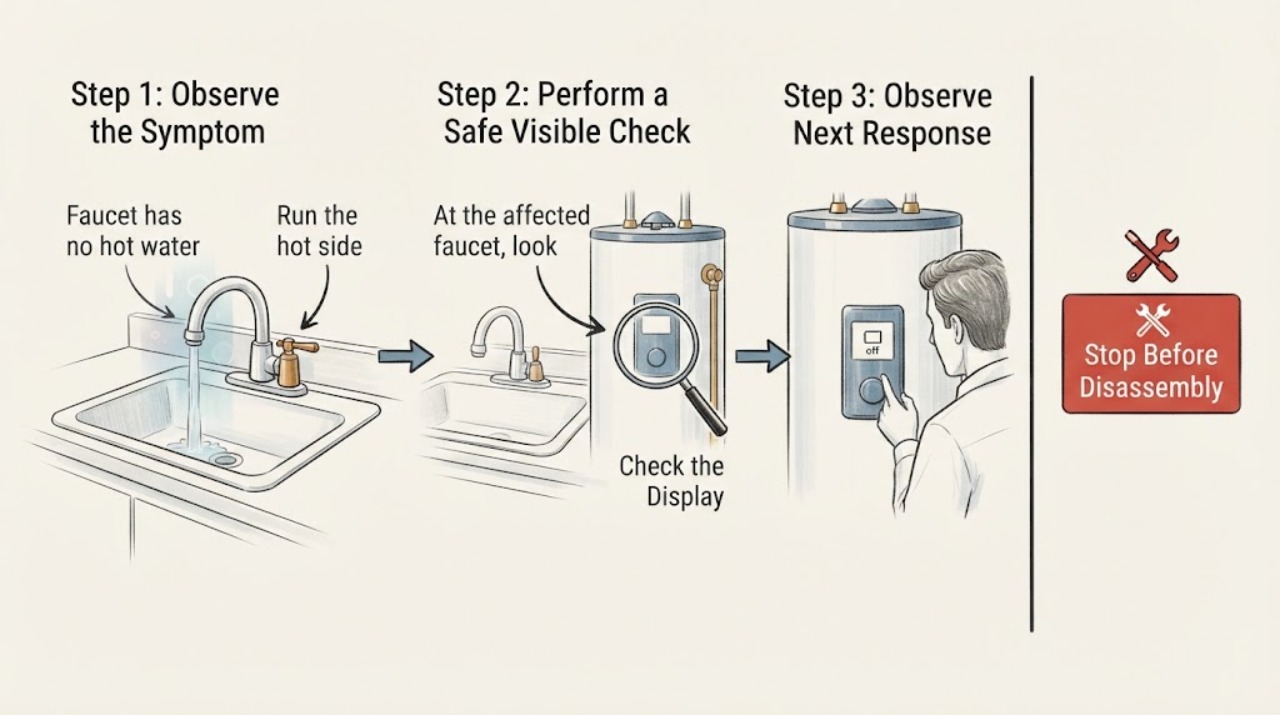
First compare this faucet with another hot-water outlet. If other outlets are hot, the fault is local to this faucet, its cartridge, or its hot-water supply path. If the whole home is cold, check the storage tank's visible power or gas status, cold-water supply, and any safe, model-approved control indication without opening the tank. Do not adjust a gas appliance, bypass a safety valve, or touch tank wiring; a leak, scalding water, gas odor, carbon-monoxide alarm, smoke, or electrical fault needs immediate stop and professional help.
Work through in order
Diagnostic checks
Use only checks that match the exact appliance or system and its official guide.
-
Check 1
Run the hot side of this faucet briefly, then compare it with a hot-water faucet at another fixture while keeping the stream away from skin and children.
Expected result: If another fixture is hot but this faucet is cold, the problem is local. If both are cold, the tank or the home's hot-water distribution is implicated. If flow is weak only on the hot side, a local valve, aerator, cartridge, or supply restriction is possible.
Next step: For one cold faucet, continue with the local valve and mixing-path check. For multiple cold outlets, continue with the tank-status check and avoid opening the tank.
Why this matters
Why: A whole-home comparison prevents replacing or resetting a tank when only one faucet has a hot-side restriction.
-
Check 2
At the affected faucet, look under the cabinet for the hot-side shutoff and visible flexible connection; confirm the valve is open and there is no dampness, corrosion, or cabinet pooling, without loosening a fitting.
Expected result: A closed valve or a dry, blocked-looking hot-side connection can explain a cold faucet while the rest of the home has hot water. Any drip, active spray, swollen cabinet material, or water near an outlet requires stopping.
Next step: If the valve position is obvious and safe to correct, open it gradually and observe for leaks. If the valve is stuck, the connection leaks, or flow remains absent, close the local valve if safely reachable and call a plumber.
Why this matters
Why: The faucet-side path can fail independently of the storage tank. A leak can also reduce hot-water delivery and create damage or electrical risk.
-
Check 3
If the whole home is cold, inspect the tank from a safe distance for its normal display, indicator, or control state and confirm the cold-water supply valve near the tank appears open; do not remove panels or touch gas or electrical parts.
Expected result: A blank display or an obvious loss of the unit's normal indicator supports a power or control branch. A gas odor, soot, unusual flame, damaged vent, or water around the tank is not a troubleshooting result; it is a stop condition.
Next step: Record the tank type, model, and visible status. For gas odor or combustion concerns, leave the area and contact the gas emergency service or fire service from a safe location; otherwise request a qualified water-heater technician for a whole-home outage.
Why this matters
Why: Storage tanks use different electric, gas, and hybrid controls. A visible status clue can guide service, but it cannot establish that an internal thermostat, element, burner, or safety control is safe to repair.
-
Check 4
For an electric tank only, look at the dedicated breaker or disconnect without opening the heater; if it is clearly tripped and the area is dry with no odor or damage, perform one normal reset and observe whether it trips again.
Expected result: A breaker that stays on but the water remains cold suggests a heater, thermostat, or control issue. A breaker that trips again, a hot panel, scorch mark, buzzing, smoke, or wet electrical area means stop.
Next step: Leave the breaker off after a repeat trip and call a qualified electrician or water-heater technician. For gas or hybrid equipment, use only the manufacturer's visible status guidance and arrange qualified service for a heating fault.
Why this matters
Why: A repeated trip is evidence of an electrical fault, not a cue to keep resetting. Do not remove access covers or attempt a live electrical diagnosis.
-
Check 5
Ask whether hot water was recently used heavily and check whether the cold-water symptom is temporary; do not raise the temperature setting or run a relief-valve test to prove the cause.
Expected result: A storage tank may need recovery after unusually high demand, while a recurring shortage with ordinary use can indicate a thermostat, heating, mixing, capacity, or hot-side plumbing problem. Water that is excessively hot is unsafe.
Next step: If hot water returns normally, monitor the same faucet and another outlet. If the whole-home shortage repeats, hot water is scalding, or the tank makes persistent rumbling or popping sounds, arrange plumbing or water-heater service.
Why this matters
Why: A temporary shortage and a failed tank can feel identical at one faucet. Sediment, a mixing valve, or a tank fault requires model-appropriate diagnosis rather than a guessed setting change.
-
Check 6
After the safe checks, make one controlled faucet comparison and document the first cold outlet, flow strength, tank status, model, and any leak or noise; do not continue cycling the equipment to reproduce a dangerous symptom.
Expected result: A single-outlet fault with normal hot water elsewhere supports faucet or local plumbing service. Multiple cold outlets, a tank leak, no visible heating status, repeated breaker trips, gas odor, or abnormal tank noise supports qualified tank or plumbing service.
Next step: Call a plumber for the faucet, hot-side pipe, mixing valve, or water leak; call a qualified water-heater technician for tank heating, controls, gas, or pressure-related symptoms. Use emergency services for gas odor, a carbon-monoxide alarm, fire, or an immediate electrical hazard.
Why this matters
Why: The evidence identifies the service boundary without requiring the homeowner to dismantle a tank or bypass a safety device.
Use your observations
Decision map
Find the observation that best matches what you see, then follow the next safe action.
-
PATH 01Next step
What you see
Only this faucet is cold while another hot-water outlet works.
Do this next
Arrange qualified service and follow the exact model guidance.
Why this path and its safety boundary
Why it matters: Treat it as a local hot-side valve, cartridge, aerator, or pipe restriction; do not reset or open the tank.
-
PATH 02Next step
What you see
Several or all hot-water outlets are cold.
Do this next
Arrange qualified service and follow the exact model guidance.
Why this path and its safety boundary
Why it matters: Inspect only the tank's visible status and accessible supply condition; record the model and request qualified water-heater service for the energy, control, mixing, or tank fault.
-
PATH 03Next step
What you see
The cold symptom follows heavy demand and resolves without a tank intervention.
Do this next
Arrange qualified service and follow the exact model guidance.
Why this path and its safety boundary
Why it matters: Allow normal recovery and monitor another outlet; a recurring shortage with ordinary use needs plumbing or water-heater diagnosis.
-
PATH 04Next step
What you see
A gas smell, carbon-monoxide alarm, soot, abnormal flame, smoke, scalding water, active tank leak, wet electrical area, or repeated breaker trip is present.
Do this next
Arrange qualified service and follow the exact model guidance.
Why this path and its safety boundary
Why it matters: Stop immediately, avoid operating switches or flames, leave if gas or combustion is suspected, and contact the appropriate emergency or qualified service from a safe location.
Helpful context
Understand the symptom
A faucet with no hot water does not prove that the tank has failed. A single outlet can have a closed service valve, blocked hot-side path, or failed mixing cartridge while other fixtures work normally. If every outlet is cold, the storage tank, its energy supply, or a plumbing leak becomes more likely.
Treat the tank as a hot, pressurized appliance. Keep hands away from the temperature-and-pressure relief valve, burner area, access panels, and exposed wiring. A faucet that suddenly becomes dangerously hot is also a stop condition, not an invitation to adjust the tank blindly.
Safety boundary
Stop conditions
- Stop immediately for gas odor, a carbon-monoxide alarm, smoke, soot, abnormal flame or venting, scalding water, a tank or pipe leak, water near electrical equipment, a hot or damaged electrical panel, buzzing, sparking, or a repeated breaker trip.
- Do not open tank access panels, dismantle gas or electrical controls, bypass a safety valve, operate the temperature-and-pressure relief valve as a diagnostic, or perform a dangerous temperature or pressure test.
Common questions
FAQ
Why is only one faucet not getting hot water?
If another outlet is hot, the tank is probably producing hot water and the fault is local to the faucet, its hot-side shutoff, cartridge, aerator, or supply path. Do not reset the tank for a one-faucet symptom.
What should I check when the whole home has no hot water?
Record the tank type and visible status, check only an accessible supply or electric breaker condition from a dry safe position, and use the model manual or qualified service for tank controls. Do not open gas or electrical panels.
Is a leaking tank safe to keep using?
No. Stop for an active tank leak, water near electrics, gas odor, smoke, or a carbon-monoxide alarm. Isolate utilities only when safe and obtain qualified plumbing or water-heater help.
Read the exact guide
Official sources
- TROUBLESHOOTING CHECKLISTA. O. Smith · Storage electric water-heater troubleshooting checklist
- Water Heater Repair: Things to ConsiderA. O. Smith · Storage water-heater troubleshooting and service boundaries
- How to Turn a Water Heater On & OffA. O. Smith · Storage water-heater isolation, tank-full, and restart safety guidance
- Is Your Hot Water Not Getting Hot? Common Causes & What To Do About ThemA. O. Smith · Storage water-heater no-hot-water and safety guidance
Community feedback
Share a repair observation
Share a plain-text repair observation. Accepted observations are published automatically; this page may take a moment to update.