
On this page
Start here
Quick answer
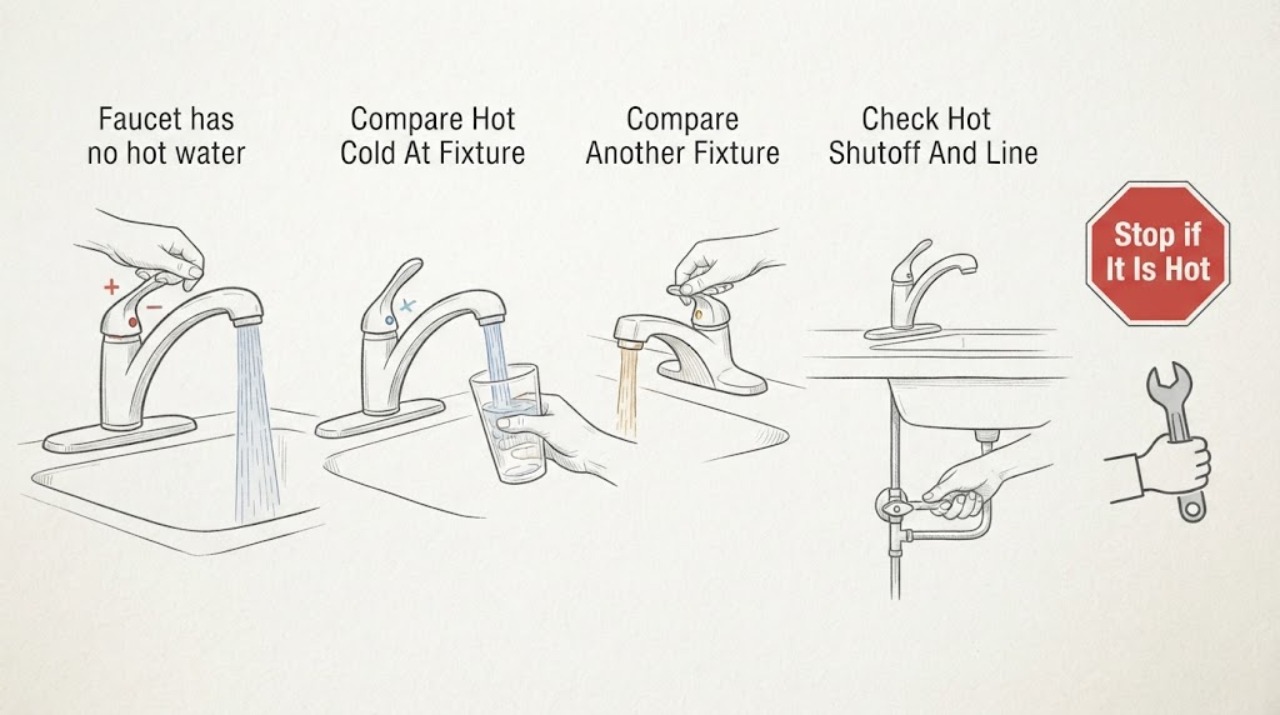
Compare the same faucet's hot and cold flow, then compare another faucet before assuming the faucet itself has failed. If cold water flows normally but no hot water reaches only one fixture, check that fixture's hot shutoff valve and accessible supply line, then consider a clogged screen or faucet cartridge only after the faucet design is identified; if several fixtures have no hot water, or the water heater shows a leak, fault, or unsafe condition, stop adjusting equipment and arrange qualified plumbing or water-heater service.
Work through in order
Diagnostic checks
Use only checks that match the exact appliance or system and its official guide.
-
Check 1
At the affected faucet, turn on cold briefly and then hot while keeping hands clear of the stream and surrounding surfaces. Note whether hot water has normal flow, reduced flow, no flow, or flow that stays cold; do not judge temperature by touching a potentially scalding stream.
Expected result: Cold flow is normal but hot flow is weak or absent, both sides have weak flow, or the faucet produces water but it never warms.
Next step: Repeat the comparison at another hot-water outlet before opening or ordering anything. If water is dangerously hot, discolored, spraying, or leaking around the fixture, stop and isolate it as needed.
Stop if: Stop for a scalding stream, uncontrolled flow, water outside the basin, a loose handle, or water entering the cabinet or wall.
Why this matters
Why: Normal cold with weak or absent hot flow narrows the issue to the hot-side valve, supply, screen, faucet valve, or upstream hot-water system; weak flow on both sides points toward a broader fixture or pressure issue.
-
Check 2
From a safe position, test a second sink or shower for hot-water flow and compare its hot and cold sides. In a multi-unit property, ask whether neighboring fixtures or units have the same issue rather than opening shared equipment.
Expected result: Another fixture has normal hot water, every fixture has no hot water, or the result is inconsistent between rooms or units.
Next step: For a local problem, continue with the fixture valve and screen checks. For a whole-home or multi-unit problem, report it to the property manager or arrange qualified plumbing and water-heater diagnosis.
Stop if: Stop operating fixtures for a whole-home leak, active water-heater discharge, gas odor, smoke, electrical damage, or water reaching electrical equipment.
Why this matters
Why: Hot water at another fixture supports a local faucet or branch-supply problem; no hot water everywhere points toward the water heater, main hot-water piping, a shutoff, or a building-wide interruption.
-
Check 3
If another fixture has hot water, inspect the affected faucet's hot shutoff valve and visible supply line under the sink or at the fixture. Confirm the valve is in its normal open position without forcing it, and look for a kink, crushed section, wet connection, or visible blockage; do not disconnect the line.
Expected result: The hot valve is partly closed, cannot be turned normally, the line is kinked or wet, or the valve and visible line appear open and intact.
Next step: Correct only an obvious valve position with gentle hand movement and retest. If the valve is stuck, the line is damaged, or flow does not return, close the fixture supply if possible and arrange a plumber.
Stop if: Stop for a valve that spins without controlling flow, a cracked or bulging hose, a fitting moving with the pipe, active leakage, or any need to use force or a wrench on the supply line.
Why this matters
Why: A local valve position or damaged supply line can block hot flow to one faucet; a normal-looking line moves the diagnosis toward the faucet screen, cartridge, mixing valve, or concealed plumbing.
-
Check 4
Only when the hot side is isolated or the faucet instructions permit it, inspect the accessible aerator, screen, or showerhead for debris. Remove and clean it only if the design allows simple hand removal, keeping small parts contained; do not dismantle a concealed mixing valve or cartridge as a generic test.
Expected result: The screen is visibly blocked, flow improves after an approved cleaning, or the screen is clear and hot flow remains absent or weak.
Next step: Reinstall the screen correctly and retest once. If hot flow remains absent, identify the faucet model and arrange service; do not substitute a cartridge or alter a temperature limiter from the symptom alone.
Stop if: Stop for a seized screen, damaged threads, a hidden filter, a shower valve requiring wall access, mineral damage that could break the fitting, or water that cannot be isolated.
Why this matters
Why: A blocked screen can restrict one fixture, but a clear screen with no hot flow points toward the valve, cartridge, supply, mixing device, or upstream system rather than the screen itself.
-
Check 5
If the no-hot-water symptom is at a shower or tub faucet, observe whether the cold side flows normally and whether the hot supply to other fixtures works. Do not remove the handle or cartridge unless the exact faucet instructions identify the valve and a safe shutoff is available.
Expected result: The shower has only a dribble or cold water while other hot fixtures work, both supplies may not be open, or the shower valve is the only point without hot water.
Next step: Confirm the accessible hot and cold shutoffs and model information, then use the manufacturer's instructions or call a plumber. Keep the temperature control unchanged if the valve cannot be identified.
Stop if: Stop for a valve behind a sealed trim, a need to open the wall, a missing shutoff, a sudden temperature surge, or a risk of scalding.
Why this matters
Why: A pressure-balance or mixing valve can restrict temperature-specific flow when a supply is absent or the valve is obstructed; the exact mechanism and repair depend on the faucet model.
-
Check 6
If several fixtures lack hot water, record which outlets were tested, whether cold flow is normal, any visible water-heater leak or error indicator, recent utility interruption, and whether hot water was used heavily. Inspect the heater only from outside and do not remove access panels or adjust controls.
Expected result: No fixture produces hot water, the water heater is leaking or shows an abnormal indicator, hot water is merely delayed after heavy use, or only one branch remains affected.
Next step: Arrange qualified plumbing or water-heater service and provide the outlet comparison and visible observations. Do not reset safety devices, change gas or electrical settings, drain the heater, or bypass a control.
Stop if: Stop immediately for gas odor, smoke, burning odor, active tank or relief-valve discharge, electrical exposure, flooding, or water near electrical equipment.
Why this matters
Why: A whole-home loss is a water-heater or hot-water distribution problem until assessed; a local branch result returns the diagnosis to the fixture or supply; a heater leak or abnormal indicator raises urgency.
Use your observations
Decision map
Find the observation that best matches what you see, then follow the next safe action.
-
PATH 01Next step
What you see
Another fixture has normal hot water, but the affected faucet has normal cold flow and little or no hot flow.
Do this next
Check the affected hot shutoff valve, visible supply line, and accessible screen. If those are normal, identify the faucet and have its valve, cartridge, or branch piping assessed.
-
PATH 02Next step
What you see
Several or all fixtures have normal cold flow but no hot water.
Do this next
Treat the symptom as a whole-house hot-water or building supply problem. Report it to property management where applicable and arrange qualified plumbing or water-heater service; do not work inside the heater.
-
PATH 03Next step
What you see
Hot water is present but its flow is lower than cold flow at one fixture.
Do this next
Check the hot-side valve, visible supply line, and accessible aerator or screen. A faucet valve or cartridge may be involved if the external path is clear.
-
PATH 04Next step
What you see
The problem is limited to a shower or tub valve and the other hot fixtures work, especially if flow is only a dribble or temperature cannot be blended.
Do this next
Confirm both supplies are available and use the exact model instructions or a plumber to assess the mixing or pressure-balance valve. Do not open a wall or remove a cartridge without a safe shutoff and model-specific procedure.
-
PATH 05Next step
What you see
The water heater leaks, discharges unexpectedly, shows an abnormal condition, or there is gas odor, smoke, burning odor, or electrical exposure.
Do this next
Keep clear, use only a normal accessible shutoff if it is safe, and arrange urgent qualified plumbing, water-heater, gas, or electrical service as appropriate. Do not reset, bypass, or open the heater.
-
PATH 06Next step
What you see
The valve is open and the screen is clear, but hot water does not return after one controlled retest.
Do this next
Stop replacing parts by guesswork. Preserve the faucet model and comparison results and have the faucet valve, supply, mixing device, or upstream plumbing diagnosed.
Helpful context
Understand the symptom
One faucet or every hot-water outlet?
Start by comparing hot and cold at the affected faucet, then check another sink or shower. Portland's water guidance treats normal cold flow with no hot water as a reason to contact a plumber or property manager, while a hot-water flow reduction at only some fixtures points toward a local plumbing issue. This comparison prevents replacing a faucet when the problem is at the heater or hot-water piping.
A faucet can restrict hot flow without making cold flow fail
If other fixtures have hot water, inspect the affected fixture's hot shutoff valve, visible supply line, and screen or aerator from outside. A partly closed valve, kinked line, debris, or a faucet cartridge can affect one side. A shower pressure-balance valve is another model-specific possibility; Delta notes that both hot and cold supplies must be on for that valve to provide normal mixed flow. Do not transfer that procedure to an unidentified faucet.
Do not turn a hot-water diagnosis into heater work
When several fixtures lack hot water, the issue is no longer just the faucet. HUD defines no hot water at a fixture as hot water not dispensing after the handle is engaged and treats it as a maintenance condition. Check only visible, user-accessible information and report the pattern; do not remove water-heater covers, alter gas or electrical controls, reset safety devices, or open walls to trace concealed piping.
Only after diagnosis
Potential parts
- faucet aerator or screen
Consider this category only when the affected fixture's accessible screen is blocked and the faucet instructions support cleaning or replacement.
Confirm thread size, screen style, flow specification, and hot-side symptom before selection; a screen cannot correct an upstream hot-water failure. - faucet cartridge or stem assembly
Consider this category only when other fixtures have hot water, the local supply path is open, and the identified faucet design points to a valve or cartridge fault.
Confirm the exact faucet model, valve orientation, handle arrangement, and manufacturer fit information; do not select by appearance alone. - faucet hot-side supply hose or shutoff component
Consider this category only when the first restriction or damage is confirmed at the accessible hot-side supply path and the line can be safely isolated.
Confirm connection type, length, material, and local requirements; replace a damaged line rather than patching or forcing its fittings.
When checks do not resolve it
Need a professional?
Cold water is normal but no hot water reaches the faucet after the visible local checks., Several fixtures lack hot water or the issue may involve the water heater or building supply., A hot-side valve, hose, fitting, shower valve, or concealed pipe is stuck, damaged, wet, or inaccessible., The faucet model or valve design is unknown, or the leak or restriction persists after a permitted screen check., The water heater leaks, discharges, shows an abnormal condition, or presents gas, electrical, smoke, or burning hazards.
Common questions
FAQ
Why does one faucet have no hot water while the others work?
That pattern points first to the affected faucet's hot shutoff valve, supply line, screen, valve, cartridge, or a local branch restriction. Check only the accessible external path and identify the faucet before selecting a part.
What does it mean if no faucet in the house has hot water?
If cold flow is normal everywhere but hot water is absent at multiple fixtures, the issue is more likely at the water heater, a hot-water shutoff, distribution piping, or a building supply. Arrange qualified service rather than opening the heater.
Can a clogged aerator cause no hot water?
A clogged screen can restrict flow at one fixture, but it does not prove that the hot supply is missing. Compare hot and cold flow, clean only an accessible screen when the instructions allow it, and escalate if hot flow remains absent.
Why is my shower only cold or only a dribble?
A shower mixing or pressure-balance valve may be affected by an absent supply or an internal obstruction, but the exact cause depends on the model. Confirm both supplies are available and use the manufacturer's procedure or a plumber rather than opening the wall.
Should I reset the water heater when the faucet has no hot water?
Do not reset a safety device or open the heater as a generic test. First compare other fixtures and inspect only visible, user-accessible information; a whole-house loss, leak, abnormal indicator, gas odor, or electrical concern needs qualified service.
Read the exact guide
Official sources
- Troubleshooting water pressure and flowCity of Portland Water Bureau · City government guidance on comparing hot and cold flow, distinguishing local fixture issues from whole-home issues, and escalating no-hot-water conditions
- NSPIRE Standard - Water HeaterU.S. Department of Housing and Urban Development · U.S. government inspection standard defining and observing a no-hot-water faucet condition
- Why does my faucet have low water pressure?Delta Faucet Company · Delta official guidance on faucet screens, hot/cold supply comparison, flushing, and flow restrictions
- Locating & Operating Water Shut-Off ValvesCity of Hamilton, Ohio · City government guidance on fixture shutoff valves and the house main for water emergencies
- The water in the shower is either hot or cold; I cannot get any temperature in between. What is wrong?Delta Faucet Company · Delta official guidance for a model-specific Monitor pressure-balance shower valve and hot/cold supply conditions
Community feedback
Share a repair observation
Share a plain-text repair observation. Accepted observations are published automatically; this page may take a moment to update.