
On this page
Start here
Quick answer
First determine whether the problem affects one faucet or every hot-water outlet. If cold water flows normally at this faucet but hot water does not, compare another faucet, check that the hot-side stop valve is open, and inspect the accessible hot supply hose for a kink, leak, or compression. A clogged aerator can reduce flow, but a gasket is not automatically the cause of no hot water; a worn gasket usually explains a leak or an incorrect seal after the correct faucet assembly has been identified. If all hot outlets are cold, the faucet is probably not the primary fault and the water-heater or building supply needs attention. Stop for scalding, a leak that cannot be isolated, water near electrical equipment, gas odor, smoke, or a fitting that requires force, and call a qualified plumber.
Before you begin
Safety first
- This article supports dry, ordinary-access observation and manufacturer-approved screen or control checks only. It does not authorize work on pressurized connections, heater internals, gas or electrical equipment, seized valves, or an unidentified gasketed assembly.
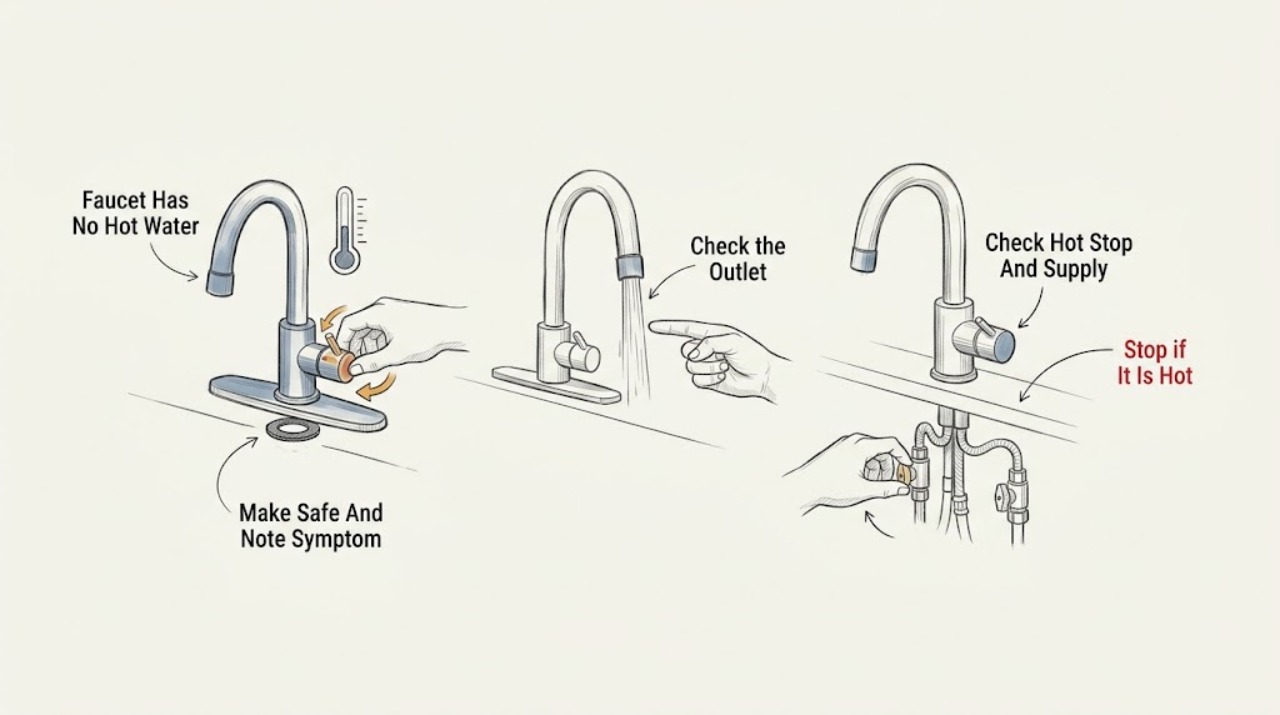
Work through in order
Diagnostic checks
Use only checks that match the exact appliance or system and its official guide.
-
Check 1
Keep the area dry, move electrical appliances away from any splash risk, and briefly operate the faucet from a standing position while keeping hands out of the stream until the temperature is known.
Expected result: Record whether water is absent, weak, cold, warm but not hot, suddenly scalding, discolored, leaking around the handle or connections, or accompanied by gas odor, smoke, or unusual sounds.
Next step: Stop using the fixture and arrange urgent plumbing, gas, electrical, or emergency help when a hazard is present; otherwise compare another hot-water outlet before touching the faucet hardware.
Stop if: Do not touch wet electrical equipment, test an overheated or leaking water heater, use a flame to inspect a leak, or continue if the water may scald.
Why this matters
Why: No or weak hot flow is a different branch from normal hot flow with a leak. Scalding, active water damage, gas odor, smoke, or water contacting electrical equipment is a stop condition rather than a gasket diagnosis.
-
Check 2
Compare this faucet's hot and cold flow with at least one other faucet or shower, using a short observation and the same general handle positions; do not run multiple outlets unattended.
Expected result: Classify the result as only this faucet has no hot water, several fixtures have no hot water, all hot outlets are cold, or hot flow changes when another fixture runs.
Next step: For a whole-home or multi-fixture issue, check the water-heater documentation and contact a qualified plumber or property manager; for an isolated fixture, continue with the local hot-side checks.
Stop if: Do not open the water heater, change its thermostat, or remove a shared valve to troubleshoot a faucet symptom.
Why this matters
Why: A single-faucet problem supports a local stop, supply tube, screen, cartridge, mixing assembly, or seal check. No hot water at multiple outlets points to the water heater, hot-water distribution, a building shutoff, or a utility/building issue rather than this faucet's gasket.
-
Check 3
From ordinary access under the sink or behind the fixture, confirm that the hot-side stop valve is open as designed and inspect the visible hot supply tube for a kink, crushed section, loose connection, or fresh moisture; do not force a seized valve.
Expected result: Note whether the cold stop is open while the hot stop is closed or restricted, whether the tube stays dry, and whether the hot-side connection has lower flow or a leak compared with the cold side.
Next step: Open a readily operable stop only gently and only if its condition is sound, then make one brief temperature and flow check; if it will not turn, leaks, or changes nothing, shut it off only if safe and call a plumber.
Stop if: Do not force a stuck stop, loosen a pressurized connection, remove a braided hose, or keep testing while water is pooling near cabinets, outlets, or wiring.
Why this matters
Why: A closed stop or restricted tube can prevent hot water at one faucet without implicating a gasket. A leaking, seized, corroded, or inaccessible stop or tube needs plumbing service; a dry and open supply moves the check toward the faucet inlet or mixing assembly.
-
Check 4
If the faucet has isolated weak hot flow but the supply remains dry and open, inspect the accessible aerator or inlet screen for visible scale or debris and clean it only according to the faucet manufacturer's instructions; keep removed pieces together.
Expected result: Determine whether both hot and cold flow are restricted, only hot flow is restricted, the screen is visibly blocked, or the flow remains weak with a clean screen.
Next step: Reinstall the screen without force and make one short check; if only hot flow remains absent or the screen cannot be removed safely, provide the faucet identity and observation to a plumber.
Stop if: Do not drill the screen, use heat or harsh chemicals, scratch sealing surfaces, or continue if the faucet begins leaking at the connection.
Why this matters
Why: A blocked aerator or inlet can reduce flow, but it cannot make a fully supplied hot line cold. A clean screen with only hot-side restriction points toward a cartridge, mixing valve, internal obstruction, or a supply-side issue; it does not prove that the gasket is at fault.
-
Check 5
With the water supplies left connected and no force applied, inspect the visible faucet body, handle area, spout base, and supply connections for the first wet point; do not remove the cartridge or valve body merely to look for a gasket.
Expected result: Classify the first wet point as a handle or stem leak, connection leak, spout leak, leak below the cabinet, or no leak at all while hot flow is absent.
Next step: Photograph the faucet and first wet point, record the model or markings, and have a plumber or manufacturer identify the exact seal or mixing component before ordering or opening the faucet.
Stop if: Do not guess gasket size, mix seal materials, overtighten a nut, apply unapproved sealant, or disassemble a faucet without first isolating both supplies and following its exact instructions.
Why this matters
Why: A gasket or other seal becomes a plausible conditional part only when the correct faucet assembly and leak location show a failed seal. No leak with no hot flow makes a stop, supply, cartridge, mixing valve, or hot-water source more likely than a gasket.
-
Check 6
If multiple fixtures lack hot water, inspect only the water heater's external, user-visible condition and documentation from a safe distance; do not remove covers, adjust internal controls, or open gas or electrical compartments.
Expected result: Record whether the heater has a visible fault indicator, leak, power or fuel-supply concern, unusual noise, or no obvious external symptom, and whether the problem affects the whole building or only the dwelling.
Next step: Use the water-heater manufacturer's support path or contact a qualified plumber/property manager with the outlet comparison and any visible external observation.
Stop if: Stop for gas odor, combustion noise, smoke, scorching, a hot or wet electrical enclosure, active heater leakage, or any need to open the heater or test live power.
Why this matters
Why: A whole-home loss of hot water is not explained by a local faucet gasket. A heater leak, electrical issue, gas concern, or missing hot-water service needs qualified service; an apartment or shared system may require the property manager or utility.
-
Check 7
After a clearly open, dry supply and an allowed screen cleaning, run one brief controlled test with a container or drain clear, then shut the faucet off and inspect the connections again.
Expected result: Note whether hot flow returns, remains cold, remains weak, changes temperature unexpectedly, or produces a new drip at the handle, spout, supply, or gasketed connection.
Next step: Stop testing and request plumbing service when the symptom persists, a leak appears, the hot stream becomes unsafe, or the faucet needs cartridge or valve-body work.
Stop if: Do not repeat tests with a leaking connection, use hot water for drinking or food preparation, or leave a temporary repair unattended.
Why this matters
Why: Restored flow after a stop or screen correction supports that visible cause. Persistent no-hot flow needs faucet or hot-water diagnosis; a new leak after handling indicates a sealing or reassembly problem and is not a reason to tighten indefinitely.
Use your observations
Decision map
Find the observation that best matches what you see, then follow the next safe action.
-
PATH 01Safety boundary
What you see
Cold flow is normal and no hot water is available at only this faucet.
Do this next
Check the accessible hot stop and tube, then the permitted screen; arrange faucet-specific plumbing diagnosis if the hot side remains absent.
Why this path and its safety boundary
Why it matters: The local hot stop, supply tube, inlet screen, cartridge or mixing assembly, or a local obstruction is more likely than a whole-home heater problem.
Safety stop: Do not order or install a gasket until the leak location and exact faucet assembly are identified.
-
PATH 02Safety boundary
What you see
Several faucets or all hot outlets are cold while cold flow is normal.
Do this next
Contact a qualified plumber or property manager and provide the outlet comparison; use only the heater's documented external checks.
Why this path and its safety boundary
Why it matters: The water heater, hot-water distribution, shared stop, building system, or utility is more likely than one faucet's gasket.
Safety stop: Do not open a gas or electrical heater compartment or change heater controls as a faucet repair.
-
PATH 03Safety boundary
What you see
Hot water is present but weak, while cold flow is normal at the same faucet.
Do this next
Compare the visible supply and screen, then have a plumber identify the internal restriction if the accessible checks do not restore flow.
Why this path and its safety boundary
Why it matters: A hot stop, supply tube, inlet screen, cartridge or mixing assembly, or an obstruction is plausible; temperature alone does not identify a gasket.
Safety stop: Stop for a leaking hose, seized valve, damaged connection, or a need to open the faucet body without exact instructions.
-
PATH 04Safety boundary
What you see
A leak is localized to a gasketed joint or handle seal, the faucet identity is known, and the matching instructions identify a replaceable seal.
Do this next
Isolate hot and cold supplies, follow the exact manufacturer's procedure or use a qualified plumber, and confirm the replacement seal's fit before reassembly.
Why this path and its safety boundary
Why it matters: A gasket or seal is conditionally relevant to the leak, but it still does not by itself explain missing hot water unless the seal is preventing the correct assembly from operating or sealing.
Safety stop: Do not guess dimensions, combine incompatible seal materials, overtighten, or keep using a connection that leaks after reassembly.
-
PATH 05Safety boundary
What you see
There is scalding, active leakage, water near electrical equipment, gas odor, smoke, a repeated leak, or no improvement after safe visible checks.
Do this next
Stop using the fixture, isolate water only if the valve operates safely, leave the area for gas or fire danger, and contact the appropriate qualified professional or emergency service.
Why this path and its safety boundary
Why it matters: The problem exceeds a safe faucet-only observation and may involve the water heater, hidden plumbing, electrical or gas equipment, or a damaged valve body.
Safety stop: Do not test with flame, touch wet electrical equipment, open a heater, or force a shutoff valve or faucet assembly.
Helpful context
Understand the symptom
The first split is one faucet versus the whole hot-water system
A single faucet with normal cold flow and no hot flow points toward its hot-side stop, supply tube, inlet screen, cartridge or mixing assembly, or a seal that is preventing the correct assembly from seating. If several faucets have no hot water, the fault is more likely at the water heater, hot-water distribution, building supply, or a shared valve. Compare outlets before removing a gasket: changing a local seal cannot restore heat that never reaches the faucet.
No hot water can mean no hot-side flow, not only a temperature problem
Note both temperature and volume. A strong stream that stays cold is different from a weak or absent hot stream. A normal cold stream with restricted hot flow makes the hot stop valve, supply tube, inlet screen, aerator, cartridge or mixing valve relevant. A faucet that drips around a handle, nut, or connection may need a model-matched gasket or other seal, but the leak location must be identified before a part is selected.
Protect against scalding and water damage while checking
Hot-water fixtures can deliver unexpectedly hot water after a supply or heater issue changes. Run only a brief, controlled observation and keep hands away from the stream until its temperature is known. Do not increase a water-heater setting as a first faucet repair; official health guidance notes that higher hot-water settings increase burn risk, and the manufacturer's instructions or a professional should govern water-heater maintenance.
Safety boundary
Stop conditions
- Stop for scalding water, gas odor, smoke, scorching, electrical arcing, a hot or wet electrical enclosure, or water contacting an outlet or appliance.
- Do not force a seized stop valve, loosen a pressurized or leaking connection, open a water heater, remove gas or electrical covers, or test live electrical parts.
- Do not guess that a gasket is the cause, guess its size or material, mix sealants, or order a part without the faucet identity and leak location.
- Do not use a flame to find a leak, run a leaking fixture unattended, or keep testing after a connection begins to drip.
- Do not use hot tap water for drinking, cooking, or making baby formula; use cold water for those purposes and follow local health guidance.
Only after diagnosis
Potential parts
- faucet gasket or seal
Consider this category only when inspection identifies a leak at a gasketed joint or handle seal and the exact faucet instructions identify that seal as replaceable; no-hot-water alone does not establish gasket failure.
Confirm the faucet model, seal location, dimensions, material, and manufacturer's fit information before ordering; do not substitute a generic seal or compensate for a mismatch by overtightening.
When checks do not resolve it
Need a professional?
Call a qualified plumber when only one faucet has no hot water after the hot stop, supply tube, and permitted screen checks; when a cartridge, mixing valve, valve body, or gasketed assembly must be opened; when the faucet or supply leaks; or when the faucet identity and seal fit are uncertain. If several outlets are cold, contact the water-heater provider or property manager. Use emergency help for gas odor, smoke, fire, flooding, or immediate electrical danger.
Safety scope: This article supports dry, ordinary-access observation and manufacturer-approved screen or control checks only. It does not authorize work on pressurized connections, heater internals, gas or electrical equipment, seized valves, or an unidentified gasketed assembly.
Common questions
FAQ
Why does one faucet have no hot water but the others work?
Start with the hot-side stop valve and visible supply tube, then inspect the accessible screen or aerator as the faucet instructions allow. A local cartridge, mixing assembly, obstruction, or seal may be involved, but a gasket should be considered only after the leak location and exact faucet model support it.
Could a faucet gasket cause no hot water?
A failed gasket more commonly explains a leak or poor sealing at a known joint. It is not proof of a no-hot-water fault by itself. First determine whether hot water reaches the faucet and whether the symptom is isolated to one fixture; have a plumber identify the exact seal before ordering a replacement.
What if every faucet has no hot water?
Treat that as a water-heater, hot-water distribution, shared shutoff, building, or utility branch rather than a local faucet repair. Use only safe external observations and the water-heater manufacturer's documentation, then contact a qualified plumber or property manager.
Is it safe to turn up the water-heater temperature to fix a cold faucet?
Not as a first faucet repair. Higher hot-water settings increase scald risk, and heater maintenance or adjustment should follow the equipment instructions or be handled by a professional. Do not open gas or electrical covers.
Read the exact guide
Official sources
- What do I do about water dripping from the spout of my two-handle (or three-handle) tub/shower faucet?Delta Faucet · Delta's model-specific tub or shower procedure illustrates why leak location and exact assembly matter; it is not a universal part-fit guide.
- Troubleshooting water pressure and flowCity of Portland, Oregon · Official municipal customer guide; local equipment and water-heater instructions still control a particular installation.
- Low water flow from spout- ONLY hot or cold water on sink faucetsMoen Solutions · Moen's manufacturer guidance is used for general faucet mechanisms; the installed faucet's own instructions control its parts and procedure.
- Why can’t I use hot water from the tap for drinking, cooking, or making baby formula?U.S. Environmental Protection Agency · EPA consumer lead-exposure guidance for household hot-water use.
- Preventing Waterborne Germs at HomeCenters for Disease Control and Prevention · CDC household drinking-water guidance; follow the installed faucet and water-heater manufacturer's procedures.
Community feedback
Share a repair observation
Share a plain-text repair observation. Accepted observations are published automatically; this page may take a moment to update.