
On this page
Start here
Quick answer
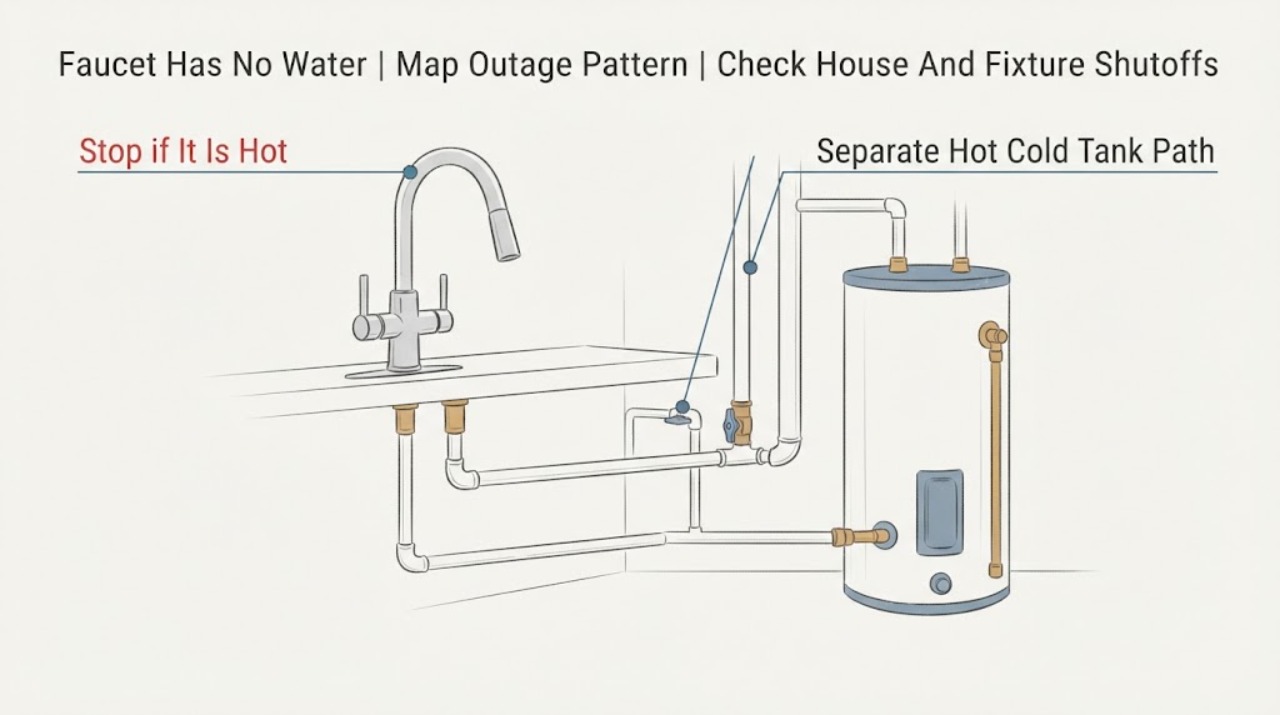
When a faucet has no water, do not assume the tank is the cause. First compare this faucet with another fixture and compare hot with cold. One dead faucet points toward its supply stops, hose, cartridge or aerator; every fixture being dry points toward the home shutoff, a building or utility interruption, or a broader plumbing fault. If only hot water is absent, inspect the accessible hot-water path and the tank's visible supply state without opening or disassembling the heater. If a valve, tank, pipe, ceiling, or cabinet is leaking, water is near electricity, hot water can scald, or a gas or combustion warning is present, stop and use a plumber or emergency service. A clean, safe faucet-side check can include a fully open handle, visible shutoff valves, and a removable aerator only when the fitting is cool and easy to remove; do not bypass a tank safety control or work inside a gas or electric heater.
Work through in order
Diagnostic checks
Use only checks that match the exact appliance or system and its official guide.
-
Check 1
Open the affected faucet normally and compare it with a nearby cold-water fixture and, if safe, another hot-water fixture; check both positions on a single-handle faucet or both handles on a two-handle faucet without forcing them.
Expected result: Only this faucet is dry, both hot and cold are dry here, only hot is dry, only cold is dry, or several fixtures across the home are dry.
Next step: Use the matching branch below. If several fixtures are dry, check for a utility or building interruption before disturbing the faucet or tank.
Stop if: Stop if a valve, pipe, wall, ceiling, cabinet, or heater area is leaking or if water is near electricity.
Why this matters
Why: The pattern narrows the fault to the faucet outlet, one supply side, the hot-water system, or a broader supply interruption. It does not by itself prove a tank failure.
-
Check 2
For a single dry faucet, look only at the visible hot and cold supply valves and flexible connections under or behind the fixture; confirm a valve is not closed and look for kinks, crushed tubing, corrosion, or wet connections.
Expected result: One valve is closed, a hose is kinked, a connection is wet or corroded, both visible valves are open, or the faucet has no accessible local valves.
Next step: If a valve is clearly closed and dry, open it gently only as far as normal operation allows and recheck. If it will not move, leaks, or the faucet remains dry, close the local supply if safe and call a plumber.
Stop if: Do not force a seized valve, remove a hose under pressure, or continue if water is pooling.
Why this matters
Why: A closed or damaged faucet-side supply can stop one outlet while the rest of the home works. A wet, corroded, or inaccessible connection is a leak or service boundary, not an invitation to force the valve.
-
Check 3
If cold water works but hot water does not, observe from a safe, dry position whether the water heater has a visible leak, an intentionally closed cold inlet or hot outlet state, a service or vacation setting, or a recent shutoff; do not remove heater access panels.
Expected result: Only hot outlets are dry, the tank area is wet, an inlet or outlet state is abnormal, the heater is in a documented reduced-use mode, or the visible heater area appears normal.
Next step: Follow the exact heater manual for a safe visible control state only. For a leak, repeated loss of hot water, or an unclear tank condition, stop and arrange qualified plumbing or water-heater service.
Stop if: Do not touch hot discharge, drain the tank, open access covers, relight a gas appliance, or bypass a safety device.
Why this matters
Why: A hot-only outage can be in the tank, its supply path, a mixing valve, or the faucet; a normal-looking tank does not rule out an internal fault. Water around a heater can create burn, electrical, or structural risk.
-
Check 4
If several fixtures are dry, check a utility or building notice and observe the home's accessible main shutoff and pressure pattern without loosening fittings; note whether toilets, showers, and outdoor fixtures also lack water.
Expected result: The whole home is dry, only one room or branch is dry, neighbors or the building also have no water, or the main shutoff appears closed or leaks.
Next step: Contact the utility or building manager for a shared interruption. If the home's shutoff is closed or leaking, keep it in the safest known state and call a plumber; do not force or dismantle it.
Stop if: Stop if there is flooding, sewage, a damaged main, structural wetting, or water near electrical equipment.
Why this matters
Why: A broad pattern points away from one faucet aerator and toward a utility, building, house shutoff, pressure, or branch issue. An EPA WaterSense pressure range is a general service reference, not a reason to adjust a regulator yourself.
-
Check 5
If the supply pattern is normal and the faucet is otherwise dry, place a drain cover or container below the outlet, remove only a cool, hand-accessible aerator as the faucet instructions permit, and inspect it for scale or debris; keep the faucet controls closed while the aerator is off.
Expected result: The aerator is blocked, the faucet flows with the aerator removed, the aerator is clean, or the fitting will not remove safely.
Next step: Clean or replace the aerator only according to the faucet instructions and refit it without cross-threading. If it will not come off or flow remains absent, call a plumber or faucet service.
Stop if: Do not use excessive force, poke deep into the faucet body, or continue if the fitting or connection begins to leak.
Why this matters
Why: A restricted aerator can stop or severely reduce flow at one faucet even when supply pressure is present. Flow without the aerator points to the outlet screen; no flow still points upstream to the valve, hose, cartridge, or broader supply.
-
Check 6
For a single-handle faucet with one temperature position dry or for a two-handle faucet with one side dry, compare the working side, handle travel, and visible supply hose behavior without removing the handle or cartridge.
Expected result: One side works, neither side works despite open supplies, the handle is loose or jammed, flow changes when the handle moves, or a connection drips.
Next step: Record the faucet make and model if available and call a plumber for cartridge or valve diagnosis. If a connection drips, close the local supply when safe and stop using the faucet.
Stop if: Do not disassemble a pressurized faucet, force a stuck handle, or treat a tank symptom as proof of cartridge failure.
Why this matters
Why: A single-sided failure can be a cartridge or mixer restriction; no flow on both sides can be a supply or faucet-body issue. A loose, jammed, or leaking control needs model-specific service rather than a guessed replacement.
-
Check 7
From a dry, safe position, inspect around the tank and nearby pipework for active water, a relief discharge, corrosion, soot, unusual combustion noise, gas odor, or a wet electrical control; do not open the heater or touch hot water.
Expected result: There is a tank or pipe leak, hot discharge, soot or combustion concern, gas odor, water on electrical parts, or no visible tank hazard.
Next step: For water, close the nearest safe supply and call a plumber. For gas odor or combustion concern, leave and contact the gas utility or emergency service from safety. For wet electrical equipment, keep clear and use qualified electrical service.
Stop if: Do not relight, reset, drain, open covers, bypass a relief or temperature control, or restore power to wet equipment.
Why this matters
Why: A tank-related no-water symptom may be secondary to a safety shutdown or a leaking connection, but those findings cannot be diagnosed safely by opening the heater. Gas and electrical symptoms require their own emergency path.
-
Check 8
Record which fixtures work, hot and cold results, the first wet point if any, visible valve positions, faucet make and model, tank type if known, recent shutoff or utility work, and any odor, heat, pressure, or sound before requesting plumbing service.
Expected result: The outage is intermittent, follows a shutoff or service event, affects one temperature side, returns after aerator cleaning, or remains unexplained.
Next step: Keep the affected fixture or tank out of service when leakage or heat risk exists and schedule qualified plumbing service. Use the utility or building manager for a shared outage.
Stop if: Do not make a temporary bypass, clamp a pressurized line, or operate a heater with missing covers or a water-exposed control.
Why this matters
Why: This record lets a plumber choose between faucet-side restriction, branch supply, tank inlet or outlet, mixing control, pressure, and whole-home service without unsafe exploratory work.
Use your observations
Decision map
Find the observation that best matches what you see, then follow the next safe action.
-
PATH 01Next step
What you see
Water is pooling near an outlet, electrical equipment, a heater control, a wall, ceiling, or a lower level.
Do this next
Stop using the fixture and keep clear. Close the nearest safe water shutoff, do not operate wet electrical controls, and call a plumber; use qualified electrical or emergency service when electrical damage or immediate danger is present.
-
PATH 02Next step
What you see
Gas odor, soot, unusual combustion noise, a carbon-monoxide alarm, or symptoms are present near a gas water heater.
Do this next
Leave immediately for suspected gas or combustion danger without operating switches or ignition sources. Contact the gas utility or emergency service from a safe location and arrange qualified service before reuse.
-
PATH 03Next step
What you see
Only one faucet is dry while other fixtures have normal water.
Do this next
Check the visible local hot and cold valves, hoses, and the removable aerator if safe. If supplies are open and dry but flow does not return, call a plumber for faucet-body or cartridge diagnosis.
-
PATH 04Next step
What you see
Several fixtures or the whole home are dry.
Do this next
Check for a utility or building interruption and observe the accessible main shutoff without forcing it. Contact the utility or building manager, or call a plumber if the house shutoff or branch is abnormal.
-
PATH 05Next step
What you see
Cold water works but hot water is absent at one or more fixtures.
Do this next
Observe the tank's visible leak and shutoff state from a dry position, follow only the exact heater manual's safe controls, and call qualified water-heater or plumbing service for repeated or unexplained loss.
-
PATH 06Next step
What you see
Flow returns with the cool removable aerator off or the screen is visibly blocked.
Do this next
Clean or replace the aerator only as the faucet instructions permit and refit it gently. Escalate if the fitting leaks or the faucet remains dry.
-
PATH 07Next step
What you see
A local valve or hose is abnormal, one handle side is dry, the handle is jammed, or flow remains absent after a safe aerator check.
Do this next
Keep the local supply in the safest known state and call a plumber for supply, cartridge, mixer, or branch diagnosis. Do not disassemble the pressurized faucet.
-
PATH 08Next step
What you see
The tank leaks, discharges hot water, shows corrosion or soot, has a wet control, or needs an internal reset or repair.
Do this next
Stop using the affected system and call qualified plumbing or water-heater service. Do not open covers, drain hot water, relight gas equipment, bypass controls, or restore power to wet equipment.
Helpful context
Understand the symptom
Use the pattern of the outage
A faucet with no water is a symptom, not proof that a water-heater tank has failed. The fastest safe split is one faucet versus the whole home, followed by hot versus cold. A single outlet can be restricted by an aerator or faucet-side valve, while loss at several fixtures can involve a house shutoff, building supply, pressure problem, or service interruption. Keep those branches separate before touching the tank.
A tank is not a DIY repair target
An accessible cold-water inlet or hot-water outlet can be observed, but a heater may contain scalding water, gas, combustion products, stored pressure, or high-voltage parts. Do not remove covers, open a gas compartment, bypass a temperature or pressure control, drain a hot tank, or restore power to equipment that has been wet. The exact heater manual and a qualified plumber or heater technician control any tank work.
Stop when water, heat, or gas changes the risk
If the first wet point is at a tank connection, a pipe, a wall, or an electrical area, close the nearest safe water shutoff and keep clear. Do not turn an electrical control with wet hands or stand in water. If gas odor, soot, combustion noise, or a carbon-monoxide alarm is present near a gas water heater, leave and use the gas or emergency route from a safe location.
Only after diagnosis
Potential parts
- faucet aerator
Consider only if flow returns with the removable screen off or the screen is visibly restricted by scale or debris.
Confirm the faucet make, model, thread style, and flow specification before selecting a replacement. - faucet cartridge or mixer valve
Consider only after a plumber identifies a faucet-side restriction or single-temperature failure with normal supply valves and hoses.
Match the exact faucet model and cartridge design; no-water symptoms alone do not establish compatibility. - water-heater inlet or outlet shutoff valve
Consider only when a plumber confirms a tank-side valve is closed, leaking, seized, or failing and the heater installation permits replacement.
Tank-side work can involve hot water, pressure, gas, or electrical hazards. Use qualified plumbing service and confirm the heater configuration first.
When checks do not resolve it
Need a professional?
Call a plumber for a faucet that remains dry after safe supply and aerator checks, an abnormal local valve or hose, a whole-home or branch outage, a leaking tank connection, or an unexplained hot-water failure. Use a qualified water-heater technician for internal tank work. Use utility, gas, electrical, or emergency service first when the relevant warning sign is present.
Have this ready
- Provide the fixture pattern, hot and cold results, faucet make and model if known, tank type and visible controls, valve observations, first wet point, recent shutoff or service event, and any odor, heat, pressure, sound, or electrical history.
Common questions
FAQ
Why is only one faucet getting no water?
A single dry faucet is more consistent with its local valves, hose, aerator, cartridge, or mixer than with a whole-house tank failure. Compare hot and cold and inspect only visible, dry connections before calling a plumber.
How can I tell if the tank is causing no hot water?
Compare hot water at more than one fixture and observe the tank only from a dry, safe position for a leak or abnormal visible state. Do not open, drain, relight, or bypass the heater; repeated or unclear hot-water loss needs qualified service.
Can a faucet aerator stop all the water?
Scale or debris at a removable aerator can restrict or stop flow at one outlet. Remove it only when cool and safe according to the faucet instructions; if flow is still absent or the fitting leaks, call a plumber.
What should I do if the whole home has no water?
Check for a utility or building interruption and observe the accessible main shutoff without forcing it. Contact the utility or building manager, or call a plumber for an abnormal house shutoff, branch, pressure, or leak condition.
When is no faucet water an emergency?
Stop when water is near electricity, a tank or pipe is actively leaking, hot water is discharging uncontrollably, flooding or structural wetting is occurring, or a gas odor, soot, combustion warning, or carbon-monoxide alarm is present. Use the appropriate plumber, utility, electrical, fire, or emergency route.
Read the exact guide
Official sources
- Leak Detection and Flow Monitoring DevicesU.S. Environmental Protection Agency WaterSense · General household leak guidance, not a replacement for plumbing diagnosis.
- What do I do if my single-handle kitchen faucet drips from the aerator?Delta Faucet · Use as general faucet-side guidance only when the user's faucet design permits the same safe, removable-aerator check.
- Home MaintenanceU.S. Environmental Protection Agency WaterSense · General household plumbing guidance; it does not diagnose a particular faucet, tank, or heater model.
- DOE_Water_Heater_Meeting_111612.pdfU.S. Department of Energy · General water-heater safety material; exact heater manual and local requirements take precedence.
- Water Decontamination Frequently Asked Questions for CustomersU.S. Environmental Protection Agency · Use for water-advisory and safe-use decisions, not faucet hardware diagnosis.
Community feedback
Share a repair observation
Share a plain-text repair observation. Accepted observations are published automatically; this page may take a moment to update.