
On this page
Start here
Quick answer
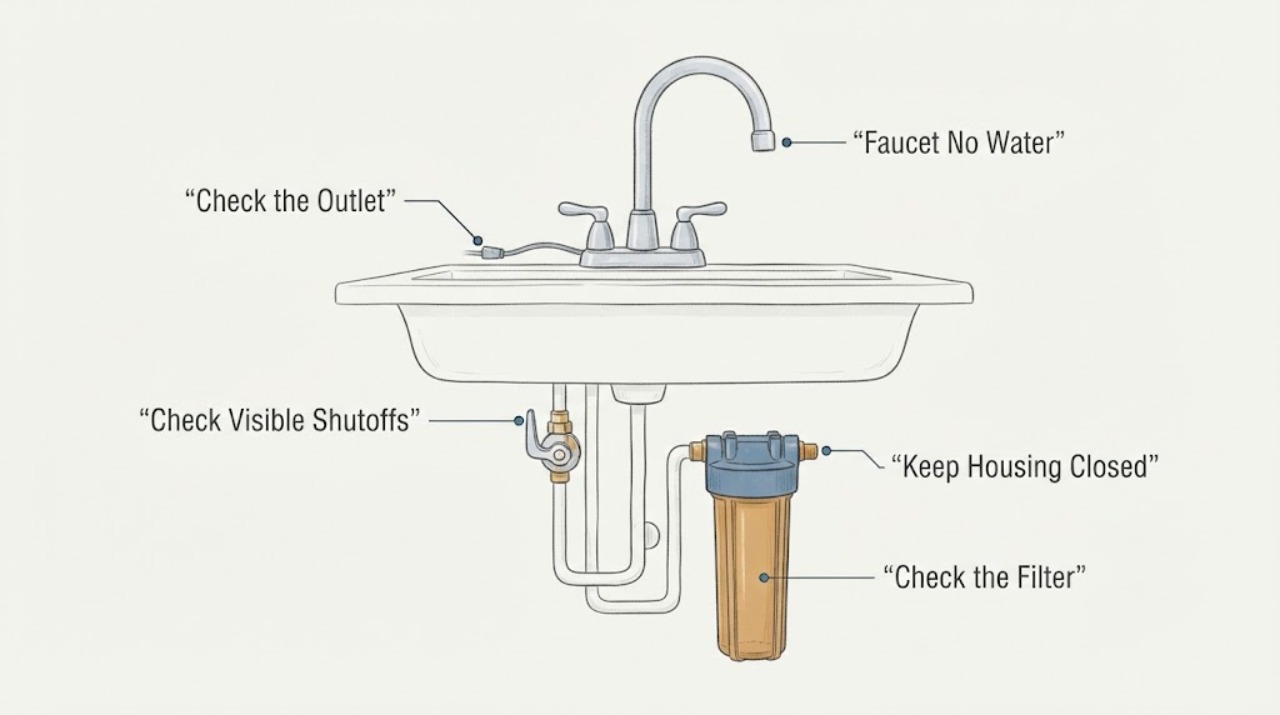
When a faucet has no water, first compare it with another faucet and test hot and cold separately. A blocked aerator or faucet-mounted filter can stop one outlet, but a closed shutoff, kinked supply line, cartridge, diverter, under-sink filter housing, or building-wide supply problem can look similar. Check only visible, accessible controls and the filter arrangement specified for the exact faucet; do not force an adapter, open a pressurized filter housing, or assume the filter is the cause. Stop for a leak, cabinet water near electricity, hot-water hazard, contaminated-looking water, or a shutoff that will not close, and arrange qualified plumbing service.
Before you begin
Safety first
- Do not open pressurized filter housings, disconnect tubing, force adapters or shutoffs, bypass a drinking-water filter, cut walls, touch wet electrical equipment, or continue using a leaking or suspect-water outlet.
Work through in order
Diagnostic checks
Use only checks that match the exact appliance or system and its official guide.
-
Check 1
From a dry, safe position, open the affected faucet normally and compare it with another nearby faucet; test hot and cold independently without removing trim or opening a wall.
Expected result: Record whether no water affects only this faucet, only one temperature, every nearby fixture, or the whole building; note any pressure change when another fixture runs.
Next step: Photograph the faucet and filter arrangement and check for a known local or building supply interruption before touching the filter path; arrange plumbing service for multi-fixture loss or unexplained pressure changes.
Stop if: Stop for flooding, a burst line, sewage-contaminated water, hot water that cannot be controlled, or water reaching electrical equipment.
Why this matters
Why: One-faucet failure supports a local filter, aerator, supply, cartridge, or diverter check. Whole-home or multi-fixture failure points upstream to a shutoff, supply, pressure, or outage rather than the faucet filter alone.
-
Check 2
Look beneath the sink or at the visible faucet supply for closed or partly closed shutoff handles, a sharply kinked hose, crushed tubing, or an obvious external leak; do not force a corroded handle.
Expected result: Classify the supply as open and dry, closed or partly closed, kinked, leaking, damaged, or inaccessible; record whether the hot and cold sides differ.
Next step: If a clean, clearly labeled shutoff is simply closed and moves normally, restore it gently and recheck once; otherwise stop and provide photos and the affected temperature side to a plumber.
Stop if: Do not wrench a stuck valve, disconnect a pressurized hose, or continue if water is spraying, the cabinet is wet, or electrical equipment is nearby.
Why this matters
Why: A closed or kinked supply can produce no water without a filter fault. A leak, damaged connection, or shutoff that will not operate needs isolation and plumbing service rather than tightening by guesswork.
-
Check 3
From ordinary safe access, identify whether the no-water faucet has a faucet-end aerator or filter, an integrated filtered outlet, an in-line screen, or a separate under-sink housing and dedicated tap; record the faucet model if visible.
Expected result: Record the filter brand/model marking, cartridge date or indicator, flow direction, whether the cartridge is seated, and whether the non-filtered faucet stream works if the design provides one.
Next step: Use the exact product instructions to decide whether the filter is a user-replaceable cartridge or screen; arrange a plumber for an under-sink manifold, pressurized housing, or unknown integrated system.
Stop if: Do not bypass an unknown drinking-water filter, open a pressurized housing, or use a cartridge whose fit, direction, or sanitation status is uncertain.
Why this matters
Why: An expired, missing, mis-seated, or blocked filter can stop a filtered outlet, but a working unfiltered stream points to the filter branch while failure of both streams points toward supply, cartridge, valve, or control components. An unknown housing cannot be safely diagnosed by forcing it open.
-
Check 4
If the exact faucet instructions identify a hand-removable aerator or accessible screen, remove it only with the water controls closed and the faucet supported; rinse visible debris with clean water and do not scrape or enlarge openings.
Expected result: Record whether the screen or aerator is packed with scale/debris, damaged, missing a washer, clean, or impossible to remove without force; note whether flow returns only while the part is removed if the instructions permit that observation.
Next step: Rinse and reinstall only as the exact instructions specify, then make one normal flow check; if the outlet remains dry or leaks, stop and request plumbing or manufacturer diagnosis.
Stop if: Do not poke with wire, drill, pry, force threads, mix cleaning chemicals, or operate a drinking-water outlet with loose or missing filter components.
Why this matters
Why: A blocked aerator or inlet screen can explain a single dry outlet, while a clean screen with no flow points upstream or deeper into the faucet. A missing washer or damaged filter path can cause leakage or contamination and needs the correct model-specific part.
-
Check 5
For a clearly identified user-serviceable cartridge, follow the manufacturer's shutoff, removal, seating, and flush instructions; do not improvise a replacement or force an adapter or housing.
Expected result: Record whether flow returns after the correctly seated approved cartridge, remains absent, bypasses around a seal, leaks, or produces cloudy, discolored, or unusual-tasting water.
Next step: Keep the removed cartridge and installation information for the service record; arrange a plumber or manufacturer-specific service when flow remains absent or water quality is questionable.
Stop if: Do not run unfiltered drinking water through a system that requires a cartridge, reuse a damaged cartridge, open a pressurized housing, or continue after a leak or contamination concern.
Why this matters
Why: Restored flow supports a blocked, expired, or mis-seated filter as the contributor. No improvement points toward the supply, valve, cartridge, diverter, faucet body, or an incorrect filter path; a leak or suspect water quality is a stop condition.
-
Check 6
Compare hot and cold flow again after the accessible filter/aerator check and note whether the symptom follows one supply side, the filtered outlet, or the whole faucet; do not disconnect supply lines to prove the result.
Expected result: Record cold-only loss, hot-only loss, both sides dry, filtered outlet dry with unfiltered outlet working, or no water from the faucet but normal pressure at the supply connection if a professional has already checked it.
Next step: Give the split result and filter identity to the plumber or manufacturer and request a model-specific diagnosis; do not replace a cartridge or valve based on the symptom alone.
Stop if: Stop for hot water that can scald, a supply line leak, water in the cabinet, or any need to loosen a connection under pressure.
Why this matters
Why: One temperature side suggests that side's shutoff, screen, supply line, or cartridge passage. Filtered-only loss focuses on the filter assembly; both sides dry with open supplies points toward the faucet body, diverter, cartridge, or a concealed restriction.
-
Check 7
Prepare a service note with the faucet model, filter type and date, affected outlet and temperature, comparison-faucet result, shutoff and hose observations, aerator condition, and photos taken from dry safe access.
Expected result: Include whether the problem began after a cartridge change, plumbing work, outage, freezing event, or filter installation, and whether the faucet is integrated, faucet-mounted, or under-sink.
Next step: Arrange qualified plumbing service for a persistent no-water condition, concealed filter, inaccessible shutoff, or any leak; provide the record and do not dismantle the faucet further.
Stop if: Do not open walls, cut tubing, dismantle a pressurized filter, or substitute a filter or valve without exact model and compatibility information.
Why this matters
Why: These details distinguish filter blockage from supply, shutoff, cartridge, diverter, valve, pressure, or installation problems and avoid unsafe trial-and-error replacements.
Use your observations
Decision map
Find the observation that best matches what you see, then follow the next safe action.
-
PATH 01Safety boundary
What you see
The affected faucet and nearby fixtures are all dry, or pressure changes throughout the home.
Do this next
Check only known accessible supply information and contact the water utility, landlord, or plumber; do not dismantle the faucet.
Why this path and its safety boundary
Why it matters: The likely first point is upstream supply, main shutoff, pressure, outage, or a building plumbing fault, not the faucet filter.
Safety stop: Stop for flooding, a burst line, sewage contamination, or a main valve that cannot close.
-
PATH 02Safety boundary
What you see
The non-filtered stream or another faucet works, but the filtered outlet remains dry and the filter path is clearly identified.
Do this next
Follow the exact filter instructions once, using a compatible cartridge and proper seating; arrange service if flow does not return.
Why this path and its safety boundary
Why it matters: A blocked, expired, missing, or mis-seated cartridge, integrated filter, aerator, or diverter is plausible.
Safety stop: Do not bypass an unknown filter, force an adapter, or operate with a leaking or suspect cartridge.
-
PATH 03Safety boundary
What you see
Only hot or only cold water is absent while the other side flows normally.
Do this next
Check the clearly visible matching shutoff and hose for position, kink, or leak; request a plumber when the result persists or the valve is stuck.
Why this path and its safety boundary
Why it matters: The restricted side's shutoff, supply line, inlet screen, cartridge passage, or upstream supply is more likely than a common filter blockage.
Safety stop: Do not loosen supply connections or open a cartridge body under pressure.
-
PATH 04Safety boundary
What you see
The filter or faucet leaks, water reaches the cabinet or electrical equipment, or water is cloudy, discolored, or has an unusual odor/taste after filter work.
Do this next
Stop using the affected outlet, isolate the accessible water supply only if it moves normally and safely, protect the area, and arrange plumbing or water-quality guidance.
Why this path and its safety boundary
Why it matters: The priority is water isolation, property/electrical safety, and drinking-water hygiene, not restoring flow by further filter experimentation.
Safety stop: Do not drink suspect water, touch wet electrical equipment, open a pressurized housing, or continue operating the faucet.
-
PATH 05Safety boundary
What you see
The faucet has an integrated or under-sink filter/housing whose model, shutoff, cartridge, or pressure state cannot be identified safely.
Do this next
Record the markings and arrange a plumber or manufacturer-specific service; keep the water off at a known safe shutoff if there is a leak.
Why this path and its safety boundary
Why it matters: Filter, cartridge, valve, and faucet-body causes cannot be separated without product-specific instructions or professional access.
Safety stop: Do not force the housing, substitute a cartridge, disconnect tubing, or bypass the treatment system.
Helpful context
Understand the symptom
Start with the first point where water disappears
A faucet with no flow is not automatically a failed filter. If every nearby fixture is dry, the building supply, main shutoff, local outage, or pressure problem comes first. If only this faucet is affected, compare the hot and cold sides and locate the first disconnected or blocked point: a visible shutoff, flexible supply, aerator, faucet inlet screen, diverter, cartridge, or filter housing. Moen's manufacturer guidance also says the faucet model matters because the filter and cartridge arrangement varies.
Treat faucet filters as model-specific water equipment
A faucet may have a screw-on or integrated aerator, a faucet-mounted drinking-water filter, an in-line screen, or a separate under-sink cartridge and dedicated tap. EPA explains that faucet filters need compatible adapters and a properly seated cartridge, while under-sink systems may require a licensed plumber. Do not force an adapter, run a filter outside its intended direction, bypass an unknown cartridge, or assume filtered water is safe after an unverified installation.
Protect the cabinet, water quality, and the next repair
Before loosening any water connection, know which visible shutoff controls the faucet and have a way to contain a small amount of water. Do not open a pressurized housing or disconnect a line when water could reach an outlet or appliance. If the first dry point is inside a wall, at a concealed filter manifold, or at a valve that will not close, stop and call a plumber. Keep the cartridge identity, installation date, filter direction, and outlet comparison for the service record.
Only after diagnosis
Potential parts
- faucet aerator or inlet screen
Consider only when the exact faucet instructions identify a damaged or blocked removable aerator or screen and cleaning does not restore flow.
Confirm the faucet model, thread/retainer design, flow specification, washer, and drinking-water suitability before selecting a replacement. - faucet filter cartridge
Consider only when a clearly identified filter system has an expired, blocked, missing, or damaged cartridge and the manufacturer's instructions specify replacement.
Confirm the exact filter system, cartridge orientation, certification, and installation/flush instructions; do not use a generic cartridge by appearance. - faucet cartridge or diverter
Consider only after a plumber or manufacturer-specific diagnosis rules out supply, shutoff, aerator, and filter causes and identifies the faucet-body component.
Faucet cartridges and diverters are model-specific; confirm the exact faucet and service procedure before ordering or opening the body.
When checks do not resolve it
Need a professional?
Arrange a qualified plumber when the faucet remains dry after the safe outlet, shutoff, and model-specific filter checks; when both temperatures are affected; when an under-sink or integrated filter is unknown; or when the restriction is concealed. Treat active leaks, water near electricity, an uncontrollable shutoff, hot-water hazard, or suspect drinking water as urgent safety conditions.
Safety scope: Do not open pressurized filter housings, disconnect tubing, force adapters or shutoffs, bypass a drinking-water filter, cut walls, touch wet electrical equipment, or continue using a leaking or suspect-water outlet.
Have this ready
- Provide the faucet and filter model markings, filtered versus unfiltered outlet result, hot/cold comparison, nearby-faucet result, visible shutoff and hose condition, cartridge identity/date/direction, first wet or dry point, recent filter or plumbing work, and photos from a dry safe position.
Common questions
FAQ
Can a faucet filter cause no water at all?
It can, if the faucet-mounted cartridge, integrated filter, inlet screen, or aerator is blocked or mis-seated. First compare filtered and unfiltered outlets and check other fixtures; a closed supply, cartridge, diverter, or building restriction can produce the same symptom.
Why does only the hot or cold side have no water?
A one-temperature failure points toward that side's shutoff, supply hose, inlet screen, cartridge passage, or upstream supply. Check only the visible shutoff and hose for position, kink, or leak; do not disconnect a pressurized line.
Should I remove the faucet filter to test the water?
Only if the exact manufacturer's instructions identify it as a safe, removable user-serviceable part. Do not bypass an unknown drinking-water system, force an adapter, or open a pressurized housing; use a plumber when the filter arrangement is unclear.
What if every faucet in the home has no water?
That points upstream to a main shutoff, supply interruption, pressure problem, or building plumbing rather than this faucet's filter. Check only known accessible information and contact the water utility, landlord, or plumber; escalate active leaks immediately.
When is a no-water faucet an emergency?
Treat active spraying or pooling, water near electricity, a shutoff that will not close, scalding hot water, or cloudy/discolored/unusual-tasting water after filter work as stop conditions. Isolate water only from a safe accessible control and arrange qualified help.
Read the exact guide
Official sources
- Bathroom Faucet: Low FlowMoen Solutions · Moen bathroom-faucet guidance; only the equivalent safe checks are generalized here.
- Choose the water filter that’s right for you!U.S. Environmental Protection Agency · General point-of-use filtration guidance, not a replacement for a specific faucet manual.
- Learn how to install your water filterU.S. Environmental Protection Agency · General consumer water-filter guidance; the installed manufacturer's instructions control.
- Low water flow from spout- BOTH hot and cold water on sink faucetsMoen Solutions · Moen faucet guidance used for general faucet-path triage; exact faucet design remains model-specific.
- Home MaintenanceU.S. Environmental Protection Agency WaterSense · General home faucet maintenance guidance.
Community feedback
Share a repair observation
Share a plain-text repair observation. Accepted observations are published automatically; this page may take a moment to update.