
On this page
Start here
Quick answer
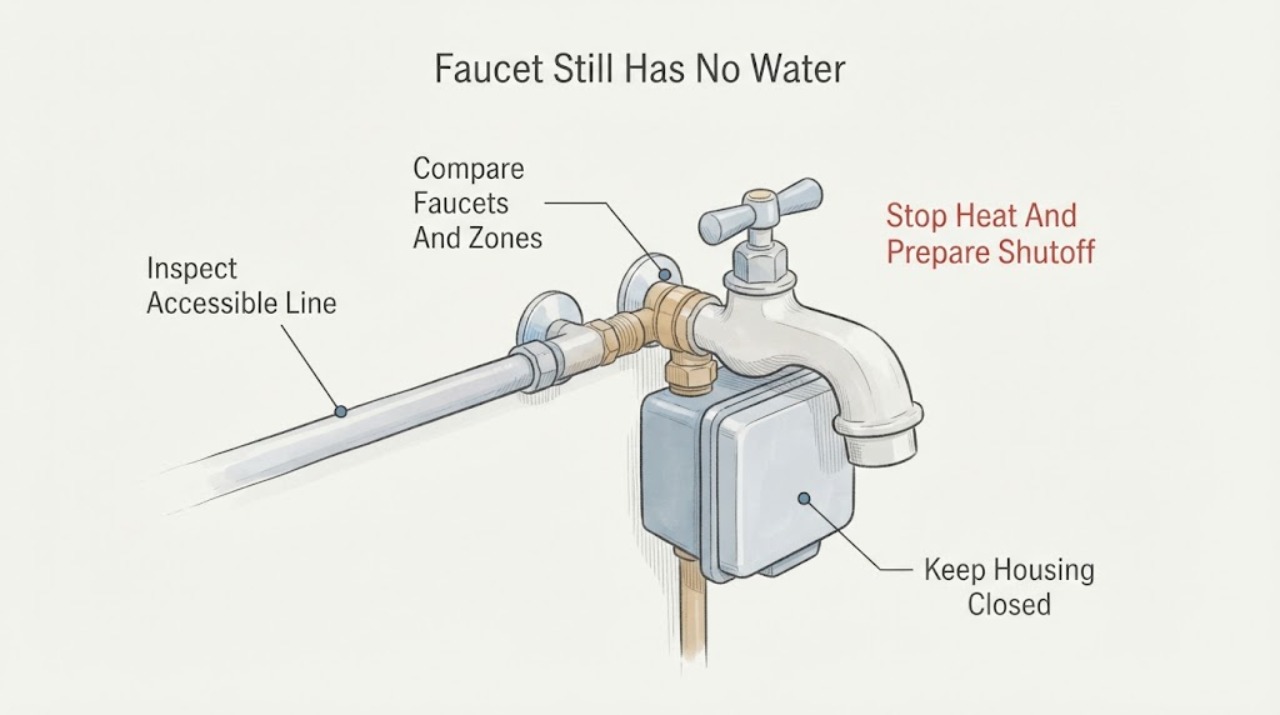
Stop the heat treatment first; do not keep heating a faucet or pipe simply because water has not returned. If the faucet was dry or only trickled during freezing weather, the restriction may be in the supply line under the sink, in an exterior wall, at the service entry, or near the water heater. Before any thawing or water restoration, know where the main shutoff is and look for a crack, bulge, fresh moisture, or water near electrical equipment. If the faucet begins flowing after the pipe warms, restore water slowly while watching every accessible joint; a pipe can have cracked while frozen and leak as it thaws. If the frozen section is hidden or inaccessible, the pipe is damaged, water cannot be isolated, or the area contains standing water, stop and call a licensed plumber. A faucet gasket may be relevant only if the first wet point is a confirmed gasketed faucet joint; it does not explain every no-water symptom.
Before you begin
Safety first
- This article supports only dry, ordinary-access observation and safe isolation. It does not authorize open-flame thawing, operation of electrical heat in wet areas, wall or meter access, pressurized fitting work, faucet disassembly, or water-heater work.
Work through in order
Diagnostic checks
Use only checks that match the exact appliance or system and its official guide.
-
Check 1
Stop the heat treatment and move away from any hot surface, open flame, fuel-burning device, or energized appliance; locate the main water shutoff from a dry, accessible position before restoring water.
Expected result: Record whether the heat source was an open flame, fuel-burning heater, electrical device, heating pad, warm air, or warm cloth; note whether the area is dry, whether smoke or odor is present, and whether the shutoff is reachable without entering standing water.
Next step: Leave the area and contact emergency help for fire, smoke, gas or fuel odor, or electrical danger; otherwise keep the heat off and proceed only with dry, ordinary-access observations.
Stop if: Never resume open-flame thawing, use a fuel-burning heater indoors for this purpose, or operate an electrical heating device in standing water.
Why this matters
Why: Open flame or fuel-burning heat creates fire and carbon-monoxide hazards, while electrical equipment in standing water creates shock risk. An unreachable shutoff or unsafe area means this is not a safe do-it-yourself thawing situation.
-
Check 2
From a dry position, briefly compare this faucet with another faucet and, if safe, check whether cold water, hot water, or both sides are absent; do not leave a faucet running while unattended.
Expected result: Classify the result as only this faucet is dry, one room or branch is dry, one side of this faucet is dry, or every faucet is dry; note whether other fixtures produce a normal stream, a trickle, or no water.
Next step: Use the affected zone to guide a plumber and inspect only accessible pipe locations; do not remove faucet parts until the supply path is confirmed safe.
Stop if: Stop if another fixture also leaks, water is entering a wall or floor, or checking the faucet requires wet electrical access or force.
Why this matters
Why: A single dry faucet supports a local stop, supply tube, faucet passage, or nearby freeze. A dry room or branch supports a shared frozen line. No water throughout the home points toward a main service, meter, building supply, or shutoff issue rather than a faucet gasket.
-
Check 3
Inspect only exposed, reachable sections of the supply line near the faucet, under the sink, along an exterior wall, in an unheated space, or near the service entry without removing insulation, walls, fittings, or faucet covers.
Expected result: Look for frost, a bulge, split or cracked tubing, a displaced connection, fresh droplets, damp insulation, staining, or no visible abnormality; note whether the faucet or line is against an exterior wall or in a cold cabinet, crawl space, garage, basement, or attic.
Next step: Photograph the finding and call a plumber for any damage, hidden section, or uncertain connection; do not apply more heat or disturb the pipe to make the diagnosis clearer.
Stop if: Do not cut into walls, remove pipe insulation, loosen fittings, squeeze tubing, or touch wet wiring or electrical equipment.
Why this matters
Why: A cold or visibly frozen section supports a freeze location, but a hidden or normal-looking line can still contain a break. A crack, bulge, or moisture means water must remain isolated while the pipe is repaired; no visible finding moves the issue toward an inaccessible line, valve, meter, or supply fault.
-
Check 4
With the main shutoff ready but not forced, inspect accessible joints and the floor or cabinet around the faucet and line for water that could appear as the pipe warms; keep people and electrical equipment away from any wet area.
Expected result: Determine whether the area stays dry, water begins to seep, water pressure returns suddenly, the shutoff turns normally, or the shutoff is seized, leaking, or inaccessible.
Next step: If a leak starts and the shutoff operates safely, close it and call a plumber; if it cannot be closed or water approaches electrical equipment, leave the area and obtain emergency plumbing or electrical help.
Stop if: Do not force a shutoff valve, stand in water while touching electrical equipment, or wait for a leak to worsen while continuing the thaw.
Why this matters
Why: Water appearing during thawing can indicate a burst or cracked pipe even if it was dry while frozen. A seized or inaccessible shutoff removes the ability to control a release, so the professional boundary is immediate.
-
Check 5
If the line has warmed without a visible hazard and water begins to return, open the faucet only enough to observe the first flow and keep the main shutoff accessible; do not fully restore pressure or leave the test unattended.
Expected result: Note whether the flow is a trickle that increases, full flow, cloudy or discolored water, spurting air, or no flow; simultaneously watch accessible joints, cabinets, ceilings, and floors for moisture.
Next step: If flow is stable and all accessible areas remain dry, close the faucet normally and monitor; if any leak or abnormal result appears, close the safe shutoff and call a plumber.
Stop if: Do not restore full pressure, run multiple fixtures, or continue if water escapes from a joint, ceiling, wall, floor, or cabinet.
Why this matters
Why: Increasing flow suggests the restriction may be clearing, but it does not prove the pipe is intact. Spurting, discoloration, a sudden leak, or flow that stops again can indicate a damaged line, trapped air, additional freeze, or a supply problem.
-
Check 6
Only after the supply is confirmed available and the area is dry, inspect the faucet exterior and accessible stop or supply connection for the first wet point; do not remove the cartridge, valve body, or gasket as a diagnostic experiment.
Expected result: Classify the first wet point as the faucet handle or stem, spout base, supply connection, stop valve, under-sink line, or no leak while the faucet still has no water.
Next step: Record faucet markings and the wet-point location, then have a plumber or the faucet manufacturer identify the correct seal and isolation procedure before repair.
Stop if: Do not guess gasket size or material, overtighten a nut, apply unapproved sealant, or work on a pressurized fitting.
Why this matters
Why: A confirmed leak at a gasketed faucet joint makes a model-matched gasket or seal conditionally relevant. No leak with no flow points upstream or inside the valve and does not justify replacing a gasket by guesswork.
-
Check 7
Prepare a service note with the weather or heat event, the heat method already used, affected faucets, flow changes, pipe locations, shutoff status, and every leak or safety symptom.
Expected result: Confirm whether the frozen section is hidden or inaccessible, whether water remains absent after the area is safe, whether a pipe may have burst, and whether the issue affects one fixture, one zone, or the whole home.
Next step: Call a licensed plumber and provide the service note; use emergency services when flooding, fire, gas or fuel odor, or immediate electrical danger is present.
Stop if: Do not continue applying heat, reopen the main supply for repeated tests, or leave a thawing pipe unattended when damage is possible.
Why this matters
Why: An inaccessible freeze, suspected burst, unresolved no-water condition, or multi-zone outage needs professional diagnosis; a local gasket should not be selected until the supply and first wet point are established.
Use your observations
Decision map
Find the observation that best matches what you see, then follow the next safe action.
-
PATH 01Safety boundary
What you see
Only this faucet is dry while other fixtures work normally.
Do this next
Inspect accessible dry sections and the stop position, then call a plumber if the line is hidden, damaged, or still dry after the heat has stopped.
Why this path and its safety boundary
Why it matters: A local stop, supply tube, faucet passage, or nearby frozen line is more likely than a whole-home supply failure.
Safety stop: Do not remove the faucet body or order a gasket unless a leak location and exact faucet identity support that part.
-
PATH 02Safety boundary
What you see
Several fixtures in one area, or every fixture in the home, is dry.
Do this next
Check only the accessible main-shutoff and building or utility status, keep the water isolated if a burst is suspected, and contact a plumber or property manager.
Why this path and its safety boundary
Why it matters: A shared branch, service entry, meter, main shutoff, building system, or utility condition is more likely than a faucet seal.
Safety stop: Do not open walls, disturb a meter, or apply heat to an inaccessible service line.
-
PATH 03Safety boundary
What you see
Flow returns gradually and every accessible pipe and joint remains dry.
Do this next
Close the faucet normally, monitor accessible areas, reduce cold exposure using safe building measures, and call a plumber if flow falls again or any leak appears.
Why this path and its safety boundary
Why it matters: The restriction may have cleared, but thawing has not proved that the line is undamaged or that another freeze is absent.
Safety stop: Do not restore pressure abruptly, run unattended fixtures, or resume hazardous heat treatment.
-
PATH 04Safety boundary
What you see
Water appears from a crack, joint, cabinet, wall, ceiling, floor, or other area as the line warms.
Do this next
Close the main shutoff only if it can be operated safely from a dry position, keep clear of wet electrical equipment, and call emergency plumbing help.
Why this path and its safety boundary
Why it matters: The pipe or connection may have burst or cracked while frozen; the absence of a leak before thawing was not conclusive.
Safety stop: Do not keep thawing, reopen the supply for a test, or enter standing water near electricity.
-
PATH 05Safety boundary
What you see
Water is available to the faucet and the first wet point is a confirmed gasketed faucet joint with a known model and documented replaceable seal.
Do this next
Isolate supplies safely and follow the exact faucet instructions or use a plumber to identify and fit the seal.
Why this path and its safety boundary
Why it matters: A gasket or seal may be relevant to the local leak, but it is not the explanation for a frozen or upstream no-water condition.
Safety stop: Do not guess dimensions, force the assembly, or work on a pressurized connection.
-
PATH 06Safety boundary
What you see
The heat source was hazardous, the freeze is inaccessible, water remains absent, the shutoff is not usable, or electrical, fire, gas, or flooding danger is present.
Do this next
Leave the hazard area and contact the appropriate emergency service, electrician, plumber, property manager, or utility from a safe location.
Why this path and its safety boundary
Why it matters: The situation is outside safe ordinary-access troubleshooting and requires professional or emergency response.
Safety stop: Do not apply more heat, touch wet electrical equipment, use open flame, or continue restoring water.
Helpful context
Understand the symptom
Applying heat does not prove that the pipe is intact
If water was absent during a freeze and remains absent after heat was applied, the heat may not have reached the blockage, the restriction may be farther along the line, or the pipe may have cracked while frozen. A frozen pipe can hold back water until it warms, so the absence of a visible leak is not proof that it is sound. Treat the first return of water as a leak-check moment, not as permission to turn the supply fully on.
Separate a local faucet problem from a supply-line problem
Check another faucet before removing a screen or faucet part. If other fixtures work and only this faucet is dry, the local stop, flexible supply tube, inlet passage, or faucet valve is more likely. If several fixtures in one area are dry, look for a shared line in a cabinet, exterior wall, crawl space, garage, or basement. If the whole home is affected, the main service, meter, or building supply may be frozen or shut off.
A gasket is a conditional leak repair, not a thawing diagnosis
A gasket or seal matters when water is visibly escaping from a known faucet joint and the exact faucet instructions identify that seal. It cannot restore water stopped upstream by ice, a closed valve, a burst pipe, or a failed supply. Do not remove the faucet body or order a seal until the first wet point and the faucet identity are known.
Safety boundary
Stop conditions
- Stop immediately for smoke, fire, gas or fuel odor, a hot or damaged electrical device, or any electrical concern near water.
- Do not use an open flame, torch, kerosene or propane heater, charcoal stove, or other fuel-burning heat source to thaw a pipe.
- Do not use an electrical appliance in standing water, and do not touch a wet electrical device or socket while standing in water.
- Do not force a seized shutoff, open walls, remove insulation or fittings, enter an inaccessible service space, or work on a pressurized connection.
- Stop restoring water if a crack, bulge, seep, flooding, or water near a wall, floor, ceiling, or electrical equipment appears as the line warms.
- Do not assume that a faucet gasket is the cause of no water; identify the first wet point and exact faucet assembly before selecting a seal.
When checks do not resolve it
Need a professional?
Call a licensed plumber when the frozen section is hidden or inaccessible, the faucet remains dry after the heat is stopped, more than one fixture is affected, a pipe may have burst, a shutoff is seized or unreachable, or any leak appears during thawing. Use emergency services for fire, gas or fuel odor, flooding, or immediate electrical danger. A gasket should be considered only after water is available and a model-matched gasketed joint is confirmed as the leak source.
Safety scope: This article supports only dry, ordinary-access observation and safe isolation. It does not authorize open-flame thawing, operation of electrical heat in wet areas, wall or meter access, pressurized fitting work, faucet disassembly, or water-heater work.
Common questions
FAQ
Why is one faucet still dry after applying heat?
The heat may not have reached the frozen section, the restriction may be farther along the supply line, or the pipe may have cracked and is still holding water back. Compare other fixtures, inspect only exposed dry sections, keep the main shutoff ready, and call a plumber if the line is hidden, damaged, or still dry.
Should I keep applying heat until water returns?
No. Stop the heat treatment, especially if it involved an open flame, fuel-burning device, or electrical equipment near water. A frozen pipe can be damaged without leaking until it thaws, so use safe isolation and professional help when the section is uncertain or inaccessible.
Can replacing a faucet gasket restore water after a freeze?
Only if water is available and a known gasketed faucet joint is confirmed as the leak or sealing fault. A gasket cannot clear an upstream freeze, closed stop, burst pipe, or shared water-supply problem. Identify the first wet point and exact faucet assembly before selecting a seal.
What should I do if water starts leaking while the pipe thaws?
If it is safe to do so from a dry position, close the main shutoff and call a plumber. Keep away from standing water and electrical equipment, and do not reopen the supply or continue heating to test the line.
Read the exact guide
Official sources
- Preventing & Thawing Frozen PipesAmerican Red Cross · American Red Cross emergency-preparedness guidance for residential frozen pipes.
- What do I do about water dripping from the spout of my two-handle (or three-handle) tub/shower faucet?Delta Faucet · Delta's model-specific tub or shower leak procedure illustrates why leak location and exact assembly matter; it is not a universal gasket-fit guide.
- Frozen Pipe Prevention and RemediesCity of Independence, Missouri · Official municipal water-department guidance for residential frozen pipes.
- Preventing or Thawing Frozen Water PipesMaine Emergency Management Agency · Official state emergency-management guidance for household frozen water pipes.
- Low water flow from spout- ONLY hot or cold water on sink faucetsMoen Solutions · Moen manufacturer guidance used for general faucet mechanisms; the installed faucet's instructions control its parts and procedures.
Community feedback
Share a repair observation
Share a plain-text repair observation. Accepted observations are published automatically; this page may take a moment to update.