
On this page
Start here
Quick answer
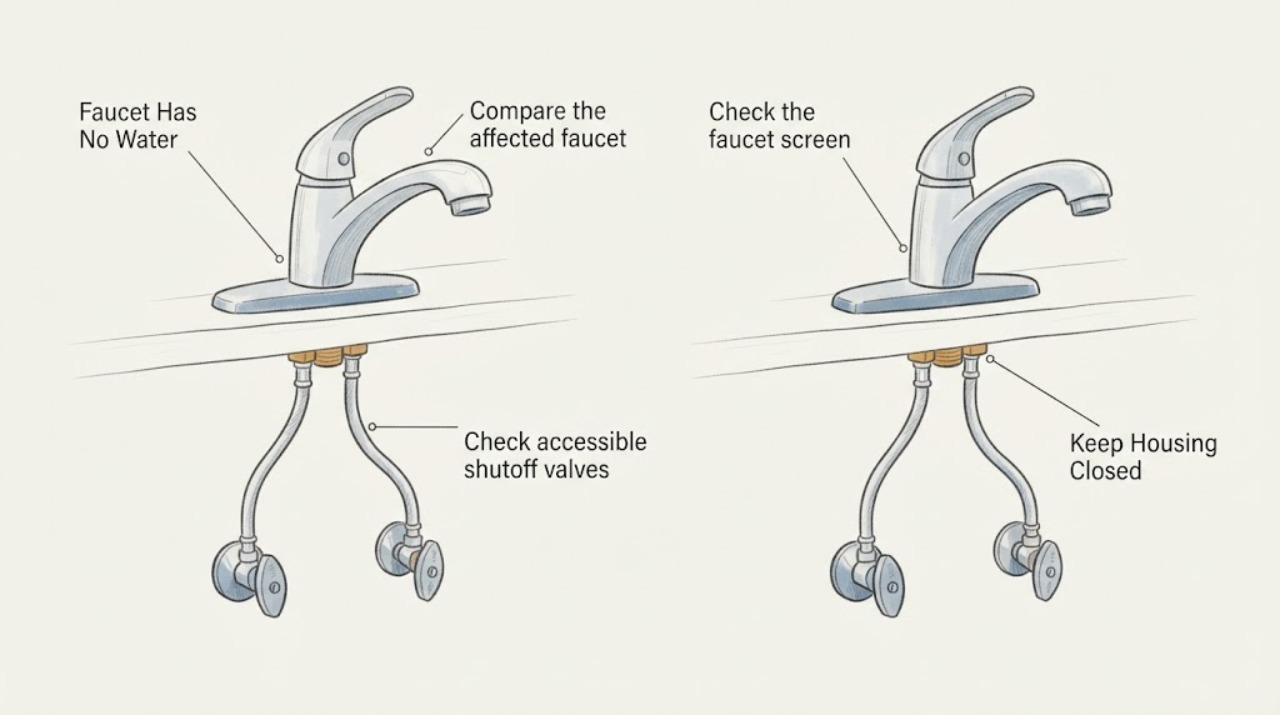
Start by comparing the affected faucet with other fixtures and with both hot and cold handles. If only one faucet is dry, inspect its accessible shutoff valves, aerator, and visible supply path; if every faucet is dry, check the home's main valve, a utility or building shutoff, and whether neighbors are also affected. A leak, burst pipe, water near electrical equipment, a damaged valve, or a blockage inside a wall requires a plumber rather than force or deeper disassembly. Do not force a handle or valve, remove pressurized plumbing, open a wall, or assume that normal pressure elsewhere clears the affected branch.
Work through in order
Diagnostic checks
Use only checks that match the exact appliance or system and its official guide.
-
Compare the affected faucet with other fixtures
Open the affected faucet gently, then check another faucet and, if available, a tub or outdoor spigot. Compare both hot and cold handles without forcing a stiff handle or running water near an electrical outlet or appliance.
Expected result: Only this faucet has no flow, several fixtures in one area are dry, every faucet is dry, only hot water is absent, or flow is normal elsewhere.
Next step: Record which fixtures and temperature sides work, then follow the matching branch below. If the whole home is dry, check for a utility notice, nearby work, or a building-wide issue before dismantling a faucet.
Stop if: Stop for spraying water, a broken handle, a leaking wall or ceiling, water near electrical equipment, or a valve that would need force to move.
Why this matters
Why: One dry faucet points toward its screen, shutoff, supply tube, or local branch. Several fixtures in one area suggest a shared branch. No cold water anywhere points toward a main valve, meter, utility, or building interruption. Normal cold flow with no hot water shifts attention to the hot-water system.
-
Check accessible shutoff valves and the supply path
For a single affected faucet, look under the sink or at the exposed supply route for an accessible shutoff that is visibly closed, a kinked flexible tube, corrosion, a wet joint, or a pipe damaged by freezing. Move a valve only if its normal operation is clear and it turns easily; do not loosen a fitting or remove a supply line.
Expected result: A valve is closed, a supply tube is kinked, a joint is wet, the pipe is bulging or cracked, the route is behind a wall, or the accessible path looks intact.
Next step: If the valve is clearly closed and opens normally without force, restore it gradually while watching for leaks; otherwise leave it alone and continue to the faucet screen or call a plumber. Isolate a visibly damaged or leaking line at the main valve if safe.
Stop if: Do not force, disassemble, loosen, cut, or cap a valve or supply tube, and do not open a wall or ceiling to reach a hidden pipe.
Why this matters
Why: A closed valve or kink can stop one faucet while other fixtures work. Water at a joint, a bulge, or a crack means the line may be leaking or damaged and can worsen when supply returns. An intact visible path does not clear hidden piping, the faucet cartridge, or a branch restriction.
-
Check the faucet screen for a local blockage
If only one faucet is affected and the shutoffs and visible supply tube look dry and intact, remove the outlet screen or aerator only if it is designed to unscrew by hand or with the correct gentle tool. Keep small parts contained, rinse visible sediment, and briefly check whether flow changes with the screen removed; do not pry the faucet body or disturb pressurized connections.
Expected result: The screen is packed with sediment, flow returns with the screen removed, no debris is present, the screen will not release, or water leaks from the faucet body or supply connection.
Next step: Clean and reinstall the screen if the fixture is otherwise dry and intact. If flow does not return, the screen is damaged, or the faucet leaks, stop and request plumbing service for the fixture and local branch.
Stop if: Do not use excessive force, drill the screen, remove the cartridge, disconnect supply lines, or continue if water sprays or a fitting begins to turn.
Why this matters
Why: A blocked screen can create low or zero flow at one faucet even when household pressure is normal. If flow remains absent with a clean screen, the restriction may be in the cartridge, valve, supply tube, or branch. A stuck screen or leak needs a plumber rather than more force.
-
Check the main valve, meter area, and outside supply clues
If several or all faucets are dry, look for a shutoff notice, nearby utility work, a building notice, or a visible main valve near the meter. Check whether neighbors or another unit have water. Inspect only for visible water accumulation or a leaking meter; do not remove meter covers, alter utility equipment, or force the main valve.
Expected result: Neighbors also have no water, a notice or crew is present, the home's main valve is visibly closed, the meter area is wet or damaged, or other properties have normal water while the home remains dry.
Next step: Follow the local utility or building manager's restoration information when an outage is confirmed. If the private supply is closed, restore it only as directed and only while watching for leaks; otherwise arrange a plumber to inspect the main valve, meter connection, and house piping.
Stop if: Do not open utility equipment, enter a flooded meter pit, force a main valve, or work near water that could contact electrical equipment.
Why this matters
Why: A neighborhood or building interruption points away from one faucet. A closed house valve can stop all fixtures. A wet or damaged meter or supply line may require the utility or a licensed plumber. Normal neighbors with no household flow makes the private main, valve, leak, or internal branch more likely.
-
Check for leakage before restoring or continuing supply
From a dry, safe position, inspect exposed pipes, cabinet floors, ceilings below bathrooms, basement areas, and the meter vicinity for dripping, spraying, staining, frost, bulges, or a running-water sound when no fixture is open. If water is escaping, close the house-side or main valve if it can be operated safely and leave the affected faucet open to relieve residual pressure.
Expected result: No leak is visible and water remains off, a drip or spray appears, a pipe is cracked or bulging, water is inside a wall or ceiling, or the leak detector or meter indicates flow with all fixtures closed.
Next step: Keep the supply isolated when damage or uncontrolled flow is present and call a licensed plumber. If no leak is found, report the observations and continue only with the safe, fixture-specific checks; do not pressurize a suspect line repeatedly.
Stop if: Stop for flooding, active spray, structural water damage, sewage, water near electrical equipment, an inaccessible leak, or a main valve that cannot safely stop the flow.
Why this matters
Why: A leak can reduce pressure and can cause hidden damage even when the faucet itself looks normal. A frozen or concealed pipe may start leaking as flow or pressure returns. Unexpected meter flow can indicate a hidden leak rather than a faucet blockage.
Use your observations
Decision map
Find the observation that best matches what you see, then follow the next safe action.
-
PATH 01Safety boundary
What you see
Only one faucet is dry while other fixtures have normal flow, and the visible shutoffs, supply tube, and cabinet area are dry and intact.
Do this next
Check the faucet screen or aerator for sediment and arrange fixture or branch service if cleaning does not restore flow.
Why this path and its safety boundary
Safety stop: Do not force the handle or screen, remove pressurized supply parts, or continue after a leak appears.
-
PATH 02Safety boundary
What you see
Cold water flows normally but the hot side of one or more faucets is dry or has greatly reduced flow.
Do this next
Check for a local hot-side valve or visible leak without disturbing the water heater; contact a plumber or property manager if the cause is not obvious.
Why this path and its safety boundary
Safety stop: Do not open the water heater, change temperature or pressure controls, or work on hot-water piping that is leaking or hot.
-
PATH 03Safety boundary
What you see
All or nearly all faucets are dry, neighbors or another unit are also affected, or a utility/building shutoff notice or work is present.
Do this next
Confirm the outage with the utility or building manager and check that the home's main valve is not simply closed; arrange plumbing service for a private supply issue.
Why this path and its safety boundary
Safety stop: Do not force the main valve, open utility equipment, enter a flooded meter area, or assume a private faucet repair will restore a building-wide outage.
-
PATH 04Safety boundary
What you see
A pipe, joint, meter connection, wall, ceiling, or cabinet shows dripping, spray, a crack, bulge, staining, or uncontrolled flow.
Do this next
Close the house-side or main valve if safe, keep clear of wet electrical equipment, and call a licensed plumber for isolation and repair.
Why this path and its safety boundary
Safety stop: Do not reopen or pressurize the damaged line, conceal water damage, or dismantle walls or fittings to chase the leak.
-
PATH 05Safety boundary
What you see
The visible valve and screen checks are inconclusive, the suspected restriction is behind a wall or in an inaccessible space, or no water returns after safe checks.
Do this next
Leave the fixture in a safe state and request a plumber to diagnose the cartridge, branch piping, main valve, service line, or hidden leak.
Why this path and its safety boundary
Safety stop: Do not force valves, open building surfaces, use unverified heat on frozen pipe, or continue disassembling the faucet.
Helpful context
Understand the symptom
Use the pattern of missing water to choose the next check
A completely dry kitchen faucet with normal flow in the bathroom is a local fixture or branch problem. If both hot and cold are absent at several fixtures, look toward the main valve, meter, building supply, or a neighborhood interruption. If cold water works but hot water does not, the water heater or hot-water branch becomes more likely. Flow and pressure are not identical: a blocked screen or corroded pipe can restrict one faucet even when overall pressure is normal.
Keep low-risk checks outside the pressurized system
Check accessible valve positions, visible leaks, the faucet screen, and the route under the sink without forcing anything or opening a wall. A valve that will not turn, a pipe that is bulging or cracked, or a leak that starts when water returns is a stop signal. If the affected line is frozen, enclosed, or otherwise unreachable, do not chase it with destructive work or unverified heat; arrange plumbing service.
Treat a leak or supply interruption as a different branch
No water can follow a planned shutoff, main break, frozen pipe, closed main valve, or a building issue. A leak can also reduce flow and may become obvious only after a valve is reopened or a frozen section thaws. Check local notices and neighbors, but do not rely on a city page to diagnose private plumbing. Shut off the house supply when a damaged pipe is leaking and call a licensed plumber; use another safe water source while the problem is isolated.
Only after diagnosis
Potential parts
- faucet aerator or screen
Consider this category only when one faucet has no or low flow and the removed screen is visibly blocked or damaged while the supply path remains intact.
Confirm the existing screen's thread, size, and faucet configuration; no fit or replacement is assumed from the symptom alone. - faucet shutoff valve or supply tube
Consider this category only after inspection confirms a failed, leaking, closed-and-stuck, or kinked local supply component and a plumber determines the repair.
Confirm connection type, dimensions, material, and local plumbing requirements; do not remove a pressurized fitting as a diagnostic step.
When checks do not resolve it
Need a professional?
Call a licensed plumber when one faucet remains dry after safe valve and screen checks, several fixtures are affected without a confirmed utility outage, the main valve or meter connection is suspect, the restriction is behind a wall, or the cause remains unclear. Seek urgent service for active spraying, flooding, a burst or bulging pipe, water near electrical equipment, sewage, structural water damage, or a main valve that cannot stop the flow.
Common questions
FAQ
Why does only one faucet have no water?
A blocked aerator, closed or failed shutoff, kinked supply tube, faucet cartridge, local branch restriction, or leak can affect one faucet while other fixtures work. Compare hot and cold flow, check accessible dry components, and stop if a fitting leaks or needs force.
What should I check if no faucet in the house has water?
Check whether neighbors or another unit are also without water, look for a utility or building shutoff notice, and verify the home's main valve is not visibly closed. If the outage is private or the valve or meter area is wet or damaged, call a licensed plumber rather than opening utility equipment.
Why do I have cold water but no hot water at the faucet?
The hot-side valve, hot-water branch, water heater, or a hot-side leak may be involved. Check only visible local conditions and do not open or adjust the water heater; contact a plumber or property manager if the cause is not obvious.
Can I remove the faucet aerator when there is no water?
If only one faucet is affected and the supply path is dry and intact, a screen that is designed to unscrew can be checked gently for sediment. Do not force it, disconnect supply lines, or continue if the faucet or fitting leaks; a plumber should handle a stuck screen or internal restriction.
Read the exact guide
Official sources
- All About Frozen PipesPhiladelphia Water Department · Supports distinguishing neighborhood water loss from private pipe problems, checking flow and damage after a freeze, using the house-side shutoff for a damaged pipe, and calling a licensed plumber.
- Troubleshooting water pressure and flowCity of Portland Water Bureau · Supports comparing all faucets and hot versus cold, identifying local versus whole-home flow problems, checking aerators and valves, and escalating unresolved plumbing issues.
- Water Shut OffsNew York City Department of Environmental Protection · Supports checking notices and nearby water service, confirming a house or building main valve, and distinguishing a utility or building interruption from a private faucet problem.
Community feedback
Share a repair observation
Share a plain-text repair observation. Accepted observations are published automatically; this page may take a moment to update.