
On this page
Start here
Quick answer
First determine whether low flow affects only the Kohler faucet, only hot or cold water, or every fixture. Then confirm both under-sink supply stops are fully open, inspect the hot and cold hoses for kinks, and check whether the handle is reaching the full-open position. A clogged aerator or sprayhead is more likely when flow improves with that outlet removed; Kohler says debris in a valve, cartridge, spray hose, or faucet body can also restrict flow, especially after months or years of use. Clean only a removable outlet part that your Kohler model supports and identify the faucet model before ordering a cartridge, hose, or valve. Stop and call a plumber for a leaking shutoff, damaged connection, water that cannot be isolated, widespread pressure loss, or any repair requiring the valve, cartridge, faucet body, or supply connections to be opened.
Before you begin
Safety first
- This article supports comparing fixtures, checking a handle, observing accessible stops and hoses, identifying the model, and cleaning a model-supported removable outlet. It does not authorize forced aerator removal, supply-line disconnection, cartridge or valve disassembly, uncontrolled flushing, pressure testing, or work on plumbing near energized electrical equipment.
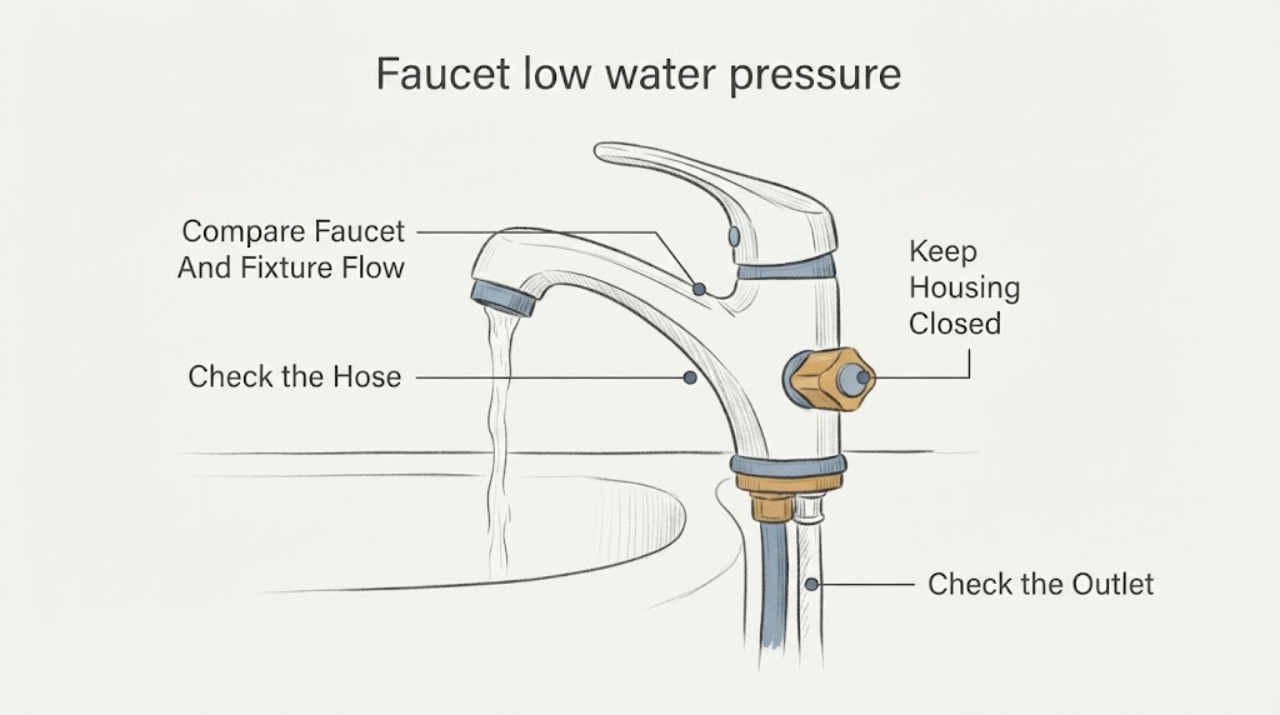
Work through in order
Diagnostic checks
Use only checks that match the exact appliance or system and its official guide.
-
Check 1
Run the Kohler faucet briefly and compare it with another nearby fixture. Check hot and cold separately, using the normal handle range, and note whether the weak flow is at the main spout, a pull-out or pull-down sprayhead, or every outlet. Stop if water is leaking or the faucet cannot be controlled.
Expected result: Record low flow only at this faucet, low flow only on hot or cold, low flow from both sides, low flow from every nearby fixture, or a spray pattern that is poor even when total flow seems normal.
Next step: Use the faucet-only, temperature-specific, or wider-plumbing branch. Record whether the symptom is new, follows installation or water work, or has gradually worsened.
Stop if: Do not remove plumbing connections or keep running water if the handle, spout, hose, or shutoff leaks.
Why this matters
Why: A restriction isolated to one Kohler faucet points toward its outlet, supply hoses, stops, valve, cartridge, or body. One-temperature loss points more toward that supply path or cartridge side. Low flow throughout the home or branch is less likely to be fixed by cleaning this faucet's aerator.
-
Check 2
Look under the sink with the faucet off. Confirm the hot and cold supply stops are fully open, the handle reaches its normal full-open position, and neither visible supply hose is kinked, twisted, crushed, or sharply bent. Turn a stop only if it moves normally and there is no sign of leakage; do not force a seized valve.
Expected result: Record a partially closed stop, handle that does not reach full open, a kinked or twisted hose, a wet or corroded connection, or normal-looking stops and hoses.
Next step: Correct only a plainly partial stop or hose kink without disturbing connections, then retest briefly. If flow remains low, the stop will not move, or any joint leaks, isolate water only if safely possible and arrange a plumber.
Stop if: Do not remove a hose, force a shutoff, loosen a compression fitting, or continue operating with water collecting in the cabinet.
Why this matters
Why: Kohler identifies partially closed stops, a partially closed handle, and kinked supply hoses as direct low-flow causes. A wet, seized, or corroded stop can fail when operated and changes the task from adjustment to plumbing repair. Normal visible supply conditions do not rule out an internal valve, cartridge, or outlet restriction.
-
Check 3
Identify the Kohler faucet model and the outlet type before removing anything. If the model's instructions identify a removable threaded or keyed aerator, stream breaker, or sprayhead, turn the handle off, protect the finish, remove only that outlet as instructed, and rinse or soak the removable screen or spray face according to the Kohler guide. Do not force a recessed outlet or insert a sharp object.
Expected result: Record visible mineral or debris, a clogged screen, an outlet that will not release with the documented method, a recessed or keyed design, or no apparent blockage.
Next step: Reinstall the cleaned part with its seal in the documented orientation and retest. If flow remains low or the outlet cannot be safely removed, move to the hose or internal-valve branch and arrange service when access is required.
Stop if: Do not drill, pry, scratch the finish, remove a flow-control component to defeat the faucet's designed flow, or use chemicals not permitted by the model instructions.
Why this matters
Why: A blocked aerator, stream breaker, or sprayhead can make the stream weak or uneven while supply flow remains normal. Kohler shows that outlet designs differ and that removal is model-specific; failure to release safely means the outlet should not be forced or damaged.
-
Check 4
For a Kohler pull-out or pull-down faucet only, follow the model's instructions to remove the sprayhead from its hose while the handle is off; hold the hose so it cannot retract into the spout. With the hose directed into the sink, briefly turn on the faucet and compare the flow, without disconnecting an under-sink connection unless the exact Kohler guide explicitly permits that check and the water can be safely controlled.
Expected result: Record good flow from the bare spray hose, poor flow from the hose, a kinked or damaged spray hose, or a sprayhead that cannot be removed safely.
Next step: Clean and reinstall the sprayhead if the model permits and the hose flow was good. If hose flow stays poor, the hose is damaged, or the test is not supported by the model guide, arrange service for model-specific valve, cartridge, hose, or body diagnosis.
Stop if: Do not let the hose retract into the faucet, disconnect a pressurized line, open the valve body, or leave the faucet running unattended.
Why this matters
Why: Kohler says good flow with the sprayhead removed points toward debris in the sprayhead, while poor flow from the hose points toward debris in the valve or cartridge. A kinked or damaged hose can also restrict flow. This check does not identify the correct replacement part without the model number.
-
Check 5
If the stops, hoses, handle, and removable outlet are normal but flow is still low, record the Kohler model number, faucet style, hot-versus-cold pattern, outlet test result, and any recent installation or water-line work. Use Kohler's product-support and parts documentation to locate the model-specific guide; do not open the cartridge, valve, or faucet body as a first-line test.
Expected result: Record a known model, an unknown model, low flow that persists after outlet cleaning, a new-installation symptom, sediment after water work, a leaking valve or hose, or low pressure in multiple fixtures.
Next step: Arrange Kohler support or a qualified plumber with the model and observations. Ask for a model-specific diagnosis before replacing a cartridge, supply hose, valve, or complete faucet.
Stop if: Do not dismantle a faucet with water still available, force a cartridge, bypass a check screen, or substitute an unverified part.
Why this matters
Why: Persistent faucet-only restriction can involve the valve, cartridge, spray hose, internal screen, or faucet body. Kohler states that replacement part numbers vary by faucet model. A new-installation or whole-home pattern can instead involve supply-line debris, shutoffs, pressure regulation, or upstream plumbing.
Use your observations
Decision map
Find the observation that best matches what you see, then follow the next safe action.
-
PATH 01Safety boundary
What you see
Other nearby fixtures have normal flow, while the Kohler faucet is weak on both hot and cold and its visible stops and hoses look normal.
Do this next
Identify the Kohler model and perform only its supported removable outlet or sprayhead check. Arrange service if flow remains low or internal access is required.
Why this path and its safety boundary
Why it matters: A faucet-side restriction is more likely than a whole-home pressure problem. The outlet, spray hose, valve, cartridge, or faucet body remains possible.
Safety stop: Do not open the faucet body or replace an internal part without exact-model confirmation.
-
PATH 02Safety boundary
What you see
Only hot or only cold flow is weak at the Kohler faucet, while the opposite temperature is normal.
Do this next
Check the affected stop and visible hose for partial closure or kinking without disconnecting anything. If they are normal, provide the model and temperature pattern to a plumber or Kohler support.
Why this path and its safety boundary
Why it matters: The affected supply stop, hose, inlet screen, cartridge side, or upstream branch is more likely than a shared aerator restriction, although a faucet-specific valve problem remains possible.
Safety stop: Do not force the affected shutoff, loosen a supply connection, or open the cartridge with water not safely isolated.
-
PATH 03Safety boundary
What you see
Flow improves when the model-supported aerator, stream breaker, or sprayhead is removed, or visible mineral debris blocks that outlet.
Do this next
Clean the removable outlet as the Kohler guide allows, restore its seal and orientation, and retest briefly. Replace it only after model and finish details are confirmed.
Why this path and its safety boundary
Why it matters: Debris at the removable outlet is more likely than a supply-pressure failure. Kohler's outlet designs vary, so cleaning and reinstallation must follow the exact model method.
Safety stop: Do not enlarge the opening, remove designed flow-control parts, force a keyed or recessed outlet, or scratch the faucet finish.
-
PATH 04Safety boundary
What you see
A supported pull-out or pull-down test shows poor flow from the bare spray hose, or the spray hose is visibly kinked or damaged after the outlet is addressed.
Do this next
Arrange model-specific service and provide the hose-flow result, model number, and temperature pattern. Have the technician identify the valve, cartridge, spray hose, or internal screen before parts are selected.
Why this path and its safety boundary
Why it matters: Kohler's flow decision points toward debris or restriction in the valve or cartridge when hose flow is poor; a damaged hose is another possibility. The faucet body and model-specific screens are not ruled out.
Safety stop: Do not disconnect an under-sink line, open the valve, flush uncontrolled water into the cabinet, or order a cartridge from a generic faucet appearance.
-
PATH 05Safety boundary
What you see
Low flow affects multiple fixtures, begins after water service or installation, or is accompanied by a leaking stop, hose, fitting, wall, or cabinet.
Do this next
Stop using the affected plumbing, close the local or main water shutoff only if safely identifiable and operable, protect the area from water, and arrange a qualified plumber. For a leak near electrical equipment, keep clear and seek urgent help.
Why this path and its safety boundary
Why it matters: The issue is more likely upstream supply pressure, line debris, a shutoff, pressure regulation, or a plumbing leak than a Kohler outlet alone. A leak can worsen while a faucet is being tested.
Safety stop: Do not keep testing, force a seized shutoff, open walls, or disassemble a wet connection.
Helpful context
Understand the symptom
Define low pressure before opening anything
A faucet that feels weak may have a clogged outlet, a kinked supply hose, a partially closed stop or handle, sediment in a valve or cartridge, or low pressure in the home's supply. Compare the Kohler faucet with another nearby fixture and compare hot with cold. A problem isolated to one outlet leads to a faucet-side inspection; a whole-home or whole-branch problem needs plumbing diagnosis rather than an aerator replacement.
Use the Kohler model to choose the outlet check
Kohler identifies several outlet designs, including threaded aerators, keyed aerators, and recessed stream breakers. Pull-down and pull-out sprayheads may also use a hose and internal screens. Do not force a tool into a recessed outlet or assume that one Kohler sprayhead, aerator, cartridge, or hose fits another model. Identify the faucet before selecting parts or using model-specific removal instructions.
Stop at the supply and valve boundary
Opening a supply connection, cartridge, valve, or faucet body can release water and create a leak if the shutoff does not work or a seal is disturbed. Basic checks can cover the handle, accessible stops, visible hoses, and a removable outlet part. A persistent restriction, leaking connection, damaged stop, or pressure problem belongs with a qualified plumber or Kohler service professional.
Safety boundary
Stop conditions
- Do not force, drill, pry, or scratch a Kohler aerator, stream breaker, sprayhead, handle, cartridge, or valve; outlet designs are model-specific.
- Do not disconnect supply hoses, open the valve or cartridge, or loosen fittings unless water is safely isolated and the exact model instructions or a qualified plumber support the work.
- Stop immediately for a leaking shutoff, hose, fitting, wall, or cabinet; water near electrical equipment; inability to control the faucet; or a seized valve that could fail when turned.
- Do not remove designed flow-control parts, bypass screens, or substitute a generic cartridge, spray hose, aerator, or valve from appearance alone.
- Arrange Kohler support or qualified plumbing service when low flow persists after supported outlet and stop checks, affects multiple fixtures, follows installation or water work, or requires valve, cartridge, faucet-body, supply-line, or pressure diagnosis.
Only after diagnosis
Potential parts
- Kohler faucet aerator or stream breaker
Consider this category only when the exact Kohler model and outlet type are confirmed and the removable outlet is clogged, damaged, or missing.
Kohler documents threaded, keyed, and recessed outlet designs and model-specific parts. Confirm model, finish, outlet style, and any designed flow-control requirement before selection. - Kohler faucet sprayhead or spray hose
Consider this category only when a supported outlet or hose-flow check identifies a clogged, damaged, or leaking sprayhead or hose and the exact model is known.
Connection, hose length, sprayhead functions, seals, and finish vary by faucet. Do not substitute a part from another Kohler style without model confirmation. - Kohler faucet valve or cartridge
Consider this category only after visible supply and outlet checks are normal and Kohler support or a plumber confirms an internal valve or cartridge restriction or failure.
Kohler states that replacement part numbers vary by faucet model. Water must be safely isolated and the exact installation method confirmed before internal repair. - faucet supply hose or stop valve
Consider this category only when inspection confirms a kinked, leaking, damaged, or failed supply component and the connection can be safely isolated.
Thread, length, seal, valve, and local plumbing requirements vary. A leaking or seized shutoff should be handled by a qualified plumber.
When checks do not resolve it
Need a professional?
Arrange Kohler support or a qualified plumber when a Kohler faucet remains low after model-supported outlet, handle, stop, and hose checks, when only one temperature remains restricted with normal visible supply, or when a cartridge, valve, spray hose, faucet body, or upstream pressure problem is suspected. Stop for any leak, uncontrolled water, water near electrical equipment, a seized shutoff, or damage caused by forced removal; use urgent plumbing help for active water damage.
Safety scope: This article supports comparing fixtures, checking a handle, observing accessible stops and hoses, identifying the model, and cleaning a model-supported removable outlet. It does not authorize forced aerator removal, supply-line disconnection, cartridge or valve disassembly, uncontrolled flushing, pressure testing, or work on plumbing near energized electrical equipment.
Common questions
FAQ
Why is my Kohler faucet water pressure low?
Low flow can come from a partially closed stop or handle, kinked supply hose, clogged aerator or sprayhead, debris in a screen, valve or cartridge, or a faucet body restriction. Compare other fixtures and hot with cold first; a whole-home pressure problem needs plumbing diagnosis rather than a faucet outlet cleaning.
What should I check first on a Kohler faucet with low flow?
Check whether both supply stops are fully open, the handle reaches full open, and the visible hot and cold hoses are not kinked. Identify the faucet model and outlet type before removing an aerator, stream breaker, or sprayhead.
How do I know whether the Kohler aerator is clogged?
If the model supports safe outlet removal and flow improves with the aerator, stream breaker, or sprayhead removed, debris at that outlet is more likely. Kohler lists threaded, keyed, and recessed outlet types, so follow the model's method and do not force a recessed or keyed part.
What if only the hot or cold side of my Kohler faucet has low pressure?
Check the affected supply stop and visible hose for partial closure or a kink without disconnecting anything. If those look normal, the affected cartridge side, screen, valve, or upstream branch may be restricted; provide the model and temperature pattern to Kohler support or a plumber.
When should a plumber repair a Kohler faucet with low flow?
Call a plumber or Kohler support when flow stays low after supported outlet and supply checks, multiple fixtures are affected, the issue follows water-line work, or a cartridge, valve, faucet body, supply connection, or pressure problem is suspected. Stop for a leak, seized shutoff, uncontrolled water, or water near electrical equipment.
Read the exact guide
Official sources
- Removing an aeratorKohler Assist · Kohler outlet-identification guide; it does not establish that every faucet has a removable outlet or that one tool or part fits another model.
- Faucet Troubleshooting TableKohler Co. · Kohler technical guide for a specified electronic faucet family; it illustrates possible causes and is not universal to every Kohler faucet.
- Low Flow from Hot and Cold WaterKohler Assist · Kohler Assist guidance for kitchen faucets, especially pull-out and pull-down styles; exact steps, outlet designs, and parts vary by faucet model.
- Customer Service & Product SupportKohler · Kohler's general support portal; the product model and installation determine the applicable guide and replacement part.
Community feedback
Share a repair observation
Share a plain-text repair observation. Accepted observations are published automatically; this page may take a moment to update.