
On this page
Start here
Quick answer
A Moen faucet with low flow may have debris in the aerator, wand screen, in-line filter, cartridge, or diverter, but a partially closed shutoff valve, kinked supply line, leak, or whole-home pressure problem can look similar. First compare the affected faucet with another fixture and determine whether both hot and cold sides are weak. Check the under-sink shutoff valves and visible supply lines, then clean only a model-appropriate aerator or screen with the water isolated as the instructions require. If only one temperature is weak, the supply path or cartridge becomes more likely; if several fixtures are weak, investigate the home's water supply. Stop for a leak, damaged connection, inaccessible filter, or any cartridge or valve work you cannot identify for the exact Moen model.
Before you begin
Safety first
- This article supports ordinary visual checks and model-approved cleaning only. Do not force valves or faucet parts, disconnect water-bearing lines without isolation, open a valve body, alter flow controls, or improvise pressure or piping repairs.
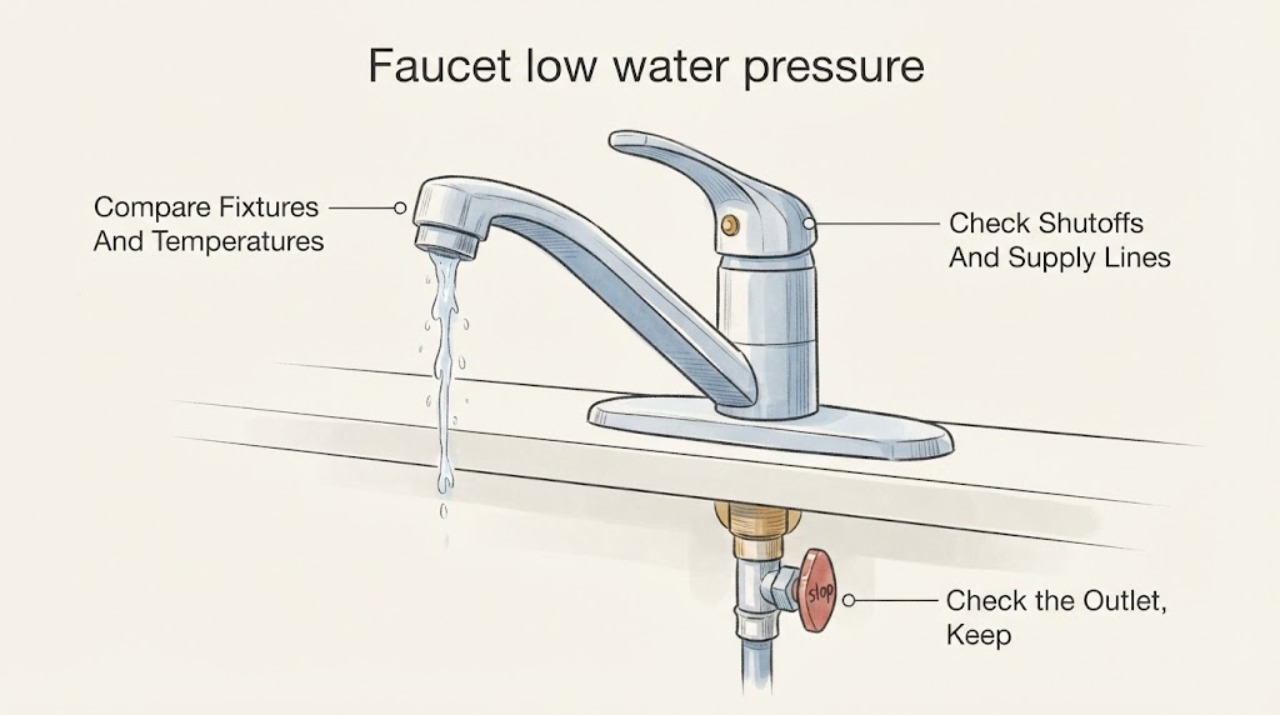
Work through in order
Diagnostic checks
Use only checks that match the exact appliance or system and its official guide.
-
Check 1
Run the affected Moen faucet normally and compare it with a nearby faucet or other outlet. Test hot and cold separately, then together, without removing any parts.
Expected result: Only this faucet is weak, both temperatures are weak, only hot or only cold is weak, or several fixtures are weak or change when another fixture runs.
Next step: Record the pattern and continue with the matching visible check; arrange plumbing assessment instead of dismantling the faucet when the problem affects several fixtures or the whole home's pressure.
Stop if: Stop for a burst or active leak, flooding, a hot-water scald risk, or any unsafe condition around the faucet or cabinet.
Why this matters
Why: A single-faucet problem supports a local aerator, screen, cartridge, diverter, or supply-line check. One-temperature weakness supports that temperature's shutoff or supply path. Several weak fixtures point toward the home's supply, pressure, pump, reducing valve, leak, or piping rather than the Moen outlet alone.
-
Check 2
With the cabinet dry and the faucet off, look at both shutoff valves and the flexible supply lines. Confirm each valve is in its normal open position and check for kinks, crushing, dampness, or a visibly damaged line without forcing the valve.
Expected result: A valve is partly closed, a line is kinked or wet, both lines look sound, or the valve or connection will not move or cannot be judged safely.
Next step: If a valve is obviously not in its normal open position and turns normally, restore it gently and recheck for leaks; otherwise stop and have a plumber inspect the supply. Do not force or disassemble a valve.
Stop if: Stop for active leaking, corrosion that could break when moved, a seized valve, a bulging hose, or water near electrical equipment.
Why this matters
Why: A partly closed valve or restricted supply line can reduce flow before the faucet. Dampness or a damaged line may be a leak rather than a low-pressure adjustment. Sound visible supplies make an outlet restriction or internal faucet component more likely, but do not rule out a hidden plumbing issue.
-
Check 3
Identify the exact Moen faucet and, only if its instructions allow ordinary service, remove the exposed or concealed aerator or outlet screen with the intended method. Rinse visible debris, preserve the seal and screen orientation, and reinstall without force.
Expected result: The screen or aerator contains mineral deposits or debris, is damaged or missing, is clean, or cannot be removed without unusual force or an unidentified tool.
Next step: Reassemble only the identified original arrangement and retest. If flow remains low, follow the branch for the faucet type rather than drilling openings, removing flow-control elements, or improvising a replacement.
Stop if: Turn water off before any step that disconnects a line, do not scratch or enlarge the outlet, and stop for a damaged seal, cracked body, or a part that will not release safely.
Why this matters
Why: A dirty outlet restriction can explain low flow at one faucet, while a clean outlet points farther upstream. A damaged or missing screen is a parts or fitment question. An inaccessible or stuck aerator should not be forced because Moen uses multiple designs and removal methods.
-
Check 4
For a Moen pullout or pulldown kitchen faucet, inspect the visible screen between the hose and wand only as the model instructions allow. If the wand can be separated without force, briefly compare flow from the hose into the sink with the wand attached, keeping the hose secure and water controlled.
Expected result: Flow is good from the hose but weak through the wand, the hose itself is weak, the screen contains debris, or the faucet does not use a removable wand arrangement.
Next step: Rinse only the identified screen if the instructions permit, reinstall it correctly, and retest. If hose flow is low or the result remains unclear, stop disassembly and arrange model-specific service.
Stop if: Do not pull hard on the hose, disconnect a line without isolating water, run water into the cabinet, or open the cartridge or valve body as an improvised test.
Why this matters
Why: Good hose flow with weak wand flow focuses the restriction on the screen or wand. Low hose flow points toward the cartridge, valve body, supply, or a deeper obstruction. A non-pullout faucet needs the aerator, side-spray, cartridge, or supply path instead.
-
Check 5
If the kitchen faucet has a side spray, observe the spout and side spray separately with the area clear. Operate the side-spray trigger normally; do not open the faucet body or remove a diverter to make the comparison.
Expected result: The side spray has good flow while the spout is weak, both are weak, or activating the side spray does not change the spout result.
Next step: After the aerator and supply checks, use the exact model guide or qualified service to evaluate a diverter, cartridge, or valve body; do not substitute a part by appearance.
Stop if: Stop for a leaking hose, uncontrolled spray, damaged trigger, or any need to disassemble the valve body while water is connected.
Why this matters
Why: Good side-spray flow with a weak spout makes a diverter or spout-side restriction more likely. Weak flow at both outlets keeps the cartridge, supply, or whole-home pressure in consideration. No change after the spray test does not establish that a diverter is replaceable without model identification.
-
Check 6
Document the faucet model, sink type, one-versus-two-handle design, hot/cold pattern, fixture comparison, shutoff and supply observations, aerator or screen condition, and any side-spray or wand result.
Expected result: The low-flow cause is clear after an approved clean-and-retest, or flow remains low despite clear visible parts and normal shutoffs.
Next step: Give the record to a qualified plumber or Moen support channel and request a model-specific diagnosis before ordering or replacing an internal part.
Stop if: Do not flush, hydro-jet, replace a cartridge, open a valve body, or alter the home's pressure controls as a guess.
Why this matters
Why: A persistent local restriction may involve a cartridge, diverter, valve body, in-line filter, or concealed supply. A whole-home pattern may involve pressure, a pump, a reducing valve, a leak, or piping. The model and observed split determine the safe repair path.
Use your observations
Decision map
Find the observation that best matches what you see, then follow the next safe action.
-
PATH 01Safety boundary
What you see
Several fixtures have low flow, the pressure changes when other fixtures run, or both hot and cold sides are weak at multiple outlets.
Do this next
Check only the visible main-shutoff status if it is safe and familiar, then arrange plumbing assessment for the home's supply and pressure rather than replacing the faucet first.
Why this path and its safety boundary
Why it matters: The Moen faucet is unlikely to be the only restriction; a main shutoff, utility supply, pump, pressure-reducing valve, leak, or older piping may be involved.
Safety stop: Stop for a suspected burst pipe, active leak, flooding, sudden major pressure change, or any plumbing work beyond ordinary observation.
-
PATH 02Safety boundary
What you see
Only the Moen faucet is weak on both temperatures and the outlet aerator or screen contains debris, while supply valves and lines look normal.
Do this next
Clean and reinstall the identified screen using the model-appropriate method, then retest without changing any flow-control or internal valve parts.
Why this path and its safety boundary
Why it matters: A local aerator, wand screen, or in-line screen restriction is the strongest explanation, subject to the faucet's exact design.
Safety stop: Stop if the screen cannot be removed, the seal is damaged, the faucet leaks after reassembly, or flow does not improve after an approved clean.
-
PATH 03Safety boundary
What you see
Only hot or only cold water is weak at the Moen faucet, and the matching shutoff or supply line is partly closed, restricted, wet, or not delivering normal flow.
Do this next
Do not force the valve or disconnect the line. If it is not a simple, safe valve-position issue, have a plumber inspect the shutoff, supply line, and faucet inlet.
Why this path and its safety boundary
Why it matters: The affected temperature's supply path is more likely than the shared aerator; a leak or restricted valve needs plumbing attention.
Safety stop: Stop for corrosion, a seized valve, active leakage, a damaged hose, or water near electrical equipment.
-
PATH 04Safety boundary
What you see
A pullout or pulldown hose has good flow but its wand is weak, or a side spray has good flow while the spout is weak.
Do this next
Clean only the identified, user-serviceable screen and retest. If the restriction persists, use the model guide or qualified service for wand, diverter, cartridge, and valve-body diagnosis.
Why this path and its safety boundary
Why it matters: The screen, wand, or diverter path is more likely than the home's water pressure, but the correct replacement depends on the Moen model.
Safety stop: Do not substitute a diverter or wand by appearance, run water into the cabinet, or open the valve body without isolating water and following exact instructions.
-
PATH 05Safety boundary
What you see
Only the Moen faucet is weak, visible shutoffs and supply lines are normal, and an approved aerator or screen clean does not restore flow.
Do this next
Stop trial-and-error part replacement and provide the model, handle and sink type, temperature pattern, screen result, and fixture comparison to a plumber or Moen support for exact service instructions.
Why this path and its safety boundary
Why it matters: A cartridge, diverter, in-line filter, valve body, concealed supply restriction, or model-specific flow design remains possible; the faucet cannot be diagnosed safely from the symptom alone.
Safety stop: Do not remove the cartridge, flush the valve body, alter a flow regulator, or force a concealed aerator when the model procedure is unknown.
Helpful context
Understand the symptom
Classify the low pressure before taking the faucet apart
Low pressure at one Moen faucet is usually a local restriction or supply issue, while weak flow at several fixtures points toward the home's shutoff, pressure, pump, reducing valve, leak, or piping. Also separate both hot-and-cold weakness from a problem affecting only hot or only cold. Moen uses those distinctions to choose different checks, so do not start by replacing a cartridge without recording the pattern.
Start with the visible water path
Confirm the under-sink hot and cold shutoff valves are open and look along the flexible supply lines for kinks, crushing, dampness, or a connection that is not dry. Do not force a stiff valve or tighten a wet connection as a test. A restricted or leaking supply line can reduce flow before water reaches the faucet, and Moen says the supply lines must deliver adequate pressure for the faucet to produce full flow.
Clean the outlet restriction only in the model's intended way
Moen says aerators collect debris and mineral deposits and that cleaning may restore performance. An exposed or concealed aerator may use a different removal method, while some faucets have an in-line filter or a screen between a pullout or pulldown hose and wand. Identify the faucet model first, isolate water when the instructions call for it, preserve the seal and screen orientation, and stop if the part will not release without force.
Use the result to choose cartridge, diverter, or plumbing service
If flow is good before a pullout or pulldown wand but weak after it is reconnected, the wand screen or wand is the focused path. If a side spray has good pressure while the spout is weak, the diverter becomes more likely. If both temperatures remain weak after the outlet is clear, the cartridge or valve body may need model-specific service. If only one temperature is weak, inspect that temperature's shutoff and supply path first. These are diagnostic distinctions, not permission to open the valve body without the exact Moen instructions.
Safety boundary
Stop conditions
- Stop for an active leak, flooding, a cracked faucet body, damaged supply hose, seized or corroded shutoff, or water near electrical equipment.
- Turn water off before disconnecting a supply line, cartridge, screen housing, or other water-bearing component, and do not work by guesswork when the model is unknown.
- Do not force a shutoff valve, aerator, hose, screen, cartridge, or diverter; do not enlarge outlets or alter any flow-control component.
- Do not replace a cartridge, diverter, valve body, pressure-reducing valve, pump, or piping based only on the low-flow symptom; confirm the exact model and diagnostic result first.
- Stop and arrange plumbing service when several fixtures are weak, the pressure changed suddenly, a leak is suspected, or low flow persists after approved local cleaning.
Only after diagnosis
Potential parts
- Moen faucet aerator or outlet screen
Consider this category only when the exact model uses that screen and inspection confirms debris damage, a missing screen, or a restriction that remains after the model-approved cleaning method.
Confirm the faucet model, aerator type, flow design, seal, and manufacturer's fit information; do not substitute a screen or alter its openings by appearance alone. - Moen pullout or pulldown wand screen
Consider this category only when hose flow is good but the attached wand remains restricted and the model-specific inspection identifies the screen or wand as the cause.
Confirm the exact faucet model, hose and wand connection, screen orientation, seal, and manufacturer's fit information before ordering. - Moen faucet cartridge or diverter
Consider this category only after shutoff, supply, aerator, screen, wand, and side-spray results point to an internal cartridge or diverter for the exact faucet model.
Confirm the model and handle or spray configuration with Moen or a qualified plumber; cartridge and diverter appearance alone does not establish fit.
When checks do not resolve it
Need a professional?
Arrange qualified plumbing or model-specific Moen service when low flow affects several fixtures, changes suddenly, is accompanied by a leak or damaged supply, affects only one temperature after the shutoff check, persists after an approved aerator or screen clean, or requires cartridge, diverter, valve-body, pressure-control, pump, or piping work. Request service before moving a seized valve or forcing an unidentified aerator.
Safety scope: This article supports ordinary visual checks and model-approved cleaning only. Do not force valves or faucet parts, disconnect water-bearing lines without isolation, open a valve body, alter flow controls, or improvise pressure or piping repairs.
Common questions
FAQ
Why is my Moen faucet low pressure on both hot and cold?
Start by comparing another fixture and checking the two under-sink shutoffs and visible supply lines. If only this faucet is weak, clean the model-appropriate aerator or screen; if several fixtures are weak, investigate the home's water supply or pressure instead of replacing the faucet first.
Why is only the hot or cold side of my Moen faucet weak?
The affected temperature's shutoff valve or supply line may be partly closed, restricted, or obstructed. Check that visible path without forcing a valve; if it is normal or wet, arrange plumbing service before attempting cartridge or valve-body work.
Can cleaning the Moen faucet aerator restore low water pressure?
It can when debris or mineral deposits restrict the outlet. Identify whether the aerator is exposed, concealed, or replaced by an in-line filter, then use the exact model's cleaning method. Stop if it will not release without force, the seal is damaged, or flow remains low after an approved clean.
How do I know whether a Moen kitchen faucet wand or diverter is causing low flow?
Good hose flow with a weak pullout or pulldown wand points toward its screen or wand. Good side-spray flow with a weak spout makes a diverter or spout restriction more likely. Use those results to select model-specific service; do not substitute an internal part by appearance.
Read the exact guide
Official sources
- Low water flow from spout- ONLY hot or cold water on sink faucetsMoen Solutions · Manufacturer guidance for shutoff valves, hot or cold supply lines, and cartridge or valve-body service when only one temperature is weak.
- Faucet Aerator CleaningMoen Solutions · Manufacturer guide for exposed, concealed, and non-accessible aerators and for recognizing screens or in-line filters.
- Low Water PressureMoen Solutions · Manufacturer guidance used to distinguish faucet-local restrictions from a home water-system pressure, shutoff, pump, pressure-reducing-valve, leak, or piping issue.
- Kitchen Faucet: Low FlowMoen Solutions · Manufacturer guidance for kitchen faucet aerators, side sprays, diverters, pullout or pulldown wands, screens, and cartridge paths.
- Low water flow from spout- BOTH hot and cold water on sink faucetsMoen Solutions · Manufacturer guidance for supply checks, aerator and wand screens, side sprays, diverters, cartridges, and valve-body service when both temperatures are weak.
- Bathroom Faucet: Low FlowMoen Solutions · Manufacturer guidance for under-sink shutoff checks, one-temperature versus overall low flow, aerator cleaning, and model-dependent filter or cartridge service.
Community feedback
Share a repair observation
Share a plain-text repair observation. Accepted observations are published automatically; this page may take a moment to update.