
On this page
Start here
Quick answer
A standpipe overflow that eventually drains, followed by slow shower drainage or a rise when an upstairs toilet is flushed, points beyond a simple shower-hair clog: the fixtures may share a restricted branch, building drain, venting problem, private sewer lateral, or a municipal main. Stop flushing, showering, washing, and sending other water down the drains until the line is assessed; another flush can recreate the overflow. Keep children and pets away from wastewater, avoid contact with sewage, and stay out of standing water near electrical equipment. Record which fixtures are slow, whether the shower rises when water is used elsewhere, whether the backup occurs with no water use, and where the lowest drain is located. Contact the local sewer utility when a main-line problem is possible and a licensed plumber for a private building drain or lateral. Do not open a pressurized cleanout, use caustic chemicals, enter a manhole, or keep flushing to reproduce the symptom.
Before you begin
Safety first
- Keep water use off during backup risk. Do not open cleanouts, remove manhole covers, enter confined spaces, climb onto the roof, use caustic chemicals, force tools into a backed-up line, or work around sewage or wet electrical equipment.
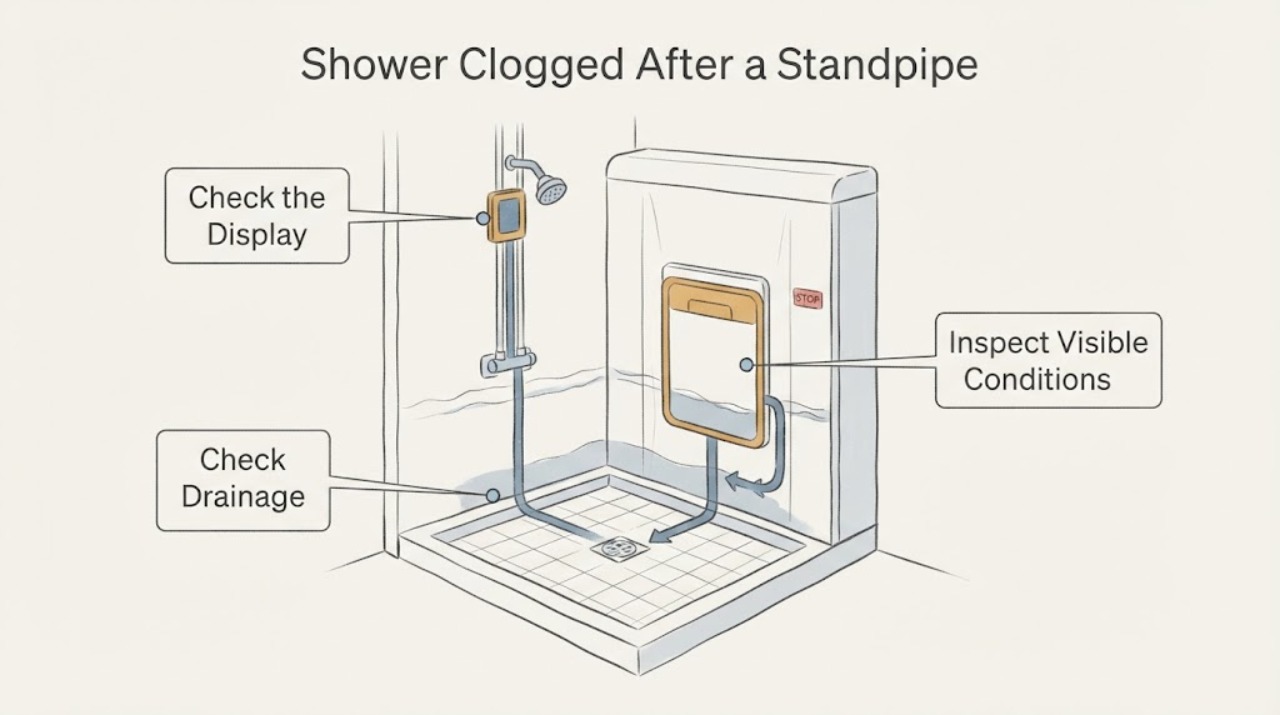
Work through in order
Diagnostic checks
Use only checks that match the exact appliance or system and its official guide.
-
Check 1
Stop all nonessential water use now: do not flush the upstairs toilet, run the washer or dishwasher, shower, or send water into sinks. If a fixture is actively overflowing, stop its water flow only when the control is safely reachable without entering wastewater or standing water.
Expected result: The overflow stops when the home stops sending water to the drains, or wastewater continues to rise even though no fixture is being used.
Next step: Keep water use suspended. Arrange a licensed plumber for a private drain or lateral assessment, and contact the sewer utility when backup continues without household use or neighbors are affected.
Stop if: Stop immediately for uncontrolled wastewater, an overflowing fixture, sewage contact, or any need to enter standing water or handle a wet electrical device.
Why this matters
Why: Stopping the inflow prevents another surge through a restricted line. Continued backup without household water raises concern about a main-line, shared building, or other external drainage problem.
-
Check 2
From a dry, safe position, record the behavior that already occurred rather than repeating it: which fixture overflowed, whether the shower was the lowest opening, whether the upstairs flush caused a rise or gurgle, how long drainage took, and whether the standpipe or shower is still slow.
Expected result: Only the shower is slow, the standpipe and shower are both affected, several fixtures are slow, or the shower reacts to toilet use upstairs.
Next step: Give the timeline and fixture map to the plumber or utility. Do not use another flush as a diagnostic test while the overflow risk remains.
Stop if: Stop for wastewater at the shower or standpipe, sewer odor with visible contamination, rapid water rise, or any urge to reproduce the overflow.
Why this matters
Why: A single slow shower can be local, but a standpipe overflow plus a shower response to an upstairs toilet suggests a restriction or pressure interaction in a shared downstream path. Several slow fixtures make a building drain, lateral, or main more likely.
-
Check 3
Without opening plumbing or touching contaminated water, observe other fixtures and floors: sinks, tubs, toilets, floor drains, basement or lower-level drains, and any visible cleanout area. Note gurgling, sewer odor, wastewater, dampness, or a missing or displaced cover from a safe distance.
Expected result: Only the shower is affected, more than one fixture is slow, a lower drain backs up, sewage appears when no water is used, or nearby buildings appear affected.
Next step: Keep the home off the drains and contact the sewer utility when a public-main or neighborhood issue is possible. Contact a licensed plumber for a private building drain or lateral after the utility's boundary is clarified.
Stop if: Stop for raw sewage, a flooded basement, a missing manhole cover, an unstable floor, or any need to approach a contaminated or confined area.
Why this matters
Why: Multiple affected fixtures or a lower-level backup points toward a shared service line or main. A backup while no home fixture is used can be a public-main issue; a private-only pattern is more consistent with building plumbing or the private lateral.
-
Check 4
If there is no active backup and the shower alone remains slow, inspect only the visible drain opening for hair, soap residue, or a displaced strainer. Keep hands and tools out of wastewater, do not reach past the visible opening, and do not pour a chemical cleaner into a line that may be shared or contaminated.
Expected result: A visible surface obstruction is present, the opening is clear but the shower remains slow, or wastewater has recently backed up through the shower or standpipe.
Next step: Remove only a plainly visible surface obstruction if the area is clean and dry. If the shower remains slow or the overflow history applies, stop DIY clearing and arrange a plumber to assess the shared line.
Stop if: Stop for sewage, standing water, chemical residue, a fragile or sealed drain assembly, or any need to push a tool into the trap or shared line.
Why this matters
Why: A surface obstruction may contribute to an isolated shower slowdown, but a clear opening does not clear a downstream restriction. Recent standpipe overflow and upstairs-to-shower interaction outweigh a guess that the strainer is the whole problem.
-
Check 5
Observe the shower and standpipe area for contamination and electrical exposure without touching it: note whether water is clear or sewage-like, whether it reached an outlet, appliance cord, furnace area, sump equipment, or other electrical device, and whether the floor is stable and dry enough to leave safely.
Expected result: There is no standing water or electrical contact, or wastewater or water is near electrical equipment or a person would need to walk through it.
Next step: Keep everyone away. If power can be disconnected from a dry, safe location, have a qualified person isolate the affected circuit; otherwise do not approach the panel. Arrange professional cleanup and plumbing or electrical help as applicable.
Stop if: Stop for standing water near electrical equipment, a wet electrical panel or cord, shock, burning odor, sparks, sewage exposure, or a floor that cannot be crossed safely.
Why this matters
Why: Sewage can carry harmful organisms, and water near electricity adds shock and fire risk. The drain diagnosis must wait until the area is isolated and safe.
-
Check 6
From a safe location, check only whether a visible, clearly labeled building-water shutoff or an automatically running water device can be stopped without entering the affected area. Do not open a cleanout, remove a manhole cover, enter a pit, use a drain machine, or pour chemicals.
Expected result: Water use is fully stopped, an automatic appliance continues to discharge, a cleanout or manhole is involved, or the source or line boundary is uncertain.
Next step: Leave access covers closed, keep water use off, and tell the plumber or utility exactly what is visible. Ask the utility to determine whether the public main is open before authorizing private lateral work when that boundary is unclear.
Stop if: Stop for pressure, sewage, a blocked or unsafe access opening, a confined space, unknown underground utilities, or any need to use powered clearing equipment yourself.
Why this matters
Why: Stopping inflow reduces further backup. A cleanout, lateral, or public main requires the correct trained service and may contain pressure, sewage, or nearby utility hazards; uncertainty is a reason to escalate rather than improvise.
-
Check 7
Prepare a service report instead of performing another flush: list the home's levels, shower and standpipe locations, the upstairs toilet, other affected fixtures, overflow timing, slow-drain timing, weather or neighborhood reports, recent plumbing work, and any wastewater or electrical exposure.
Expected result: The symptom is repeatable from the existing history, affects multiple fixtures, occurs only with household use, occurs without household use, or has not recurred since water use stopped.
Next step: Request a licensed plumber for the private drain or lateral and contact the sewer utility for a possible public-main issue. Resume normal water use only after the responsible professional confirms the blockage and backup risk are cleared.
Stop if: Stop for recurring overflow, sewage, strong sewer odor, a lower-level backup, structural damage, or any request to keep testing the line with additional water.
Why this matters
Why: The pattern helps separate an isolated private fixture from a shared building drain, private lateral, public main, or possible vent issue. A temporary improvement does not prove the restriction is gone.
Use your observations
Decision map
Find the observation that best matches what you see, then follow the next safe action.
-
PATH 01Next step
What you see
The standpipe or shower overflowed, or wastewater still rises after all household water use stops.
Do this next
Keep toilets, showers, sinks, washers, and other drains unused. Keep people and pets away, contact the sewer utility for a possible main issue, and arrange licensed plumbing help for the private line.
Why this path and its safety boundary
Why it matters: This is an active backup risk, not a routine shower-strainer clog.
-
PATH 02Next step
What you see
The upstairs toilet flush previously made the shower rise, gurgle, or drain more slowly.
Do this next
Do not flush again to confirm it. Give the plumber the fixture map and timing, and keep water use suspended until the shared path is assessed.
Why this path and its safety boundary
Why it matters: The fixtures likely interact through a shared downstream drain or vent path; the symptom is not localized safely by cleaning the shower opening alone.
-
PATH 03Next step
What you see
Several fixtures are slow, a lower drain backs up, or wastewater appears when no fixture is being used.
Do this next
Keep all drains unused and contact the sewer utility when a public-main issue is possible. Use a licensed plumber for a private building drain or lateral after the utility boundary is checked.
Why this path and its safety boundary
Why it matters: A building sewer lateral or public main is more likely than an isolated shower clog. A backup without household use can indicate an external main or shared-line problem.
-
PATH 04Next step
What you see
Only the shower remains slow, there has been no wastewater backup, and a visible surface obstruction is present.
Do this next
Remove only the plainly visible surface material from a clean, dry opening. If flow is still slow or the overflow history applies, stop and arrange plumbing service rather than using chemicals or forcing a tool into the drain.
Why this path and its safety boundary
Why it matters: A local shower-opening restriction is plausible, but it does not explain the standpipe overflow or a prior upstairs-to-shower response if those events are genuine.
-
PATH 05Next step
What you see
The shower gurgles or changes level without an active overflow, while traps and visible drains appear otherwise intact.
Do this next
Record when the gurgle occurs and have a licensed plumber evaluate the branch, venting, and downstream line. Do not climb onto the roof, open a wall, or reproduce the symptom with another flush.
Why this path and its safety boundary
Why it matters: A restriction or venting problem may be changing air and water movement; a roof vent or shared line is not a safe homeowner inspection target.
-
PATH 06Next step
What you see
Standing water or wastewater is near an outlet, appliance, electrical cord, panel, or other electrical equipment.
Do this next
Keep clear, keep others away, and have power isolated only from a dry, safe location by a qualified person. Arrange professional cleanup and plumbing or electrical service.
Why this path and its safety boundary
Why it matters: The immediate hazard is shock or fire, and sewage exposure may add a health hazard.
-
PATH 07Next step
What you see
Neighbors or nearby buildings report similar backup, or the problem occurs while no water is used in the home.
Do this next
Stop household water use and contact the responsible sewer utility or public-works emergency channel. Keep a plumber informed for any private-line diagnosis after the public system is checked.
Why this path and its safety boundary
Why it matters: A public sewer main or shared external line may be involved rather than only the private shower branch.
Helpful context
Understand the symptom
Why the upstairs flush matters
The shower, standpipe, and upstairs toilet may connect to different branches that join farther downstream. If the standpipe overflowed and later drained slowly, and a prior upstairs flush made the shower respond, the useful distinction is shared drainage behavior rather than the location of hair in the shower strainer. Multiple fixtures, gurgling, or wastewater appearing at a lower fixture can indicate a restriction in a building drain, private sewer lateral, or public main. A vent problem can also change trap pressure and produce gurgling, but the overflow history still makes a drain-path assessment the priority.
Treat the overflow as wastewater until proven otherwise
Do not intentionally flush the upstairs toilet again to see whether the shower rises. Stop nonessential water use, keep people and pets away from any wastewater, and do not touch wet electrical equipment. The safe checks below use the behavior that has already occurred, visible dry observations, and a service call; they do not require opening a cleanout, entering a confined space, pouring chemicals, or dismantling plumbing.
Safety boundary
Stop conditions
- Stop flushing, showering, washing, or sending water into drains while wastewater is backing up, a standpipe has overflowed, or the restriction has not been cleared. Do not intentionally repeat the upstairs flush.
- Stop and keep people and pets away from sewage, raw wastewater, a flooded lower level, a missing manhole cover, or any unstable or contaminated area. Arrange professional cleanup and plumbing or utility help.
- Stop for standing water near outlets, cords, panels, appliances, sump equipment, or other electrical parts. Do not walk through the water or touch wet equipment; have power isolated only from a dry, safe location by a qualified person.
- Do not pour chemical drain cleaner into a possibly shared or backed-up line, mix drain chemicals, open a pressurized cleanout, remove a manhole cover, enter a pit or confined space, climb onto the roof to inspect a vent, or use powered clearing equipment yourself.
- Stop for a backup that continues with no household water use, a lower-level overflow, strong sewer odor with contamination, or similar symptoms in nearby buildings. Contact the responsible sewer utility and a licensed plumber rather than assuming the shower trap is the cause.
When checks do not resolve it
Need a professional?
Request plumbing service for the shared-drain pattern even if the shower eventually empties. Do not resume normal water use until the overflow risk is assessed and the responsible professional says the line is clear.
Safety scope: Keep water use off during backup risk. Do not open cleanouts, remove manhole covers, enter confined spaces, climb onto the roof, use caustic chemicals, force tools into a backed-up line, or work around sewage or wet electrical equipment.
Common questions
FAQ
Why would an upstairs toilet flush affect a downstairs shower?
The fixtures can join a shared downstream drain or interact through the building's drain and vent system. When a standpipe has already overflowed and drainage is slow, the interaction makes a shared restriction more important to assess than a shower strainer alone. Do not flush again to reproduce it.
Should I keep using the toilet if the standpipe eventually drains?
No. Eventual drainage does not prove that the restriction is clear. Keep toilets, showers, sinks, washers, and other drains unused until the overflow risk is assessed; another flush can send more water into the restricted path.
Is this just hair in the shower drain?
It could be only if the shower is the sole symptom and there was no wastewater backup or cross-fixture response. A standpipe overflow followed by a shower change when an upstairs toilet was flushed points toward a shared downstream or external line; have a plumber assess it instead of pouring chemicals into the drain.
Who should I call: the utility or a plumber?
Contact the sewer utility when backup occurs with no household water use, neighbors are affected, or the public-main boundary is uncertain. Contact a licensed plumber for a private building drain or lateral after the public line is checked or when the pattern is confined to the property.
Read the exact guide
Official sources
- Sewer and Drain StoppageSpringdale Water Utilities · Municipal utility guidance; local utility contacts and line ownership vary by location.
- Sanitary Sewer MaintenanceCity of South St. Paul · General municipal sewer-maintenance guidance; exact building plumbing and local ownership boundaries vary.
- Wastewater FAQFairfax County Department of Public Works and Environmental Services · County wastewater guidance; the correct local utility and private-line responsibility depends on the property location.
- Coping with a Sewage BackupCity of Sheboygan · Municipal sewage-backup guidance; local utility responsibilities and emergency procedures vary by location.
Community feedback
Share a repair observation
Share a plain-text repair observation. Accepted observations are published automatically; this page may take a moment to update.