
On this page
Start here
Quick answer
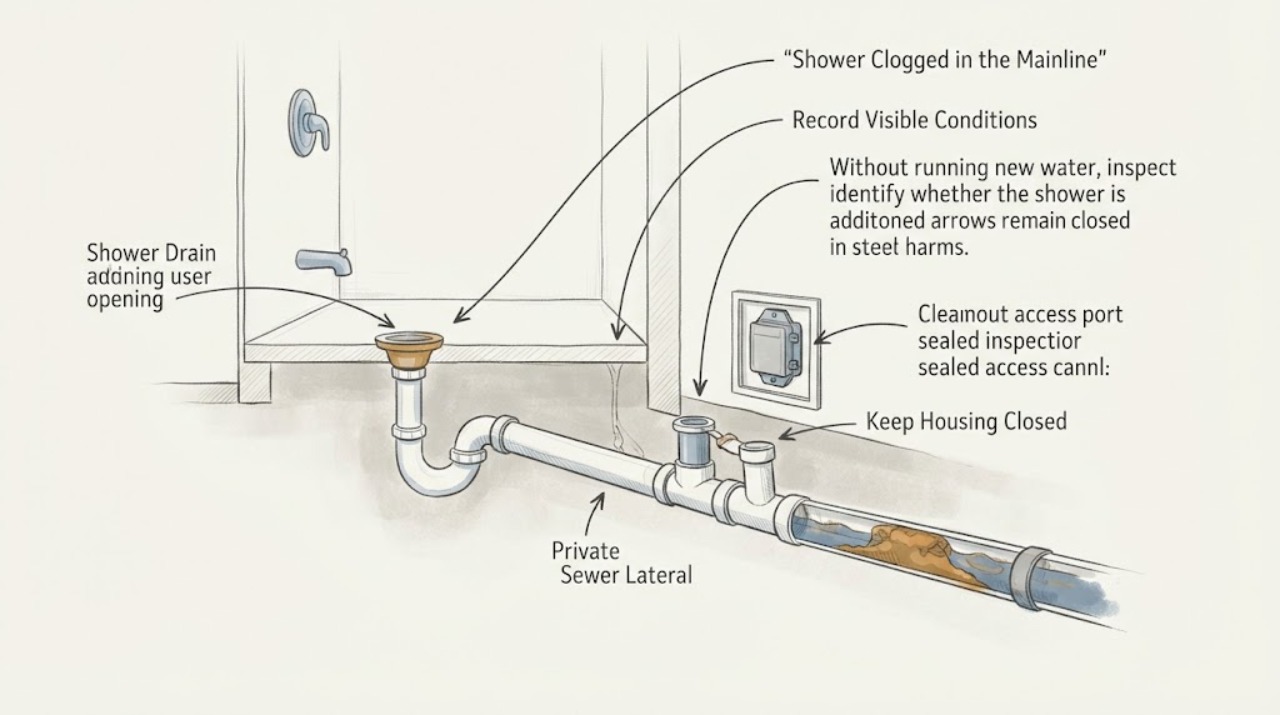
A shower that backs up because of a suspected mainline clog is a whole-drainage problem, not just hair at the shower grate. Stop using water, note whether toilets, sinks, laundry, or other low fixtures are also slow or backing up, and keep people and pets away from wastewater. Multiple fixtures affected, gurgling, foul sewage odor, or water rising in the lowest shower strongly supports a downstream building sewer or public-main problem. Do not open a pressurized cleanout, pour chemical opener into the line, mix products, or enter contaminated water; contact the local sewer utility about a public-main issue and a qualified plumber about a private lateral, cleanout, camera inspection, or clearing job.
Before you begin
Safety first
- This article supports safe observation and reporting only. The professional decides whether to open a cleanout, clear or jet a line, use a camera, handle contaminated water, or assess a public-versus-private boundary. Do not enter wastewater, open a potentially pressurized line, mix chemicals, or work near electricity.
Work through in order
Diagnostic checks
Use only checks that match the exact appliance or system and its official guide.
-
Check 1
Stop showers, flushing, washing-machine use, dishwashing, and other water discharge as soon as the shower is suspected to be backing up from the mainline. From a dry, safe position, record the time, water level, whether it is clear or dirty, odor, and the last fixture used; do not deliberately add water to reproduce the event.
Expected result: Water is rising or standing in the shower, wastewater or sewage odor is present, or the level changes after another fixture is used; alternatively, the shower is only slow with no backup or odor.
Next step: Keep all water use stopped for the backup branch and call a plumber or sewer utility. Use the local-drain branch only when there is no wastewater return and no other fixture is affected.
Stop if: Stop immediately for sewage contact, water near an outlet or appliance, smoke, burning odor, arcing, a hot electrical panel, or a rapidly rising level; keep clear and request emergency or qualified help.
Why this matters
Why: Rising or dirty water that responds to another fixture is consistent with a downstream restriction or sewer backup and can spread contamination. A single slow shower with no cross-fixture response does not yet prove a mainline clog.
-
Check 2
Without running new water, inspect the visible status of the nearest toilet, sink, tub, floor drain, and laundry drain. Ask whether another fixture became slow, gurgled, bubbled, or sent dirty water into the shower at the time of the incident; keep the toilet unflushed while the pattern is being assessed.
Expected result: Several fixtures are slow, a toilet bubbles, the lowest shower receives water when a higher fixture discharges, or only this shower is affected.
Next step: For several fixtures or any cross-fixture return, report a suspected mainline blockage and the affected fixtures to the plumber and utility. For one slow shower only, do not label it a mainline failure until the branch drain is checked safely.
Stop if: Do not flush, run a washing machine, remove a toilet, or open a drain connection while water is backing up or the drain pattern is unknown.
Why this matters
Why: A shared pattern points toward the building drain, private lateral, or public main. An isolated shower points first toward its trap, grate, or branch drain, although a recurring backup still needs professional assessment.
-
Check 3
From outside the affected area, identify whether the shower is the lowest nearby fixture and whether the returning water looks like clean supply water, grey wastewater, or sewage. Keep hands, tools, children, and pets away from the water and do not try to bail or push contaminated water into another drain.
Expected result: The shower is low in the home and receives dirty water, or the water is clean and appears limited to a fixture-side leak or spill.
Next step: For dirty or uncertain water, preserve the area, stop water use, and request plumbing or emergency cleanup guidance. For a clean isolated spill, shut the local water control only if it is dry and easy to reach, then arrange plumbing assessment if it returns.
Stop if: Do not enter contaminated water, touch wet electrical equipment, use a wet vacuum near electricity, or use disinfectant or drain chemicals before the source and cleanup method are established.
Why this matters
Why: A low shower can be an early point for a sewer backup because wastewater seeks a low opening. Clean water without a shared drain pattern may be a supply or fixture event, but an unknown source should still be treated cautiously.
-
Check 4
From a safe standing position, look for an existing exterior sewer cleanout, wet soil, sewage seepage, or an overflowing cap without opening, loosening, digging around, or touching the cap. Photograph the location and note whether the cleanout is near the property line, driveway, or street; do not enter a pit or excavation.
Expected result: The area around the cleanout is wet or overflowing, the cap is damaged or displaced, no cleanout is visible, or the area looks dry while indoor fixtures back up.
Next step: Give the location and photos to the plumber and ask the utility whether its public main is affected. Let a qualified person decide whether to open the cleanout, clear the line, jet it, or use a camera.
Stop if: Do not open a cap that may be pressurized, stand over it, handle sewage, excavate, or attempt high-pressure cleaning yourself.
Why this matters
Why: An exterior overflow can help a professional locate the restriction, but it does not by itself establish who owns the affected section. A dry cleanout does not rule out a blockage inside the property lateral or farther downstream.
-
Check 5
Call the local sewer or wastewater utility to report possible public-main backup when neighbors, the street, or a public manhole also show symptoms; call a qualified plumber for an indoor-only pattern or a suspected private lateral. Share the fixture pattern, cleanout location, property boundary, photos, and whether water use has stopped.
Expected result: The utility confirms a public obstruction or overflow, neighbors report the same issue, the symptoms stop at the property connection, or responsibility remains unclear.
Next step: Follow the utility's no-water instruction during a public event. For a private or unresolved event, keep the line unused and have the plumber assess the lateral, cleanout, roots, damage, and downstream flow with appropriate equipment.
Stop if: Do not resume normal water use merely because the shower level falls, and do not excavate or alter a lateral, backwater valve, or public connection.
Why this matters
Why: A public-main event and a private lateral blockage may require different responders. Sewer-lateral responsibility and access differ by jurisdiction, so guessing ownership can delay containment.
-
Check 6
Before the plumber arrives, write down every product already poured into the shower or drain, the time and amount if known, prior clearing or root work, the exact fixtures affected, and any utility report number. Keep chemical containers available for the professional but do not add another product or try to plunge against a chemical-filled backup.
Expected result: No chemical was used, a drain product was used, or the product and amount are unknown; the backup is contained or is still spreading.
Next step: Tell the plumber the exact product and condition before any work. Keep the area unused and ventilated without entering it; follow local emergency guidance for fumes, exposure, or contaminated water.
Stop if: Stop all DIY clearing for fumes, chemical splash, sewage exposure, rapidly spreading water, or any need to open a pressurized line or work near electricity.
Why this matters
Why: Chemical residue changes the risk of splash, fumes, and contact during clearing. An active or spreading backup needs faster containment and may require cleanup or emergency response in addition to line clearing.
Use your observations
Decision map
Find the observation that best matches what you see, then follow the next safe action.
-
PATH 01Safety boundary
What you see
The shower, toilet, sink, tub, floor drain, or laundry drain show a shared slow, gurgling, or backflow pattern.
Do this next
Stop all water use and request qualified plumbing assessment; report possible public-main symptoms to the sewer utility.
Why this path and its safety boundary
Why it matters: A restriction downstream of several fixtures is more plausible than hair at the shower opening.
Safety stop: Do not flush, run appliances, pour chemicals, or open a cleanout cap.
-
PATH 02Safety boundary
What you see
Dirty water rises in the shower when a toilet, sink, or appliance discharges, and the shower is one of the lowest fixtures.
Do this next
Stop water use, keep people and pets away, and call a plumber or utility; provide the timing and fixture sequence.
Why this path and its safety boundary
Why it matters: The low shower is acting as a relief point for a downstream sewer restriction or backup.
Safety stop: Treat sewage, standing water near electricity, and rapidly rising water as immediate stop-use hazards.
-
PATH 03Safety boundary
What you see
Only the shower is slow, there is no dirty-water return or odor, and other fixtures operate normally.
Do this next
A user may remove only visible hair at the accessible grate if it can be done without contact with wastewater; stop and ask a plumber when the restriction persists, returns, or is below the visible opening.
Why this path and its safety boundary
Why it matters: A shower grate, trap, or branch drain issue is more likely than an established mainline clog.
Safety stop: Do not push a chemical opener into the line or force a tool into an unknown branch, especially if any other fixture begins to back up.
-
PATH 04Safety boundary
What you see
An exterior cleanout area is wet, overflowing, damaged, or surrounded by sewage.
Do this next
Keep clear and give the location and photos to a qualified plumber and the local sewer utility; let them decide whether safe access, clearing, jetting, or camera work is appropriate.
Why this path and its safety boundary
Why it matters: The cleanout observation is useful to locate the affected drainage section, but it does not determine public versus private responsibility.
Safety stop: Do not loosen the cap, stand above it, enter an excavation, handle sewage, or use pressure equipment.
-
PATH 05Safety boundary
What you see
A drain opener, bleach, acid, or another chemical has already been poured into the backed-up shower or line.
Do this next
Stop adding products, keep people away, retain the container or product name, and tell the plumber before any access or clearing.
Why this path and its safety boundary
Why it matters: Chemical residue creates an exposure risk for anyone opening, plunging, or clearing the line, and mixing products can create dangerous fumes.
Safety stop: Leave the area for fumes, splash, breathing symptoms, or eye or skin exposure and follow local emergency or poison guidance.
-
PATH 06Safety boundary
What you see
Neighbors, the street, a public manhole, or several properties show the same backup or overflow pattern.
Do this next
Report the event to the sewer utility, follow its water-use and access instructions, and keep the indoor area isolated until the source is resolved.
Why this path and its safety boundary
Why it matters: A public sewer main or shared line may be involved, so a private clearing attempt may not address the cause.
Safety stop: Do not enter a manhole, touch public wastewater, or alter a public connection.
Helpful context
Understand the symptom
A mainline clue is the pattern across fixtures
Hair or soap at the shower opening usually affects that one fixture. A mainline restriction is farther downstream, so the shower may slow at the same time that a toilet bubbles, a sink drains poorly, a laundry discharge makes water rise, or another low fixture receives dirty water. Record the timing and fixtures involved rather than repeatedly flushing or running water to see what happens.
Treat wastewater as a health and electrical hazard
Sanitary sewer overflows can back up into homes and threaten public health. Keep children and pets away, avoid skin contact, and do not step into standing water when outlets, appliances, or wiring could be wet. If water is near electrical equipment, use only a dry, safe location to isolate power if that can be done without approaching the water; otherwise leave the area and get emergency help.
Do not turn a suspected mainline clog into a chemical or pressure event
Do not pour drain opener into a backed-up shower, combine products, or use a forceful tool against an unknown downstream obstruction. EPA septic-care guidance specifically advises avoiding chemical drain openers for a clogged drain, and a sewer cleanout may hold pressure or liquid. A plumber can safely determine whether the blockage is in the building lateral, at a cleanout, in the public main, or related to roots, damage, or a downstream backup.
Safety boundary
Stop conditions
- Stop all water use when wastewater rises in the shower, multiple fixtures back up, or the lowest fixture receives dirty water; do not flush or run appliances to test the line.
- Do not open, loosen, or stand over a cleanout cap that may hold pressure or liquid; do not dig, enter an excavation, or use high-pressure equipment.
- Do not pour chemical drain opener into a backed-up line, mix products, or plunge against an unknown chemical residue; tell the plumber exactly what was used.
- Keep away from sewage and standing water near outlets, appliances, panels, or wiring; stop for smoke, burning odor, arcing, a hot panel, or any electrical contact risk.
- Do not resume normal water use or alter a sewer lateral, public connection, or backwater valve until the responsible utility or qualified plumber confirms the safe next step.
Only after diagnosis
Potential parts
- sewer cleanout access assembly
Consider this category only if a qualified inspection finds a damaged, missing, or inaccessible cleanout that is appropriate for the property's drainage layout and local requirements.
Confirm pipe size, material, location, access, ownership boundary, local plumbing requirements, and the exact installation method with the plumber; do not open or replace an access point as a DIY response to a backup. - backwater valve
Consider this category only after a professional confirms that reverse flow is a recurring risk, the property layout permits protection, and local requirements support the installation.
Confirm the valve type, pipe dimensions, service access, cleanout arrangement, maintenance needs, and local approval with a qualified plumber; it is not a substitute for clearing an active blockage.
When checks do not resolve it
Need a professional?
Call a qualified plumber promptly for multiple slow drains, shower backflow when another fixture is used, sewage odor, recurring mainline symptoms, a wet or overflowing cleanout, or any blockage below the visible shower drain. Contact the local sewer utility as well when neighbors, the street, or a public manhole show the same pattern. Seek emergency help for rapidly rising wastewater, fumes, exposure, structural flooding, or water near electrical equipment.
Safety scope: This article supports safe observation and reporting only. The professional decides whether to open a cleanout, clear or jet a line, use a camera, handle contaminated water, or assess a public-versus-private boundary. Do not enter wastewater, open a potentially pressurized line, mix chemicals, or work near electricity.
Common questions
FAQ
How can I tell whether a clogged shower is a mainline problem?
A mainline problem is more likely when several fixtures are slow, a toilet gurgles, or dirty water returns into the shower when another fixture discharges. If only the shower is slow and there is no odor or cross-fixture response, a grate, trap, or branch drain is more likely, although recurrence still warrants a plumber.
Should I keep flushing the toilet to test a suspected mainline clog?
No. Stop flushing and stop other water use when wastewater rises, several fixtures are affected, or the shower receives dirty water. More discharge can increase the backup and contamination; report the pattern to a plumber or sewer utility.
Can I open the sewer cleanout myself?
Do not open or loosen a cleanout cap as a first response. It may release liquid or pressure, and the location may be on a private or public section. Observe and photograph it from a safe distance and let a qualified professional decide whether and how to access it.
Is chemical drain opener appropriate for a shower backed up from the mainline?
No. Do not pour chemical opener into a backed-up line or mix products. Chemical residue can injure the person clearing the line and can create fumes or splash hazards. Tell the plumber exactly what product was used, if any.
Who should I call if neighbors also have sewer backup?
Report a shared or street-level pattern to the local sewer or wastewater utility and keep indoor water use stopped. A plumber can assess the private lateral, while the utility determines whether its main or public assets are involved.
Read the exact guide
Official sources
- The Sewer Clean outIndian River County, Florida · County public-works educational material; its examples are diagnostic clues, not a substitute for local utility rules or professional line clearing.
- Sanitary Sewer Overflows (SSOs)U.S. Environmental Protection Agency · EPA overview of sanitary sewer overflows and their potential effects; local emergency and utility instructions control a particular incident.
- Sewer LateralsSan Francisco Public Utilities Commission · A municipal utility explanation for San Francisco sewer laterals; ownership, response, and installation rules vary by jurisdiction.
- How to Care for Your Septic SystemU.S. Environmental Protection Agency · EPA household wastewater guidance; the chemical-safety warning is relevant to a clogged drain, while septic-specific maintenance advice does not establish a sewer-main diagnosis.
Community feedback
Share a repair observation
Share a plain-text repair observation. Accepted observations are published automatically; this page may take a moment to update.