
On this page
Start here
Quick answer
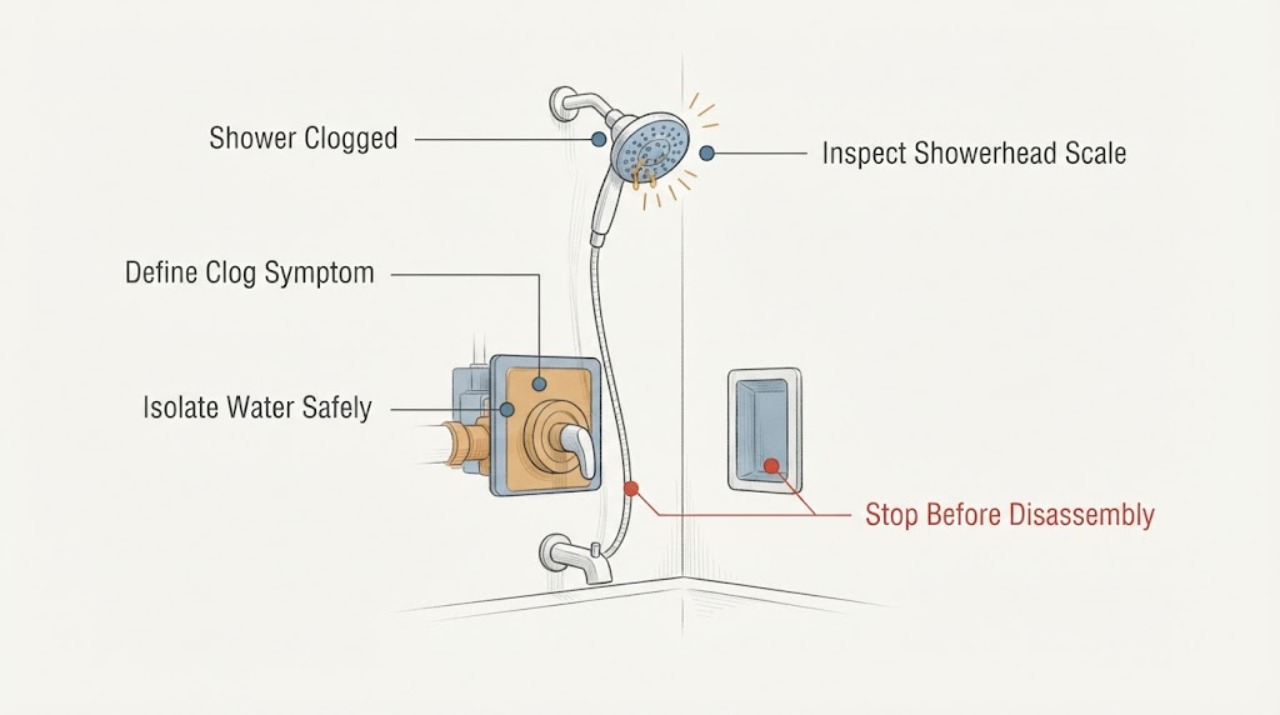
A shower can seem clogged because the showerhead is scaled, the tub or shower drain is blocked, the diverter is not routing water correctly, or an upstream tank or water-heater supply issue is reducing hot-side flow. “Tank” is not a standard part inside every shower: treat it as an upstream storage or water-heater component only when the symptoms affect the hot side or several fixtures. First compare the shower with another fixture and note whether the problem is weak spray, slow drain, standing water, or both. From a safe, dry position, inspect the visible showerhead, diverter, drain cover, and water location. Clean scale only with a product or white vinegar allowed for the fixture, and do not drill holes or remove a flow-control insert by guesswork. Do not mix drain chemicals, reach into contaminated water, work near wet electricity, open a water-heater tank, or change gas, electrical, or pressure controls. Active leaks, scalding water, sewage, chemical exposure, concealed blockage, or a tank or valve problem needs qualified plumbing service.
Work through in order
Diagnostic checks
Use only checks that match the exact appliance or system and its official guide.
-
Check 1
From a dry, stable position, decide whether the shower is clogged at the outlet, the drain, or both, and record whether the symptom is weak spray, no spray, slow draining, standing water, or water backing up.
Expected result: Note whether the showerhead sprays unevenly, water rises in the base, the tub spout flows normally, the problem occurs only on hot or cold, and whether another fixture has the same symptom.
Next step: Use the matching branch below and do not remove a tank cover or use chemical opener before the symptom is localized.
Stop if: Stop for active flooding, sewage-like water, scalding water, exposed wiring, a slippery floor, or any need to enter unsafe standing water.
Why this matters
Why: Weak spray points toward the showerhead, valve, diverter, or supply; slow draining points toward the local or shared drain; a hot-only or whole-home flow problem makes an upstream tank or supply branch relevant.
-
Check 2
If water is leaking or the drain is backing up, stop using the shower and close the nearest accessible water shutoff only if it can be reached from a dry, safe position; keep hot-water contact to a minimum.
Expected result: Record whether flow stops, whether water continues from a pressurized supply, whether the leak is at the showerhead, valve trim, tub spout, drain, or wall, and whether water is near an electrical outlet or device.
Next step: Keep the area isolated, dry accessible surfaces without touching electrical equipment, and arrange plumbing service for a valve, concealed pipe, tank, or persistent leak.
Stop if: Do not stand in water to reach a shutoff, force a stuck valve, touch a wet electrical device, or handle hot water that may scald.
Why this matters
Why: A continuing supply leak or water near electricity is a damage and shock-risk branch, while a closed supply with no further flow points toward retained water or a drain issue. The shower may be unsafe even if the clog is local.
-
Check 3
With water off and the fixture cool, inspect the visible showerhead spray face, inlet, screen, washer, and hose connection for scale, debris, stray spray, or a damaged seal without enlarging any opening.
Expected result: Look for blocked spray holes, mineral crust, a loose connection, uneven spray, a missing or displaced washer, or a clean head with normal flow at the tub spout.
Next step: Use only the fixture instructions and a suitable cleaner or white vinegar for accessible scale; keep the original flow-control arrangement and replace or service the head if cleaning does not restore flow.
Stop if: Do not drill the head, pry out a flow restrictor, use a sharp tool in passages, or continue if the fitting or wall connection is damaged.
Why this matters
Why: Scale or debris at the head is a local outlet restriction; a clean head with weak flow points back toward the valve, supply, shared pressure, or upstream tank branch. EPA warns against drilling holes or manually removing scale and flow-control parts.
-
Check 4
If the shower is paired with a tub spout or hand shower, observe the diverter and visible valve trim while water runs briefly from a safe, dry position; do not remove trim or reach into the wall.
Expected result: Record whether water continues from the tub spout when diverted, the shower spray is weak only when diverted, the valve drips while off, or the handle is stiff, loose, or unable to select a position.
Next step: Stop using the affected control for a leak or unsafe temperature and arrange a plumber to inspect the diverter or valve; do not force the handle or open the wall.
Stop if: Stop for hot spray that cannot be controlled, a valve that will not shut off, water entering the wall, or any need to disassemble the valve or trim.
Why this matters
Why: A diverter leak or incomplete routing can make the shower seem clogged and can waste hot water. A valve leak, stiff control, or concealed failure is not solved by cleaning the showerhead.
-
Check 5
For standing or slow water, remove only a plainly user-accessible drain cover or hair screen when cool and dry, and inspect the visible opening without pushing material deeper or entering contaminated water.
Expected result: Note hair, soap residue, a visible obstruction, a clear opening with slow drainage, water rising from another drain, or a sewer-like smell or backup.
Next step: Remove only loose visible debris if safe and permitted; arrange plumbing service for hidden blockage, shared backup, repeated slow drainage, or any contaminated water.
Stop if: Do not mix or pour chemicals, use a drain tool against resistance, handle sewage, or continue when water threatens flooring, wiring, or lower levels.
Why this matters
Why: A local visible obstruction may explain one shower drain, while slow drainage at several fixtures, water rising elsewhere, or backup suggests a shared or main drain problem. A clear opening does not prove the hidden line is open.
-
Check 6
Treat the tank as an upstream storage or water-heater branch only after comparing hot and cold flow and other fixtures; from a safe location, inspect the tank area for visible leakage, corrosion, unusual water discharge, or an obvious supply isolation state.
Expected result: Record whether only this shower is affected, all hot outlets are weak, hot water is absent, the cold side is normal, the whole home has low flow, or the tank area shows a leak or damage.
Next step: Leave tank covers, gas controls, electrical panels, relief valves, and pressure controls untouched; arrange qualified plumbing or water-heater service for an upstream pattern.
Stop if: Stop for hot discharge, a leaking or corroded tank, gas odor, a combustion concern, electrical moisture, a relief-valve discharge, or any need to open or drain the tank.
Why this matters
Why: A single shower with normal other fixtures does not establish a tank fault. Several hot outlets affected together, visible tank leakage, or a tank-side valve or pressure issue needs plumber or water-heater service.
-
Check 7
Before any cleaning, ask whether a commercial drain opener, acid, bleach, or another chemical has already been poured into the shower or drain, and keep the fixture out of use until the product instructions and safety information are known.
Expected result: Record the product name if available, fumes, heat, splashing, skin or eye contact, breathing irritation, and whether another product was added; do not add a second chemical to neutralize the first.
Next step: Move to fresh air for fumes and seek prompt poison or medical guidance for exposure; tell the plumber exactly what product was used before any drain work.
Stop if: Stop immediately for fumes, breathing difficulty, eye or skin pain, burns, splashing, or an unknown chemical mixture; do not handle the drain or contaminated water.
Why this matters
Why: Drain-opening agents can cause serious chemical burns and harmful fumes. A chemical history changes the safe service and cleanup decision and can make ordinary plunging or disassembly dangerous.
-
Check 8
After safe visible checks, compare the result with the exact fixture and water-heater instructions and make no further intervention if the blockage, tank, valve, or hidden pipe remains uncertain.
Expected result: Record whether flow or drainage improved, whether the problem returns, whether several fixtures remain affected, and whether any leak, hot-water, or pressure symptom remains.
Next step: Keep the shower out of use as needed and request plumbing service with the symptom map, hot or cold comparison, tank observations, chemical history, and safe photos.
Stop if: Do not open walls, drain or service a tank, bypass a mixing or pressure control, use a powered tool in wet conditions, or continue after a leak or exposure.
Why this matters
Why: No improvement or a returning symptom means the cause is likely beyond the showerhead or visible drain opening. A tank, valve, shared line, or main drain requires tools and access controlled by a plumbing professional.
Use your observations
Decision map
Find the observation that best matches what you see, then follow the next safe action.
-
PATH 01Next step
What you see
Only the shower spray is weak or uneven, the tub spout or another fixture is normal, and visible scale or debris is present at the showerhead.
Do this next
Clean accessible scale with a fixture-approved product or white vinegar and keep the original flow-control arrangement; service or replace the head if flow remains poor.
Why this path and its safety boundary
Why it matters: The restriction is likely local to the showerhead, screen, washer, or connection rather than the upstream tank.
-
PATH 02Next step
What you see
Water pools or drains slowly in one shower, with a visible local obstruction and no active leak or chemical history.
Do this next
Remove only loose visible debris when safe; arrange plumbing service for a hidden or recurring blockage and do not pour mixed chemicals.
Why this path and its safety boundary
Why it matters: A local drain blockage is more likely than a tank or supply problem.
-
PATH 03Next step
What you see
Flow changes when a tub or shower diverter is selected, water continues from the tub spout, or the valve drips, sticks, or cannot control temperature.
Do this next
Stop for a leak or unsafe temperature and request a plumber; do not force the handle or open the wall.
Why this path and its safety boundary
Why it matters: A diverter or valve can be restricting or misrouting flow and may also be leaking hot water.
-
PATH 04Next step
What you see
Several hot fixtures are weak or cold, the whole home has a supply-pressure change, or the storage tank or water-heater area shows leakage, corrosion, or an abnormal discharge.
Do this next
Leave the tank and its controls untouched and arrange qualified plumbing or water-heater service.
Why this path and its safety boundary
Why it matters: The tank or upstream water system is now relevant, but the observation does not identify a safe homeowner repair.
-
PATH 05Next step
What you see
Several drains are slow, water rises at another fixture, or the shower backs up with sewage-like water.
Do this next
Stop using affected fixtures and arrange plumbing service; keep people away from contaminated water and do not add chemicals.
Why this path and its safety boundary
Why it matters: The restriction may be in a shared or main drain rather than the shower opening.
-
PATH 06Next step
What you see
A drain chemical was used, fumes or burns are present, water is near electricity, or a concealed leak or wall damage is suspected.
Do this next
Move to fresh air for fumes, seek medical or poison guidance for exposure, isolate the wet area, and use qualified emergency plumbing or electrical help as appropriate.
Why this path and its safety boundary
Why it matters: The immediate issue is chemical, contamination, structural, or electrical safety rather than an ordinary clog.
Helpful context
Understand the symptom
Clarify what “clogged” means
Weak spray from the showerhead is an outlet-flow problem; water that pools in the tub or shower is a drain problem. A cold shower with normal hot flow, or several fixtures that lose hot flow together, makes the upstream tank or water-heater supply relevant. One shower with normal nearby fixtures points first to the head, valve, diverter, or local drain rather than the tank.
Keep the tank as a conditional branch
Many showers are supplied by a storage water heater or other upstream system, but the shower itself may have no tank. Do not open a tank, adjust a relief or pressure control, or infer a tank failure from weak spray alone. Observe whether the hot side, cold side, or whole home is affected and whether the tank shows a visible leak, corrosion, or unusual noise from a safe location.
Use a controlled cleaning boundary
Scale can narrow showerhead passages, while a diverter can leak or fail to route flow fully to the showerhead. EPA recommends inspecting and cleaning scale with a suitable product or white vinegar, but warns against boring holes or manually removing scale. Drain-opening chemicals are a separate hazard: do not mix products or handle a drain after chemical treatment without following the product and safety guidance.
Only after diagnosis
Potential parts
- showerhead screen or washer
Consider only when visible scale, debris, or a damaged seal is confirmed at the showerhead and cleaning does not restore flow.
Confirm the fixture connection and original flow-control arrangement; do not remove a restrictor by guesswork. - shower diverter
Consider only when water remains at the tub spout or the diverter is confirmed to misroute flow or leak.
Diverter design varies by valve and tub or shower layout; a plumber should confirm the correct configuration. - shower valve cartridge or mixing valve
Consider only after a plumber confirms that the valve restricts flow, leaks, or cannot control temperature after local outlet checks.
Valve fit and temperature-control requirements are model and installation specific; do not bypass scald protection. - water-heater tank valve or tank component
Consider only when several hot fixtures or a visible tank-side symptom points to an upstream tank or water-heater fault.
Tank, fuel, pressure, and relief arrangements require qualified service; do not open, drain, or adjust the tank from this symptom alone.
When checks do not resolve it
Need a professional?
Stop using the shower and seek qualified help for active flooding, sewage or contaminated water, a hidden leak, a tank or water-heater leak or abnormal discharge, scalding or uncontrolled temperature, gas odor, chemical fumes or burns, water near electricity, or a blockage that returns or affects several fixtures.
Have this ready
- Give the plumber the exact symptom type, hot or cold comparison, other-fixture results, first wet point, diverter behavior, tank or water-heater observations, drain or chemical history, and safe photos.
Common questions
FAQ
Does a clogged shower always mean the tank is blocked?
No. A showerhead with scale or a local drain can be clogged while the upstream tank is normal. Treat the tank as relevant only when several hot fixtures, the whole home, or a visible water-heater symptom is affected.
How do I tell a clogged showerhead from a clogged shower drain?
Weak or uneven spray with normal drainage points toward the showerhead, valve, diverter, or supply. Water pooling or backing up while spray flow is otherwise normal points toward the drain. If both occur, map each symptom separately before using any cleaner.
Can I drill the holes in a scaled showerhead?
No. EPA WaterSense guidance recommends suitable cleaning products or white vinegar for scale and warns against boring holes or manually removing scale, because that can change performance and water use. Keep the original flow-control parts in place.
Should I pour drain cleaner into a clogged shower?
Do not add a chemical before you know the drain and chemical history, and never mix products. Drain-opening agents can cause severe burns and harmful fumes. If a chemical was already used, keep the area out of use and tell the plumber what product was added.
When does a clogged shower need a plumber?
Use a plumber for a recurring or hidden blockage, several slow fixtures, a diverter or valve problem, a hot-only or whole-home flow loss, a tank or water-heater symptom, a concealed leak, or any backup, scalding, chemical, or electrical risk.
Read the exact guide
Official sources
- Home MaintenanceU.S. Environmental Protection Agency WaterSense · EPA home water pressure, water-heater tank, showerhead, visible leak, and plumbing maintenance guidance
- Fix a Leak WeekU.S. Environmental Protection Agency WaterSense · EPA showerhead leak observation, shutoff, connection, and plumber boundary guidance
- Drain opener poisoningU.S. National Library of Medicine MedlinePlus · Drain-opening chemical hazards, exposure symptoms, fresh-air response, and medical or poison guidance
- Bath and Shower DivertersU.S. Environmental Protection Agency WaterSense · EPA bath and shower diverter routing and leak behavior
- WaterSense at Work Sanitary Fixtures and Equipment 3.4 Showerheads and Bath and Shower DivertersU.S. Environmental Protection Agency WaterSense · EPA showerhead and bath or shower diverter scale, flow restriction, leak, and flow-control maintenance guidance
Community feedback
Share a repair observation
Share a plain-text repair observation. Accepted observations are published automatically; this page may take a moment to update.