
On this page
Start here
Quick answer
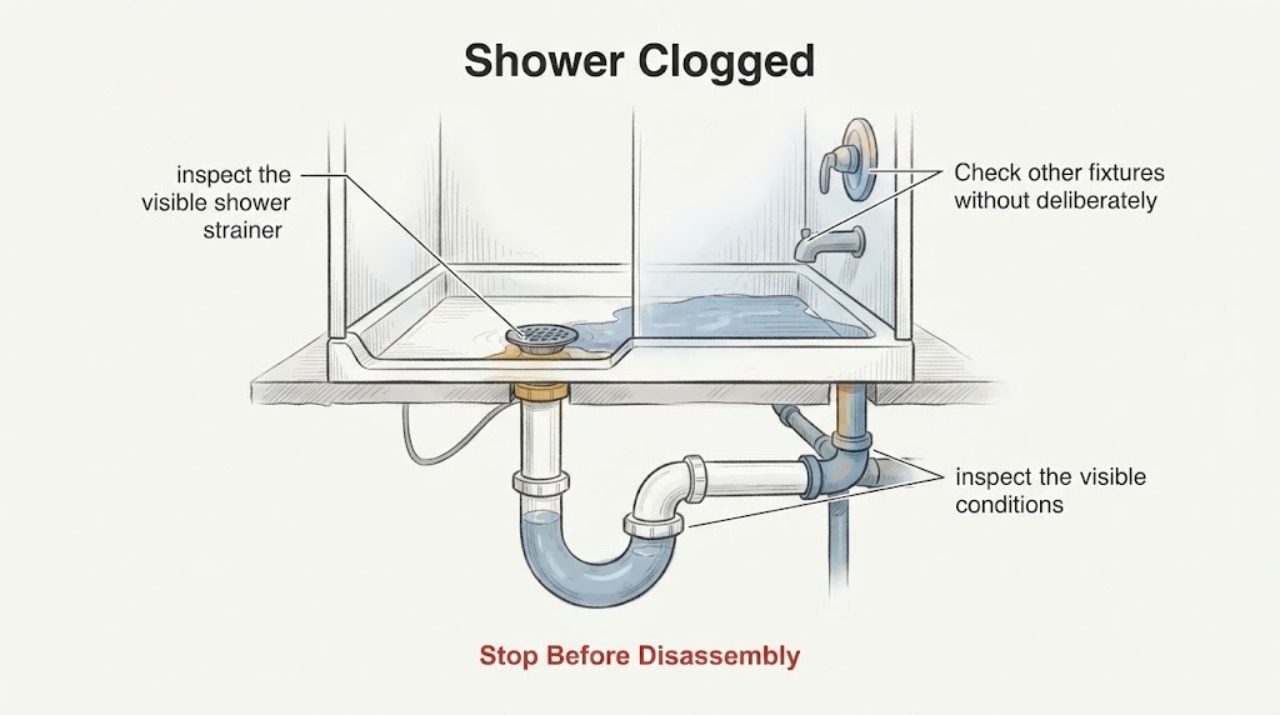
A clogged shower is often near the drain strainer or the short trap/branch serving that fixture, but the symptom does not prove that the P-trap is the blockage. Stop adding water, remove only visible hair or soap from an accessible strainer, and check whether other fixtures drain normally. If several fixtures are slow, wastewater rises elsewhere, or water returns through the shower, suspect a shared branch or main line and call a plumber. Do not mix drain chemicals, open a pipe after chemicals were used, force a concealed trap, or work around sewage, standing water, or electrical equipment.
Work through in order
Diagnostic checks
Use only checks that match the exact appliance or system and its official guide.
-
Check 1
Stop using the shower and observe the water level without stepping into standing water. Note whether the water is merely slow, completely stopped, rising toward the threshold, or returning after another fixture is used.
Expected result: The level falls slowly, does not fall, rises when another fixture runs, or wastewater returns with odor or visible solids.
Next step: If water is rising, contaminated, or returning from another fixture, stop all nearby water use and arrange plumbing service. Otherwise continue only with the dry, accessible checks below.
Why this matters
Why: A slow or stopped single fixture can be local to the drain, trap, or branch. Return flow linked to another fixture suggests a shared branch or main obstruction and raises the risk of overflow and contamination.
-
Check 2
From outside the water, inspect the visible shower strainer or drain cover. Remove only loose hair, soap residue, or an object that is clearly accessible without unscrewing a fitting, pushing debris deeper, or using a sharp tool in the pipe.
Expected result: A visible wad is removed, the strainer is clear, the cover is fixed or damaged, or the drain remains blocked after the accessible debris is removed.
Next step: Dispose of removed debris and do not force the cover. If drainage does not improve, stop adding water and move to the fixture comparison rather than pushing tools into a concealed trap.
Why this matters
Why: Visible debris can restrict the entry point, but a clear strainer does not prove that the P-trap or branch is clear. A damaged or fixed cover may require a model- or installation-specific method.
-
Check 3
Check other fixtures without deliberately creating more flow: ask whether a nearby tub, toilet, laundry fixture, or floor drain is slow, gurgling, or wet. Do not flush or run a fixture if the shower is already close to overflowing.
Expected result: Only the shower is affected, two nearby fixtures share the symptom, or several fixtures across the home are slow or backing up.
Next step: For multiple affected fixtures or a low-point backup, stop water use and contact a plumber or the local utility as appropriate. For one fixture only, continue with safe history and location checks.
Why this matters
Why: One affected fixture points more toward its strainer, trap, or branch. Multiple fixtures indicate a downstream private line, main line, vent, or public sewer issue that a local drain treatment may not solve.
-
Check 4
Record what entered the shower drain recently: hair, soap buildup, a dropped object, renovation dust, a cleaning product, or no known event. If any chemical drain product was added, keep the container and do not open the trap or use a plunger until a plumber has been told exactly what was used.
Expected result: There is visible organic debris, a possible hard object, a history of chemical use, or no credible local cause.
Next step: Do not combine products or add another cleaner. Tell the plumber the product name, approximate amount, and time if known; request professional clearing when the cause is hidden or the history is uncertain.
Why this matters
Why: A soft surface blockage may be local, while a hard object, construction debris, or chemical residue changes the safe method. Unknown history makes mechanical opening or mixing products hazardous.
-
Check 5
Look only at accessible pipe and wall areas for a leak, damp ceiling, bulge, stain, or water around a service opening. Do not remove a concealed P-trap, cut a wall, loosen a glued joint, or reach into sewage or standing water.
Expected result: The area is dry, there is a localized leak near the shower, water appears below or behind the fixture, or the ceiling or wall is becoming wet.
Next step: If water is escaping, the wall or ceiling is soft, sewage is present, or electrical equipment is wet, stop using the fixture and request prompt plumbing service. Keep the area dry and isolated.
Why this matters
Why: A clog with leakage may involve a failed joint, trap, drain body, or branch rather than a simple surface obstruction. Hidden moisture can damage structure and may reach electrical wiring.
Use your observations
Decision map
Find the observation that best matches what you see, then follow the next safe action.
-
PATH 01Next step
What you see
Only the shower is slow or stopped, and loose debris is visible at the strainer.
Do this next
Remove only the accessible debris without forcing the cover or pushing material into the pipe. If flow does not return, arrange plumbing service for the trap or branch.
-
PATH 02Next step
What you see
The strainer is clear but the shower remains blocked, or a hard object may be in the trap.
Do this next
Do not assume the P-trap is accessible or remove a concealed fitting. Stop water use and have a plumber locate and clear the obstruction with the correct access.
-
PATH 03Next step
What you see
The shower and one or more nearby fixtures are slow, gurgling, or backing up.
Do this next
Treat this as a shared branch or main-line warning. Stop using water, keep people away from wastewater, and contact a plumber or local sewer utility for location of the obstruction.
-
PATH 04Next step
What you see
A chemical drain product was used, or the product history is unknown.
Do this next
Do not mix products, plunge, open a trap, or put hands near the drain. Keep the label available and tell the plumber what was used so the line can be handled safely.
-
PATH 05Next step
What you see
A leak, wet wall or ceiling, sewage odor, or wastewater appears outside the shower drain.
Do this next
Stop using the fixture and arrange prompt plumbing service. Keep electrical items away from water and do not open concealed piping or enter a contaminated area.
-
PATH 06Next step
What you see
The blockage returns after a temporary improvement or no safe external cause is found.
Do this next
Do not keep repeating clearing attempts. Request a plumber to assess the trap, branch, vent, cleanout, and downstream line as appropriate for the building layout.
Helpful context
Understand the symptom
What the P-trap clue means
A shower drain has a trap that holds a water seal and a vented waste path. Hair, soap residue, or a small object may restrict the strainer or trap arm, while a vent, shared branch, or main line can create the same slow or stopped drainage. The phrase “in the P-trap or something wrong” is therefore a location question, not a diagnosis.
Start with water and exposure control
Do not keep running the shower to see whether it clears. Keep the shower unused, prevent overflow, and keep electrical items away from wet flooring. If wastewater has backed up, avoid skin contact and stop before opening any fitting that may contain contaminated water or chemical residue.
A local shower clog versus a shared line
If only this shower is affected and nearby fixtures behave normally, the strainer, trap, or short branch is more plausible. If a toilet, tub, laundry fixture, or floor drain also slows or receives wastewater, the obstruction may be farther downstream. Do not infer a hidden P-trap fault from one symptom or use a harsh product to force a result.
Safety boundary
Stop conditions
- Stop immediately if wastewater is rising, returning through another fixture, or contacting skin, flooring, or electrical equipment.
- Do not mix drain chemicals, add a second product, plunge after chemical use, or open a fitting when chemical history is unknown.
- Do not force a strainer, remove a concealed P-trap, cut a wall, loosen glued or pressurized piping, or use sharp tools in the drain.
- Stop for a leak behind the wall, a wet ceiling, structural softening, sewage odor with backup, or any condition that cannot be safely observed from a dry accessible position.
Only after diagnosis
Potential parts
- shower drain strainer
Consider this category only if the existing strainer is damaged and a plumber or exact installation documentation confirms the replacement type.
Drain covers, openings, finishes, and fastening methods vary. Do not force a cover or choose a size from the symptom alone. - P-trap or drain fitting
Consider this category only after the obstruction or leak is located and a plumber confirms the fitting must be repaired or replaced.
Trap geometry, access, material, venting, and local plumbing requirements vary. Concealed or glued fittings need professional handling.
When checks do not resolve it
Need a professional?
Request plumbing diagnosis for a persistent or recurring shower clog, suspected trap or branch obstruction, multiple-fixture backup, chemical history, wastewater exposure, or hidden leak.
Common questions
FAQ
Is the clog definitely in the shower P-trap?
No. The strainer, trap arm, branch, vent, or a downstream shared line can produce similar symptoms. A single affected shower suggests a local path, while several slow fixtures or wastewater returning elsewhere suggests a farther downstream obstruction.
What can I safely do first when a shower drain is clogged?
Stop adding water and remove only loose material that is clearly accessible at the strainer without forcing the cover or pushing debris deeper. If the blockage remains, avoid chemical products and arrange plumbing service.
Should I use drain cleaner before opening the P-trap?
Do not mix products or open a fitting after chemical use or when the product history is unknown. Tell the plumber exactly what was used so the line can be handled safely; concealed or glued shower piping should not be forced open.
Read the exact guide
Official sources
- Sanitary Sewer MaintenanceCity of South St. Paul · Household shower drains, traps, vents, single-fixture versus multiple-fixture backups, and chemical disposal
- Waste and vent pipe installationKing County, Washington · Waste pipe, cleanout, P-trap, vent, fitting, and sewage backflow principles
- WaterSense at Work: Showerheads and Bath and Shower DivertersU.S. Environmental Protection Agency · Shower fixture flow, scale-related restriction, leaks, and safe maintenance boundaries
- Household Hazardous WasteU.S. Environmental Protection Agency · Household chemical handling and safer alternatives for drain blockages
Community feedback
Share a repair observation
Share a plain-text repair observation. Accepted observations are published automatically; this page may take a moment to update.