
On this page
Start here
Quick answer
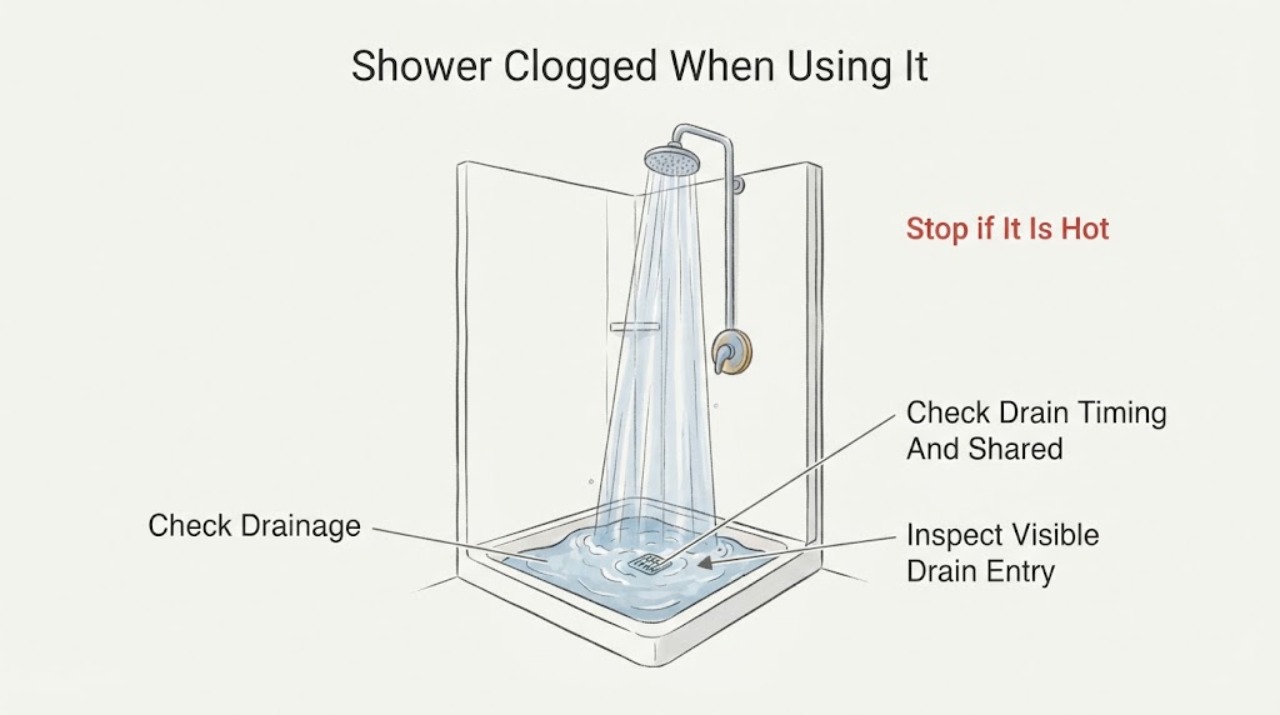
If the shower seems clogged only when it is running, first decide whether water cannot leave the shower or cannot arrive at the showerhead. Weak or uneven spray with little pooling points to showerhead scale, an inlet screen, diverter, valve, or supply problem. Water that rises around your feet points to the drain cover, hair and soap at the trap, a branch drain, or a shared downstream blockage. If the drain is slow only while the shower runs but clears after stopping, that still indicates restricted drainage rather than a blocked showerhead. From a dry position, observe the first wet or slow point, check only visible screens and covers after stopping the water, and compare another fixture. Do not mix drain chemicals, reach into sewage or contaminated water, force a cover, use a powered tool near water, or open a wall or floor. Stop for backflow, a hidden leak, water near electrical equipment, structural damage, or chemical exposure and arrange qualified plumbing service.
Before you begin
Safety first
- The user should limit work to normal water use, dry-distance observation, and accessible visible cleaning approved for the fixture. A plumber handles traps, branch and main drains, valves, hidden leaks, pressure devices, water-heater connections, and chemical-contaminated lines.
Work through in order
Diagnostic checks
Use only checks that match the exact appliance or system and its official guide.
-
Check 1
During one ordinary use, observe from a safe dry position whether the spray is weak or uneven, whether water rises at the floor, or whether both occur. Stop the water before the level reaches the threshold or any electrical equipment.
Expected result: Spray is weak while the floor remains clear; the floor pools or rises; both happen; or water appears at the wall, trim, ceiling, or supply connection.
Next step: Use the matching branch. Stop immediately for a hidden leak, fast water rise, water near electricity, or water entering a wall or ceiling; isolate the fixture if safe and arrange plumbing service.
Why this matters
Why: Weak spray points toward the showerhead, screen, diverter, valve, or supply. Pooling points toward the local drain, trap, branch, or downstream line. Water at a wall or connection is a leak rather than an ordinary clog and may be hidden.
-
Check 2
After stopping the shower, watch from a safe position to see whether the pool falls slowly, remains, or backs up elsewhere. Then, without adding more water, note whether a nearby sink, tub, toilet, or floor drain changes level or makes a sound when the shower runs during a normal safe test.
Expected result: Only the shower drain is slow; several fixtures are slow or gurgle together; water returns after the shower stops; or the shower clears promptly.
Next step: For a shared, returning, or contaminated-water problem, stop using affected fixtures and call a plumber. For an isolated, clear-water drain restriction, continue only with visible, dry, low-risk checks.
Why this matters
Why: A single slow shower drain favors the cover, hair, trap, or local branch. Several fixtures or return flow suggests a shared branch or main obstruction and increases the risk of sewage exposure. A prompt clear drain shifts attention back to showerhead or supply flow if spray is weak.
-
Check 3
With the water off and the area dry enough to work safely, inspect the drain cover or strainer for hair, soap, lint, or a visible obstruction. Remove only loose material that is reachable without forcing the cover or putting hands into dirty standing water; do not remove a trap or open a wall.
Expected result: Hair or soap is caught at the visible entry; the cover is damaged or immovable; the opening looks clear but flow remains slow; or standing water is dirty or returns from below.
Next step: Clear only loose visible material and run a small normal amount of water once, stopping if it rises. If the obstruction is deeper, the cover is damaged, or water is contaminated or returning, keep the shower unused and arrange a plumber.
Why this matters
Why: A visible surface obstruction can explain an isolated slow drain. A clear entry with slow flow points farther into the trap or branch. An immovable cover, dirty backflow, or returning water is a service boundary, not a reason to apply more force or chemicals.
-
Check 4
If the floor drains normally but spray is weak or uneven, inspect the showerhead face and any visibly accessible inlet screen for chalky scale or debris after the water is off. Clean only with the fixture or model instructions and a suitable scale method; do not drill holes, scrape passages, or remove a flow-control insert by guesswork.
Expected result: Scale or debris is visible at the face or inlet; spray improves after an approved cleaning; or the head is clean and flow remains weak.
Next step: Reinstall the fixture without forcing threads and check for a drip from a dry position. If flow remains weak, the head leaks, or the screen is inaccessible, have a plumber assess the head, diverter, valve, and supply.
Why this matters
Why: Scale can restrict outlet flow and affect performance. Improvement after approved cleaning supports a local head restriction. Persistent weak flow points toward the diverter, valve, supply, pressure, or a hidden restriction rather than proof that a part should be replaced.
-
Check 5
With the shower running only as long as needed for a safe observation, look at the tub spout, showerhead, and valve trim. Note whether water continues from the spout while the shower is selected, whether temperature or pressure changes sharply, and whether water leaks behind or around the trim. Stop if water enters the wall.
Expected result: A substantial stream remains at the tub spout, the handle or diverter is stiff, spray changes when the diverter moves, or the valve trim leaks; or the diverter behaves normally.
Next step: Do not remove the valve or force a handle. Keep the fixture out of service for a wall leak, major diverter leak, unstable temperature, or stiff control and arrange a plumber; otherwise continue with comparison checks.
Why this matters
Why: A diverter that does not route flow fully can make the shower seem weak and may waste water. A trim or wall leak may indicate a concealed supply or valve problem. Normal diverter behavior moves the diagnosis toward the head, screen, supply, or pressure.
-
Check 6
Compare the shower with a nearby faucet or another shower using ordinary water use, noting hot and cold sides separately. Do not dismantle a valve or adjust a pressure regulator; use only visible flow and temperature observations.
Expected result: Only this shower is weak; all hot outlets are weak; hot and cold are both weak throughout the home; or other fixtures are normal while the shower drain backs up.
Next step: Do not open a water heater or alter a pressure control. Give the comparison to a plumber, who can determine whether the cause is local, shared, upstream, or a leak.
Why this matters
Why: One weak shower favors the head, diverter, valve, or local supply. All hot outlets point toward the water-heating or hot-water distribution side, while whole-home weakness points toward service pressure, a supply restriction, or a leak. Normal supply elsewhere with pooling keeps the drain branch as the lead.
-
Check 7
Ask whether any drain opener, bleach, acid, or other cleaner was poured into the drain and whether the water is sewage-like, unusually hot, or near an outlet, appliance, or other electrical equipment. Do not add another product, reach into treated water, or use powered equipment in the wet area.
Expected result: Chemical treatment occurred; fumes, skin or eye irritation, or breathing difficulty is present; dirty backflow or sewage is present; or water is near electrical equipment.
Next step: Leave the area for fresh air and seek medical or poison guidance for exposure. Keep people away from contaminated or electrically unsafe water and arrange qualified plumbing or electrical service as appropriate.
Why this matters
Why: Drain-opening agents can cause burns and breathing injury, and contaminated backflow requires hygiene and plumbing controls. Water near electrical equipment can create shock risk even if the shower itself is not powered.
-
Check 8
Record the first slow or wet point, how quickly pooling begins, whether it clears after use, which outlets were compared, visible scale or hair, diverter behavior, any leak location, and any prior cleaning or repair. Do not repeat a blocked-drain test to make the symptom worse.
Expected result: The issue resolves after one approved visible cleaning; it recurs during every use; it affects multiple fixtures; or the cause remains uncertain.
Next step: Give the record and photos taken from a dry, safe position to a qualified plumber. Keep the shower unused when water rises, returns, leaks into a wall, or exposes anyone to sewage, chemicals, hot water, or electrical risk.
Why this matters
Why: A one-off surface obstruction may be addressed with safe maintenance. Recurrence, shared symptoms, backflow, hidden leaks, or uncertain source indicates a deeper restriction or plumbing defect that needs professional diagnosis.
Use your observations
Decision map
Find the observation that best matches what you see, then follow the next safe action.
-
PATH 01Next step
What you see
Water rises around the feet, remains after the shower stops, returns from the drain, or other fixtures gurgle or back up.
Do this next
Stop using affected fixtures. Clear only loose visible material from a dry, safe drain entry; otherwise arrange a plumber for the trap, branch, or shared line. Treat dirty or sewage-like water as contaminated.
-
PATH 02Next step
What you see
The drain clears normally but the shower spray is weak or uneven and nearby fixtures are normal.
Do this next
Inspect and clean the visible showerhead or inlet screen only with an approved method, then assess the diverter and valve from outside. Do not drill passages or remove flow-control parts.
-
PATH 03Next step
What you see
Water continues from the tub spout, the diverter is stiff, temperature changes sharply, or trim leaks.
Do this next
Stop forcing the control and arrange plumbing service. A plumber can evaluate the diverter, mixing valve, supply, and any concealed leak without opening the wall as a DIY step.
-
PATH 04Next step
What you see
All hot outlets or most fixtures have weak flow, or the shower symptom coincides with an unexplained leak or pressure change.
Do this next
Do not open a water heater or adjust a pressure device. Arrange a plumber to check service pressure, supply, water-heating distribution, and possible leaks.
-
PATH 05Next step
What you see
Drain chemicals were used, fumes or irritation are present, or backflow is dirty or sewage-like.
Do this next
Stop handling the drain, move to fresh air for inhalation exposure, seek medical or poison guidance when needed, keep people away, and call a qualified plumber for safe handling.
-
PATH 06Next step
What you see
Water reaches an outlet, appliance, ceiling, wall cavity, or other electrical or structural area.
Do this next
Do not touch the wet equipment or stand in the water. Isolate the area and obtain appropriate plumbing and electrical service; use emergency help for immediate shock, fire, or collapse danger.
Helpful context
Understand the symptom
What the when-using condition tells you
Water flow can look normal while the shower is off, then expose a restriction as soon as the fixture is supplying water. A blocked drain causes the level to rise during use; a restricted showerhead causes weak spray at the outlet. A diverter can send part of the flow to the tub spout, and a shared branch or main drain can make other fixtures change the diagnosis. Do not use the fact that the problem appears during use to assume the showerhead is clogged.
Use the first wet point and the timing
Stop the water before removing a cover or looking under a fixture. Note whether pooling begins immediately or only after several minutes, whether it drains after the shower stops, whether water comes from the drain, wall, valve trim, or a supply connection, and whether another fixture backs up at the same time. A drain that clears slowly can still be partly obstructed; a leak outside the drain needs a different service boundary.
Keep chemical and electrical boundaries clear
Hair and soap can collect at a visible strainer or trap, while scale can narrow showerhead passages. Only work on a cool, dry, visible surface with a method allowed for the fixture. Do not add a drain opener to water left in the shower, mix products, or use a powered snake or vacuum in a wet area. If a chemical was already used, record the product and stop handling the drain until a qualified professional or medical resource gives safe guidance.
Safety boundary
Stop conditions
- Stop if water rises rapidly, returns as dirty or sewage-like backflow, or affects more than one fixture.
- Stop for a leak at the wall, ceiling, valve trim, supply connection, or any water near electrical equipment or structural materials.
- Do not mix drain chemicals, add a second product, reach into treated or contaminated water, or use powered drain tools in a wet area.
- Do not drill showerhead holes, remove a flow-control insert by guesswork, force a diverter or cover, open a wall, or open a water heater as a consumer check.
- Stop and seek medical or poison guidance for chemical fumes, eye or skin burns, breathing difficulty, or swallowed drain product.
Only after diagnosis
Potential parts
- Shower drain strainer or hair screen
Relevant only when the isolated slow drain has a damaged or missing visible cover or when a plumber confirms that the surface entry is the restriction.
Confirm drain size, installation type, and local plumbing requirements before replacement; do not force a cover into a damaged drain body. - Showerhead screen or washer
Consider only if approved cleaning does not restore local spray and inspection confirms a damaged or obstructed screen or seal.
Match the exact fixture and preserve its approved flow-control and sealing arrangement; do not remove restrictions by guesswork. - Diverter or shower mixing valve component
Relevant only when flow remains weak with a clear head and drain, or when the diverter leaks, fails to route water, or the valve shows a professional service symptom.
A plumber must identify the valve and trim system and confirm fitment before changing a component; concealed valve work is not a surface DIY assumption.
When checks do not resolve it
Need a professional?
Arrange qualified plumbing service for a recurring slow shower drain, pooling that does not clear, backflow, multiple affected fixtures, a wall or supply leak, a stiff or leaking diverter, weak flow throughout the home, or any uncertain cause. Seek urgent help for contaminated water, chemical exposure, water near electrical equipment, rapid flooding, or structural damage.
Safety scope: The user should limit work to normal water use, dry-distance observation, and accessible visible cleaning approved for the fixture. A plumber handles traps, branch and main drains, valves, hidden leaks, pressure devices, water-heater connections, and chemical-contaminated lines.
Common questions
FAQ
Why does my shower seem clogged only when I use it?
Use exposes two different restrictions: a weak spray points toward the showerhead, diverter, valve, or supply, while water rising at the floor points toward the drain, trap, branch, or shared line. Observe the first slow or wet point and stop before pooling becomes unsafe.
Should I use drain cleaner in a clogged shower?
Do not mix products or add a chemical to standing or previously treated water. Drain openers can burn skin and eyes and injure breathing passages. Use only a safe, visible, model- or fixture-approved method, and arrange plumbing service for a deeper blockage.
How do I know whether the showerhead or drain is clogged?
Weak or uneven spray with a clear floor is primarily an arrival-flow clue. A pool that rises while the spray looks normal is a drainage clue. If both occur, check each path separately after stopping the water; do not assume one obstruction explains both.
Can scale make a showerhead feel clogged?
Yes. EPA WaterSense says scale buildup can restrict showerhead flow. Inspect the visible face and inlet and use only an approved cleaning method; do not drill holes or remove flow-control parts by guesswork.
When does a clogged shower need a plumber?
Arrange a plumber for recurring or shared drainage problems, backflow, a wall or valve leak, persistent weak flow after approved cleaning, a stiff diverter, hidden water damage, or any chemical or contaminated-water history.
Read the exact guide
Official sources
- Common Water Quality ConcernsCity of Mesa · Official municipal guidance on shower drain odor, trap debris, and distinguishing fixture drain from hot-water source
- Home MaintenanceU.S. Environmental Protection Agency WaterSense · Residential showerhead scale, fixture leaks, service pressure, and hot-water maintenance
- WaterSense at Work Sanitary Fixtures and Equipment 3.4 Showerheads and Bath and Shower DivertersU.S. Environmental Protection Agency WaterSense · Showerhead scale, diverter performance, flow, valve compatibility, and safe fixture maintenance
- Drain opener poisoningMedlinePlus, U.S. National Library of Medicine · Drain-opener chemical exposure, fumes, burns, breathing injury, fresh air, and urgent medical guidance
- Sewer System Do's & Don'tsNewport News, Virginia · Municipal sewer prevention guidance for hair and shower-drain stoppages
- Bath and Shower DivertersU.S. Environmental Protection Agency WaterSense · Bath and shower diverter routing and leakage
Community feedback
Share a repair observation
Share a plain-text repair observation. Accepted observations are published automatically; this page may take a moment to update.