
On this page
Start here
Quick answer
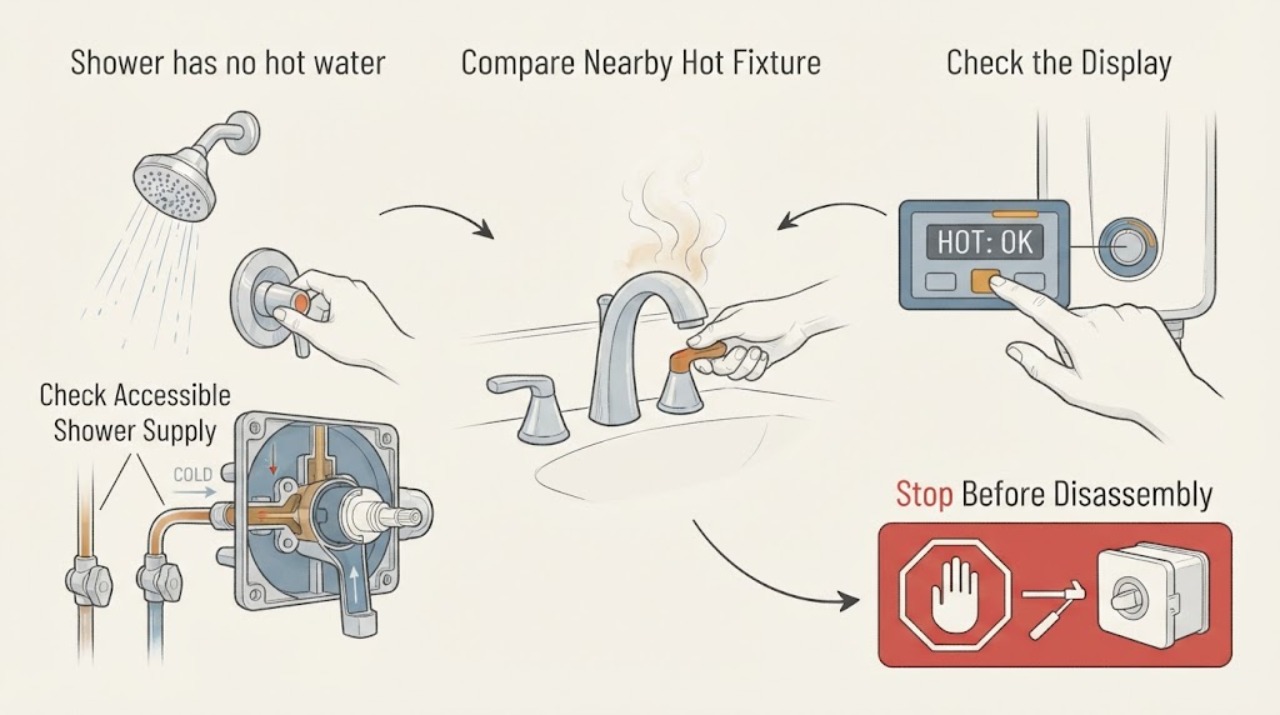
First run a brief hot-water check at a nearby sink or tub. If other fixtures also stay cold, investigate the water-heater and whole-home hot-water path; if other fixtures are hot but the shower is cold, the shower mixing valve, cartridge, check stop, or supply connection is the more likely path. With no leak, gas odor, scalding, or electrical hazard, confirm the shower handle is being operated through its hot range and look only for accessible shutoff valves that may have been closed after service. Do not remove the trim, pull a cartridge, adjust a gas control, open an electrical cover, or keep using a leaking or dangerously hot system. Persistent no-hot-water symptoms need a qualified plumber or water-heater professional.
Work through in order
Diagnostic checks
Use only checks that match the exact appliance or system and its official guide.
-
Check 1
Run a nearby sink or tub faucet briefly on its hot side while the shower remains off, then note whether the water becomes hot, stays cold, or is only lukewarm. Avoid prolonged flow if the water temperature is unstable or dangerously hot.
Expected result: Hot water at another fixture with a cold shower isolates the symptom to the shower branch. Cold or lukewarm water at multiple hot fixtures makes a water-heater, whole-home shutoff, supply, or recovery issue more likely.
Next step: If other fixtures are hot, continue with the shower-control checks. If all fixtures are cold or lukewarm, continue with the non-invasive water-heater checks and arrange service if the supply does not recover.
Stop if: Stop if the test reveals a leak, scalding temperature, gas odor, electrical damage, or uncontrolled temperature; isolate the hazard only if safe and seek qualified help.
Why this matters
Why: The comparison prevents replacing a shower cartridge when the central hot-water source is unavailable and prevents blaming the water heater when only one fixture is affected.
-
Check 2
With the shower off and no leak, operate the handle through its normal temperature range without forcing it. Confirm the handle is installed and oriented as intended and note whether flow is normal but temperature never becomes warm, or whether the handle has limited movement or unusual resistance.
Expected result: Normal flow with no hot range supports a mixing-valve, cartridge, calibration, or hot-supply path issue. A handle that is upside down, blocked, loose, or unusually stiff should not be forced or used as evidence for a particular cartridge.
Next step: Find the shower valve or faucet model and use its manual or a qualified plumber for the cartridge/valve diagnosis. Do not remove the handle or trim just to experiment.
Stop if: Do not force the handle, remove a cartridge, expose the valve cavity, or continue if water escapes behind the trim or the wall becomes wet.
Why this matters
Why: Moen identifies handle installation, cartridge condition, lack of hot/cold supply, and temperature calibration as possible causes of a shower with no warm mixture; the faucet model changes the repair.
-
Check 3
If the shower was recently installed, renovated, or serviced, look only for clearly labeled, accessible hot and cold shutoff/check-stop valves that may have been left closed. Do not remove the escutcheon or reach into the wall cavity.
Expected result: A closed hot-side stop or missing hot supply can produce cold water at the shower; a normal hot-side supply with the same symptom points back to the valve or cartridge.
Next step: If a clearly accessible valve was intentionally closed after service, have the installer or plumber confirm the correct open position and test the fixture. If valve identity is uncertain, leave it alone and arrange service.
Stop if: Do not turn an unidentified valve, disconnect tubing, open a wall, or disassemble the mixing valve based on a cold-water symptom.
Why this matters
Why: Both hot and cold supplies must reach a pressure-balance or mixing valve for normal blending, and an installation error or reversed supply can change temperature behavior.
-
Check 4
Compare the shower's flow with another hot fixture and note whether the shower has normal cold flow, a temperature-specific dribble, or low flow in every temperature position. Keep the test external and do not remove the valve internals.
Expected result: Normal cold flow but no hot flow suggests the hot side of the mixing valve or cartridge. A dribble or reduced flow only at a temperature position suggests a valve/pressure-balance restriction; low flow in every position may be a broader supply or device blockage issue.
Next step: Record the flow pattern and identify the valve brand/model for a plumber. If the showerhead alone is blocked but hot flow is normal at the valve, the device can be evaluated separately without assuming a no-hot-water fault.
Stop if: Do not flush or remove hidden valve parts, drill through the wall, or use chemicals in the mixing valve without model-specific instructions.
Why this matters
Why: Temperature-specific flow changes are diagnostically different from a central water-heater failure. Mineral deposits, a valve spool, cartridge, or supply stop can affect mixing and flow, but the exact part depends on the valve model.
-
Check 5
If other fixtures also lack hot water, inspect the water heater from outside the cabinet for visible puddles, drips, rust, unusual condensation, an accessible shutoff that is clearly closed, and any status display or indicator. For an electric heater, observe whether its accessible disconnect or breaker is on only if there is no water or electrical hazard; for gas equipment, do not relight or adjust controls as a generic test.
Expected result: Visible pooling, a bottom leak, an unavailable supply, a tripped or absent electrical supply, or a persistent status fault changes the urgency. No visible issue does not prove that the heater is safe or that an internal element, thermostat, sensor, or burner works.
Next step: If safe and clearly identified, restore only an accidentally closed external supply or accessible disconnect once; if the issue persists, the breaker trips, or the heater leaks, leave it off as appropriate and call a plumber or qualified water-heater technician.
Stop if: Do not open covers, touch wiring, press an unknown reset, adjust a gas valve or thermostat, drain a hot tank, plug a relief outlet, or work where water can contact electrical parts.
Why this matters
Why: Rheem guidance lists shutoff position, leaks, electrical supply, demand/recovery, and control conditions among possible no-hot-water paths, while its manual reserves wiring, sensors, heating elements, and safety devices for qualified service.
-
Check 6
Record whether hot water is available elsewhere, shower flow and temperature behavior, handle/valve brand and model if visible, recent installation or service, water-heater model, visible leaks or codes, and what changed after any safe external check.
Expected result: A clear whole-home-versus-single-fixture history lets the plumber separate a mixing-valve diagnosis from a water-heater or supply diagnosis without guessing from the phrase no hot water.
Next step: Give the record and photos of safe-to-view evidence to a qualified plumber or water-heater professional, and leave the affected fixture or heater out of service when a hazard or persistent fault is present.
Stop if: Do not order a cartridge, heating element, thermostat, or valve until the model and failed diagnostic are confirmed.
Why this matters
Why: The same user complaint can arise from a cartridge, check stop, reversed supply, depleted hot-water capacity, electrical supply, gas system, or water-heater safety control.
Use your observations
Decision map
Find the observation that best matches what you see, then follow the next safe action.
-
PATH 01Safety boundary
What you see
A nearby sink or tub produces hot water, but the shower remains cold or cannot blend warm water.
Do this next
Identify the shower valve model and arrange a plumber's diagnosis of the hot-side supply and mixing assembly.
Why this path and its safety boundary
Why it matters: The central hot-water source is working, so the shower mixing valve, cartridge, check stop, calibration, or local supply is the leading path.
Safety stop: Do not remove trim or cartridge parts, force the handle, or open the wall to reach the valve.
-
PATH 02Safety boundary
What you see
The shower and other hot fixtures are cold or only lukewarm.
Do this next
Inspect only safe external evidence and arrange qualified water-heater or plumbing service if hot water does not recover or any fault is visible.
Why this path and its safety boundary
Why it matters: The problem is more likely upstream at the water heater, its electrical or fuel supply, a whole-home shutoff, recovery/capacity, or a safety control.
Safety stop: Do not open the heater, adjust gas or electrical controls, drain hot water, or repair elements and safety devices yourself.
-
PATH 03Safety boundary
What you see
The shower has normal cold-water flow but never becomes warm, while other fixtures have hot water.
Do this next
Use the valve model and symptom record for a plumber; a replacement cartridge is conditional, not established by the symptom alone.
Why this path and its safety boundary
Why it matters: The hot side of the shower mixing valve or cartridge may be restricted, closed, misconnected, or failed.
Safety stop: Do not disassemble the valve or use a generic cartridge because it appears similar.
-
PATH 04Safety boundary
What you see
Only one temperature direction has a dribble or reduced flow, or the shower is hot or cold but cannot blend.
Do this next
Confirm both supplies are available and identify the valve model; arrange professional cleaning or cartridge/valve service as appropriate.
Why this path and its safety boundary
Why it matters: A pressure-balance valve, balancing spool, cartridge, check stop, mineral deposit, or supply issue can affect temperature-specific flow.
Safety stop: Do not remove internal parts or expose the valve cavity without shutting down and controlling the water safely under model-specific instructions.
-
PATH 05Safety boundary
What you see
There is water pooling, a leak behind the trim, gas odor, electrical damage, uncontrolled temperature, a relief-valve discharge, or a risk of scalding.
Do this next
Keep people away, stop using the fixture or heater, isolate water or energy only if clearly safe, and contact the appropriate emergency or qualified professional service.
Why this path and its safety boundary
Why it matters: The situation is a plumbing, fuel, electrical, pressure, or scald hazard rather than a routine temperature adjustment.
Safety stop: No more temperature tests, cartridge removal, gas/electrical work, draining, or plugging a relief outlet.
-
PATH 06Safety boundary
What you see
The no-hot-water symptom began after shower installation, renovation, water-heater work, or a supply interruption.
Do this next
Contact the installer or plumber with the symptom sequence and ask them to verify the model-specific supply and valve configuration.
Why this path and its safety boundary
Why it matters: A closed check stop, reversed hot/cold connection, incomplete supply, or installation-specific configuration is possible.
Safety stop: Do not correct suspected reversed lines, reopen unidentified stops, or remove the valve solely from an assumption.
Helpful context
Understand the symptom
Separate a shower fault from a hot-water-supply fault
A shower can be cold even while the rest of the home has hot water, because the fixture's mixing valve or cartridge may not be admitting or blending the hot side. If every hot fixture is cold, the shower is only reporting a water-heater, shutoff, electrical, fuel, or supply problem. Compare fixtures before ordering a cartridge or opening a water-heater cover.
Temperature and flow are different clues
A normal cold flow with no warmth is different from a dribble, low flow, or a shower that is hot or cold but cannot blend. Manufacturer guidance ties temperature-specific shower symptoms to the mixing valve or cartridge and notes that a pressure-balance valve needs both hot and cold supplies. Record both temperature and flow before choosing the next path.
Keep water-heater checks non-invasive
For a whole-home loss of hot water, safe user evidence is limited to visible leaks or moisture, accessible supply positions, the heater's model information, and whether the system has power or a displayed status without opening covers. Water-heater manuals warn against user repair of wiring, temperature sensors, heating elements, and safety devices; a plumber or qualified service technician should make those checks.
Safety boundary
Stop conditions
- Stop for gas odor, electrical damage, a leak into the wall, uncontrolled temperature, scalding risk, water pooling near electrical equipment, or relief-valve discharge.
- Do not open a water-heater cover, touch wiring, adjust gas or temperature controls, remove heating elements, or repair safety devices as a shower troubleshooting step.
- Do not remove a shower cartridge, trim, check stop, or valve body without model-specific water isolation and qualified plumbing procedures.
- Do not plug or obstruct a temperature-pressure relief discharge, drain a hot tank casually, or continue using a leaking water heater.
- Do not order a cartridge, mixing valve, heating element, or thermostat from the phrase no hot water alone; confirm the fixture/heater model and diagnosis first.
Only after diagnosis
Potential parts
- shower mixing cartridge or valve assembly
Only relevant when other fixtures have hot water and a qualified diagnosis finds that the shower's cartridge or mixing valve is not admitting or blending the hot side.
Confirm the exact valve brand, series, and model before ordering; visually similar cartridges are not proof of fit. - pressure-balance spool or check-stop component
Only relevant when temperature-specific low flow or hot/cold blending behavior is traced to the pressure-balance or supply-stop assembly.
The component and service method depend on the installed valve and water-supply arrangement; verify model documentation before replacement. - water-heater heating or temperature-control component
Only relevant when hot water is absent throughout the home and a qualified technician confirms a failed element, thermostat, sensor, or related control.
Electrical ratings, fuel type, tank configuration, and safety requirements must be confirmed from the heater model; installation is professional work. - showerhead or flow-device screen
Only relevant when the temperature is available at the valve or other fixtures but the shower device itself has reduced flow; it does not explain normal cold flow with no hot supply by itself.
Confirm the installed device and manufacturer's service instructions before removing or cleaning any screen.
When checks do not resolve it
Need a professional?
Call a qualified plumber when other fixtures have hot water but the shower remains cold, the handle cannot blend temperature, a temperature-specific dribble persists, or the valve model needs cartridge diagnosis., Call a qualified water-heater professional when hot water is absent throughout the home, the heater shows a persistent fault, the supply or recovery does not return, or the unit has visible leakage., Use emergency or gas/electrical authority guidance for gas odor, smoke, exposed electrical damage, major leaking, or an unsafe scald or pressure condition.
Have this ready
- Whether other fixtures have hot water
- Shower flow and temperature behavior
- Shower valve/faucet brand and model if visible
- Water-heater brand, model, fuel type, and displayed status if visible
- Recent installation or service and any leak, odor, electrical, pressure, or scald evidence
Common questions
FAQ
Why is my shower cold but the sink has hot water?
That pattern points to the shower's hot-side supply, mixing valve, cartridge, check stop, calibration, or an installation connection rather than the central water heater. Identify the shower valve model and have a plumber diagnose it without opening the wall yourself.
Why is there no hot water at any fixture?
The water heater, whole-home supply, accessible shutoff, electrical or fuel supply, recovery, or a safety control may be involved. Look only for safe external evidence such as visible leaking, a clearly closed shutoff, or a status indication; leave internal heater work to qualified service.
Can a shower cartridge cause no hot water?
Yes, if other fixtures have hot water and the shower has normal cold flow but never admits or blends the hot side. A cartridge is only a conditional possibility; the valve model and hot-supply check must be confirmed before ordering one.
What if the shower only dribbles when turned hot?
Temperature-specific low flow can point to a mixing or pressure-balance valve, cartridge, check stop, mineral restriction, or hot-side supply issue. Record whether cold flow is normal and arrange model-specific plumbing diagnosis rather than removing hidden valve parts.
When is no hot water an emergency?
Treat gas odor, a major or concealed leak, water near electrical equipment, relief-valve discharge, uncontrolled or scalding temperature, exposed wiring, or a damaged water heater as an urgent safety problem. Stop using the system and contact the appropriate emergency or qualified professional service.
Read the exact guide
Official sources
- Shower Faucet: Flow Issues- Moentrol with Integrated Transfer ValveMoen Solutions · The opened Moentrol/transfer-valve guide; use it for the diagnostic distinction, not as universal fitment instructions.
- Before You Call For Service…Rheem Manufacturing Company · The specific opened Rheem electric water-heater manual; model-specific controls and ratings vary.
- The water in the shower is either hot or cold; I cannot get any temperature in between. What is wrong?Delta Faucet · Delta Monitor pressure-balance valves; the supply and blending principle is not a universal part-fit claim.
- What to Do Before Calling a Plumber or Replacing Your Water HeaterRheem Manufacturing Company · Rheem homeowner guidance used for general water-heater triage; installed model instructions take precedence.
- No WARM water (no mixture of hot and cold) on tub shower units.Moen Solutions · Moen shower valves; use the installed valve model rather than assuming the listed cartridge family.
Community feedback
Share a repair observation
Share a plain-text repair observation. Accepted observations are published automatically; this page may take a moment to update.