
On this page
Start here
Quick answer
Low pressure at an American Standard shower is not automatically a cartridge failure. First compare the shower with another outlet and note whether the weakness affects only the showerhead, only hot or cold water, every outlet, or the whole home. From ordinary safe access, inspect the showerhead face and any visible screen for scale or debris, and check whether a diverter position or another fixture changes the flow. American Standard uses several shower-valve families: its pressure-balance cartridges regulate the response to hot- and cold-water supply changes, and different trims use different cartridges and rough-in valves. Record the exact trim or valve model before choosing a shower cartridge, showerhead, or pressure-balancing part. Do not remove trim, pull a cartridge, alter a flow-control part, or open the wall as a user check. Arrange qualified plumbing service if low flow affects multiple outlets, temperature is unstable, the valve is inaccessible, the cartridge model is uncertain, or safe flow does not return after permitted showerhead cleaning.
Before you begin
Safety first
- This article supports ordinary-access outlet comparison, visual showerhead inspection, normal user-control observation, model identification, and documentation. A qualified plumber should handle cartridge or pressure-balance service, service stops, concealed valve work, flow-control modification, in-wall leaks, and any temperature-safety symptom.
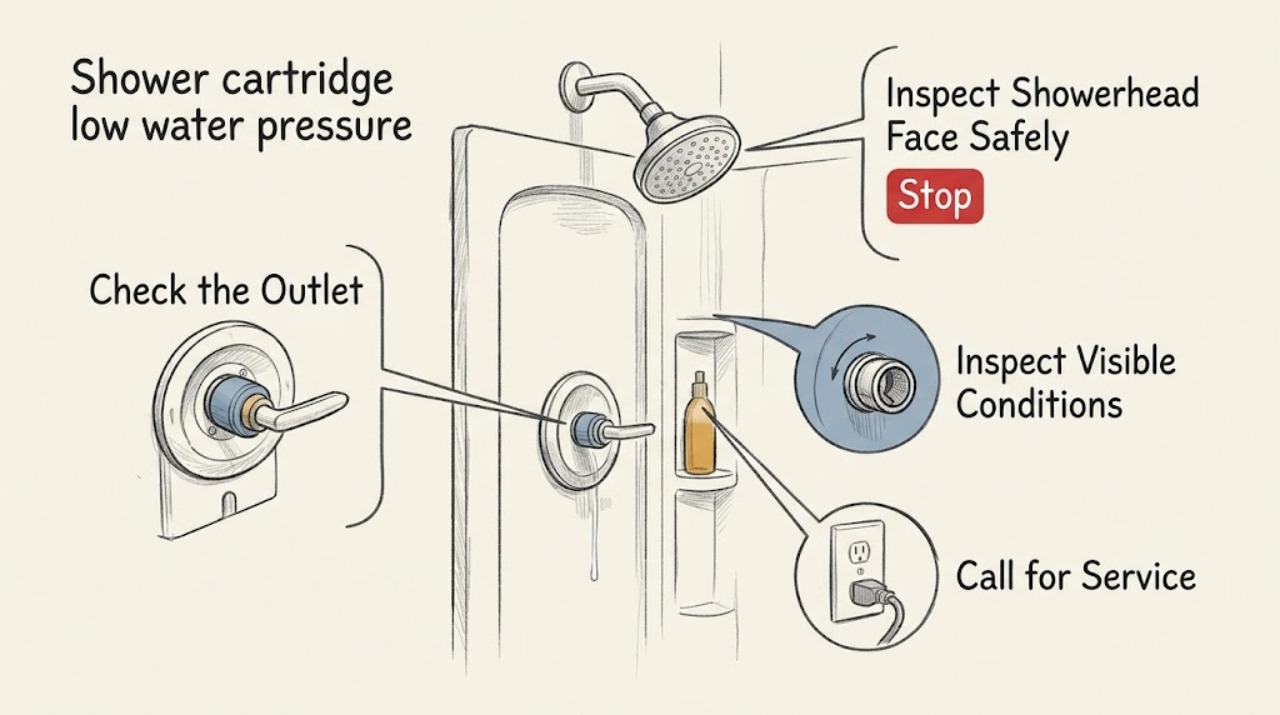
Work through in order
Diagnostic checks
Use only checks that match the exact appliance or system and its official guide.
-
Check 1
From normal user controls, compare the American Standard shower with a nearby sink or tub outlet and, if present, compare the showerhead with the tub spout or hand-shower outlet; do not remove the showerhead or trim to make the comparison.
Expected result: Record whether low flow affects only this showerhead, every shower outlet, hot water only, cold water only, all bathroom fixtures, or the whole home; note whether another fixture running changes the flow.
Next step: Keep the outlet comparison and temperature observations with the faucet or valve model information; arrange plumbing service when multiple outlets are affected or flow changes with another fixture.
Stop if: Stop for a sudden pressure loss, water at the wall or trim, unstable temperature, scalding risk, or any need to open the wall or valve.
Why this matters
Why: A problem isolated to one head supports a spray-face, inlet, or head-specific restriction. Low flow across shower outlets or fixtures points toward the valve, supply pressure, stop, or building plumbing rather than a simple showerhead obstruction.
-
Check 2
From ordinary safe access, inspect the American Standard showerhead spray face, visible inlet, and any accessible screen for white scale, sediment, blocked openings, a damaged face, or an altered flow-control insert; do not poke openings or remove valve trim.
Expected result: Classify the head as visibly scaled or blocked, damaged, clean but weak, or impossible to assess without disassembly; note whether the spray pattern is uneven or every opening is weak.
Next step: If the exact showerhead instructions permit ordinary cleaning, follow them without changing the flow-control arrangement, then compare the result. If the head is damaged or cleaning does not change flow, record the result for qualified diagnosis.
Stop if: Do not drill, pin, scrape, enlarge, remove, or bypass a flow-control insert, and stop if cleaning would require force or if the fixture begins to leak.
Why this matters
Why: Visible head scale or debris can explain a localized restriction without implicating the cartridge. A clean or damaged head with weak flow, especially when other outlets are also weak, shifts attention toward the valve, supply, pressure condition, or an inaccessible internal component.
-
Check 3
Operate the shower's normal temperature and diverter controls slowly and observe the flow and temperature from a safe position; do not force the handle or hold an outlet closed to create pressure.
Expected result: Record whether low flow is present in every handle position, only at one temperature range, only at one diverter outlet, accompanied by a hot or cold surge, or changed when another fixture runs.
Next step: Use the pattern to select the model-specific service path and give the technician the exact outlet, temperature, diverter, and cross-fixture behavior; keep the shower off for unstable or unsafe temperature.
Stop if: Do not continue showering through a scalding surge, cold shock, uncontrolled flow, stuck handle, water at the wall, or a diverter that will not operate normally.
Why this matters
Why: Low flow tied to one outlet can implicate a diverter or outlet restriction. Low flow with temperature fluctuation can involve a pressure-balance cartridge or supply imbalance, while a whole-home change suggests upstream plumbing. None of these patterns identifies a cartridge by itself.
-
Check 4
Read the American Standard trim, valve, or cartridge model from visible markings, the installation record, paperwork, or the exact product documentation without removing trim or opening the wall.
Expected result: Record the model or collection, handle type, whether it is a pressure-balance or on/off arrangement, whether a diverter is integrated, and the cartridge or rough-in reference named by the official documentation.
Next step: Match the model to its official parts diagram or installation guide and provide it to a plumber before any cartridge or pressure-balancing part is ordered.
Stop if: Do not select a cartridge from a photograph alone, do not treat a faucet cartridge as a shower cartridge, and do not remove a cover when the valve cannot be safely isolated.
Why this matters
Why: American Standard documents different cartridge and valve families: its M952100 pressure-balance unit is specified for certain rough-in valves, while other shower products use separate pressure-balance or on/off assemblies. The visible handle shape is not enough to establish fit.
-
Check 5
If the manufacturer permits ordinary showerhead cleaning, document the head's condition and compare flow and spray after cleaning while leaving the valve cartridge, pressure-balancing assembly, and flow-control arrangement untouched.
Expected result: Record whether flow improves at the head, remains weak, becomes uneven, or exposes a leak at the head connection; note whether the valve still has temperature or multi-outlet symptoms.
Next step: Keep the cleaning method and result with the model record. Arrange qualified service for persistent low flow, temperature instability, multiple weak outlets, or any diagnosis requiring cartridge or in-wall access.
Stop if: Do not remove or modify the cartridge, valve seat, pressure-balancing spool, flow restrictor, or in-wall piping as a follow-up to cleaning.
Why this matters
Why: Improvement after head cleaning supports a head-side restriction. No change with a clean, intact head shifts the diagnostic question toward the diverter, valve, cartridge, supply, or pressure condition; a new connection leak is a separate repair path.
-
Check 6
Prepare a service record with the American Standard model, outlet comparison, spray-face condition, temperature behavior, diverter position, other-fixture effect, and any permitted cleaning result; do not dismantle the valve to improve the record.
Expected result: Confirm whether low flow is localized or system-wide, whether it is hot/cold or mode-specific, whether the cartridge model is documented, and whether water or temperature symptoms make the shower unsafe to use.
Next step: Keep the shower off for unsafe temperature, water at the wall, or sudden loss of control; otherwise arrange a model-specific plumbing assessment when observation does not isolate a permitted head-side cause.
Stop if: Do not open the valve, pull a cartridge, test live or concealed plumbing, bypass a pressure-balancing function, or continue use with scalding or water-damage risk.
Why this matters
Why: This record helps distinguish a head restriction from a pressure-balance cartridge, diverter, supply, or building-plumbing issue. A missing model, persistent symptom, or safety symptom means the next useful decision is qualified diagnosis, not a guessed replacement.
Use your observations
Decision map
Find the observation that best matches what you see, then follow the next safe action.
-
PATH 01Safety boundary
What you see
Only the American Standard showerhead is weak, other outlets have normal flow and temperature, and visible scale or debris is present on the spray face or accessible inlet.
Do this next
Use only the exact showerhead's permitted cleaning method, preserve any flow-control insert, and compare the result without opening the valve.
Why this path and its safety boundary
Why it matters: A head-side restriction is more likely than a shower cartridge fault. The valve may be supplying normal flow that the head cannot pass.
Safety stop: Do not drill or remove the insert, scrape openings, or replace the cartridge for a head-only scale symptom.
-
PATH 02Safety boundary
What you see
The head is clean and intact or permitted cleaning made no meaningful difference, while the same outlet remains weak and the exact American Standard model is known.
Do this next
Give the model, head condition, outlet comparison, and cleaning result to a qualified plumber and request model-specific valve or supply diagnosis before ordering a cartridge.
Why this path and its safety boundary
Why it matters: The restriction may be at the inlet, diverter, valve, pressure-balance cartridge, supply, or a concealed part rather than removable spray-face scale. A cartridge is possible but not proven.
Safety stop: Do not remove trim, pull the cartridge, bypass a flow-control feature, or open the wall as an observation step.
-
PATH 03Safety boundary
What you see
Low flow occurs through the shower's normal control range and is accompanied by hot/cold surges, unstable temperature, or a response to changes in the household water supply.
Do this next
Stop using the shower if temperature is unsafe and arrange qualified plumbing diagnosis with the exact valve and trim model; do not attempt cartridge or balancing-valve service yourself.
Why this path and its safety boundary
Why it matters: A pressure-balance cartridge, valve, inlet, or supply imbalance is more likely than a simple showerhead clog. American Standard pressure-balance units are intended to respond to changes in hot and cold supply pressure, but the symptom does not identify a failed cartridge.
Safety stop: Do not defeat the pressure-balance function, block an outlet, or continue showering through a scalding or cold shock.
-
PATH 04Safety boundary
What you see
Several shower outlets or household fixtures are weak, flow changes when another fixture runs, or the loss began after work on the supply or valve.
Do this next
Arrange qualified plumbing diagnosis and keep the shower valve and any flow-control arrangement unchanged until the system is assessed.
Why this path and its safety boundary
Why it matters: The symptom is not isolated to the shower cartridge and may involve an upstream stop, supply pressure, building plumbing, or installation condition.
Safety stop: Stop for water damage, a leaking wall-side connection, sudden pressure loss, or unsafe temperature; do not open concealed plumbing.
-
PATH 05Safety boundary
What you see
The American Standard model or cartridge reference is unknown, the valve is concealed or inaccessible, low flow persists after permitted head checks, or water appears at the wall or trim.
Do this next
Keep the shower off when safety or water-damage symptoms are present and arrange qualified plumbing service with photos, model clues, and the observed flow pattern.
Why this path and its safety boundary
Why it matters: The safe diagnostic boundary has been reached. A generic cartridge or pressure-balancing part cannot be selected reliably, and wall-side water or unstable temperature raises the service urgency.
Safety stop: Do not remove the escutcheon, pull the cartridge, test behind the wall, force the handle, or substitute a part based on appearance.
Helpful context
Understand the symptom
Find out whether the restriction is at the head or in the valve
A scaled spray face, a partially blocked inlet screen, a diverter position, a supply issue, and a pressure-balance cartridge can all feel like low shower pressure. Compare the affected shower with another outlet and observe the spray pattern and temperature without opening the wall. If only one head is weak, start at the head; if every shower outlet is weak or the temperature changes with flow, the valve or supply path deserves professional diagnosis.
American Standard cartridges are tied to valve families
American Standard's parts pages show several distinct shower arrangements, including pressure-balance cartridges for particular rough-in valves and trims. A cartridge that looks similar may have different ports, seals, orientation, or pressure-balancing behavior. Use the exact model and official diagram before selecting a part; a showerhead washer or cleaning step cannot correct a cartridge restriction, and a cartridge cannot correct a blocked spray face or building-wide supply problem.
Keep valve service behind the professional boundary
Low pressure can tempt an owner to remove the handle or cartridge, but this task's safe scope is observation only. Do not remove the escutcheon, pull a pressure-balance cartridge, disturb service stops, or open the wall. Record the symptom pattern and model information for a plumber, especially when the valve is concealed or the temperature is not stable.
Safety boundary
Stop conditions
- Compare the shower with other outlets and inspect the head from ordinary access before treating low flow as a cartridge failure.
- Do not remove trim, pull a pressure-balance cartridge, disturb service stops, open the wall, or bypass a flow-control or pressure-balancing function.
- Do not select a cartridge or pressure-balancing part without the exact American Standard valve and trim model and the matching documentation.
- Keep the shower off for scalding or cold shock, unstable temperature, water at the wall or trim, sudden loss of control, or a stuck handle or diverter.
- If multiple outlets are weak or household flow changes with another fixture, arrange plumbing diagnosis instead of replacing the shower cartridge by guesswork.
- If permitted head cleaning does not restore flow or produces a leak, stop further user checks and arrange qualified plumbing service.
Only after diagnosis
Potential parts
- shower head
Consider this category only when low flow is isolated to the head, the head is damaged or remains restricted after permitted cleaning, and the exact model or compatible replacement is confirmed.
Confirm the showerhead connection, rated flow, spray function, and compatibility with the installed valve before ordering; do not use a head replacement to conceal a system-wide pressure problem. - shower cartridge
Consider this category only when a persistent low-flow or temperature pattern remains after head-side causes are excluded and the exact American Standard valve model and qualified diagnosis support cartridge service.
Confirm the exact rough-in and trim model, cartridge type, orientation, retaining method, and pressure-balance requirements before ordering or installing. - pressure-balancing valve
Consider this category only when the model documentation and professional diagnosis identify a pressure-balancing valve or assembly rather than a showerhead, supply, or cartridge-only issue.
Confirm the exact American Standard rough-in valve, trim compatibility, pressure and temperature function, and in-wall installation requirements; do not substitute or bypass the balancing function.
When checks do not resolve it
Need a professional?
Arrange qualified plumbing service when low flow affects multiple outlets, temperature is unstable, the shower valve or cartridge is concealed, the model or part fit is uncertain, the handle or diverter is stuck, water appears at the wall, the showerhead remains weak after permitted cleaning, or any diagnosis would require valve, cartridge, service-stop, or in-wall access.
Safety scope: This article supports ordinary-access outlet comparison, visual showerhead inspection, normal user-control observation, model identification, and documentation. A qualified plumber should handle cartridge or pressure-balance service, service stops, concealed valve work, flow-control modification, in-wall leaks, and any temperature-safety symptom.
Common questions
FAQ
Does low water pressure always mean my American Standard shower cartridge is bad?
No. A clogged or scaled showerhead, diverter, inlet, supply issue, or whole-home pressure problem can feel the same. Compare other outlets and inspect the head from ordinary access before treating the cartridge as the cause.
How can I tell whether the showerhead or cartridge is restricting flow?
If only one head is weak and its face or inlet shows scale, a head-side restriction is more likely. If the head is clean but multiple shower outlets are weak or temperature changes with flow, the valve, cartridge, diverter, or supply needs professional diagnosis.
Why does low flow with temperature changes matter?
Pressure-balance valves respond to changes in hot and cold supply pressure. Low flow combined with hot or cold surges can involve that valve, cartridge, or an upstream supply imbalance, but the symptom does not identify a failed cartridge by itself.
Can I remove the American Standard shower cartridge to check it?
Do not treat cartridge removal as an ordinary user check. Record the model and symptoms instead; cartridge and pressure-balance service can involve concealed plumbing, retaining hardware, and temperature-safety functions that require qualified handling.
Can I use any American Standard shower cartridge?
No. American Standard lists multiple shower cartridges, pressure-balance units, rough-in valves, and trim families. Confirm the exact valve and trim model, cartridge type, orientation, and compatible documentation before ordering or installing a part.
What if every shower outlet has low pressure?
Low flow at multiple shower outlets points away from a single showerhead clog and may involve the valve, diverter, supply, service stop, or building plumbing. Arrange qualified diagnosis, especially if other fixtures or temperature also change.
When should I call a plumber for American Standard shower low pressure?
Call when the head remains weak after permitted cleaning, multiple outlets are affected, temperature is unstable, the model or cartridge is uncertain, the valve is concealed, water appears at the wall, or diagnosis would require cartridge, valve, service-stop, or in-wall access.
Read the exact guide
Official sources
- Bedminister® Tub and Shower Trim Kit With ValveAmerican Standard · A specific American Standard Bedminster tub-and-shower kit; its valve and trim details do not establish fit for another shower system.
- Bath Shower Trim KitsAmerican Standard · American Standard shower trim collection; each individual trim and rough-in documentation controls cartridge and flow compatibility.
- Temperature Control Pressure Balance Valve CartridgeAmerican Standard · A specific American Standard pressure-balance cartridge page; it demonstrates model-specific compatibility and does not establish a universal cartridge fit.
- American Standard Parts StoreAmerican Standard · American Standard parts and support index; exact model documentation determines the applicable shower part or service path.
- Flash® 2-Way Integrated Shower Diverter Rough-In Valve with Pressure Balance Valve CartridgeAmerican Standard · A specific American Standard Flash rough-in valve; it demonstrates cartridge and diverter variation and is not a universal service procedure.
- Shower Faucet Cartridge with ScrewsAmerican Standard · A specific American Standard shower faucet cartridge listing; it demonstrates a cartridge category but does not establish compatibility with every shower valve.
- 1/2-Inch (13 mm) On/Off Control Rough-In ValveAmerican Standard · A specific American Standard R701 on/off valve; it demonstrates that shower flow control may be a separate in-wall path from a pressure-balance cartridge.
Community feedback
Share a repair observation
Share a plain-text repair observation. Accepted observations are published automatically; this page may take a moment to update.