
On this page
Start here
Quick answer
Low pressure from an American Standard shower can come from mineral scale or debris at the spray face or inlet, a pressure-compensating flow-control device, a shower valve or supply restriction, or low pressure affecting several fixtures. First compare the shower with another nearby outlet and determine whether the weakness is only at one American Standard head or affects the bathroom or house. Inspect the spray face and any ordinary-access screen, and use only the manufacturer's gentle cleaning method; do not drill nozzles, remove a flow-control device, or force a valve apart. If pressure stays low after safe cleaning, changes with other fixtures, fluctuates in temperature, or requires valve, pipe, or wall access, arrange qualified plumbing service.
Before you begin
Safety first
- This article supports outlet comparison, model identification, ordinary-access spray-face inspection, and manufacturer-approved fingertip cleaning only. It does not authorize drilling, internal flow-control changes, valve or wall access, pressure adjustment, or live plumbing work.
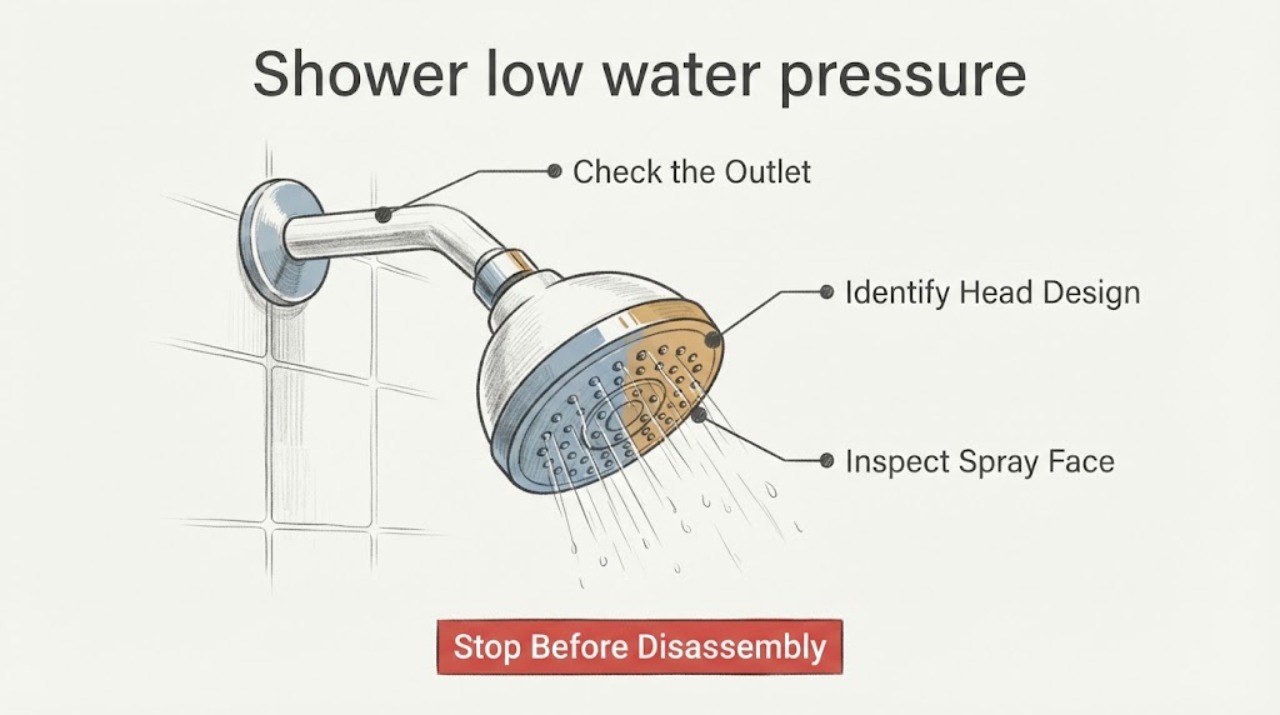
Work through in order
Diagnostic checks
Use only checks that match the exact appliance or system and its official guide.
-
Check 1
With the shower controls operated normally, compare the American Standard shower spray with a nearby sink, tub spout, or second shower outlet without removing trim or opening the wall.
Expected result: Record whether weak flow affects only this shower, both shower and tub outlets, several bathroom fixtures, or the entire home; note whether flow changes when another fixture runs.
Next step: Continue with head inspection only when the symptom is localized. Arrange plumbing assessment for multiple weak fixtures, pressure changes, or temperature instability.
Stop if: Stop for a leak inside the wall, hot-water instability, scalding risk, water damage, or an unsafe wet floor.
Why this matters
Why: A one-head problem supports a spray-face, inlet, hose, or head-specific restriction. Weakness across outlets or pressure that changes with another fixture points toward a valve, supply, pressure, or building-plumbing problem.
-
Check 2
Photograph the American Standard head or hand shower, record its model marking if visible, and note its spray modes, pressure-compensating feature, check valve, or easy-clean nozzle design from the product information.
Expected result: The head has easy-clean nozzles, a pressure-compensating flow-control device, a check valve, a specified flow design, or an unknown configuration.
Next step: Use the exact American Standard care and installation information for the identified head; ask a plumber or manufacturer support to identify an unknown head before internal changes.
Stop if: Do not drill, pry, discard, bypass, or substitute a flow-control, pressure-compensating, check-valve, or inlet component.
Why this matters
Why: A listed flow-control or pressure-compensating feature can make the spray feel different from another head and must not be removed as a clog test. An unknown design requires model-specific information before parts or cleaning methods are chosen.
-
Check 3
From ordinary safe access, inspect the spray face and visible nozzles for chalky scale, blocked openings, damaged silicone, or an uneven spray pattern; do not poke or enlarge the openings.
Expected result: Scale or debris is visible, the nozzles are clear but spray is weak, the face is damaged, or the face cannot be inspected without force.
Next step: Use the gentle easy-clean method only when it matches the installed head and manufacturer instructions. Stop and arrange service for damage, inaccessible parts, or unchanged flow.
Stop if: Do not use pins, wire, drills, knives, abrasives, or harsh chemicals on the spray face.
Why this matters
Why: Visible scale can restrict a localized spray, while a clear face with weak flow points toward the inlet, flow-control device, valve, supply, or normal product design. Damage or inaccessible parts need product-specific service.
-
Check 4
Only when the American Standard head has a documented easy-clean spray face, gently swipe the silicone nozzles with a fingertip as directed and rinse the loosened residue; do not remove the head's internal flow-control parts.
Expected result: The spray pattern becomes even and stronger, scale remains, the spray stays weak, or a leak appears at the head or hose connection.
Next step: Restore the head without changing its flow-control arrangement and compare it with the original outlet test. Arrange qualified service if flow is unchanged or a connection leaks.
Stop if: Do not mix cleaners, use harsh chemicals, soak an unapproved assembly, scrape nozzles, or enlarge any opening.
Why this matters
Why: Improvement supports surface scale as a contributor. Remaining weakness points below the face or upstream, while a leak suggests a seal, connection, or damaged head rather than permission to clean more aggressively.
-
Check 5
If the exact American Standard instructions identify an ordinary-access inlet screen or washer, inspect it only after the supply is safely off and the connection releases without force; do not open the valve or wall.
Expected result: The screen or washer is visibly blocked, clean and correctly seated, damaged or missing, or the inlet cannot be accessed without force or uncertain disassembly.
Next step: Clean or replace only the exact user-serviceable item specified for the model, restore the connection without overtightening, and arrange service when access, fit, or the cause is uncertain.
Stop if: Do not pry internal inserts, remove a flow restrictor, force threads, disturb the valve, or continue if the connection leaks.
Why this matters
Why: A blocked screen or displaced washer can restrict a single head or cause a connection leak. A clean inlet or unknown internal arrangement shifts suspicion to the pressure-compensating device, valve, supply, or head itself.
-
Check 6
After approved cleaning and correct reassembly, run a brief normal shower test and inspect the head, hose, wall connection, and surrounding area for flow, temperature, pressure, and leaks; do not keep testing a weak or leaking system.
Expected result: Spray is restored and even, spray remains weak with a clear head, pressure changes with another fixture, temperature fluctuates, or water appears at the hose, wall, ceiling, or adjacent room.
Next step: Document the model, outlet comparison, cleaning method, and result, then arrange qualified plumbing service for any unresolved, multi-fixture, temperature, pressure, or leak pattern.
Stop if: Stop immediately for water damage, a loose or leaking wall connection, scalding risk, or any need to open the wall or service a valve.
Why this matters
Why: A localized improvement supports head-scale restriction. Persistent weakness, whole-bathroom pressure changes, temperature variation, or leakage requires valve, supply, connection, or concealed-plumbing diagnosis.
Use your observations
Decision map
Find the observation that best matches what you see, then follow the next safe action.
-
PATH 01Safety boundary
What you see
Only one American Standard head is weak and visible scale or blocked easy-clean nozzles are present, while nearby outlets have normal flow.
Do this next
Use the documented fingertip cleaning method for that head, restore its original flow-control parts, and repeat a brief comparison.
Why this path and its safety boundary
Why it matters: A head-specific surface restriction is more likely than a whole-house pressure problem.
Safety stop: Stop if the spray stays weak, the head leaks, or cleaning would require drilling or internal disassembly.
-
PATH 02Next step
What you see
The spray face and any permitted inlet check are clear, but the American Standard head remains weak while the connection is dry.
Do this next
Keep the head's original internal arrangement and have the exact model and supply path assessed by a qualified plumber or manufacturer support.
Why this path and its safety boundary
Why it matters: An inlet screen, pressure-compensating device, valve, supply, pressure condition, or intended flow design is more likely than surface scale.
-
PATH 03Next step
What you see
Several bathroom fixtures or the entire home have low pressure, or shower flow changes when another fixture opens.
Do this next
Arrange plumbing assessment and leave the showerhead's flow-control design unchanged; do not adjust hidden valves or building pressure equipment as a test.
Why this path and its safety boundary
Why it matters: A supply, pressure regulator, valve, building plumbing, or utility-side condition is more likely than the American Standard head alone.
-
PATH 04Safety boundary
What you see
Low shower pressure is accompanied by temperature fluctuation, a control that does not shut off, unusual valve noise, or simultaneous flow from multiple outlets.
Do this next
Stop repeated testing and arrange qualified plumbing service with the exact American Standard valve and trim information.
Why this path and its safety boundary
Why it matters: The pressure-balancing or mixing valve, diverter, check valve, back pressure, or supply requires professional diagnosis.
Safety stop: Do not remove trim, open the wall, adjust a pressure-balancing component, or bypass a safety feature.
-
PATH 05Next step
What you see
The head is intact, the pressure is consistent at other outlets, and the observed spray matches the American Standard model's documented water-saving or pressure-compensating design.
Do this next
Keep the original flow-control arrangement and ask American Standard support or a plumber to identify a compatible alternative if the user experience is unacceptable.
Why this path and its safety boundary
Why it matters: The spray may be operating as designed rather than suffering a clog; a higher-flow result cannot be assumed safe or compatible.
Helpful context
Understand the symptom
Start by separating one weak American Standard head from low pressure everywhere
If only one showerhead or hand shower has a weak spray while a sink or tub outlet is normal, scale, debris, an inlet screen, or that head's intended flow-control design is the focused check. If several fixtures are weak, flow changes when another fixture runs, or hot and cold behavior changes, the cause is more likely upstream in the valve, supply, pressure condition, or building plumbing.
Clean the spray face without defeating its design
American Standard's Easy Clean Spray Nozzles page describes removing lime scale and buildup with a simple swipe on silicone spray nozzles. Use that method only when the installed head has the feature and its instructions allow it. A pressure-compensating device or flow restrictor is part of some American Standard designs; removing, drilling, or substituting it can change the product's intended performance and compatibility.
Know when a low-pressure check has become valve or plumbing work
A clean head with weak spray does not prove a failed head. American Standard products can include a pressure-compensating device, check valve, hose, wall connection, or a separate pressure-balancing valve. Stop at ordinary-access inspection when the inlet, valve, pipe, or wall must be opened, and give the exact model and outlet comparison to a qualified plumber.
Safety boundary
Stop conditions
- Do not drill, pin, wire, scrape, or enlarge American Standard spray openings, and do not use harsh or mixed cleaning chemicals.
- Do not remove, bypass, discard, or substitute a pressure-compensating flow-control device, restrictor, check valve, or pressure-balancing component.
- Do not open the valve or wall, adjust hidden supply or pressure equipment, force a threaded connection, or continue with uncertain disassembly.
- Stop for a leak inside the wall, water damage, hot-water instability, scalding risk, exposed wiring, or a slippery unsafe floor.
- Do not treat weak spray at one head as proof of a house-wide pressure fault, or low pressure everywhere as proof that the American Standard head is clogged.
Only after diagnosis
Potential parts
- American Standard showerhead or hand-shower inlet screen
Consider this category only when the exact head uses a replaceable screen and inspection confirms blockage or damage beyond model-approved cleaning.
Confirm the exact head, screen design, and flow-control arrangement before ordering; do not remove a screen that is not user-serviceable. - American Standard pressure-compensating flow-control component
Consider this category only after qualified diagnosis confirms that the component is damaged or incompatible with the exact head and replacement is specified by the manufacturer.
Confirm the exact model, intended flow, and pressure or valve compatibility; never use removal or substitution as a pressure test. - American Standard shower valve cartridge
Consider this category only when a qualified plumbing inspection links low pressure or temperature behavior to a failed cartridge or valve assembly after the head and supply checks.
Confirm the exact valve and trim, pressure-balancing arrangement, and manufacturer fit information before ordering or opening the wall.
When checks do not resolve it
Need a professional?
Arrange qualified plumbing service when safe spray-face and model-approved inlet cleaning does not restore pressure, several fixtures are affected, flow changes with another fixture, temperature fluctuates, the head or connection leaks, the exact model or internal flow-control arrangement is unknown, or valve, supply, wall, or pressure-equipment access is required. Keep any original flow-control and check-valve parts available for the technician.
Safety scope: This article supports outlet comparison, model identification, ordinary-access spray-face inspection, and manufacturer-approved fingertip cleaning only. It does not authorize drilling, internal flow-control changes, valve or wall access, pressure adjustment, or live plumbing work.
Common questions
FAQ
Why is my American Standard shower pressure low but the sink pressure is normal?
A problem limited to one shower points toward its spray face, inlet screen, hose, pressure-compensating device, or valve outlet. Inspect and gently clean only the model-approved areas, keep the original flow-control parts in place, and arrange service if the spray remains weak.
Can I remove the flow restrictor from an American Standard showerhead?
No. Some American Standard heads use pressure-compensating flow control and water-saving designs. Removing or drilling those parts can change the intended flow and compatibility. Identify the exact model and ask the manufacturer or a plumber about a compatible alternative if needed.
How do I clean an American Standard showerhead with low pressure?
If the head has the documented Easy Clean spray nozzles, use the manufacturer's gentle fingertip swipe to remove lime scale. Do not poke, drill, scrape, or use harsh or mixed chemicals. A clean face with continued low pressure needs an inlet, valve, supply, or system assessment.
When does low shower pressure mean a plumbing problem?
Arrange plumbing service when several fixtures are weak, flow changes with another fixture, temperature fluctuates, the shower leaks, or safe cleaning does not help. Valve, supply, pressure equipment, and wall access are professional scopes, not head-cleaning tests.
Read the exact guide
Official sources
- 3-Function 4-3/4-Inch 1.8 gpm/6.8 L/min Water-Saving ShowerheadAmerican Standard · Use as a product example showing that a marked flow design and pressure-compensating control can be intentional; it does not identify the assigned showerhead.
- Easy Clean Spray NozzlesAmerican Standard · Use only when the installed showerhead has the documented easy-clean nozzle design; it does not authorize internal part removal or harsh chemical cleaning.
- HydroFocus® 2.0 gpm/7.6 L/min 4-1/2-Inch 5-Function Hand ShowerAmerican Standard · Use as a product example showing that some American Standard hand showers have pressure-compensating and check-valve features; the assigned head model is unknown.
Community feedback
Share a repair observation
Share a plain-text repair observation. Accepted observations are published automatically; this page may take a moment to update.