
On this page
Start here
Quick answer
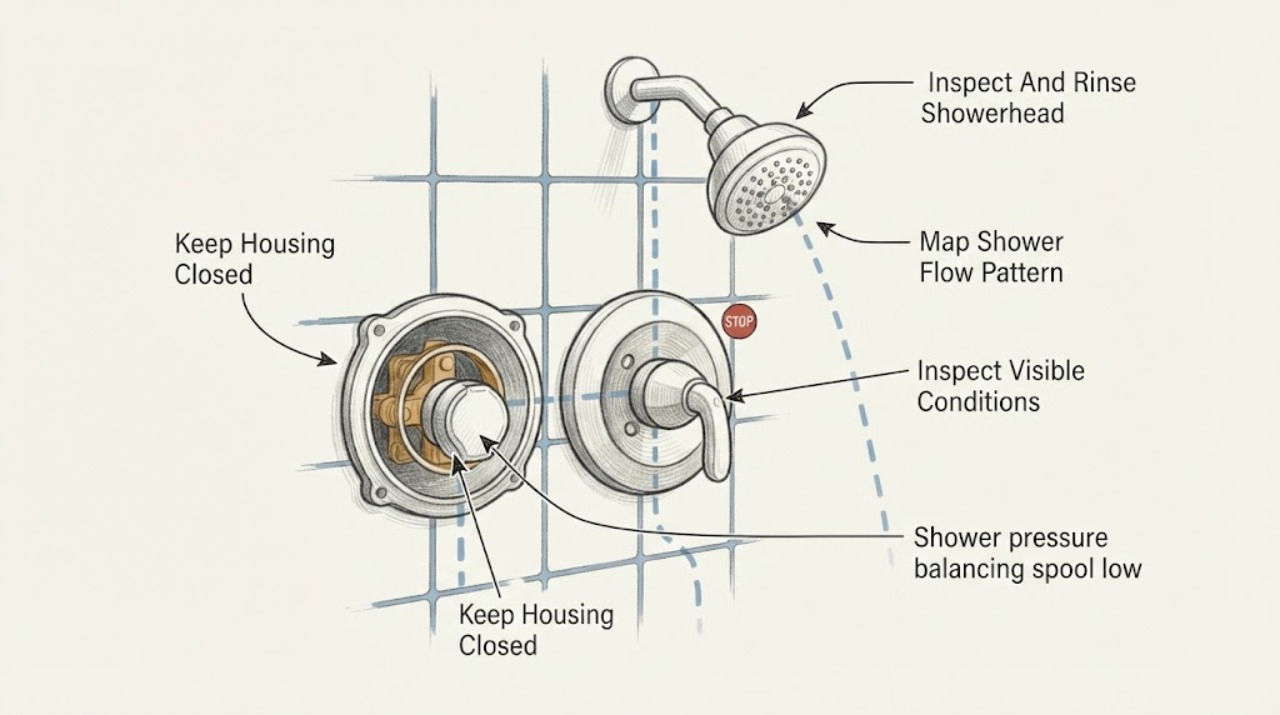
An American Standard pressure-balancing spool is primarily a temperature-safety component: American Standard describes it as responding to changes in relative hot and cold supply pressure to help maintain a steady outlet temperature. Low shower flow alone does not prove that the spool is blocked or failed. First compare this shower with another fixture and compare hot with cold, then clean or rinse the accessible showerhead only as its instructions allow. If a tub spout is present, compare flow there without opening the wall valve. A shower that is weak on both temperatures with normal nearby fixtures points toward the showerhead, a service stop, valve inlet, cartridge, or plumbing restriction; low flow plus a sudden temperature swing or one weak side keeps the pressure-balance cartridge in consideration. Do not pry out the spool, remove the cartridge, or open a concealed valve without safe water isolation and the exact model procedure. Persistent low flow, a seized service stop, a leak, or work behind the trim requires a qualified plumber.
Before you begin
Safety first
- This article supports comparing fixtures and temperatures, inspecting or gently rinsing an accessible showerhead, and identifying the exact valve from safe documentation. It does not authorize cartridge or spool removal, concealed fitting work, force on seized trim or shutoffs, or any pressurized water-path disassembly.
Work through in order
Diagnostic checks
Use only checks that match the exact appliance or system and its official guide.
-
Check 1
Run the American Standard shower briefly at cold and hot, then compare a nearby fixture and, if the installation has one, the tub spout without removing the wall trim. Record whether the weak flow affects one temperature, both temperatures, only the showerhead, or the broader plumbing.
Expected result: Only the showerhead is weak, hot or cold is weaker, both shower temperatures are weak, the tub spout is stronger, or other fixtures are also weak.
Next step: Continue with the outlet check for a local showerhead pattern. For a concealed-valve pattern, record the results and use qualified service rather than opening the wall valve.
Stop if: Stop for a leak at the trim or wall, spraying water, rapidly changing temperature, scalding, or water near electrical equipment.
Why this matters
Why: A showerhead-only pattern points toward the outlet. One-sided weakness keeps that inlet, service stop, cartridge port, or supply path in consideration. Equal weakness at the shower and tub outlet with normal nearby fixtures points toward the valve or local supply, while several weak fixtures point upstream.
-
Check 2
If the showerhead is accessible and its exact instructions permit removal, rinse the screen or spray face and inspect for visible mineral scale or debris; keep any gasket and flow insert together and do not force a seized head or probe the wall connection.
Expected result: The showerhead has scale or debris, flow improves after a gentle rinse, the flow stays weak with the outlet clear, or the head will not remove normally.
Next step: Reassemble the original parts correctly and retest once if flow improves. If flow remains weak or the head is seized, leave the wall connection alone and arrange plumbing service.
Stop if: Do not drill spray holes, use sharp tools or harsh chemicals, apply force to a seized showerhead, or loosen the wall arm as a pressure test.
Why this matters
Why: An outlet restriction is more likely when cleaning restores flow. Persistent weakness with a clear showerhead shifts attention toward the hose, valve inlet, service stop, cartridge, or upstream supply; a seized head can damage the arm or concealed connection.
-
Check 3
During one brief, safe shower test, note whether the temperature stays reasonably steady, changes sharply when another fixture starts, or changes when the handle is moved while flow remains low. Do not intentionally create a pressure change or disassemble the valve.
Expected result: Temperature is stable and only volume is low, temperature swings with supply changes, one side is weak and temperature control is abnormal, or the handle is stiff or has an unusual stop.
Next step: Give the technician the separate volume and temperature observations. Use the exact American Standard valve model to determine whether cartridge or pressure-balance service is appropriate.
Stop if: Stop immediately for scalding, a sudden temperature spike, a handle that requires force, or any leak from the trim or wall.
Why this matters
Why: Stable temperature with low volume makes an outlet or flow restriction more likely than a pressure-balance failure. A temperature swing or one-sided flow problem keeps the balancing cartridge, inlet, service stop, or supply pressure in consideration, but does not identify the spool alone.
-
Check 4
Record the exact American Standard shower trim or rough-in valve model from accessible paperwork, the manual, a visible marking, or a safe photograph; note whether the control is single-handle, two-handle, or a diverter setup. Do not remove the escutcheon or cartridge to find a number.
Expected result: The exact model is known, only the brand is known, the trim and rough-in family do not match the available documentation, or a pressure-balance cartridge is suspected but not identified.
Next step: Use the exact model's parts diagram and service instructions, or have a plumber identify the valve before ordering or opening it. Keep the shower out of service if its low flow is accompanied by temperature instability.
Stop if: Do not guess compatibility from a similar handle, finish, photograph, cartridge length, or a generic pressure-balance description.
Why this matters
Why: American Standard pressure-balance cartridges and service arrangements are tied to particular rough-in and trim families. Brand-only identification cannot establish the spool design, cartridge fit, or safe removal procedure.
-
Check 5
After the accessible checks, document whether the showerhead was clear, whether a tub spout or nearby fixture had normal flow, the hot/cold pattern, temperature behavior, model information, and any visible trim leak. Do not remove the pressure-balancing spool or open the concealed valve as a trial.
Expected result: Flow remains low with a clear outlet, one side is weak, temperature swings, the service stop or trim is seized, water appears at the wall, or the model remains unknown.
Next step: Arrange qualified plumbing service to isolate the valve, inspect the cartridge and service stops, and verify the exact American Standard part only after safe access is established.
Stop if: Do not loosen concealed fittings, remove the cartridge under pressure, pry trim, drill the wall, or continue if there is hidden moisture, a failed shutoff, scalding, or rapid leakage.
Why this matters
Why: These patterns require diagnosis of the valve inlet, service stop, cartridge or spool, supply piping, or upstream pressure. A pressure-balance spool may be involved when temperature control is abnormal, but low flow alone is insufficient evidence for replacement.
-
Check 6
If a gentle showerhead rinse or another model-approved accessible correction restores flow, dry the trim and observe another normal use for steady temperature and any return leak; do not repeatedly cycle a weak or unstable valve.
Expected result: Flow and temperature remain normal, flow falls again, temperature becomes unstable, or water appears behind or around the trim.
Next step: Keep the affected shower off when safe and arrange qualified service for recurring low flow, unstable temperature, or any trim or wall leak.
Stop if: Stop for a scalding event, rapid leak, wet wall, failed isolation, or water near electrical equipment.
Why this matters
Why: A lasting improvement after an outlet correction supports an outlet restriction. Recurrence, temperature instability, or wall moisture means the valve, cartridge, service stop, or plumbing condition still needs professional evaluation.
Use your observations
Decision map
Find the observation that best matches what you see, then follow the next safe action.
-
PATH 01Next step
What you see
The showerhead is weak but the tub spout or nearby fixture has normal flow, and temperature remains reasonably stable.
Do this next
Clean or rinse the accessible showerhead only as its instructions allow and retest once. Arrange service if the head is seized or flow stays low with the outlet clear.
Why this path and its safety boundary
Why it matters: An outlet screen, spray face, flow insert, or showerhead restriction is more likely than a pressure-balancing spool or concealed cartridge.
-
PATH 02Next step
What you see
Low flow is accompanied by abrupt temperature changes, a one-sided weak inlet, or a change when another fixture uses water.
Do this next
Keep use limited and have a plumber identify the exact American Standard valve and safely evaluate the cartridge, spool, stops, and supply path.
Why this path and its safety boundary
Why it matters: The pressure-balance cartridge or spool, valve inlet, service stop, or supply pressure becomes more likely than an outlet-only restriction. The spool cannot be diagnosed from volume alone.
-
PATH 03Next step
What you see
Both the shower and tub outlet are weak while nearby fixtures have normal flow, or the shower remains weak with a clear head.
Do this next
Do not open the concealed valve as a test. Provide the flow and temperature pattern and exact model to qualified plumbing service.
Why this path and its safety boundary
Why it matters: A local valve inlet, service stop, cartridge, spool, or branch restriction is more likely. The showerhead is less likely to be the only restriction.
-
PATH 04Next step
What you see
Several fixtures have low flow, or hot and cold are weak throughout the home rather than only at the American Standard shower.
Do this next
Stop swapping shower cartridges and arrange plumbing evaluation of the upstream supply; provide the fixture comparison and timing of the change.
Why this path and its safety boundary
Why it matters: An upstream shutoff, building supply, pressure condition, or plumbing restriction is more likely than one pressure-balancing spool.
-
PATH 05Next step
What you see
Only the American Standard brand is known, the trim and rough-in family are uncertain, or the cartridge cannot be identified without removing concealed trim.
Do this next
Do not order or pry out a spool. Have a plumber identify the valve and confirm the approved isolation and cartridge procedure.
Why this path and its safety boundary
Why it matters: Compatibility and water-damage risk are high because American Standard lists different pressure-balance cartridges, rough-ins, and service arrangements.
Helpful context
Understand the symptom
A pressure-balancing spool is not a general pressure booster
The spool moves in response to changes between hot and cold supply pressure to help prevent abrupt temperature changes. It does not increase a weak building supply or guarantee a particular shower volume. A low-flow complaint should therefore begin at the outlet and supply pattern, while a simultaneous temperature-control symptom makes the cartridge more relevant.
Use flow and temperature as separate clues
If only the showerhead is weak, scale or debris at the outlet is a more direct suspect. If both hot and cold are weak but a tub spout or nearby fixtures are normal, the valve inlet, service stop, cartridge, or an internal restriction remains possible. If temperature changes abruptly when another fixture runs, report that separately; it is a pressure-balance clue, not proof that the spool is the only fault.
American Standard valve families are model-specific
American Standard lists pressure-balance cartridges and rough-in valves for particular families, including different trim and service-stop arrangements. The word spool does not identify a universal part. Record the valve or trim model and use its installation or service documentation before removing trim or ordering a cartridge.
Concealed valve work needs a controlled stop point
A pressure-balance cartridge is behind the trim and may be connected to a concealed valve. A plumber must isolate the water, protect the wall, and follow the exact model procedure before opening that path. Stop for a failed shutoff, hidden moisture, seized trim, or any sign that the valve cannot be safely isolated.
Safety boundary
Stop conditions
- Stop for a sudden temperature spike or scalding, a rapidly growing leak, water from behind the trim or wall, flooding, or water near electrical equipment.
- Do not remove a pressure-balancing spool, cartridge, escutcheon, service stop, or concealed fitting while water is pressurized, and do not force seized trim or a shutoff.
- Do not drill showerhead ports, pry a stuck showerhead, scratch the finish, use harsh chemicals, or loosen the wall arm as a pressure test.
- Do not order a pressure-balance cartridge or spool from brand, handle appearance, cartridge size, or a generic description alone; confirm the exact American Standard valve and trim family.
- Arrange qualified plumbing service for persistent low flow with a clear outlet, low flow plus temperature instability, a failed shutoff, a concealed leak, multiple-fixture low flow, or any work requiring access behind the trim.
Only after diagnosis
Potential parts
- American Standard pressure-balance cartridge or spool
Consider this category only when low flow is accompanied by temperature instability or a one-sided inlet symptom and qualified diagnosis identifies the pressure-balance cartridge or spool in the exact valve family.
Confirm the exact American Standard rough-in valve, trim family, cartridge design, and manufacturer's fit information; do not treat low water volume alone as proof of spool failure. - American Standard showerhead screen or flow insert
Consider this category only when the showerhead outlet is visibly restricted or flow improves after the accessible screen or spray face is rinsed.
Confirm the exact showerhead model, screen or insert style, and manufacturer's instructions; do not drill or permanently remove a flow-control component. - American Standard shower valve service stop or inlet component
Consider this category only when the outlet is clear, local flow is weak, and qualified service identifies a restricted or damaged valve service stop or inlet.
Confirm the exact rough-in valve and approved isolation procedure; concealed water-path work should be performed by a qualified plumber.
When checks do not resolve it
Need a professional?
Arrange qualified plumbing service when the American Standard shower remains weak after an accessible showerhead check, when low flow is paired with temperature swings or a one-sided weak inlet, when both shower and tub outlets are weak, when a service stop or trim is seized, when water appears at the wall, or when the exact valve model is unknown. Use urgent help for scalding, rapid leakage, flooding, or water near electrical equipment.
Safety scope: This article supports comparing fixtures and temperatures, inspecting or gently rinsing an accessible showerhead, and identifying the exact valve from safe documentation. It does not authorize cartridge or spool removal, concealed fitting work, force on seized trim or shutoffs, or any pressurized water-path disassembly.
Common questions
FAQ
Can a pressure-balancing spool cause low water pressure in an American Standard shower?
It can be involved in a local valve restriction, especially when low flow is paired with temperature instability or a one-sided weak inlet, but low volume alone does not prove spool failure. Check the accessible showerhead and compare hot, cold, tub, and nearby-fixture flow before considering concealed valve service.
What does the American Standard pressure-balancing spool do?
American Standard describes the pressure-balancing unit as responding to changes in hot and cold supply pressure to help maintain a steady outlet temperature and reduce scald risk. It is not a general pressure booster and cannot correct weak water supply throughout a home.
Should I remove the American Standard pressure-balance cartridge to clear low flow?
Do not remove it as a first test. The cartridge is behind the trim and valve family, fit, and isolation procedure are model-specific. A qualified plumber should isolate water safely and verify the exact American Standard valve before opening the concealed water path.
Why is my American Standard shower weak but the tub spout is strong?
A showerhead screen, spray face, or flow insert is more likely when the tub outlet is strong and temperature is stable. Rinse the accessible showerhead only as its instructions allow. If flow stays weak with the outlet clear, have the hose and valve inlet evaluated without opening the wall connection yourself.
When should a plumber check an American Standard pressure-balance valve?
Arrange service for persistent low flow with a clear showerhead, low flow plus abrupt temperature changes, a weak hot or cold side, weak shower and tub outlets with normal nearby fixtures, a seized service stop, a concealed leak, or an unknown valve model. Use urgent help for scalding, rapid leakage, flooding, or water near electrical equipment.
Read the exact guide
Official sources
- Temperature Control Pressure Balance Valve CartridgeAmerican Standard · Official American Standard product information for a specified pressure-balance valve cartridge and R110, R120, R115, and R125 rough-in families; it is not universal fitment or a low-flow diagnosis.
- Flash® 2-Way Integrated Shower Diverter Rough-In Valve with Pressure Balance Valve CartridgeAmerican Standard · Official American Standard product information for Flash RU521 and associated compatible trims; it does not establish compatibility with every American Standard shower valve.
- Colony® PRO 1.75 gpm/6.6 L/min Tub and Shower Trim Kit With Water-Saving Showerhead, Double Ceramic Pressure Balance Cartridge With Lever HandleAmerican Standard · Official American Standard product information for the named Colony PRO tub-and-shower trim family; it is not a universal shower flow specification.
Community feedback
Share a repair observation
Share a plain-text repair observation. Accepted observations are published automatically; this page may take a moment to update.