
On this page
Start here
Quick answer
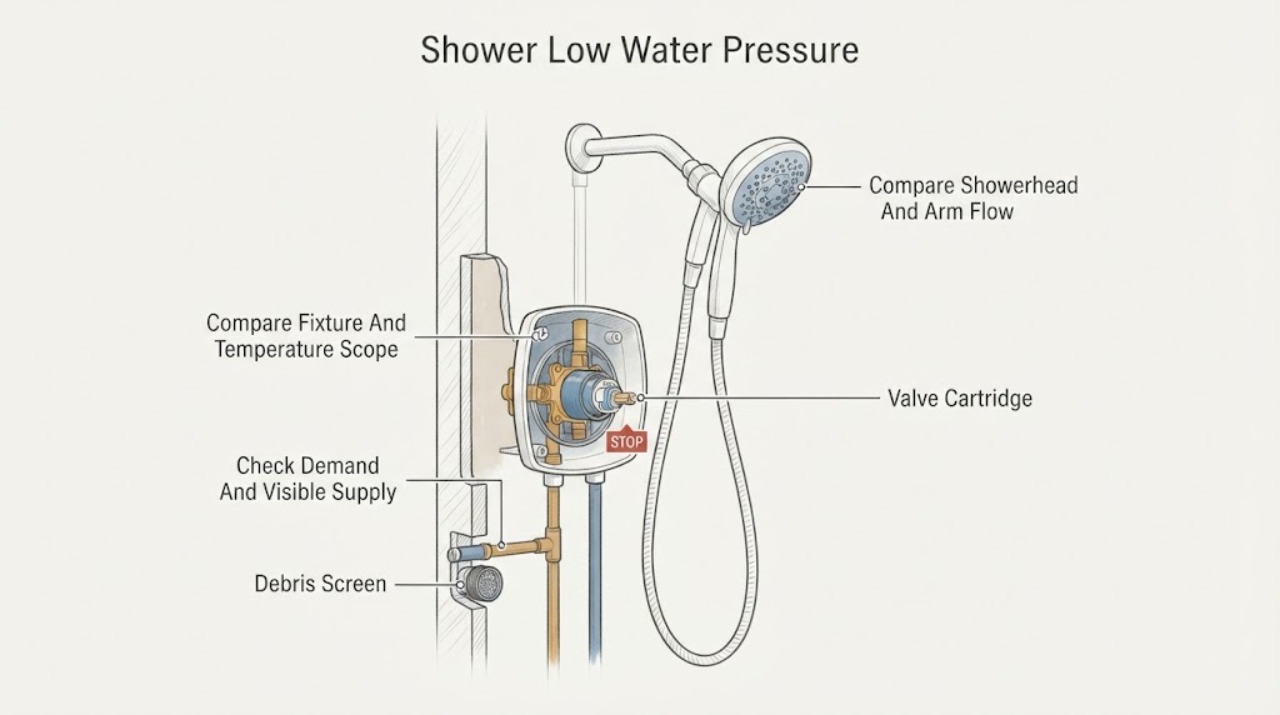
For a Delta shower with low water pressure, first determine whether the restriction affects only the shower, only hot or cold water, or the whole home. Compare the flow with the showerhead removed only if the connection can be handled safely: good flow from the shower arm points toward the head, screen, flow path, or hose, while low flow before the head points toward the valve, cartridge screens, supply, or building plumbing. Delta says mineral deposits and debris can clog the showerhead or its screen, and that flushing the shower line can clear loose material; do not remove a flow restrictor or open the valve as a pressure fix. Clean only accessible parts using the exact model guidance, then retest once. If pressure remains low with the head removed, both hot and cold are not supplied, a valve part needs disassembly, or there is a leak or water damage, stop and arrange qualified plumbing service.
Before you begin
Safety first
- This article covers fixture comparison, visible supply observations, one safe showerhead-removal flow comparison, accessible screen and hose cleaning, and brief line flushing only. Do not open concealed plumbing, disassemble internal valve parts, bypass pressure balancing, alter limit stops to chase flow, or handle a damaged or uncontrolled water connection.
Work through in order
Diagnostic checks
Use only checks that match the exact appliance or system and its official guide.
-
Check 1
Run the Delta shower briefly at its normal setting, then compare a nearby cold faucet and, if safely accessible, another hot-water fixture. Note whether the weak flow is limited to the shower, occurs at several fixtures, affects both hot and cold, or began after plumbing work or a water shutoff.
Expected result: Only the Delta shower is weak; several fixtures are weak; only hot or only cold is weak; or flow changed after the home's water was shut off.
Next step: If several fixtures are affected, check only that accessible shutoffs are fully open and ask whether the property has a known supply issue; arrange plumbing help if the whole-home problem persists. If only the shower is weak, continue with the outlet and head checks.
Stop if: Stop for active leaks, a failed shutoff, flooding, water entering a wall or ceiling, an unsafe floor, or water near electrical equipment.
Why this matters
Why: A one-shower symptom makes the showerhead, screen, hose, valve, or local supply more likely. A whole-home symptom points toward incoming supply, a main shutoff, pressure-control equipment, or building plumbing. A one-temperature symptom makes one inlet, supply, or valve side more likely. Debris released after water work is also plausible.
-
Check 2
Turn off other water-using fixtures for one brief comparison, and inspect only visible shower connections, the hand-shower hose if present, and accessible supply shutoffs for a kink, leak, or partly closed valve. Do not remove trim or reach behind the wall.
Expected result: Flow improves when another fixture stops, a hose is kinked or leaking, an accessible shutoff is partly closed, or no visible restriction is present.
Next step: Restore a visible shutoff only to its normal fully open position if it moves without force, straighten a loose hose without stressing its fittings, and retest once. Do not force a seized valve; use the matching diagnostic branch if the restriction remains.
Stop if: Do not tighten a wet connection under pressure, remove a wall plate, operate a seized shutoff, or continue if the hose or fitting sprays or directs water into the structure.
Why this matters
Why: Concurrent water use can make a shower feel weaker, while a kinked hose or partly closed supply can restrict a hand shower or valve inlet. No visible issue keeps a blocked head, cartridge screen, valve, or broader pressure problem in consideration.
-
Check 3
If the showerhead connection is accessible, turn the control Off, protect the finish, and unscrew the head without forcing it. Briefly run the shower with the open shower arm directed safely into the tub or drain, then turn it Off and compare the arm stream with the head-installed stream. Do not open the valve or remove internal cartridge parts.
Expected result: The shower arm has a strong stream but the installed head is weak; both the arm and head are weak; the arm sprays from the connection; or the fitting cannot be safely removed.
Next step: Reinstall the head with its existing components after the test and use the head-cleaning branch when arm flow is good. If arm flow is weak, preserve the result and arrange qualified diagnosis instead of disassembling the valve.
Stop if: Do not run water into an open wall, cross-thread the head, use tools that can damage the arm, or continue if the connection leaks or the fitting will not move safely.
Why this matters
Why: Strong arm flow isolates the restriction more toward the showerhead, its screen, flow path, or hand-shower hose. Weak arm flow makes the valve, cartridge screen, local supply, or building pressure more likely. A connection spray or seized fitting needs correction or service rather than force.
-
Check 4
When the shower arm stream is normal, inspect the Delta showerhead's spray openings, inlet, and accessible debris screen. Rinse or gently brush loose debris and use only a model-appropriate cleaning method; leave the flow restrictor in place. If the showerhead has a hand-shower hose, inspect it for a kink or internal leak.
Expected result: Mineral deposits or debris are visible, the screen is blocked, the spray openings are clear, the hose is kinked or leaking, or cleaning cannot be completed without an internal disassembly.
Next step: Reassemble the accessible head exactly as designed, verify the screen and gasket are seated, and perform one brief retest. Replace or service a damaged head or hose only after confirming the exact Delta model and fit; if flow does not recover, continue to service diagnosis.
Stop if: Do not remove the flow restrictor, puncture spray ports, scrape a finish with metal, use harsh chemicals, or run the shower with a missing screen, gasket, or loose connection.
Why this matters
Why: Visible scale, a blocked screen, or a kinked hose supports a local outlet restriction. A clear head with weak installed flow makes an internal head fault or a mismatch between expected and rated flow more likely. A cleaning method that requires removing a valve or unknown component is outside this safe check.
-
Check 5
With the showerhead removed and the area protected, flush the exposed shower path briefly into the tub or drain as Delta describes, then shut the control Off and reinstall the cleaned head. Keep the stream directed away from the room and do not leave the valve running unattended.
Expected result: Loose rust or grit exits during flushing, the stream stays clear but weak, flow improves after flushing, or water escapes at the arm or wall-side connection.
Next step: Rinse the screen again if debris was released, reinstall it, and retest once. If flow stays weak, the line leaks, or debris repeatedly returns, stop using the shower and arrange qualified plumbing evaluation.
Stop if: Do not flush through an unsecured fitting, open the wall, remove the cartridge, or keep operating a shower that sprays behind trim or causes water damage.
Why this matters
Why: Debris released during flushing supports a temporary line restriction and can re-clog a screen. Clear but persistently weak flow points back toward the valve, cartridge, supply, or building pressure. Water at a wall-side connection is a leak boundary, not a flushing success.
-
Check 6
If the shower arm remains weak after the accessible head and line checks, record the Delta collection or model markings, whether hot and cold are affected, the nearby-fixture comparison, and the result with the showerhead removed. Do not remove the handle, cartridge, pressure-balancing unit, or retaining hardware as a general test.
Expected result: Both temperatures are weak at the arm, only one side is weak, the control has unstable temperature or flow, a valve screen may be blocked, or the exact model cannot be identified.
Next step: Keep the shower out of use if the flow is very low, unstable, or accompanied by leakage, and arrange qualified plumbing service. Provide the model information, photos, timing, temperature-side result, and whether other fixtures are affected.
Stop if: Do not disassemble internal valve parts, bypass a pressure-balancing feature, alter a limit stop to chase flow, or order a cartridge from a photograph alone.
Why this matters
Why: Weak arm flow can involve a valve cartridge or screen, an inlet supply, a local shutoff, a pressure-balancing or thermostatic assembly, or building plumbing. Delta's maintenance document shows that cartridge-screen cleaning is a model-specific internal procedure requiring water isolation; the symptom alone does not identify a compatible part.
Use your observations
Decision map
Find the observation that best matches what you see, then follow the next safe action.
-
PATH 01Safety boundary
What you see
The shower and other fixtures lose flow together, or the shower improves when other water use stops.
Do this next
Check only accessible shutoffs for their normal position and repeat the comparison with other demand stopped. Arrange plumbing service for a persistent whole-home reduction or a shutoff that is seized, leaking, or not fully open.
Why this path and its safety boundary
Why it matters: A building supply, accessible shutoff, pressure-control issue, or concurrent demand is more likely than a Delta showerhead blockage.
Safety stop: Stop for flooding, a failed shutoff, water damage, or any need to alter pressure-control equipment.
-
PATH 02Next step
What you see
The shower arm has a normal stream, but the installed Delta head is weak and debris, scale, a blocked screen, or a kinked hand-shower hose is visible.
Do this next
Clean accessible components using the model-appropriate method, keep the flow restrictor and screen installed, reinstall the gasket correctly, and retest once. Replace or service the head or hose only after exact model fit is confirmed.
Why this path and its safety boundary
Why it matters: The outlet assembly is more likely restricted than the valve or home's incoming pressure.
-
PATH 03Next step
What you see
Loose grit or rust appears when the shower path is flushed, and flow improves temporarily or the screen becomes blocked again.
Do this next
Clean the accessible screen, reinstall the head, and monitor one normal use. If debris returns, flow falls again, or the source may be inside the valve, arrange plumbing diagnosis rather than repeatedly disassembling the outlet.
Why this path and its safety boundary
Why it matters: Debris in the shower arm or supply line is more likely, and recurring material can continue to restrict the head or valve.
-
PATH 04Next step
What you see
Flow remains weak with the showerhead removed, especially on both hot and cold, while the rest of the home's fixtures are normal.
Do this next
Stop at external observations and arrange qualified plumbing service. Give the technician the exact model, temperature-side result, head-removed flow result, and any recent water shutoff or plumbing work; do not remove internal cartridge parts as a generic test.
Why this path and its safety boundary
Why it matters: A Delta valve, cartridge screen, local inlet, pressure-balancing assembly, or shower-side supply restriction is more likely than the removable head.
-
PATH 05Safety boundary
What you see
A connection sprays or leaks behind trim, water enters the wall or floor, the control cannot shut off, or flow changes are accompanied by unsafe temperature behavior.
Do this next
Stop using the shower, isolate water only at a safe accessible shutoff, keep people away from wet electrical areas, and arrange prompt qualified plumbing service. Seek urgent help for active flooding or uncontrolled flow.
Why this path and its safety boundary
Why it matters: This is a plumbing and property-safety issue rather than a routine low-pressure cleaning problem. A restriction on one valve inlet can also affect balanced flow and temperature.
Safety stop: Do not remove trim, open the wall, bypass the valve's pressure-balancing function, or keep testing a leaking or unsafe shower.
Helpful context
Understand the symptom
First separate pressure from a restricted shower outlet
A shower that feels weak can have normal home pressure but a restricted showerhead, debris screen, hose, or flow path. Check another nearby fixture and note whether the shower is weak on both hot and cold or only one side. If the shower arm produces a strong stream with the head removed, concentrate on the head and its accessible screen; if the arm is also weak, the valve, cartridge, shutoff, supply, or building pressure remains in question. Delta also notes that rated flow varies by showerhead, so compare a measured result with the rating for the exact head rather than assuming every model should deliver the same flow.
Delta parts and cartridges are model-dependent
Delta shower assemblies do not all use the same cartridge or internal screens. Its 17T maintenance instructions describe a low-flow condition caused by clogged cartridge screens, but that procedure requires turning off both water supplies and removing valve components. Without the exact model and the manufacturer's instructions, do not treat cartridge removal as an ordinary cleaning step or order a cartridge from appearance alone. Use the model identification and Delta's parts resources when an internal valve diagnosis is needed.
Protect against leaks and sudden temperature changes
Remove the showerhead only when the fitting is accessible and the area can be kept dry. Keep the spray pointed away from people when restoring flow, and stop if a joint sprays into the wall, the hose is damaged, or the control cannot shut off. A pressure-balanced or thermostatic valve is intended to limit the effect of inlet pressure changes, but a restriction on one supply or a valve fault can affect both flow and temperature. Water behind trim, staining, or an unsafe floor is a plumbing-service boundary, not a reason to keep tightening exposed parts.
Safety boundary
Stop conditions
- Do not remove the Delta valve cartridge, pressure-balancing unit, retaining hardware, or wall trim as a generic low-pressure test without the exact model procedure and safe water isolation.
- Do not remove a flow restrictor, omit the debris screen or gasket, puncture spray ports, cross-thread the showerhead, or force a seized fitting.
- Stop using the shower for water behind trim or in the wall, staining or soft finishes, a spraying connection, uncontrolled flow, or a leak that returns after one safe external check.
- Use only an accessible water shutoff when it moves safely; stop for flooding, a failed shutoff, an unsafe floor, or water near electrical equipment.
- Do not order a Delta cartridge, screen, hose, showerhead, or valve part from appearance alone; confirm the exact model and diagnosed restriction first.
Only after diagnosis
Potential parts
- Delta showerhead debris screen or gasket
Consider this category only when the exact showerhead design has an accessible damaged or missing screen or gasket and the restriction is localized to the head connection.
Confirm the exact Delta showerhead model and screen or gasket design before ordering; do not substitute by appearance or remove the flow restrictor. - Delta hand-shower hose
Consider this category only when a hand-shower hose is kinked, cracked, leaking internally, or otherwise confirmed as the restriction.
Confirm the exact Delta hand-shower connection, length, seals, finish, and model requirements before ordering. - Delta shower valve cartridge or cartridge screen
Consider this category only after qualified diagnosis confirms that low flow at the shower arm traces to a cartridge, inlet screen, or valve assembly rather than the removable head or supply.
Confirm the exact Delta valve series, cartridge design, pressure-balancing or thermostatic feature, and manufacturer fit information before ordering or disassembling. - shower supply shutoff or pressure-control component
Consider this category only when a qualified plumber identifies a failed local shutoff or building pressure-control component as the cause of persistently weak shower flow.
Confirm the plumbing system, connection type, pressure requirements, and applicable code or manufacturer specifications; do not select a component from the shower symptom alone.
When checks do not resolve it
Need a professional?
Arrange qualified plumbing service when a Delta shower remains weak with the showerhead removed, when both temperatures are not supplied, when cartridge or valve screens may need internal cleaning, when a whole-home pressure problem persists, or when a head or hose still restricts flow after one model-appropriate external cleaning. Seek prompt help for a leak behind trim, water damage, an unsafe floor, a failed shutoff, uncontrolled flow, or water near electrical equipment.
Safety scope: This article covers fixture comparison, visible supply observations, one safe showerhead-removal flow comparison, accessible screen and hose cleaning, and brief line flushing only. Do not open concealed plumbing, disassemble internal valve parts, bypass pressure balancing, alter limit stops to chase flow, or handle a damaged or uncontrolled water connection.
Common questions
FAQ
Why is my Delta shower pressure low but the other faucets are normal?
A restriction local to the shower is more likely, such as mineral buildup or debris in the showerhead, screen, hose, shower arm, or valve. Compare the flow from the shower arm with the head removed only when the fitting is safe to handle; strong arm flow points toward the head or hose, while weak arm flow needs valve or supply diagnosis.
Can a clogged Delta showerhead screen cause low flow?
Yes. Delta says debris and mineral deposits can clog the showerhead or its debris screen and reduce flow. Clean only the accessible screen and head using the model-appropriate method, keep the screen and gasket installed, and do not remove the flow restrictor.
Should I remove the Delta flow restrictor to get more pressure?
No. Delta warns that removing the flow restrictor can void the showerhead warranty. A low-flow symptom should be investigated by cleaning the head and screen, flushing the shower path, and comparing arm flow; if the restriction remains, arrange diagnosis rather than bypassing the designed flow control.
What if the Delta shower is weak with the showerhead removed?
Weak flow at the shower arm makes a valve cartridge or screen, one inlet, a local supply, a shutoff, or building plumbing more likely than the removable head. Record whether hot and cold are both affected and whether other fixtures are normal, then have a qualified plumber evaluate it instead of removing internal cartridge parts as a generic test.
Can another fixture running make a Delta shower feel weak?
Yes. Delta recommends limiting other water use while someone is showering because concurrent demand can reduce the available flow. Repeat the comparison with other fixtures off; if several fixtures remain weak, the cause is more likely in the home's supply or pressure-control system.
When should I call a plumber for a Delta shower with low water pressure?
Call when low flow remains at the shower arm after the accessible head and line checks, when cartridge or valve screens may need internal service, when the whole home is affected, or when a head or hose still restricts flow after one model-appropriate cleaning. Stop using the shower and seek prompt help for a concealed leak, water damage, uncontrolled flow, a failed shutoff, an unsafe floor, or water near electrical equipment.
Read the exact guide
Official sources
- How to Fix Low Pressure in Your ShowerDelta Faucet · Delta consumer guidance for shower low-flow troubleshooting; exact model instructions and local plumbing conditions control.
- MultiChoiceDelta Faucet · Delta 17T Series instruction sheet only; it demonstrates why an exact valve model matters and is not a universal cartridge procedure.
- Find Parts and Identify Your ProductDelta Faucet · Delta official parts-identification resource; exact model and product selection are required before compatibility decisions.
- Why does my faucet have low water pressure?Delta Faucet · Delta support guidance for low pressure or low flow at faucets and tub/shower fixtures; model-specific parts and safe access still apply.
Community feedback
Share a repair observation
Share a plain-text repair observation. Accepted observations are published automatically; this page may take a moment to update.