
On this page
Start here
Quick answer
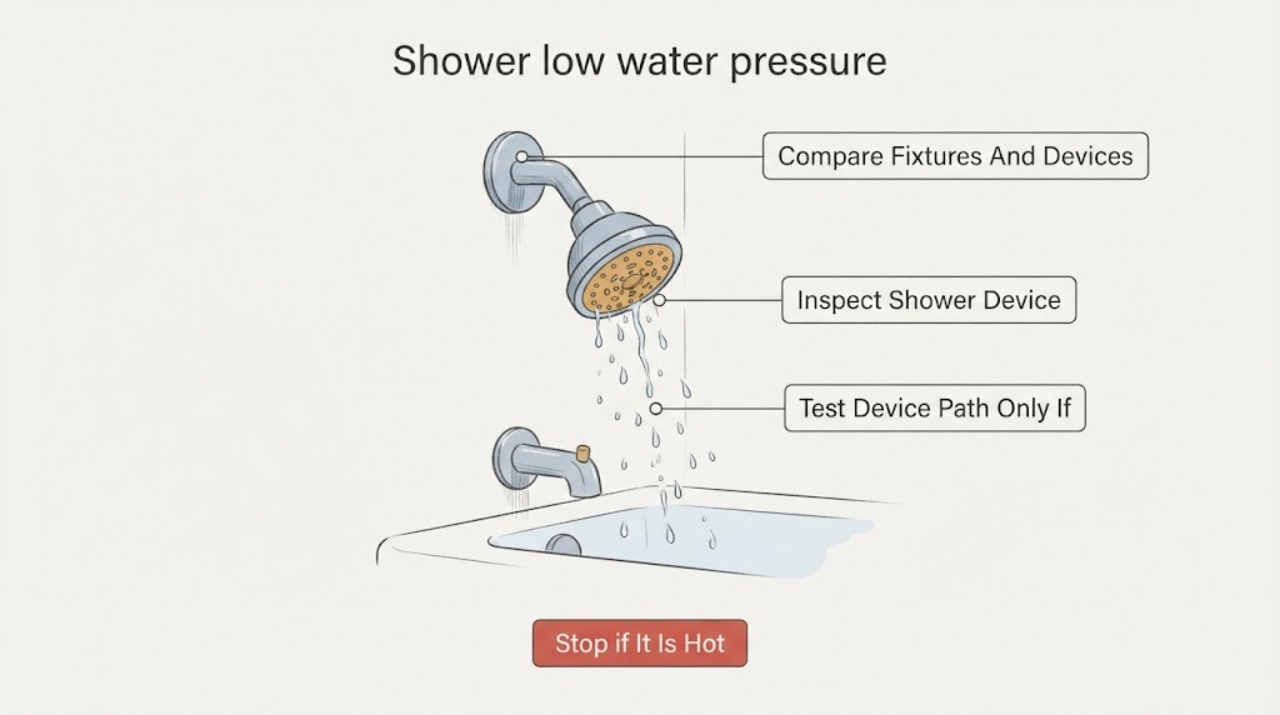
Low pressure at a Moen shower can come from a blocked showerhead or hand shower, a clogged screen, a transfer or diverter valve, a mixing-valve cartridge, a partly closed service stop, or a home water-supply problem. First compare the shower with another fixture and determine whether only one shower device is weak, only hot or cold flow is weak, or every shower device is affected. Inspect the accessible showerhead, handheld, hose, and inlet screen as the model instructions allow; clean visible debris without drilling, removing an integral flow-control part, or forcing a connection. Moen's troubleshooting guidance treats one weak device differently from a pressure reduction across all devices and recommends checking the device separately from the valve. If flow remains low with the shower device removed, temperature is unstable, the valve is behind the trim, or the whole home has low pressure, stop disassembly and arrange qualified plumbing service.
Before you begin
Safety first
- A homeowner may compare fixtures, inspect and clean an accessible shower device according to the model instructions, and preserve the original seals and flow-control arrangement. A qualified plumber should handle cartridges, valves, pressure-balance parts, service stops, regulators, concealed pipes, and any hot-water or inaccessible connection.
Work through in order
Diagnostic checks
Use only checks that match the exact appliance or system and its official guide.
-
Check 1
From a safe position, compare the Moen shower with a nearby sink or tub outlet and, if the system has both, compare the fixed showerhead with the handheld or another shower device; note hot and cold separately.
Expected result: Record whether low flow affects one device, all shower devices, all nearby fixtures, only hot water, only cold water, or flow whenever another fixture runs.
Next step: Keep the comparison record and inspect only the affected exposed device next. Arrange plumbing service for unstable temperature, whole-home low flow, or pressure that changes sharply with other fixtures.
Stop if: Stop for scalding or cold-shock risk, a leak behind trim, a burst spray, water damage, or any need to open the wall or valve body.
Why this matters
Why: One weak device supports a device-specific blockage. Low flow across all shower devices or a temperature-specific reduction makes a mixing or transfer valve, service stop, supply, or pressure problem more likely. A whole-home change is not a showerhead clog.
-
Check 2
Turn the water off and inspect the accessible Moen showerhead or hand-shower spray face, inlet, hose, and visible screen for scale, debris, kinks, damaged threads, or a displaced washer; do not remove trim or force a fitting.
Expected result: Classify the device as visibly scaled or blocked, kinked or damaged, clean but weak, or impossible to inspect without model-specific disassembly.
Next step: Follow the exact Moen care or owner instructions for rinsing or cleaning the accessible device, then compare flow once. If the device is damaged or remains weak, document the model and arrange service or a compatible replacement assessment.
Stop if: Do not drill spray holes, scrape with a sharp tool, remove an integral flow restrictor, apply unapproved chemicals, or use force on finished threads.
Why this matters
Why: A restriction isolated to one device can result from line debris, scale, a screen, hose, or nozzle. A clean device with weak flow suggests the valve or supply path, not permission to alter a flow-control insert.
-
Check 3
Only if the exact Moen instructions allow removing the showerhead or handheld without disturbing the valve, shut the water off, preserve the washer and flow-control arrangement, and compare the exposed outlet flow briefly with the device removed; otherwise skip this check.
Expected result: Record whether flow is normal from the exposed outlet, still low, or accompanied by debris, leaking threads, temperature change, or a damaged seal.
Next step: Restore the exact washer and device arrangement only if the instructions permit it. If flow is still low, the seal leaks, or the valve path is implicated, stop and arrange qualified plumbing service.
Stop if: Do not operate an open outlet unattended, leave out a washer or flow-control component, remove a valve cartridge, or continue if water sprays toward the wall or electrical equipment.
Why this matters
Why: Normal flow with the device removed supports a blocked showerhead, handheld, hose, or screen. Low flow with the device removed shifts the problem toward the mixing or transfer valve, service stop, supply, or pressure, while a leak or temperature change makes further testing unsafe.
-
Check 4
From dry, ordinary access, check whether a visible household shutoff is open, the exposed shower hose is kinked, and the low-flow symptom began after installation, plumbing work, or a change to another shower device; do not remove the trim plate.
Expected result: Note a partly closed accessible stop, kinked hose, fresh debris after plumbing work, a new showerhead with a different intended flow, or no visible supply explanation.
Next step: Correct only an obvious, safe external position or kink, preserving the device's intended design, then compare once. Arrange service for a valve stop, pressure regulator, concealed line, or installation issue.
Stop if: Do not open a valve body, change a pressure regulator, flush an unknown line into the wall, or remove a concealed connection.
Why this matters
Why: A partly closed stop, kink, or construction debris can reduce flow. A new device may have a different rated design, while no visible explanation keeps the valve, pressure, and concealed supply paths in consideration.
-
Check 5
Document the Moen model if known, which devices and temperatures are affected, the comparison result with the device removed if permitted, visible scale or debris, recent work, and any leak or temperature instability; do not keep disassembling to find a valve fault.
Expected result: Record whether cleaning restored flow, whether low flow persists at the exposed outlet, whether pressure varies with other fixtures, and whether the handle, trim, or wall becomes wet.
Next step: Keep the shower unused when a red flag is present and arrange qualified plumbing service. Give the plumber the model, measurements or comparisons, photographs, and exactly what was changed.
Stop if: Do not conceal a leak with caulk, remove the cartridge or trim, alter a pressure limiter, or continue using the shower when temperature control is unreliable.
Why this matters
Why: A lasting improvement after a permitted device cleaning supports a device restriction. Persistent low flow, an unstable temperature, moisture behind trim, or a whole-system reduction needs a plumber to assess the valve, supply, pressure, or concealed pipe.
Use your observations
Decision map
Find the observation that best matches what you see, then follow the next safe action.
-
PATH 01Safety boundary
What you see
Only the Moen showerhead or handheld is weak, and flow is normal at another device or with the device removed under the permitted procedure.
Do this next
Clean or rinse only as the exact instructions allow, restore the original arrangement, and reassess once. Replace or service the device only after confirming compatibility.
Why this path and its safety boundary
Why it matters: Debris, scale, an inlet screen, hose, nozzle, washer, or device-specific flow path is more likely than a whole-valve problem.
Safety stop: Do not drill, remove flow-control parts, force threads, or continue if the connection leaks.
-
PATH 02Safety boundary
What you see
Flow remains low from the exposed shower outlet with the shower device removed only by a permitted procedure.
Do this next
Restore the device safely if possible and arrange qualified plumbing diagnosis; provide the device comparison and hot or cold observations.
Why this path and its safety boundary
Why it matters: The mixing valve, transfer valve, check stop, supply line, pressure condition, or concealed restriction is more likely than the showerhead.
Safety stop: Do not remove a cartridge, valve screen, trim, or wall material as a general next step.
-
PATH 03Safety boundary
What you see
Only hot or only cold flow is weak, or temperature is unstable while the other temperature behaves normally.
Do this next
Stop using the shower if temperature control is unreliable and arrange qualified plumbing service for the valve and supply path.
Why this path and its safety boundary
Why it matters: A mixing valve, cartridge, balancing element, supply stop, or temperature-control problem is more likely and carries a scald or cold-shock concern.
Safety stop: Do not adjust a temperature limit stop or remove a pressure-balance cartridge without model-specific professional diagnosis.
-
PATH 04Safety boundary
What you see
The fixed head and handheld or other shower devices are all weak, while the devices themselves are not visibly blocked.
Do this next
Compare another fixture, preserve the device settings, and arrange a plumber to assess the valve and supply without opening the wall.
Why this path and its safety boundary
Why it matters: An overall mixing-valve, transfer-valve, service-stop, household pressure, regulator, or supply restriction is more likely than one clogged head.
Safety stop: Do not remove valve trim, open a pressure regulator, or alter the home's water pressure based on spray feel alone.
-
PATH 05Safety boundary
What you see
Low flow began after installation or plumbing work, or a new device has a kink, displaced washer, or visible debris at its inlet.
Do this next
Correct only a plainly visible external issue according to the instructions, then retest once. Escalate when the issue persists or the fitting leaks.
Why this path and its safety boundary
Why it matters: A partly closed stop, kink, washer or seal issue, construction debris, or device-flow change is plausible, but the valve and supply should not be disturbed casually.
Safety stop: Do not flush debris through an open valve, remove concealed screens, or force a new device onto mismatched threads.
-
PATH 06Safety boundary
What you see
Nearby faucets and fixtures also have low flow, pressure changes when another fixture runs, or the shower problem is accompanied by unexplained leaks.
Do this next
Limit shower use, check only visible fixtures for leaks, and arrange qualified plumbing assessment of the home's supply and pressure.
Why this path and its safety boundary
Why it matters: The cause is more likely upstream in the home supply, pressure regulator, leak, or building plumbing than in the Moen showerhead.
Safety stop: Do not adjust the pressure-regulating valve or open concealed plumbing without a plumber.
Helpful context
Understand the symptom
First decide whether the restriction is at the device or valve
Run the affected shower briefly and compare the flow with another nearby fixture without changing trim or opening the wall. If only one showerhead or handheld is weak, a blocked screen, nozzle, hose, or device is a focused check. If every shower device is weak, or only hot or cold flow is reduced, Moen's guidance points toward a mixing or transfer valve path, a service stop, or the home's supply rather than one showerhead. A pressure change in other fixtures also matters.
Check the shower device without defeating its design
With water off, inspect the visible spray face, hand-shower inlet, hose ends, and any screen that the exact Moen instructions identify as user-serviceable. Scale or line debris can reduce flow. EPA's showerhead criteria recognize spray force, coverage, and pressure compensation as performance features; do not drill holes, discard an integral flow-control part, or assume that a higher-flow modification is a repair. Use only a cleaning method allowed by the product instructions.
A valve or whole-home pressure issue needs a plumber
If flow remains low with the shower device removed, or if the pressure is low through all shower devices, the restriction may be at the mixing valve, transfer valve, check stop, supply line, pressure regulator, or another concealed point. If hot and cold behavior is unstable, protect against scalding and stop using the shower until it is assessed. EPA recommends professional attention when service pressure is outside the home's normal range; do not open the valve trim or change a regulator based only on a weak spray.
Safety boundary
Stop conditions
- Stop using the shower for unstable temperature, scald or cold-shock risk, water behind trim or in the wall, a burst spray, or an active leak.
- Do not drill the showerhead, remove an integral flow-control part, force finished threads, or use unapproved chemicals to chase low pressure.
- Do not remove a mixer or transfer cartridge, pressure-balance component, service stop, regulator, wall cover, or concealed screen as a general check.
- Do not operate an open shower outlet unattended or leave out a washer, seal, or flow-control component after an inspection.
- Arrange qualified plumbing service when flow remains low with the shower device removed, all devices are affected, the whole home has low pressure, or the safe device checks do not restore performance.
When checks do not resolve it
Need a professional?
Arrange qualified plumbing service when low flow persists after model-approved shower-device cleaning, when flow is low with the device removed, when all shower devices or multiple fixtures are affected, when hot or cold flow is unequal or temperature is unstable, when a valve or service stop is implicated, or when there is a leak or concealed moisture.
Safety scope: A homeowner may compare fixtures, inspect and clean an accessible shower device according to the model instructions, and preserve the original seals and flow-control arrangement. A qualified plumber should handle cartridges, valves, pressure-balance parts, service stops, regulators, concealed pipes, and any hot-water or inaccessible connection.
Common questions
FAQ
Why is only my Moen handheld shower low pressure?
If the fixed showerhead or another fixture is normal, Moen treats a one-device reduction as a focused device or transfer-valve path. Check the handheld inlet, hose, and visible screen under the exact instructions; do not remove a flow-control part.
What if the flow is still low with the Moen showerhead removed?
Low flow at the exposed outlet shifts attention to the mixing valve, transfer valve, service stop, supply, or pressure rather than the showerhead. Restore the device safely and arrange qualified plumbing diagnosis.
Should I remove the flow restrictor from a Moen showerhead?
No. A flow-control component may be part of the showerhead's intended performance and compatibility. Clean visible blockage according to the instructions and have a plumber assess persistent low flow instead of drilling or removing the part.
Why is only hot or only cold water low at the shower?
Moen identifies temperature-specific low flow as a mixing-valve path. Because unstable temperature can create a scald or cold-shock risk, stop using the shower and arrange qualified service rather than removing the cartridge or adjusting a limit stop.
When should a plumber check my Moen shower pressure?
Call when every shower device is weak, nearby fixtures are also affected, flow remains low with the device removed, temperature is unstable, a valve or regulator is implicated, or safe cleaning and connection checks do not help. Provide the model and your fixture comparisons.
Read the exact guide
Official sources
- Home MaintenanceU.S. Environmental Protection Agency WaterSense · Household service-pressure context, showerhead connection and scale inspection, and plumber boundary
- Shower Faucet: Low Flow- Independent Transfer ValvesMoen Solutions · Moen shower low-flow diagnosis across shower devices, transfer valve, mixing valve, device debris, and temperature-specific flow
- ShowerheadsU.S. Environmental Protection Agency WaterSense · Showerhead spray force, coverage, pressure compensation, and performance design
Community feedback
Share a repair observation
Share a plain-text repair observation. Accepted observations are published automatically; this page may take a moment to update.