
On this page
Start here
Quick answer
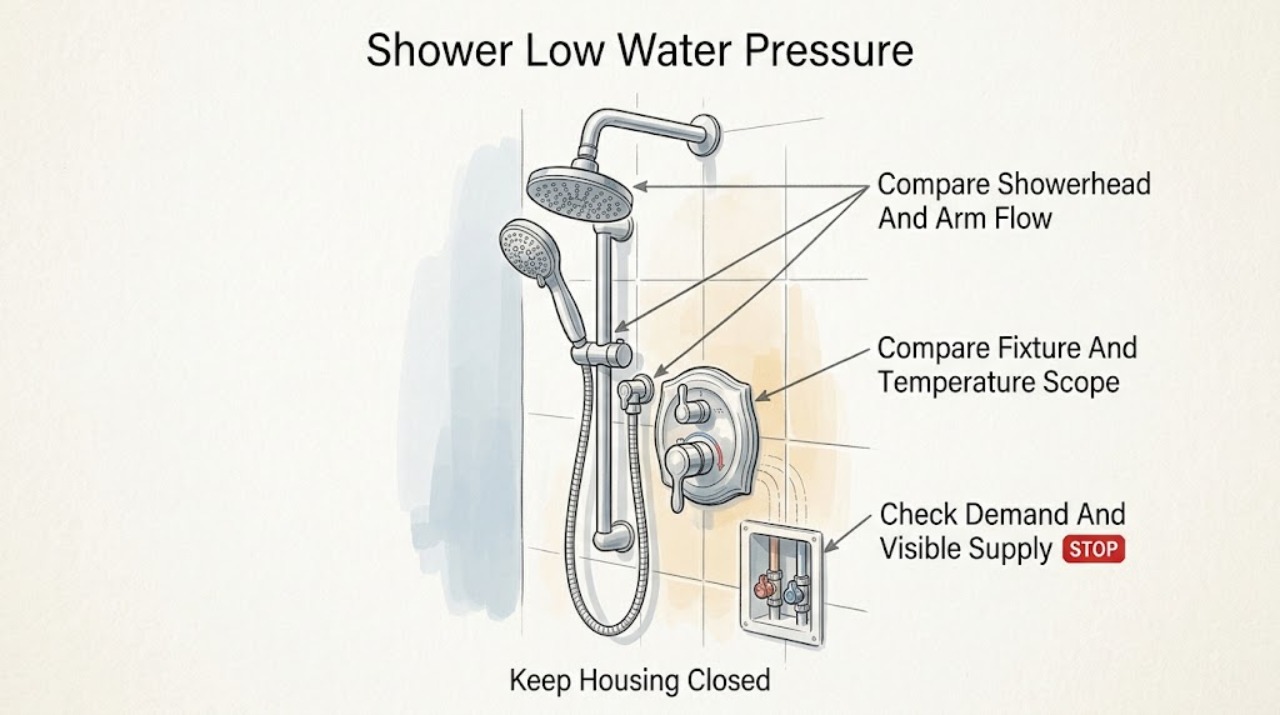
For a Kohler shower with low water pressure, first determine whether the weak flow affects only the shower, one temperature, or the whole home. Compare the showerhead stream with the shower arm only when the head can be removed safely: a normal arm stream points toward the head, screen, aerator, or hose, while weak flow at the arm points toward the valve, cartridge screens, supply stops, or building plumbing. Kohler's showerhead guidance identifies mineral buildup and debris as causes of reduced flow and provides model-specific cleaning steps; it also says not to remove the flow control. Clean accessible spray holes and screens using the exact Kohler guide for the installed model, then retest once. If the arm remains weak, both hot and cold are not supplied, an internal cartridge or pressure-balancing unit needs service, or a leak or water damage is present, stop and arrange qualified plumbing help.
Before you begin
Safety first
- This article covers fixture comparison, visible supply observations, one safe showerhead-removal flow comparison, accessible screen and hose cleaning, and a brief model-directed flush only. Do not open concealed plumbing, disassemble internal valve parts, bypass pressure balancing, alter limit stops to chase flow, or handle a damaged or uncontrolled water connection.
Work through in order
Diagnostic checks
Use only checks that match the exact appliance or system and its official guide.
-
Check 1
Run the Kohler shower briefly at its normal setting, then compare a nearby cold faucet and, if safely accessible, another hot-water fixture. Note whether only the shower is weak, several fixtures are weak, both shower temperatures are affected, or the change began after plumbing work or a water shutoff.
Expected result: Only the Kohler shower has low flow; multiple fixtures are affected; only hot or only cold is weak; or flow changed after the home's water was shut off.
Next step: If several fixtures are affected, check only that accessible shutoffs are in their normal fully open position and arrange plumbing help if the reduction persists. If only the shower is weak, continue with the outlet and showerhead checks.
Stop if: Stop for active leaks, flooding, a failed shutoff, water entering a wall or ceiling, an unsafe floor, or water near electrical equipment.
Why this matters
Why: A one-shower symptom makes the head, screen, hose, valve, or local supply more likely. A whole-home symptom points toward the incoming supply, main shutoff, pressure-control equipment, or building plumbing. A one-temperature symptom makes one inlet, stop, or valve side more likely. Debris released after water work is also plausible.
-
Check 2
Turn off other water-using fixtures for one brief comparison. Inspect only visible shower connections, the hand-shower hose if present, and any accessible supply stops for a kink, leak, or partly closed position. Do not remove trim or reach behind the wall.
Expected result: Flow improves when other water use stops, a hose is kinked or leaking, a visible stop is partly closed, or no visible restriction is present.
Next step: Restore a visible stop only to its normal open position if it turns without force, straighten a loose hose without stressing its fittings, and retest once. Do not force a seized stop; use the corresponding diagnostic branch if flow remains low.
Stop if: Do not tighten a wet connection under pressure, operate a seized stop, remove a wall plate, or continue if the hose or fitting sprays or directs water into the structure.
Why this matters
Why: Concurrent demand can make a shower feel weaker, while a kinked hose or partly closed stop can restrict an outlet or valve inlet. No visible issue keeps a blocked head, cartridge screen, valve fault, or broader pressure problem in consideration.
-
Check 3
If the Kohler showerhead connection is accessible, turn the control Off, protect the finish, and unscrew the head without force. Briefly run the shower with the open arm directed safely into the tub or drain, then turn it Off and compare the arm stream with the head-installed stream. Do not remove the valve cartridge or internal valve parts.
Expected result: The shower arm has a normal stream but the installed head is weak; both the arm and head are weak; the arm sprays at the connection; or the head cannot be removed safely.
Next step: Reinstall the head with its existing components after the comparison and use the head-cleaning branch when arm flow is normal. If arm flow is weak, preserve that result and arrange qualified diagnosis instead of disassembling the valve.
Stop if: Do not run water into an open wall, cross-thread the head, damage the arm with excessive force, or continue if the connection leaks or the fitting will not move safely.
Why this matters
Why: Normal arm flow isolates the restriction more toward the showerhead, aerator, screen washer, or hand-shower hose. Weak arm flow makes the valve, cartridge screen, supply stop, or building pressure more likely. A connection spray or seized fitting needs service rather than force.
-
Check 4
When the shower arm stream is normal, inspect the Kohler showerhead's spray holes, aerator, gasket, and accessible screen washer. Follow the exact Kohler homeowner guide for the installed design: gently clear mineral buildup, clean the aerator or screen washer as directed, and keep the flow control in place. Inspect a hand-shower hose for kinks or leaks if one is fitted.
Expected result: Mineral deposits or debris are visible, the screen washer or aerator is blocked, the spray holes are clear, the hose is damaged, or cleaning would require an unverified internal disassembly.
Next step: Reassemble the screen, aerator, gasket, and head exactly as designed and perform one brief retest. Consider a replacement head or hose only after the exact Kohler model and fit are confirmed; if flow does not recover, continue to service diagnosis.
Stop if: Do not remove the flow control, puncture spray ports, scrape the finish with metal, use unapproved cleaners, or run the shower with a missing screen, gasket, or loose connection.
Why this matters
Why: Visible scale, a blocked screen, or a damaged hose supports a local outlet restriction. A clear outlet with weak installed flow makes an internal head fault or a rated-flow expectation more likely. A procedure that requires opening the valve is not an accessible showerhead cleaning step.
-
Check 5
After the head and accessible screen are clean and the head is securely reinstalled, perform one brief normal-use retest. If the Kohler guide for the exact product calls for line flushing, direct the open flow into the tub or drain only while the head is safely removed; do not leave the valve unattended or open a wall.
Expected result: Flow improves after cleaning or flushing, loose grit returns, flow stays clear but weak, or water escapes from the arm or wall-side connection.
Next step: Clean the screen again if debris was released, reinstall all components, and monitor one normal use. If flow falls again, debris repeatedly returns, or the connection leaks, stop using the shower and arrange plumbing diagnosis.
Stop if: Do not flush through an unsecured fitting, repeatedly remove the head, open the wall, or keep operating a shower that sprays behind trim or causes water damage.
Why this matters
Why: Improvement after cleaning supports a head or line restriction, although recurring grit can continue to clog the screen. Clear but persistently weak flow points toward the valve, cartridge, supply, or building pressure. Water at a wall-side connection is a leak boundary, not a successful flush.
-
Check 6
If the shower arm remains weak after accessible head checks, record the Kohler collection or model markings, whether hot and cold are affected, the nearby-fixture comparison, and the head-removed result. Do not remove the handle, cartridge, pressure-balancing unit, or service-stop components as a general test.
Expected result: Both temperatures are weak at the arm, only one side is weak, the control has unstable temperature or flow, a valve screen may be blocked, or the exact model cannot be identified.
Next step: Keep the shower out of use if flow is very low, unstable, or accompanied by leakage, and arrange qualified plumbing service. Provide the model information, photos, timing, temperature-side result, and whether other fixtures are affected.
Stop if: Do not disassemble internal valve parts, bypass pressure balancing, alter a temperature limit stop to chase flow, or order a cartridge from a photograph alone.
Why this matters
Why: Weak arm flow can involve a Kohler valve cartridge or filter screen, a pressure-balancing unit, an inlet supply, a service stop, or building plumbing. Kohler's valve instructions show that internal screen cleaning requires water isolation and model-specific disassembly; the symptom alone does not identify a compatible part.
Use your observations
Decision map
Find the observation that best matches what you see, then follow the next safe action.
-
PATH 01Safety boundary
What you see
The Kohler shower and other fixtures lose flow together, or the shower improves when other water use stops.
Do this next
Check only accessible stops for their normal position and repeat the comparison with other demand stopped. Arrange plumbing service for a persistent whole-home reduction or a stop that is seized, leaking, or not fully open.
Why this path and its safety boundary
Why it matters: A building supply, accessible shutoff, pressure-control issue, or concurrent demand is more likely than a Kohler showerhead blockage.
Safety stop: Stop for flooding, a failed shutoff, water damage, or any need to alter pressure-control equipment.
-
PATH 02Next step
What you see
The shower arm has a normal stream, but the installed Kohler head is weak and debris, scale, a blocked screen, or a kinked hand-shower hose is visible.
Do this next
Clean accessible components using the exact Kohler guide, keep the flow control and screen washer installed, reinstall the gasket correctly, and retest once. Replace or service the head or hose only after exact model fit is confirmed.
Why this path and its safety boundary
Why it matters: The outlet assembly is more likely restricted than the valve or home's incoming pressure.
-
PATH 03Next step
What you see
Mineral deposits or loose grit are visible in the spray holes, aerator, screen washer, or shower path, and flow improves after the accessible cleaning step.
Do this next
Keep the accessible components clean and monitor one normal use. If debris returns, flow falls again, or the source may be inside the valve, arrange plumbing diagnosis rather than repeatedly removing internal parts.
Why this path and its safety boundary
Why it matters: A local debris or scale restriction is more likely, but recurring material can indicate sediment in the line or valve and can re-clog the outlet.
-
PATH 04Next step
What you see
Flow remains weak with the showerhead removed, especially on both hot and cold, while the rest of the home's fixtures are normal.
Do this next
Stop at external observations and arrange qualified plumbing service. Give the technician the exact model, temperature-side result, head-removed flow result, and any recent water shutoff or plumbing work; do not remove internal cartridge parts as a generic test.
Why this path and its safety boundary
Why it matters: A Kohler valve, cartridge screen, pressure-balancing unit, service stop, or shower-side supply restriction is more likely than the removable head.
-
PATH 05Safety boundary
What you see
A connection sprays or leaks behind trim, water enters the wall or floor, the control cannot shut off, or low flow is accompanied by unsafe temperature behavior.
Do this next
Stop using the shower, isolate water only at a safe accessible shutoff, keep people away from wet electrical areas, and arrange prompt qualified plumbing service. Seek urgent help for active flooding or uncontrolled flow.
Why this path and its safety boundary
Why it matters: This is a plumbing and property-safety issue rather than a routine low-pressure cleaning problem. A one-sided supply restriction or pressure-balancing fault can also affect flow and temperature.
Safety stop: Do not remove trim, open the wall, bypass the valve's pressure-balancing function, or keep testing a leaking or unsafe shower.
Helpful context
Understand the symptom
Use the shower arm to separate outlet restriction from valve or supply trouble
Low pressure is often a description of low flow at the spray face. A Kohler showerhead can accumulate mineral deposits or debris even when other fixtures are normal. Compare a nearby fixture and, when safe, compare the stream from the shower arm with the showerhead installed and removed. A strong arm stream isolates the restriction toward the removable head, screen, aerator, or hose. A weak arm stream means the valve, cartridge, supply stops, or building pressure still need consideration. Because Kohler products have different showerhead and valve designs, the exact product guide controls which cleaning steps apply.
Kohler's screens and flow controls are not interchangeable assumptions
Kohler's homeowner guide describes a screen washer, aerator, gasket, and flow control on certain showerhead and handshower designs. It specifically says not to attempt to remove the flow control. A separate Kohler valve guide lists blocked filter screens, partially closed supply stops, a flow-control cartridge, and a thermostatic cartridge as model-specific possibilities. Do not transfer one guide's cartridge or screen procedure to an unidentified shower or order a part based only on appearance.
Keep temperature, leaks, and concealed plumbing inside the safety boundary
A pressure-balancing shower valve depends on both hot and cold supplies. A one-sided supply problem can reduce or stop outlet flow and can also affect temperature behavior. Kohler's valve cleaning instructions require water isolation before internal work and warn about securing seals to prevent leakage inside the wall. For an unidentified valve, limit your work to visible observations and model-directed head cleaning. Water behind trim, staining, a spraying connection, or uncontrolled flow requires service rather than repeated adjustment.
Safety boundary
Stop conditions
- Do not remove the Kohler valve cartridge, pressure-balancing unit, service stops, retaining hardware, or wall trim as a generic low-pressure test without the exact model procedure and safe water isolation.
- Do not remove a flow control, omit the screen washer or gasket, puncture spray ports, cross-thread the showerhead, or force a seized fitting.
- Stop using the shower for water behind trim or in the wall, staining or soft finishes, a spraying connection, uncontrolled flow, or a leak that returns after one safe external check.
- Use only an accessible water shutoff when it moves safely; stop for flooding, a failed shutoff, an unsafe floor, or water near electrical equipment.
- Do not order a Kohler cartridge, screen, hose, showerhead, or valve part from appearance alone; confirm the exact model and diagnosed restriction first.
Only after diagnosis
Potential parts
- Kohler showerhead screen washer or gasket
Consider this category only when the exact showerhead design has an accessible damaged or missing screen washer or gasket and the restriction is localized to the head connection.
Confirm the exact Kohler showerhead model and screen or gasket design before ordering; do not substitute by appearance or remove the flow control. - Kohler hand-shower hose
Consider this category only when a hand-shower hose is kinked, cracked, leaking internally, or otherwise confirmed as the restriction.
Confirm the exact Kohler handshower connection, length, seals, finish, and model requirements before ordering. - Kohler shower valve cartridge or filter screen
Consider this category only after qualified diagnosis confirms that low flow at the shower arm traces to a cartridge, filter screen, or valve assembly rather than the removable head or supply.
Confirm the exact Kohler valve series, cartridge design, pressure-balancing or thermostatic feature, and manufacturer fit information before ordering or disassembling. - Kohler pressure-balancing unit or flow-control cartridge
Consider this category only when a qualified plumber identifies a failed or blocked pressure-balancing unit or flow-control cartridge as the cause of low arm flow or unstable operation.
Confirm the exact Kohler valve body, product series, cartridge position, seals, and installation instructions; do not bypass or substitute the assembly from appearance alone.
When checks do not resolve it
Need a professional?
Arrange qualified plumbing service when a Kohler shower remains weak with the showerhead removed, when both temperatures are not supplied, when cartridge or valve screens may need internal service, when a whole-home pressure problem persists, or when a head or hose still restricts flow after one model-appropriate external cleaning. Seek prompt help for a leak behind trim, water damage, an unsafe floor, a failed shutoff, uncontrolled flow, or water near electrical equipment.
Safety scope: This article covers fixture comparison, visible supply observations, one safe showerhead-removal flow comparison, accessible screen and hose cleaning, and a brief model-directed flush only. Do not open concealed plumbing, disassemble internal valve parts, bypass pressure balancing, alter limit stops to chase flow, or handle a damaged or uncontrolled water connection.
Common questions
FAQ
Why is my Kohler shower pressure low but the other faucets are normal?
A restriction local to the shower is more likely, such as mineral buildup or debris in the showerhead, screen washer, aerator, hose, shower arm, or valve. Compare the flow from the shower arm with the head removed only when the fitting is safe to handle; normal arm flow points toward the head or hose, while weak arm flow needs valve or supply diagnosis.
Can a clogged Kohler showerhead screen cause low flow?
Yes. Kohler's homeowner guidance identifies mineral buildup and debris as causes of reduced showerhead performance and describes cleaning the screen washer and aerator for the documented designs. Keep the screen, gasket, and flow control installed, and use the exact guide for the installed model.
Should I remove the Kohler flow control to get more pressure?
No. Kohler's homeowner guide says not to attempt to remove the flow control. Investigate the symptom by cleaning accessible spray holes and screens, comparing arm flow, and checking visible supply conditions; if the restriction remains, arrange diagnosis rather than bypassing the designed flow control.
What if the Kohler shower is weak with the showerhead removed?
Weak flow at the shower arm makes a valve cartridge or filter screen, pressure-balancing unit, service stop, one inlet, or building plumbing more likely than the removable head. Record whether hot and cold are both affected and whether other fixtures are normal, then have a qualified plumber evaluate it instead of removing internal valve parts as a generic test.
Can another fixture running make a Kohler shower feel weak?
Yes. Concurrent demand can reduce the flow available at a shower, especially when the home's supply is limited. Repeat the comparison with other fixtures off; if several fixtures remain weak, the cause is more likely in the home's supply or pressure-control system than in the Kohler head.
When should I call a plumber for a Kohler shower with low water pressure?
Call when low flow remains at the shower arm after the accessible head checks, when valve or cartridge screens may need internal service, when the whole home is affected, or when a head or hose still restricts flow after one model-appropriate cleaning. Stop using the shower and seek prompt help for a concealed leak, water damage, uncontrolled flow, a failed shutoff, an unsafe floor, or water near electrical equipment.
Read the exact guide
Official sources
- Customer Service & Product SupportKOHLER · Kohler's general official support entry point; use the exact model and product category before selecting instructions or parts.
- Homeowners GuideKohler Co. · Kohler homeowner guide for the documented showerhead and handshower designs; exact product instructions control when the installed design differs.
- K-304 Rite-Temp® Valve - CleaningKohler Assist · Kohler K-304 Rite-Temp valve guidance only; it is not a universal procedure for an unidentified Kohler shower valve.
- Rite-Temp Valve Dripping from Showerhead or SpoutKohler Assist · Kohler Rite-Temp valve troubleshooting; model and installation details determine whether a cited condition applies.
- Valve TrimKohler Co. · The specific Kohler valve-trim installation guide represented by this document; it illustrates model dependence and is not a universal valve procedure.
Community feedback
Share a repair observation
Share a plain-text repair observation. Accepted observations are published automatically; this page may take a moment to update.