
On this page
Start here
Quick answer
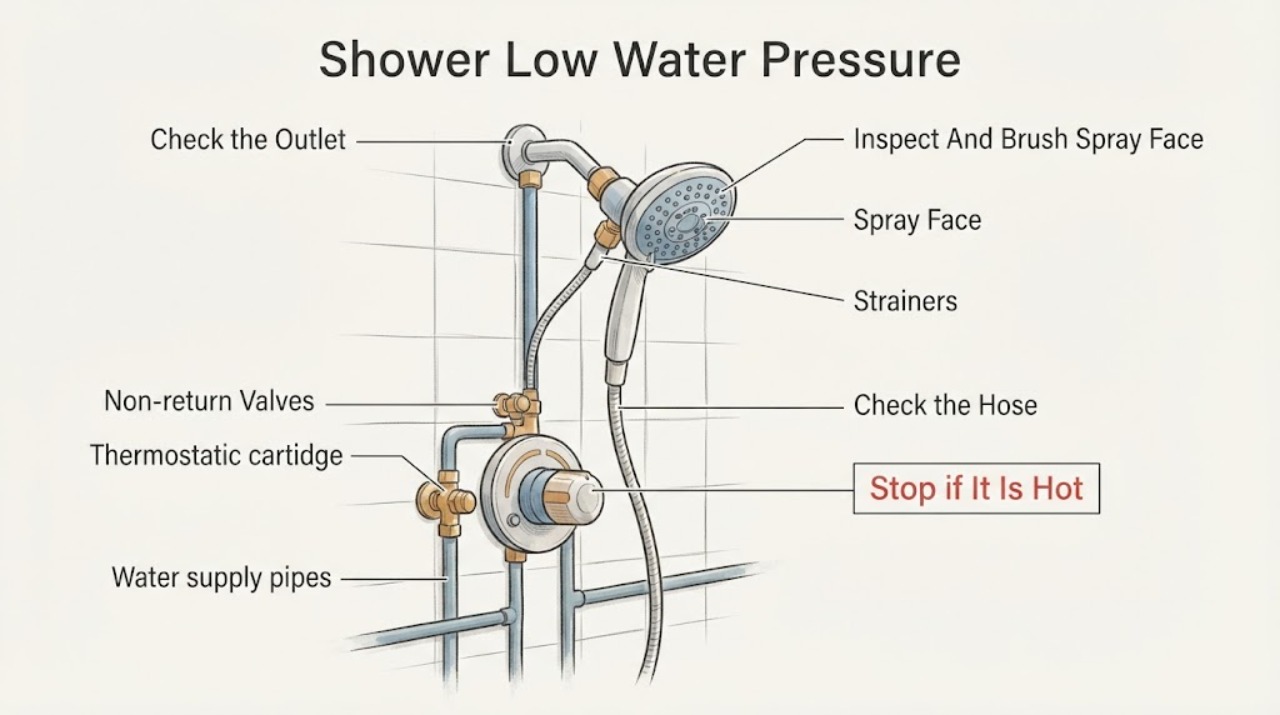
First compare the GROHE shower with another shower outlet and a nearby faucet, then compare hot and cold flow separately. If only the shower is weak or its spray pattern changed, an obstructed spray face, strainer, hose, or model-specific flow limiter is more likely. GROHE troubleshooting documents also list insufficient supply pressure and dirty or defective non-return valves as possible reduced-flow causes, but the exact fitting manual controls the procedure. Brush accessible SpeedClean nozzles as the GROHE consumer guidance describes, and clean a removable strainer only when the exact manual permits it. Do not remove the fitting, non-return valves, cartridge, hidden limiter, or pressurized connections, and do not use toothed pliers or unapproved chemicals. Persistent low flow, a hot/cold imbalance, a leak, or a symptom that affects multiple fixtures needs qualified plumbing service.
Work through in order
Diagnostic checks
Use only checks that match the exact appliance or system and its official guide.
-
Check 1
With the shower controls in their normal positions, compare the GROHE shower with another shower outlet and a nearby faucet. If possible, compare hot and cold flow separately. Note whether the symptom is weak flow, an altered spray pattern, pulsing, or a temperature change.
Expected result: Only the GROHE shower is weak; all shower outlets are weak while other fixtures are normal; several fixtures are weak; or one temperature side is much weaker than the other.
Next step: Use the matching branch below and keep a note of which outlets and temperature sides were compared. Do not change a pressure setting or remove a fitting to make the comparison.
Stop if: Stop and arrange service for a wall leak, an exposed electrical hazard, uncontrolled flow, scalding or unstable temperature, or a shutoff that will not isolate the fitting.
Why this matters
Why: A shower-only symptom makes the spray face, strainer, hose, flow limiter, shower-side valve, or non-return path more likely. Several affected fixtures point toward an upstream supply or valve issue. A hot/cold difference shifts attention toward a supply side, thermostatic cartridge, or non-return component.
-
Check 2
Inspect the visible GROHE showerhead or spray face for limescale, blocked nozzles, debris, or a changed pattern. Where the exact product supports SpeedClean, brush the nozzles with your fingers as the GROHE consumer guidance describes. Do not insert sharp tools or use abrasive or unapproved chemical cleaners.
Expected result: Nozzles are visibly scaled or blocked and the pattern improves after brushing; the spray face is clear but flow stays low; or the spray face cannot be reached without disassembly.
Next step: Run one brief comparison after the approved cleaning. If flow remains low, record the result and continue only with checks allowed by the exact GROHE model instructions.
Stop if: Stop if the spray face cracks, the head loosens from the wall, the connection begins leaking, or cleaning would require removing a concealed or pressurized component.
Why this matters
Why: An external spray-face restriction can reduce flow at one outlet. No improvement, or an inaccessible spray face, makes a strainer, hose, limiter, valve, or supply cause more plausible and does not justify deeper disassembly.
-
Check 3
Inspect the visible shower hose for kinks, crushing, or a damaged seal. If the GROHE model instructions identify a user-accessible inlet screen or strainer, isolate the water exactly as instructed and clean only that accessible part. Do not use toothed pliers, force threaded unions, or remove non-return valves.
Expected result: The hose is kinked or damaged; an approved accessible strainer contains debris; the hose and strainer are clear; or access would require removing the hand shower, fitting, or wall connection beyond the manual's stated procedure.
Next step: Correct a simple visible hose kink or clean the approved strainer, then repeat the outlet comparison. Replace a damaged hose only after matching the exact connection and model instructions; escalate if internal access is required.
Stop if: Stop for any leak at a wall connection, a seized union, damaged threads, inability to shut off hot or cold supply, or a need to remove the fitting or valve body.
Why this matters
Why: A kink or permitted strainer blockage can restrict one shower outlet. GROHE troubleshooting also names dirty or defective strainers and non-return valves, but a valve hidden in the fitting requires model-specific service rather than trial-and-error removal.
-
Check 4
Identify the complete GROHE product or series from the label, manual, or visible trim. Check whether that exact documentation describes a user-adjustable flow setting or FlowBalance feature. Do not turn a concealed screw, bypass a limiter, or assume a feature on one GROHE model applies to another.
Expected result: The manual documents an accessible flow adjustment and the setting is reduced; no adjustment is documented; or the part is hidden inside the fitting or cannot be identified confidently.
Next step: Restore or adjust only the setting and direction explicitly documented for the exact model. If no approved setting is available or low flow remains, preserve the model information and arrange plumbing service.
Stop if: Do not remove a limiter, cartridge, non-return valve, or trim to reach a setting; stop for dripping, unstable temperature, or any connection that remains pressurized.
Why this matters
Why: Some GROHE products expose model-specific flow regulation, while others use a fixed limiter or internal component. An undocumented adjustment can alter intended flow, temperature behavior, or safety performance and may damage the fitting.
-
Check 5
Record the model or series, the outlets tested, hot/cold comparison, spray-face and strainer results, hose condition, visible leaks, and whether low flow changes when other fixtures run. Photograph only visible labels and conditions. Do not perform a live pressure test or remove the fitting as a homeowner check.
Expected result: Low flow persists after approved external checks; multiple fixtures are affected; hot/cold flow is unbalanced; the shower leaks; or a non-return valve, cartridge, supply pressure, or concealed limiter is suspected.
Next step: Keep the fitting in a safe state and arrange qualified plumbing diagnosis. Provide the exact model, comparison results, and the timing of any leak, temperature change, or flow loss.
Stop if: Stop immediately for uncontrolled water, a wall or ceiling leak, scalding temperature, a failed shutoff, damaged pipework, or any repair that requires opening a pressurized fitting.
Why this matters
Why: The remaining possibilities include upstream pressure or shutoff issues and internal GROHE components that need model-specific isolation, pressure measurement, or disassembly. The cited documents do not support choosing a replacement part from the symptom alone.
Use your observations
Decision map
Find the observation that best matches what you see, then follow the next safe action.
-
PATH 01Next step
What you see
Do this next
Brush compatible SpeedClean nozzles and perform only the exact manual's accessible strainer or hose check. Escalate if there is no improvement or if access requires disassembly.
Why this path and its safety boundary
Why it matters: A blocked spray face, accessible strainer, kinked hose, or model-specific flow restriction is more likely than a whole-home pressure problem.
-
PATH 02Next step
What you see
Do this next
Confirm the exact GROHE model and documented settings, then arrange qualified service if the symptom persists. Do not remove the fitting or valve body.
Why this path and its safety boundary
Why it matters: The restriction may be in the shower supply path, a flow setting, a non-return valve, or a thermostatic fitting rather than the individual spray face.
-
PATH 03Next step
What you see
Do this next
Record which side is weaker and whether another hot or cold fixture shows the same pattern. Stop at external observations and arrange service for internal valve or cartridge diagnosis.
Why this path and its safety boundary
Why it matters: A supply-side restriction, thermostatic cartridge, strainer, or non-return valve on one side becomes more plausible than a spray-face restriction alone.
-
PATH 04Next step
What you see
Do this next
Check only visible, fully open shutoffs that you can identify without tools and compare neighboring fixtures. Arrange plumbing service for supply measurement or building-side diagnosis.
Why this path and its safety boundary
Why it matters: The issue may be upstream supply pressure, a building shutoff, a pressure-reducing device, or shared pipe restriction rather than the showerhead.
-
PATH 05Next step
What you see
Do this next
Shut off the affected supplies only if the correct isolation is known and safe, protect the area from water, and arrange qualified service with the model and symptom timing.
Why this path and its safety boundary
Why it matters: A leaking functional element, cartridge seal, pressure surge, non-return valve, or installation condition may be involved; these are not reliably identified by flow alone.
Helpful context
Understand the symptom
Separate a shower-only restriction from a supply problem
Run the affected GROHE shower briefly and compare it with another shower outlet and a nearby faucet. Repeat the comparison with hot and cold separately if the controls allow it. Weak flow only at one shower points toward the spray face, strainer, hose, flow setting, or shower-side valve path. Weak flow at several fixtures points farther upstream, while a large hot-versus-cold difference changes the path toward a supply, thermostatic, cartridge, or non-return-valve diagnosis.
Start with the external spray face and approved cleaning features
GROHE consumer guidance describes SpeedClean as a way to remove limescale from nozzles by brushing over them with the fingers. Use that only on a compatible GROHE spray face. A removable strainer or flow limiter may exist, but its location, cleaning method, and whether it is user-accessible vary by model. Do not pry out a hidden insert, disassemble the fitting, or force a connection just because the spray remains weak.
Internal valves and pressure settings are a service boundary
GROHE documents identify non-return valves, flow settings, cartridge seals, and supply pressure as model-dependent installation or troubleshooting points. The cited installation document gives a 1 to 5 bar flow-pressure range for its documented fitting, but that value must not be applied to every GROHE shower. If low flow persists after safe external checks, or if the head leaks, the temperature is unstable, or work would require shutting supplies and removing the fitting, record the symptoms and use qualified plumbing service.
Safety boundary
Stop conditions
- Stop and isolate water only if the correct shutoff is known and safe for an active leak, uncontrolled flow, wall or ceiling water damage, or a connection that will not hold.
- Do not open a pressurized fitting, remove a non-return valve, cartridge, concealed limiter, or trim, or use toothed pliers to force a connection.
- Do not bypass a flow limiter, alter a thermostatic safety stop, use unapproved chemicals or sharp tools on nozzles, or apply the specifications of one GROHE model to another.
- Stop for scalding or unstable temperature, a failed shutoff, damaged threads or pipework, or any task that requires hidden disassembly or live pressure measurement.
- Arrange qualified service when low flow persists after approved SpeedClean or external checks, affects multiple fixtures, or is accompanied by a leak, temperature imbalance, or suspected internal valve or cartridge fault.
Only after diagnosis
Potential parts
- GROHE showerhead spray face, inlet strainer, or flow limiter
Consider this part class only when the exact model documentation and inspection confirm an obstructed, damaged, or missing external flow component after approved cleaning.
Spray face, screen, limiter location, flow rate, thread, and serviceability vary by GROHE series; match the complete product identifier before selecting a part. - GROHE non-return valve or shower supply valve component
Consider this part class only after qualified diagnosis confirms a defective non-return or supply-side valve is causing the measured or observed restriction.
Valve style, size, orientation, access, and required shutoff procedure are model- and installation-specific; do not remove it as a trial repair. - GROHE thermostatic cartridge and seals
Consider this part class only when hot/cold imbalance, temperature instability, or a qualified inspection confirms cartridge or seal wear or debris.
Cartridge geometry, temperature stop, seals, calibration, and trim compatibility differ across GROHE products; identify the full model and follow its service documentation.
When checks do not resolve it
Need a professional?
Call qualified plumbing service when approved external cleaning and comparisons do not restore flow, more than one fixture is affected, hot and cold flow differ substantially, a leak or unstable temperature is present, or diagnosis requires removing trim, valves, cartridges, or wall connections. Seek urgent help for uncontrolled water or active wall or ceiling water damage.
Have this ready
- Complete GROHE product or series identifier and visible installation configuration
- Which shower outlets and nearby fixtures were compared
- Hot-versus-cold flow observations and whether other fixtures change the symptom
- Spray-face, accessible strainer, hose, and documented flow-setting results
- Any leak, temperature instability, recent installation work, visible water damage, or failed shutoff
Common questions
FAQ
Why is my GROHE shower weak while the sink faucet has normal flow?
A restriction in the shower path is more likely: scaled nozzles, a strainer, kinked hose, model-specific limiter, shower-side valve, or non-return component. Compare another shower outlet, brush compatible SpeedClean nozzles, and follow only the exact model's accessible cleaning instructions before arranging service.
Should I remove the GROHE flow limiter or non-return valve?
Not as a trial repair. GROHE documents treat flow regulation and non-return valves as model-specific fitting components and call for supply isolation before fitting-side work. Have qualified service identify the exact part and restore the intended configuration.
Does every GROHE shower need 1 to 5 bar of pressure?
No universal number should be assumed from one manual. The cited GROHE installation document gives 1 to 5 bar for its documented fitting and notes that higher pressure may require reduction. Use the exact model documentation and qualified measurement for the installed shower.
Can limescale cause low flow from a GROHE showerhead?
Yes, it can restrict spray nozzles or change the pattern. On a compatible SpeedClean shower, brush over the nozzles with your fingers as GROHE describes. If the pattern remains weak or cleaning would require disassembly, stop and escalate.
When should low shower pressure become a plumbing service call?
Arrange service when approved external checks do not restore flow, multiple fixtures are weak, hot and cold differ substantially, a head or wall connection leaks, temperature is unstable, or the suspected cause is a cartridge, non-return valve, concealed limiter, supply pressure, or other internal component.
Read the exact guide
Official sources
- untitledGROHE · Official GROHE PDF used narrowly for its documented fitting's 1-5 bar flow-pressure note, flushing and connection guidance, reduced-flow causes, and cartridge or installer boundary.
- GROHE shower systemsGROHE · Official GROHE consumer page used for the SpeedClean feature only; apply it only to a compatible GROHE spray face that has the feature.
- Rainshower F-Series 5″ Side shower 1 sprayGROHE · Official product page for one GROHE side-shower model; used only to show that some products list a flow regulator and SpeedClean, not as a universal feature or specification.
- untitledGROHE · Official GROHE PDF for its documented fitting; used for possible reduced-flow causes, non-return-valve cautions, and installer escalation. It is not a universal specification for every GROHE shower.
Community feedback
Share a repair observation
Share a plain-text repair observation. Accepted observations are published automatically; this page may take a moment to update.