
On this page
Start here
Quick answer
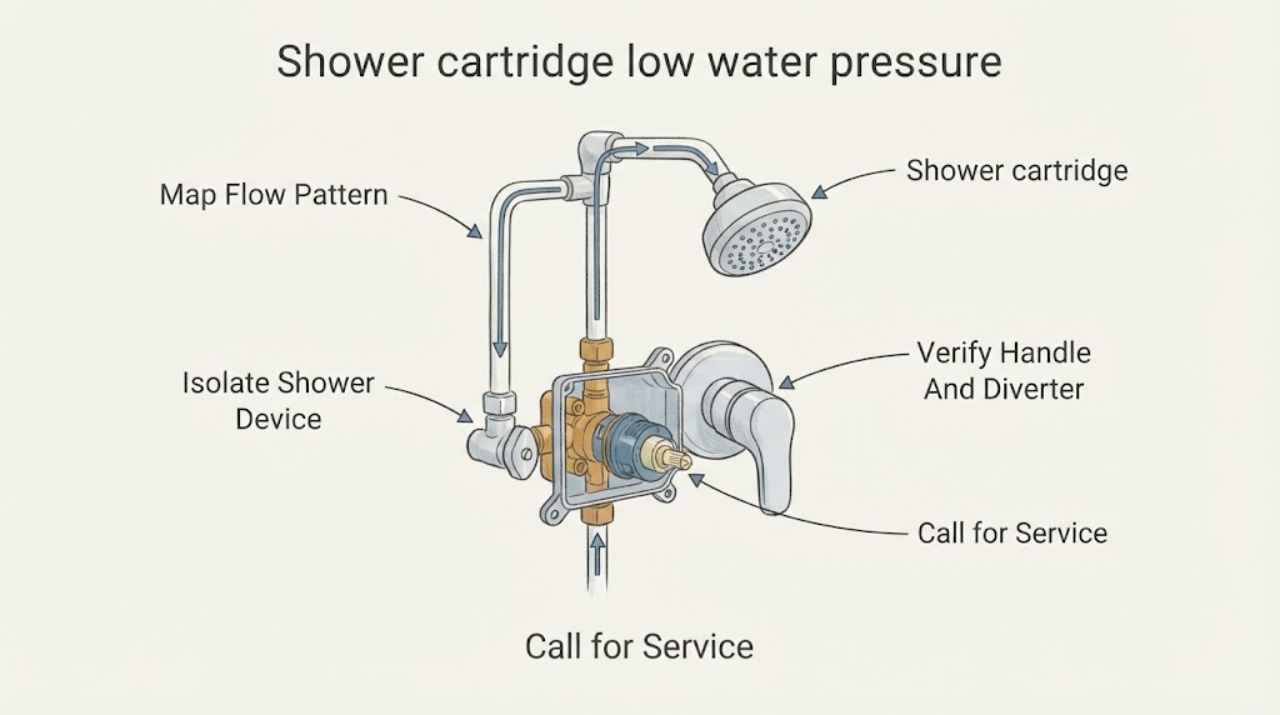
A shower cartridge can restrict flow or create a hot-or-cold imbalance, but low pressure at the shower does not prove the cartridge is bad. First compare the affected shower with another fixture, then check whether the loss is at the showerhead or already present at the shower arm. Confirm the handle and diverter are fully open and inspect only accessible screens or hose connections. If flow is still low at the shower arm, the problem returns, the valve leaks, or diagnosis requires removing trim or the cartridge, shut off the water and arrange qualified plumbing service.
Work through in order
Diagnostic checks
Use only checks that match the exact appliance or system and its official guide.
-
Check 1
Run the shower briefly at its normal setting and compare it with a nearby faucet or another shower. Note whether the low flow affects the showerhead, hand shower, tub spout, both hot and cold positions, or the entire home.
Expected result: Only one shower device is weak, the whole shower is weak, only hot or only cold is weak, or multiple fixtures are weak at the same time.
Next step: Record the pattern and continue to the showerhead-versus-arm check. If multiple fixtures are weak, stop treating the shower cartridge as the first suspect and arrange a plumbing assessment of the supply.
Stop if: Stop immediately for an active leak, scalding or uncontrollable temperature, exposed electrical equipment, or a loose or damaged valve.
Why this matters
Why: A single-device symptom points downstream of the transfer or mixing valve; low flow from the whole shower keeps the valve, cartridge, inlet screens, and local supply in consideration; a temperature-specific or whole-home pattern points to a supply or balancing issue rather than a generic cartridge failure.
-
Check 2
If the showerhead connection is accessible and not seized or leaking, follow the exact fixture instructions to remove the showerhead or handheld device, then briefly run water through the shower arm or outlet into the shower area while keeping the opening controlled.
Expected result: Flow is strong from the shower arm but weak through the showerhead, or flow remains weak at the arm.
Next step: If the arm flow is strong, clean only the accessible showerhead or screen according to its instructions and reinstall it without forcing the connection. If arm flow is weak, stop downstream cleaning and continue only with documentation and professional diagnosis.
Stop if: Do not force a corroded connection, open an in-wall fitting, or leave the shower outlet unattended where water could enter a wall or floor.
Why this matters
Why: Strong arm flow makes a clogged showerhead, screen, hose, or flow-control insert more likely and makes the cartridge less likely. Weak flow at the arm means the restriction is upstream or inside the valve and cannot be diagnosed from the showerhead alone.
-
Check 3
With the shower device reinstalled or the outlet controlled, verify that the volume or mixing handle reaches its normal fully-open position and that any diverter or transfer control is set to one device rather than a shared or partly closed position.
Expected result: The handle was not fully open, the diverter sends water to more than one device, the control feels stiff or abnormal, or the control is correctly positioned but flow remains low.
Next step: Correct only the obvious control position and make one brief retest. If the control is stiff, damaged, or still produces low flow when correctly positioned, stop turning it and arrange service rather than forcing the stem.
Stop if: Do not remove the handle or escutcheon just to look for a cartridge, and do not force a seized control.
Why this matters
Why: A partly opened handle or shared diverter can reduce the stream without a failed cartridge. A stiff control, abnormal transfer behavior, or low flow with a correctly positioned control makes internal wear, debris, or a cartridge or valve problem more plausible.
-
Check 4
Observe one normal shower while noting whether flow or temperature changes when another fixture uses water, whether hot and cold behave differently, and whether the valve or nearby trim shows seepage after the control is turned off.
Expected result: Flow drops when another fixture runs, only one temperature side is weak, temperature drifts with the stream, or the valve leaks after shutoff.
Next step: Document which side and under what conditions the symptom occurs. Arrange a qualified plumber when the pattern is temperature-specific, the building supply is implicated, or the valve leaks; do not compensate by removing a safety or temperature-limiting feature.
Stop if: Stop using the shower for uncontrolled temperature, active leakage, water behind the trim, or any sign of wall or ceiling damage.
Why this matters
Why: A flow change with another fixture points to supply pressure or an installation limitation. A hot-or-cold-specific loss or temperature drift can involve a blocked inlet, check or balancing element, or supply imbalance. A leak at the valve body or continued drip needs a different repair assessment from a low-flow-only complaint.
-
Check 5
Record the faucet brand, visible model or valve information, number and operation of handles, which devices the controls operate, and whether the showerhead-versus-arm test found strong or weak arm flow. Use the exact manufacturer manual to identify the valve family before discussing a cartridge.
Expected result: The valve identity and flow pattern are clear, the identity is uncertain, or a prior cartridge change was followed by lower flow, leakage, or a changed temperature response.
Next step: Give the technician the model information, photos, flow pattern, and prior-service details. Have a qualified professional shut off the supply and inspect or replace the cartridge when arm flow is weak and the local supply checks are normal.
Stop if: Do not order or install a cartridge from appearance alone, and do not remove a cartridge while the valve may still be pressurized.
Why this matters
Why: Cartridge shape and function depend on the installed valve; a transfer cartridge, mixing cartridge, and thermostatic cartridge are not interchangeable. An uncertain identity or a symptom that began after service raises compatibility, orientation, debris, seal, or installation questions rather than proving the new part is correct.
Use your observations
Decision map
Find the observation that best matches what you see, then follow the next safe action.
-
PATH 01Safety boundary
What you see
The shower arm produces a strong stream, but the reinstalled showerhead or handheld remains weak, and another fixture is normal.
Do this next
Clean or replace only the accessible shower device component allowed by its instructions, then make one controlled retest. Seek service if the connection leaks or the weak flow remains.
Why this path and its safety boundary
Why it matters: The restriction is downstream of the cartridge, such as the device screen, hose, or flow-control insert; replacing the cartridge first is unlikely to address this pattern.
Safety stop: Do not force a seized fitting or open the wall to reach the valve.
-
PATH 02Safety boundary
What you see
Another fixture has normal flow, the shower arm is also weak, the handle and diverter are correctly positioned, and the affected shower has no obvious supply leak.
Do this next
Arrange qualified plumbing diagnosis with the valve identity and arm-flow observation. The professional can isolate the cartridge and confirm compatibility after shutting off and securing the water supply.
Why this path and its safety boundary
Why it matters: A local valve restriction, inlet screen, diverter, or cartridge problem becomes more likely, but the observed pattern still does not identify a specific replacement part.
Safety stop: Do not pull the cartridge, probe the valve, or substitute a test plug without the exact model procedure and appropriate isolation.
-
PATH 03Safety boundary
What you see
Only hot or cold flow is weak, the temperature drifts, or the flow changes as supply conditions change.
Do this next
Stop trying to correct temperature by removing a limiter or bypassing a balancing function. Have a qualified plumber check the supply and valve using the exact installation guidance.
Why this path and its safety boundary
Why it matters: A hot or cold supply restriction, filter or check element, pressure imbalance, or thermostatic or pressure-balancing cartridge issue is more likely than a generic showerhead blockage.
Safety stop: Stop using the shower if temperature is uncontrolled or can scald, or if the valve leaks.
-
PATH 04Safety boundary
What you see
The shower and other fixtures are weak together, or the shower drops sharply whenever another fixture opens.
Do this next
Record which fixtures were running and arrange a plumbing supply assessment. Do not replace the cartridge as a first response to a whole-home pressure problem.
Why this path and its safety boundary
Why it matters: The building supply, pressure, isolation valve, filtration, or shared plumbing is more likely than this shower cartridge.
Safety stop: Stop for a sudden widespread loss of water, active leak, or any unsafe plumbing condition.
-
PATH 05Safety boundary
What you see
The symptom began after cartridge service, the valve identity is uncertain, the valve leaks, or the arm remains weak after accessible checks.
Do this next
Leave the shower off if it leaks or temperature is unsafe and call a qualified plumber with the photos, model information, flow pattern, and prior work details.
Why this path and its safety boundary
Why it matters: Compatibility, orientation, debris, seals, internal valve damage, or an unresolved supply problem remains possible; repeated disassembly can create leaks or damage.
Safety stop: Do not continue trial-and-error cartridge changes or leave an opened valve pressurized.
Helpful context
Understand the symptom
What a cartridge can and cannot tell you
The cartridge sits inside a shower valve, but “low pressure” may actually be low flow at the showerhead, a partly closed handle or diverter, a blocked screen, an imbalanced hot or cold supply, or a whole-house supply problem. In some valve designs the cartridge controls both temperature and flow; in transfer valves it may route water between the showerhead and hand shower. Because the same symptom can occur at different points, locate the restriction before choosing a part.
Keep the inspection on the safe side
Use a dry, stable position and keep the shower controls in their normal configuration while observing. Do not pry off trim, pull a cartridge, open an in-wall valve, or test a pressurized connection unless the exact manual and your tools, shutoffs, and access make that work appropriate. Close the water supply before any hose or screen service, protect the drain from loose parts, and stop for a leak, damaged valve body, or water near an electrical device.
The useful dividing line
If the showerhead is weak but the shower arm has a strong stream, the restriction is downstream of the cartridge. If the arm is also weak while another fixture is normal, the valve, cartridge, inlet screen, diverter, or local supply path becomes more likely. If every fixture is weak or the flow changes when another fixture runs, investigate the building supply instead of replacing a shower cartridge by guesswork.
Safety boundary
Stop conditions
- Stop for active leakage, water behind the trim, uncontrolled or scalding temperature, a damaged valve body, or water near electrical equipment.
- Do not remove trim or a cartridge from a pressurized valve, open an in-wall connection, or force a seized handle or fitting.
- Do not bypass temperature or pressure-balancing safety functions or choose a replacement cartridge by appearance alone.
- If flow remains weak at the shower arm after accessible checks, leave the shower off as appropriate and call a qualified plumber.
Only after diagnosis
Potential parts
- shower mixing or flow cartridge
Consider only when arm flow is weak, the local supply is normal, and qualified diagnosis confirms that the installed valve cartridge is restricting flow or failing to regulate temperature.
Confirm the exact manufacturer, valve family, cartridge function, orientation, seals, and model fit information before selection. - shower transfer or diverter cartridge
Consider only when one shower device is weak or unavailable while another has normal flow and the transfer path is identified as the cause.
Confirm whether the installed control is a transfer valve or mixing valve and verify exact model compatibility before selection. - showerhead screen or flow-control component
Consider only when the shower arm has strong flow but the device remains weak after accessible cleaning allowed by the manufacturer's instructions.
Match the exact showerhead or handheld model and do not remove a required safety or flow-control feature without manufacturer guidance.
When checks do not resolve it
Need a professional?
Call a qualified plumber when flow is weak at the shower arm, the symptom returns, only one temperature side is affected, the valve leaks, the identity is uncertain, or any check requires removing trim or the cartridge.
Have this ready
- Faucet brand, visible model or valve information, and handle count
- Whether the showerhead or shower arm has weak flow
- Whether hot, cold, or both sides are affected
- Comparison with another fixture and any change when water is used elsewhere
- Photos, leak or temperature observations, and any prior cartridge work
Common questions
FAQ
How can I tell whether the cartridge or showerhead is causing low flow?
If the shower arm has a strong stream with the showerhead removed under the fixture instructions, the restriction is downstream and the showerhead, screen, hose, or flow-control insert is more likely. If the arm is weak too, the valve, cartridge, inlet screen, diverter, or local supply needs professional diagnosis.
Can a shower cartridge reduce pressure on only hot or cold water?
It can be part of a temperature-specific flow problem, but a blocked inlet, supply imbalance, check element, or installation issue can look similar. Record which side is weak and have the valve checked before selecting a cartridge.
Should I replace the shower cartridge as soon as pressure drops?
No. First separate a showerhead restriction, handle or diverter position, and whole-home supply issue from low flow at the valve. Replace a cartridge only after the exact valve is identified and the diagnostic pattern supports it.
What if the low flow started after a cartridge replacement?
Stop repeated disassembly and record whether the arm or showerhead has weak flow, whether the temperature changed, and whether the valve leaks. Incorrect compatibility, orientation, debris, seals, or an unrelated restriction are all possible; arrange a qualified inspection with the old and new part information if available.
When should I stop using the shower?
Stop for an active leak, water behind the trim, uncontrolled or scalding temperature, a damaged valve body, or any work that requires opening an in-wall connection or handling a pressurized cartridge. Shut off the local water supply when safe and call a qualified plumber.
Read the exact guide
Official sources
- Low flow from the shower (K-305 Rite-Temp Diverter Valve)Kohler Assist · Kohler K-305 Rite-Temp Diverter Valve only; other valve families require their own instructions.
- Troubleshooting GuideKohler Co. · Kohler shower valve troubleshooting guide; exact valve and installation conditions govern.
- Cartridge Assembly - MultiChoice Universal - 17 Series RP46463Delta Faucet · Delta MultiChoice 17 Series support page; the cited product and valve family are model-specific.
- Shower Faucet: Low Flow-Standard ValveMoen Solutions · Moen standard-valve guidance; exact valve and handle system govern.
- Faucet Cartridges: ShowerMoen Solutions · Moen shower cartridge identification; models, valve functions, and service steps vary.
Community feedback
Share a repair observation
Share a plain-text repair observation. Accepted observations are published automatically; this page may take a moment to update.