
On this page
Start here
Quick answer
After a blizzard, a cold shower can come from a frozen branch serving the shower, a whole-house water or power interruption, a gas or electric water-heater shutdown, or a shower mixing valve that is limiting hot water. First ask whether hot water is also missing at a nearby sink; check only from a dry, safe location whether cold water flows and whether other fixtures are affected. If the home lost power, a generator is present, a gas appliance has an odor, a vent is blocked by snow, or a pipe may have frozen, do not improvise with a stove, torch, open flame, or indoor combustion device. CDC guidance says frozen pipes should be thawed slowly with warm air and not a torch; a pipe that cannot be safely thawed or has broken needs professional help. For the water heater, use only model-authorized visible controls and follow the exact gas or electric manual. Stop for leaks, bulging or split pipe, scalding water, wet electrical equipment, smoke, gas odor, blocked exhaust, or carbon-monoxide symptoms, and call a licensed plumber or the appropriate emergency service.
Before you begin
Safety first
- This article supports safe fixture comparison, dry-location observation, exact-manual visible checks, and only slow warm-air thawing of an intact accessible pipe when official guidance permits it. It does not authorize open flame, high heat, indoor combustion devices, panel removal, live electrical work, gas work, pressure-relief manipulation, forced valve repair, or concealed-pipe access.
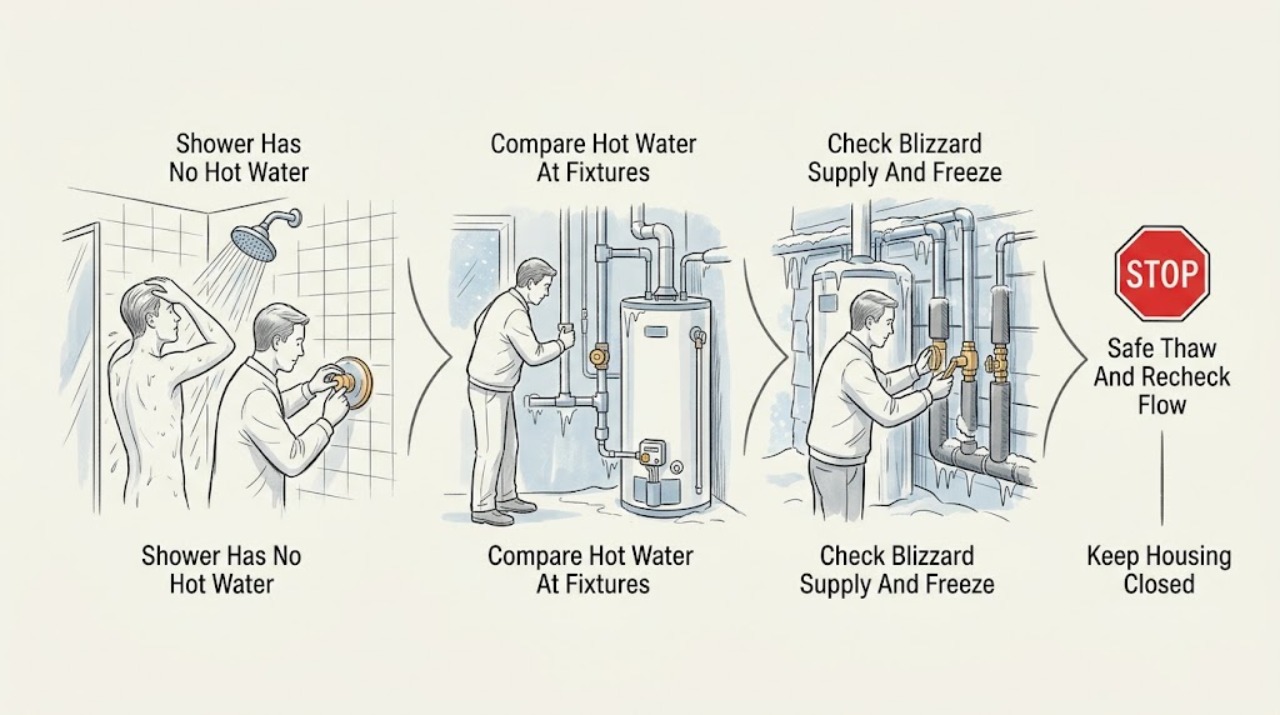
Work through in order
Diagnostic checks
Use only checks that match the exact appliance or system and its official guide.
-
Check 1
From a dry, safe location, briefly check whether cold water flows at the shower and whether the hot side at a nearby sink is cold, warm, or normal. Do not keep running water if a pipe is frozen, leaking, or the water is scalding.
Expected result: Only the shower lacks hot water, all fixtures lack hot water, there is no water at all, or water appears discolored, cloudy, or unusually hot.
Next step: Use the matching branch below. If there is active leaking, a burst or bulging pipe, scalding water, or water near electrical equipment, shut off water only if safely reachable, stay clear, and call a plumber or emergency service.
Stop if: Stop for a leak, split pipe, water near electricity, scalding water, smoke, gas odor, a blocked vent, or a carbon-monoxide alarm or symptom.
Why this matters
Why: A shower-only problem points toward the shower mixing valve or local branch; a whole-house problem points toward supply, frozen pipes, outage, or the water heater; no water points toward a supply interruption or freeze. Unusual water or heat can signal a separate safety or plumbing issue.
-
Check 2
Inspect only visible, accessible plumbing around the shower, exterior walls, basement, crawlspace, and water-entry area for frost, an unheated section, condensation, bulging, splitting, dripping, or a shut main valve. Do not crawl onto icy surfaces or open walls, ceilings, or insulation.
Expected result: A localized pipe is cold or frosted, a pipe is bulging or split, water flow stopped after the blizzard, the main valve is closed, or no visible freeze or leak is found.
Next step: If the pipe is intact, accessible, and the area is dry, use only slow warm air as allowed by CDC; otherwise keep the water off or avoid the area and call a plumber. Never use a torch, flame, torch-like heater, or high heat.
Stop if: Stop for a split or bulging pipe, active water, water near electrical equipment, inaccessible or hidden pipe, unsafe snow or ice, or any need to open a wall or floor.
Why this matters
Why: A localized frozen branch can stop hot or cold flow to the shower, while a split can release water when thawing starts. A closed or disrupted supply can affect the whole home; no visible sign does not exclude a hidden freeze.
-
Check 3
Only if the visible pipe is intact, the area is dry, and the manual or local plumbing guidance permits it, apply gentle warm air to the accessible frozen section while watching the first downstream joint. Keep a nearby faucet open only as a safe pressure-relief measure if the plumbing guidance supports it; do not use flame, boiling water, a heat gun, or an improvised heater.
Expected result: Flow returns gradually with no leak, flow remains absent, or water begins leaking as the section warms.
Next step: Stop the heat and call a plumber if flow does not return promptly, the pipe is hidden, or any leak appears. After a safe thaw, inspect accessible joints for leakage and arrange a professional check if pressure or hot-water service remains abnormal.
Stop if: Stop immediately for leaking, bulging, steam, smoke, scorching, water near electricity, or any need to increase heat or access a concealed pipe.
Why this matters
Why: Gradual flow without leakage supports a thawed restriction, but does not prove the pipe or fittings are undamaged. Persistent no-flow suggests a hidden or continuing freeze or supply fault. Leakage during thawing indicates a split and an urgent water-damage risk.
-
Check 4
If hot water is absent at every fixture but water flows, record whether the blizzard caused a power outage, whether the water heater is electric, gas, or another type, and whether its exterior display or status indicator is normal. Check only an accessible labeled switch or manual-authorized control from a dry location; do not remove covers.
Expected result: The electric heater has no visible power, a gas heater has no normal status, a manual-authorized reset is available, the water heater is wet or damaged, or status appears normal but water stays cold.
Next step: Follow only the exact model manual for one visible recovery step. If the status does not return, the reset repeats, the unit is wet or damaged, or the cause is unclear, keep it off and call a qualified plumber or water-heater technician.
Stop if: Do not open panels, touch wiring, relight after gas odor, operate a wet appliance, reset a repeatedly tripping circuit, or touch the pressure-relief valve.
Why this matters
Why: An outage, tripped protection, fuel interruption, pilot or ignition state, high-limit condition, heating element, thermostat, or plumbing fault can all produce no hot water. A normal indicator does not rule out an internal fault, and a wet or damaged heater is unsafe to operate.
-
Check 5
For a gas water heater or gas-fired home, from outside the appliance area observe only whether snow or ice is visibly obstructing the vent or flue termination and whether there is a gas odor, soot, unusual flame, or carbon-monoxide alarm. For an electric heater, note wet equipment or a breaker event without touching the installation.
Expected result: A vent is blocked, gas odor or soot is present, the flame or status is abnormal, the generator or other fuel-burning device was used indoors, or the electrical supply is wet or repeatedly trips.
Next step: Leave the area or home as appropriate, do not operate switches or fuel appliances, and contact emergency or gas service from a safe location. For an electrical hazard, keep clear and contact a licensed electrician; arrange plumbing service for the no-hot-water fault after the hazard is controlled.
Stop if: Stop immediately for gas odor, smoke, soot, blocked exhaust, an alarm or symptoms of carbon-monoxide exposure, sparking, burning smell, hot equipment, or water near electrical parts.
Why this matters
Why: Combustion and exhaust problems can create carbon-monoxide or fire risk, while wet or repeatedly tripping electrical equipment can cause shock or fire. These are not hot-water reset problems.
-
Check 6
If other fixtures have reliable hot water and the shower alone remains cold, record whether the shower has normal cold flow, whether the handle or control moves normally, and whether the symptom began after freezing or a pressure interruption. Do not remove the cartridge, disturb stops, or force a seized handle.
Expected result: The shower has cold water but no hot blend, hot water is weak only at the shower, the control is stuck, or both hot and cold flow are absent.
Next step: Use the exact shower-valve manual for visible handle or temperature-setting checks. Arrange licensed plumbing service for a seized control, cartridge, hidden freeze, or any repair requiring disassembly.
Stop if: Stop for a leaking trim plate or wall, a cracked valve, uncontrolled water, scalding water, or any need to open the wall or force the valve.
Why this matters
Why: A shower mixing cartridge, balancing control, local stop, or frozen branch becomes more likely when the water heater supplies other fixtures. No flow at both sides points back to the local supply or freeze, not simply a temperature cartridge.
-
Check 7
Prepare a service record with the blizzard and outage timing, fixtures checked, hot and cold flow, water-heater fuel type and model, status or error display, pipe or leak observations, vent condition, and every safe visible step already taken. Stop trying to restore hot water once a service trigger exists.
Expected result: The record points to a shower-only control issue, localized freeze, whole-house supply problem, water-heater outage, gas or vent hazard, electrical hazard, or an unresolved combination.
Next step: Keep the affected water-heater or supply section out of service as directed and call a licensed plumber. Use gas, electrical, emergency, or medical response first when the relevant stop condition is present.
Stop if: Do not open panels, bypass controls, relight gas equipment after an odor, force a valve, use flame to thaw, or continue around smoke, water, electrical heat, or carbon monoxide.
Why this matters
Why: The timing and distribution of the cold water help the plumber distinguish a frozen or burst supply from a heater or shower-valve issue without asking the resident to reproduce a hazardous condition.
Use your observations
Decision map
Find the observation that best matches what you see, then follow the next safe action.
-
PATH 01Safety boundary
What you see
Nearby fixtures have hot water, but the shower alone is cold after the blizzard.
Do this next
Check only the visible valve control and accessible, dry supply area. Arrange licensed plumbing service for a stuck cartridge, hidden freeze, or any disassembly.
Why this path and its safety boundary
Why it matters: The shower mixing valve, local stop, or branch pipe is more likely than a whole-house heater failure.
Safety stop: Do not force the handle, remove the cartridge, open the wall, or continue with a leak, scalding water, or damaged valve.
-
PATH 02Safety boundary
What you see
Cold water flows, but the shower and nearby fixtures all lack hot water.
Do this next
Identify gas versus electric and follow one model-authorized visible status or reset instruction. If it does not recover or the cause is unclear, call a qualified plumber or water-heater technician.
Why this path and its safety boundary
Why it matters: The water heater, its power or fuel, a high-limit or control state, or a whole-house plumbing issue is more likely than the shower head.
Safety stop: Do not open panels, touch wiring, relight after gas odor, operate a wet heater, or repeatedly reset a breaker or safety device.
-
PATH 03Safety boundary
What you see
Flow stopped after the blizzard and a pipe is frosted, bulging, split, leaking, or located in an unheated or inaccessible space.
Do this next
If the main shutoff is safely reachable, close it and call a plumber. For an intact, accessible, dry pipe only, use slow warm air as official guidance permits; never use a torch or open flame.
Why this path and its safety boundary
Why it matters: Freezing can restrict flow and can rupture a pipe; thawing may release water suddenly and cause damage.
Safety stop: Stop for any leak, water near electricity, a hidden pipe, unsafe ice, steam, smoke, or a need to increase heat or open a wall.
-
PATH 04Safety boundary
What you see
The blizzard caused a power outage or the electric water heater has no safe visible status.
Do this next
When dry and safe, follow the exact manual for a single visible power-state check. If the breaker trips again, the heater is wet, or hot water does not return, leave it off and call service.
Why this path and its safety boundary
Why it matters: The heater may not have recovered from the outage or may have tripped a protective device; internal heating and wiring faults remain possible.
Safety stop: Do not remove covers, touch wet equipment or wiring, use test instruments, or keep resetting a breaker.
-
PATH 05Safety boundary
What you see
A gas water heater has an odor, soot or abnormal flame, a vent is snow-blocked, a carbon-monoxide alarm or symptoms occur, or indoor fuel-burning equipment was used during the outage.
Do this next
Leave the area and contact emergency or gas service from a safe location. Do not operate switches, relight, inspect internally, or return until the hazard is cleared by qualified responders.
Why this path and its safety boundary
Why it matters: This is a combustion or carbon-monoxide emergency, not a pilot-light or hot-water troubleshooting branch.
Safety stop: Do not use an indoor generator, grill, camp stove, range, or oven for heat, and do not continue testing a gas appliance after an odor or alarm.
Helpful context
Understand the symptom
Start by locating the boundary of the cold water
Do not begin at the shower valve. With the shower off, briefly compare the hot side at a nearby sink only if the area is dry and the water is safe to touch. If every fixture is cold, suspect a whole-house supply, frozen main or branch, water-heater, fuel, or power problem. If sinks have hot water but the shower does not, the shower cartridge or mixing control becomes more likely. If there is no cold water either, treat a frozen or interrupted supply as the priority rather than adjusting the water heater.
A blizzard changes the safe sequence
Snow, ice, outages, and burst pipes can create hazards around water heaters and plumbing. Look for wet floors, ceiling stains, bulging pipe, dripping joints, or water near outlets and equipment without touching wet electrical parts. Keep combustion-appliance vents and flues clear only from a safe position; do not use a gas range or oven to heat the home, and do not use a generator, grill, or camp stove indoors. A gas odor, blocked vent, smoke, or carbon-monoxide alarm ends troubleshooting and requires a safe-location emergency response.
Keep thawing and water-heater work conditional
Only a visibly accessible, intact pipe may be approached for the slow warm-air thawing described by CDC, and only when there is no water near electricity or sign of a split. Never use a torch, open flame, or improvised high heat. For gas or electric water heaters, use the exact manual's visible status and reset guidance; do not remove covers, handle wiring, relight a gas appliance after an odor, or disturb a pressure-relief device. If safe checks do not restore hot water, a licensed plumber or qualified water-heater technician should diagnose the system.
Safety boundary
Stop conditions
- Stop immediately for an active leak, burst or bulging pipe, water near electrical equipment, scalding water, smoke, fire, burning odor, gas odor, soot, abnormal flame, blocked exhaust, carbon-monoxide alarm or symptoms, sparking, shock, or repeated breaker trips.
- Do not use a torch, open flame, heat gun, boiling water, stove, oven, generator, grill, or camp stove to thaw pipes or heat the home; do not use fuel-burning equipment indoors during a blizzard-related outage.
- Do not open water-heater panels, touch wiring, use test instruments, relight gas equipment after an odor, touch a pressure-relief device, force a shower valve, or open a wall or floor to chase a freeze.
- Keep the affected supply or water heater out of service and arrange licensed plumbing or qualified water-heater service when safe visible checks do not restore hot water, a pipe is hidden or damaged, or the symptom returns.
When checks do not resolve it
Need a professional?
Call a licensed plumber when the shower remains cold after safe comparison checks, a localized branch is frozen or inaccessible, a pipe leaks or may have split, the main supply is disrupted, or the shower mixing valve needs disassembly. Call a qualified water-heater technician for persistent whole-house no-hot-water, repeated high-limit or power events, gas-control or ignition problems, or a heater that is wet or damaged. Use emergency or gas/electrical response first for gas odor, carbon-monoxide alarm or symptoms, smoke, fire, exposed energized equipment, or water near electricity.
Safety scope: This article supports safe fixture comparison, dry-location observation, exact-manual visible checks, and only slow warm-air thawing of an intact accessible pipe when official guidance permits it. It does not authorize open flame, high heat, indoor combustion devices, panel removal, live electrical work, gas work, pressure-relief manipulation, forced valve repair, or concealed-pipe access.
Common questions
FAQ
Why did my shower lose hot water after a blizzard?
Compare the shower with a nearby sink. If all fixtures are cold, a frozen or disrupted supply, outage, gas or electric water-heater issue, or safety shutdown is more likely. If only the shower is cold, a local frozen branch or shower mixing valve is more likely.
Can I thaw a frozen pipe with a torch?
No. CDC guidance says not to use a torch and describes slow warm-air thawing for an intact accessible pipe. Do not attempt thawing if the pipe is split, leaking, hidden, near electricity, or unsafe to reach; call a plumber.
What should I check on a gas or electric water heater after an outage?
Identify the fuel type and follow only the exact manual's visible status or reset guidance from a dry, safe location. Do not open covers, touch wiring, relight after a gas odor, operate a wet heater, or repeatedly reset a breaker or safety device.
When is the no-hot-water problem an emergency?
Leave the area and use the appropriate emergency response for gas odor, a carbon-monoxide alarm or symptoms, smoke, fire, blocked exhaust, exposed energized equipment, water near electricity, or a burst pipe. Do not use a stove, oven, generator, grill, or camp stove indoors for heat.
Read the exact guide
Official sources
- Safety Guidelines: During & After a Winter StormCenters for Disease Control and Prevention · CDC public-health guidance for winter storms and extreme cold; apply local plumbing and appliance manuals for model-specific systems.
- What to Do to Protect Yourself During a Power OutageCenters for Disease Control and Prevention · CDC emergency guidance for outages during winter storms; it does not replace the exact water-heater manual or local emergency instructions.
- Is Your Hot Water Not Getting Hot? Common Causes & What To Do About ThemA. O. Smith · A. O. Smith homeowner guidance; exact water-heater model, fuel, region, and installation manual control any reset or status procedure.
Community feedback
Share a repair observation
Share a plain-text repair observation. Accepted observations are published automatically; this page may take a moment to update.