
On this page
Start here
Quick answer
First determine whether the shower is the only fixture without hot water. If a nearby sink or tub tap becomes hot, the storage tank is probably working and the shower's mixing or thermostatic valve, cartridge, anti-scald setting, or hot-side supply is the better target. If every hot tap is cold, check the storage tank's user-facing power or fuel status, temperature control, recent demand, and visible leaks without opening covers or gas controls. A failed heating element, thermostat, burner, relief device, or concealed valve needs qualified service; stop immediately for gas odor, smoke, scorching, electrical arcing, a tripping breaker, scalding water, or a leaking tank.
Before you begin
Safety first
- This article supports comparison of outlets and ordinary exterior observations only. Do not open the tank, wall, valve, gas controls, or electrical enclosure, and do not operate a relief valve or continue testing after a safety symptom.
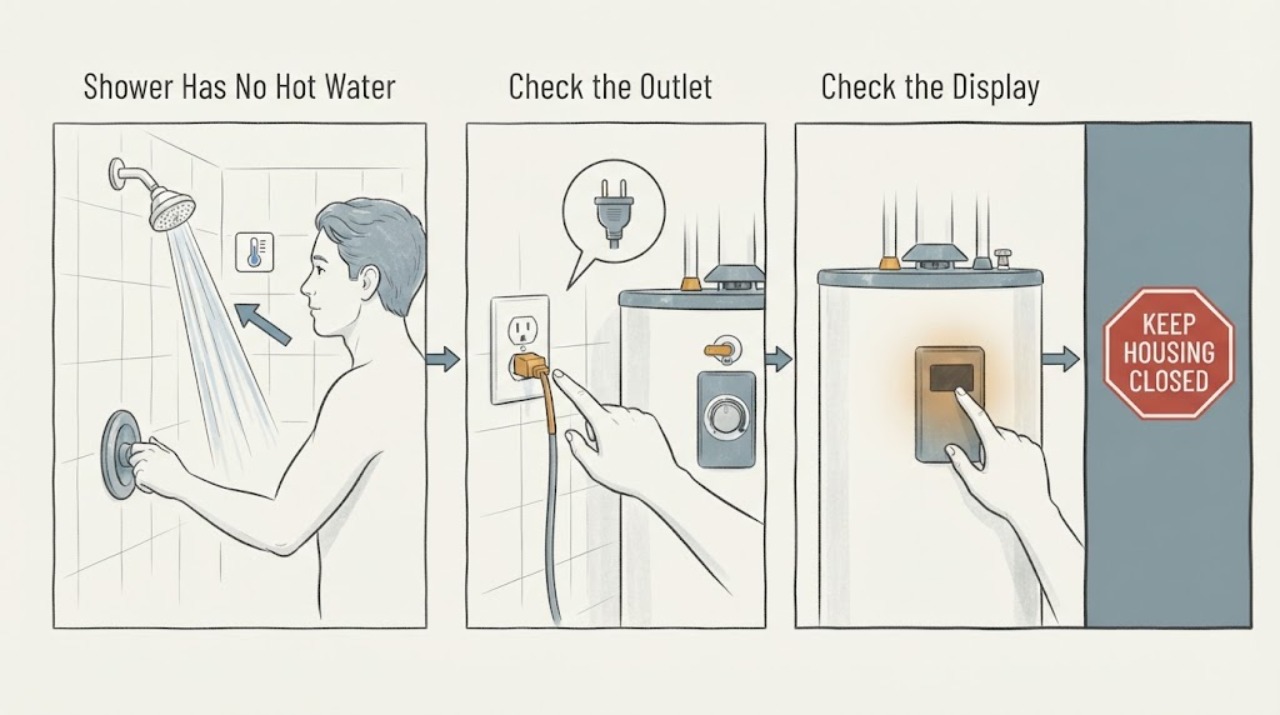
Work through in order
Diagnostic checks
Use only checks that match the exact appliance or system and its official guide.
-
Check 1
With the shower controls in their normal positions, briefly run a nearby sink or tub hot tap and compare it with the shower; keep hands and skin away from water until its temperature is known.
Expected result: Record whether the other outlet becomes hot while the shower stays cold, whether all outlets are cold, or whether temperature is intermittent; note whether the shower has normal flow and whether the issue is only at one fixture.
Next step: Use the one-fixture branch for a shower-only result, or continue with the tank's exterior status and usage observations when all hot outlets are affected; arrange qualified plumbing service if the pattern is unclear.
Stop if: Stop immediately for scalding water, sudden temperature swings, a leak, water near electrical equipment, gas odor, smoke, or an electrical fault.
Why this matters
Why: Hot water at another outlet points toward the shower's mixing or thermostatic valve, cartridge, anti-scald limit, or hot-side restriction rather than proving the tank has failed. Cold water at every hot outlet makes storage-tank energy, controls, demand, or a whole-house plumbing issue more likely.
-
Check 2
From ordinary safe access, confirm that the shower handle or thermostatic control is actually set toward hot, that a control lock or child lock is not limiting it, and that the trim, handle, and visible shower outlet are intact; do not remove the trim or valve cover.
Expected result: Record whether the handle reaches its normal hot stop, the control feels loose or jammed, the temperature changes at all, or the shower has normal cold flow but no hot-side response.
Next step: Photograph the visible control and identify any model marking; ask a plumber or the valve manufacturer for the compatible cartridge or adjustment procedure when the control does not respond.
Stop if: Do not force a handle, remove a valve cover, open a wall, bypass an anti-scald feature, or continue if the trim is loose, the wall is wet, or the water can become suddenly scalding.
Why this matters
Why: A normal sink or tub with no temperature change at the shower supports a shower-valve, cartridge, anti-scald, or hot-side passage problem. A damaged, jammed, or inaccessible control needs a valve-specific assessment rather than force or an adjustment by guesswork.
-
Check 3
If every hot outlet is cold, observe the storage tank from outside the appliance for a readable display, user control, status light, or clearly labeled water-heater switch; consult the exact owner manual rather than opening an access panel.
Expected result: Record whether the display or indicator is on, shows an alert, appears off, or is absent; record the fuel type if known and whether an exterior switch is visibly off without repeatedly operating it.
Next step: Use the manual's model-specific user checks once, then provide the tank model, status text or light pattern, fuel type, and outlet comparison to a qualified plumber or electrician as appropriate.
Stop if: Do not remove covers, touch wiring, measure voltage, adjust gas controls, relight a pilot without the exact manual and safe conditions, or test an appliance that smells of gas, smokes, scorches, or trips protection.
Why this matters
Why: No display or indicator can point to a supply or control issue, while an alert can identify a model-specific service path. An exterior status observation cannot prove an element, thermostat, burner, or wiring fault and should not lead to cover removal.
-
Check 4
Compare the timing of the cold shower with recent hot-water demand: long showers, laundry, dishwashing, several outlets at once, or a recent interruption of the tank's heating schedule.
Expected result: Record whether hot water was available at the beginning and then ran out, whether the shortage occurs only during busy periods, and whether it returns after the tank's normal recovery period or scheduled heating cycle.
Next step: Reduce simultaneous demand while waiting for the normal recovery cycle, then retest one outlet cautiously; if the tank does not recover or the pattern is new and persistent, arrange service and provide this timing record.
Stop if: Do not keep running a cold or unstable shower to force recovery, and stop for scalding fluctuations, a leak, unusual tank noise, fuel odor, smoke, or electrical symptoms.
Why this matters
Why: Hot water that is initially available but depletes during peak use can reflect storage capacity or recovery rather than a sudden component failure. A tank that stays cold after normal recovery, or becomes cold with ordinary demand, needs heating-system diagnosis.
-
Check 5
From a dry, safe distance, inspect only the floor and exterior of the tank and connected visible pipework for active water, a relief outlet discharging, corrosion, scorching, or damage; do not touch hot discharge water or open a drain or relief valve.
Expected result: Record whether the tank is dry, has a small persistent drip, is actively leaking or discharging, or shows corrosion, scorching, smoke, or damage; note whether water could reach an outlet, switch, or other electrical equipment.
Next step: Keep people away, use only an accessible labeled shutoff if it can be reached without entering water or touching hot components, and request urgent qualified plumbing service for active leakage or relief discharge.
Stop if: Do not touch hot water, operate a relief valve, drain the tank, remove panels, or approach the appliance if there is smoke, gas odor, exposed wiring, arcing, a hot electrical surface, or water contacting electrical equipment.
Why this matters
Why: A visible leak can waste hot water and can make a supply appear unreliable, while relief discharge can indicate a pressure or temperature-control problem. Active leakage, hot discharge, or water near electricity changes this from troubleshooting to an immediate safety and service decision.
-
Check 6
If the exact manual identifies a user-accessible reset or clearly labeled water-heater isolator, and there is no leak, odor, smoke, scorching, wet electrical area, or prior repeat trip, follow that manual's single safe reset or switch-position check without opening the panel.
Expected result: Record whether the status returns, hot water recovers after the normal heating cycle, the protection trips again, or the tank remains cold; do not repeatedly reset or keep the shower running as a test.
Next step: Stop using the appliance and arrange qualified service if the reset does not restore hot water, protection trips again, or any unsafe symptom appears; provide the exact model and reset result.
Stop if: Do not reset repeatedly, use an extension cord, bypass protection, open a service panel, test live voltage, or continue after a trip, arcing, burning smell, smoke, or gas odor.
Why this matters
Why: A single recovery may indicate a temporary control state, but a repeat trip or no recovery is evidence of an unresolved fault. Repeated breaker or fuse operation is a professional electrical or appliance-service issue, not a reason to increase the reset count.
Use your observations
Decision map
Find the observation that best matches what you see, then follow the next safe action.
-
PATH 01Safety boundary
What you see
A sink or tub hot tap is hot, but this shower remains cold or has no hot-side temperature change.
Do this next
Keep the valve intact, document the control response and visible markings, and arrange a qualified plumber or valve-manufacturer procedure for this shower.
Why this path and its safety boundary
Why it matters: The tank is producing hot water for at least one outlet; a shower mixing or thermostatic valve, cartridge, anti-scald limit, or local hot-side restriction is more likely than a failed tank.
Safety stop: Do not force or remove the handle, bypass anti-scald protection, open the wall, or use the shower if temperature can jump to scalding or a concealed leak is suspected.
-
PATH 02Safety boundary
What you see
All hot outlets are cold after several showers or appliances used hot water, but the tank normally recovers later.
Do this next
Allow the normal recovery or scheduled heating period, reduce simultaneous demand, and record whether the tank returns to normal before arranging capacity or service advice.
Why this path and its safety boundary
Why it matters: Stored hot water may have been depleted faster than the tank could recover; the pattern does not by itself prove a component failure.
Safety stop: Stop for persistent cold water after recovery, leaks, abnormal heat, gas odor, smoke, scorching, or electrical protection operation.
-
PATH 03Safety boundary
What you see
The shower and every other hot outlet remain cold after normal recovery, or the tank has no user-facing status.
Do this next
Record model, fuel type, status indication, timing, and any visible leak, then request qualified water-heater service; use only the model manual's ordinary user checks.
Why this path and its safety boundary
Why it matters: A power or gas-supply issue, control shutdown, heating element, thermostat, burner, or other tank fault is possible; the exact cause cannot be established from an exterior check.
Safety stop: Do not open panels, measure live voltage, adjust gas components, repeatedly reset protection, or continue operation with smoke, burning odor, gas odor, arcing, or a leak.
-
PATH 04Safety boundary
What you see
The shower alternates between hot, warm, and cold without a deliberate control change, or becomes hot unexpectedly.
Do this next
Stop using the shower, document when the change occurs and whether other outlets change, and arrange qualified plumbing or water-heater diagnosis.
Why this path and its safety boundary
Why it matters: A mixing valve, changing pressure, tank control, or heating-system problem may be present, and the temperature may be unsafe even if the shower occasionally feels normal.
Safety stop: Do not keep retesting against skin, bypass a temperature limiter, or adjust a tank control by guesswork; stop for scalding water, steam, smoke, or a gas or electrical warning.
-
PATH 05Safety boundary
What you see
The tank or nearby pipework is actively leaking, a relief outlet is discharging, water reaches electrical equipment, a breaker trips, or there is gas odor, smoke, scorching, or arcing.
Do this next
Move people away, avoid switches and flames, use only an accessible labeled water or energy shutoff when safe from a dry location, and contact the appropriate emergency or qualified service channel from safety.
Why this path and its safety boundary
Why it matters: The immediate issue is a water, fuel, fire, pressure, or electrical safety hazard, not a routine no-hot-water diagnosis.
Safety stop: Do not touch wet electrical equipment, operate a relief valve, relight or test a burner, reset a tripping breaker repeatedly, or open the tank or wall.
Helpful context
Understand the symptom
Start with the one-fixture or whole-home split
Run a nearby sink or tub hot tap briefly and compare it with the shower, taking care not to touch water that may be scalding. If another outlet is hot while the shower stays cold, the storage tank is not yet proven faulty. A shower mixing or thermostatic valve, worn cartridge, anti-scald limit, or restricted hot-side passage can affect one shower independently. If the kitchen, bathroom sink, and other outlets are also cold, treat the storage tank and its energy supply as the primary branch. This comparison is the most useful early observation because the repair path changes completely between a fixture problem and a tank problem.
A storage tank can be empty of heat without being completely failed
A tank can run cold after long showers or several appliances use hot water close together, then recover later. A recurring loss of hot water, a tank that never recovers, or a sudden whole-home loss points more toward the heating system, control, fuel or power supply, or a leak. Electric storage systems may have a dedicated isolating switch or breaker; gas storage systems may have an exterior status indicator or pilot arrangement that is specific to the model. Observe only controls and indicators that are designed for the user and follow the exact manual. Do not remove access covers, expose wiring, adjust gas components, or test live terminals.
Keep hot-water and fuel safety ahead of a repair attempt
Hot water can burn even when the shower feels intermittently cold, so stop the test if temperature changes suddenly. A water heater with a leak, discharge from its relief outlet, scorching, smoke, unusual gas odor, a damaged cord or outlet, or a breaker that trips again is not a candidate for repeated testing. Keep the area dry, avoid electrical contact with wet surfaces, and use a licensed plumber or other qualified trade for a tank, gas, electrical, concealed valve, or pressure-relief diagnosis.
Use the symptom pattern to choose the next service path
Record whether the shower starts cold, turns cold partway through, fluctuates when another fixture runs, or has no temperature change from cold to full hot. Also record whether the sink and tub are hot, whether the tank has an exterior display or indicator, whether the problem follows heavy demand, and whether any leak or alarm is present. These observations help a plumber distinguish a shower cartridge or mixing-valve fault from depleted storage, a heating fault, a supply problem, or a safety shutdown without asking you to dismantle the tank.
Safety boundary
Stop conditions
- Stop using the shower for sudden temperature changes, scalding water, steam, or unstable hot/cold cycling.
- If you smell gas, see smoke, scorching, flame outside the normal appliance area, or hear abnormal ignition, avoid flames and electrical switches, leave the area, and seek help from a safe location.
- Do not open a water-heater access panel, touch wiring, measure live voltage, bypass a breaker or fuse, or repeatedly reset electrical protection.
- Do not adjust gas controls, search for a leak with a flame, relight or repeatedly test a burner, operate a pressure-relief valve, or drain a hot tank as a troubleshooting step.
- Stop for active leakage, hot discharge, water near electrical equipment, exposed wiring, a hot outlet or switch, a damaged tank, or a concealed wall leak; keep the area dry and request qualified service.
Only after diagnosis
Potential parts
- shower mixing valve cartridge
Consider this category only when another outlet is hot and the shower has no hot-side response, with a qualified diagnosis of the installed valve.
Confirm the exact valve manufacturer, model, cartridge geometry, temperature-control arrangement, and installation procedure; do not force or bypass the valve. - storage water heater thermostat or heating element
Consider this category only after qualified diagnosis confirms a persistent whole-home no-hot-water condition on an electric storage tank.
Confirm the tank model, fuel and voltage configuration, ratings, safety controls, and manufacturer procedure; this is not a user diagnosis or universal replacement. - storage water heater gas control or burner service
Consider this category only after a qualified gas professional confirms a gas storage tank heating fault and the exact model-specific part or service path.
Do not order or adjust gas components from a generic symptom; exact model, gas type, local requirements, and qualified installation control.
When checks do not resolve it
Need a professional?
Arrange qualified plumbing or water-heater service when the whole home stays cold after normal recovery, the shower-only valve branch is confirmed, the tank has a persistent leak or relief discharge, a status alert remains, a single safe user check does not restore hot water, or the cause would require access to a valve, tank cover, gas control, burner, thermostat, element, or concealed pipe. Use a licensed electrician for an electrical supply or repeated protection-trip concern and an appropriately qualified gas professional for a gas appliance concern.
Safety scope: This article supports comparison of outlets and ordinary exterior observations only. Do not open the tank, wall, valve, gas controls, or electrical enclosure, and do not operate a relief valve or continue testing after a safety symptom.
Common questions
FAQ
Why is the shower cold when the sink has hot water?
That pattern points first to the shower's mixing or thermostatic valve, cartridge, anti-scald limit, or local hot-side passage. The storage tank is producing hot water somewhere else, so do not open the tank just because one shower is cold.
What if every hot tap in the home is cold?
Check the recent demand and normal recovery pattern, then observe the tank's exterior status or clearly labeled user-facing supply control according to its manual. Persistent whole-home cold water needs qualified water-heater diagnosis rather than panel or gas-control work.
Can a storage tank simply run out of hot water?
Yes. Several showers or appliances can deplete stored hot water faster than it recovers. If the tank never recovers, becomes cold during ordinary demand, or the pattern is new, arrange service to distinguish capacity from a heating or control fault.
Should I reset the water-heater breaker?
Only follow a single user-accessible reset or switch-position check when the exact manual permits it and there is no leak, odor, smoke, scorching, wet electrical area, or prior repeat trip. Never repeatedly reset, bypass protection, open a panel, or test live wiring.
When is a cold shower an emergency?
Treat gas odor, smoke, arcing, scorching, a hot outlet or switch, active tank leakage, hot relief discharge, water near electrical equipment, repeated breaker trips, or sudden scalding temperature changes as stop conditions. Move away safely and use the appropriate qualified or emergency service channel without operating risky controls.
Read the exact guide
Official sources
- Troubleshooting - Hot WaterRinnai Australia · Rinnai guidance spans gas and electric storage systems and varies by product; use the exact installed manual and local qualified trades for a different tank.
- Troubleshooting - No Hot WaterWhirlpool Water Heaters · Whirlpool electric water-heater owner-center guidance; it does not authorize opening a different model or performing live electrical diagnosis.
- No Hot Water in Shower? Troubleshooting and SolutionsLennox · General consumer guidance from a heating and water-heating manufacturer; the installed shower valve and tank manual control model-specific work.
Community feedback
Share a repair observation
Share a plain-text repair observation. Accepted observations are published automatically; this page may take a moment to update.