
On this page
Start here
Quick answer
If a shower has no water at all, first separate a shower-only blockage or valve problem from a house-wide supply problem. Check another cold-water fixture and the tub spout if the shower shares one, then make sure the shower control is being operated in the direction required by its model and that any safely accessible supply stops are open. If the tub spout has flow but the showerhead does not, an obstruction or shower device is a focused possibility. A storage tank or water heater normally explains no hot water, slow recovery, or temperature trouble—not loss of both hot and cold flow at one shower—so do not open, drain, relight, or service a tank as a first response. Stop for leaking connections, uncontrolled water, scalding water, gas odor, smoke, or water near electrical equipment, and call a qualified plumber for concealed valves, tank faults, or a recurring no-water condition.
Before you begin
Safety first
- This article covers ordinary fixture comparison, documented control operation, and safe-distance observation only. Concealed valves, trim removal, tank access, hot-water service, gas appliances, electrical work, and pressurized plumbing belong to qualified professionals.
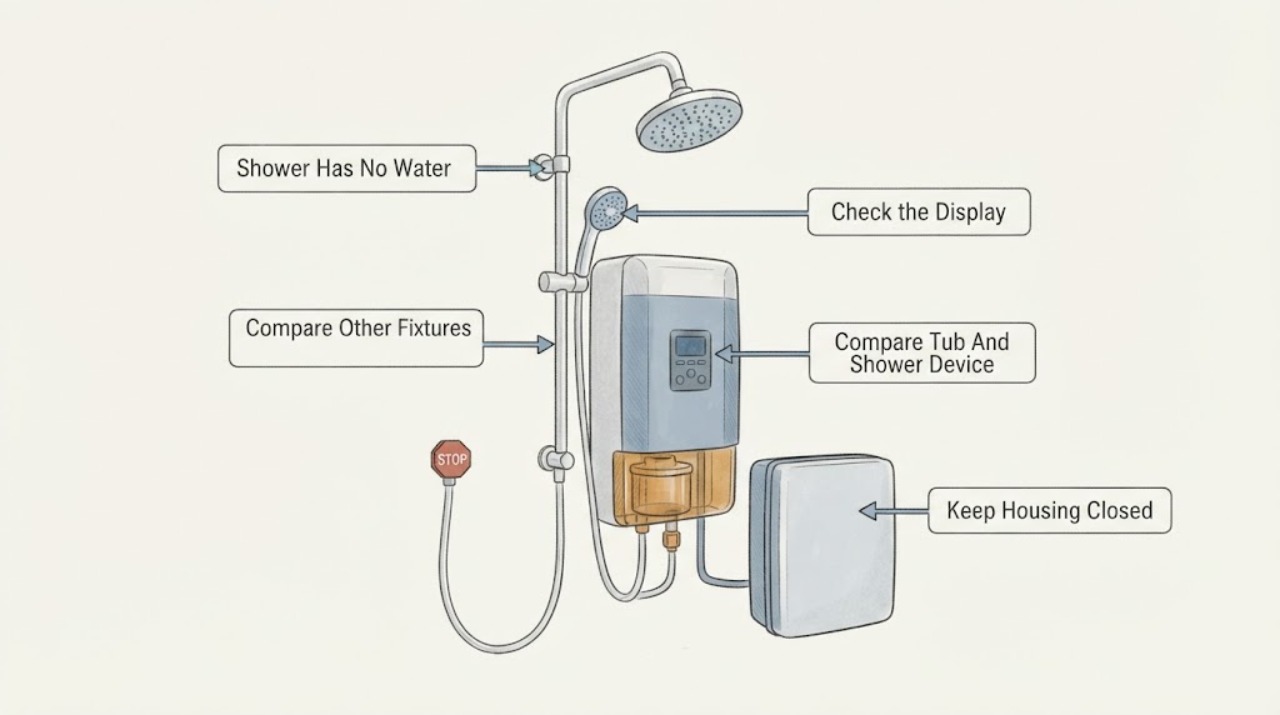
Work through in order
Diagnostic checks
Use only checks that match the exact appliance or system and its official guide.
-
Check 1
From a dry, stable position, open a nearby cold-water tap normally and note whether it has flow; if the shower shares a tub outlet, check the tub spout without removing the showerhead or trim.
Expected result: Other fixtures have normal flow, all nearby fixtures are dry, only hot water is missing, or the home has little or no water anywhere.
Next step: Use the matching branch below. If the whole home is affected, check only the visible main-shutoff position and contact the water provider or plumber if the cause is not obvious; do not force a valve.
Why this matters
Why: Normal nearby flow focuses the problem on the shower control, valve, shared tub/shower path, or shower device. Little or no flow throughout the home points toward the main shutoff, building supply, utility, pump, or a wider plumbing fault; a hot-only loss keeps the tank or hot-water path in scope.
-
Check 2
Identify the control style from its visible markings or manual and operate it once in the documented normal direction; do not force a stuck handle, pull a control that is not designed to pull, or remove the trim.
Expected result: The handle moves normally but no water appears, the control was being used in the wrong direction, the handle is stuck or damaged, or the control produces a drip or spray at the trim.
Next step: If documented operation does not restore flow, stop cycling the handle and arrange a qualified plumbing diagnosis. Keep a leaking or damaged control out of use and protect the area from water.
Why this matters
Why: Some shower systems require rotation, pulling, or a separate volume control, while a stuck or leaking control may indicate a cartridge, stop, or concealed valve issue. Correct operation can restore flow only when the control was misused; it does not clear a hidden valve fault.
-
Check 3
If the shower and tub share a visible outlet path, compare the tub spout and shower device only through ordinary manufacturer-approved operation; inspect the showerhead face from outside for debris without poking openings or opening the wall.
Expected result: Water reaches the tub spout but not the shower device, neither outlet has water, or the showerhead has visible debris or damage.
Next step: Follow the exact fixture manual for any user-accessible showerhead cleaning or device check. If the device is clear, damaged, or inaccessible, leave it unused and ask a plumber or manufacturer to identify the compatible procedure.
Why this matters
Why: Flow at the tub spout with no shower flow focuses attention on the diverter, shower arm, or showerhead obstruction. No flow at both outlets points back toward the valve supply, control, or shared plumbing. Visible damage is not a reason to force the device apart.
-
Check 4
Look only at safely accessible external shutoff valves serving the shower or bathroom, without removing panels or applying force, and record whether a valve appears fully open, partly closed, damaged, or wet.
Expected result: An external stop is visibly closed or partly closed, no external stop is present, or the stop is wet, seized, or damaged.
Next step: If the stop is clearly designed for ordinary hand operation and the area is dry, follow the installed system's instructions; otherwise leave it alone and provide its location and condition to a plumber.
Why this matters
Why: A closed external stop can prevent water reaching the valve, and some systems require both hot and cold inlets. A missing, seized, wet, or damaged stop needs plumbing service rather than force or concealed access.
-
Check 5
If cold water flows but hot water does not, compare hot-water flow at another tap and observe the tank or water-heater exterior from a safe distance for a label, leak, warning display, or obvious water contact; do not open access panels or disturb the heater.
Expected result: Hot water is absent at multiple taps, only the shower lacks hot water, the tank is leaking or wet, a warning or lockout is shown, or the tank exterior appears normal.
Next step: Record the heater type, visible model information, warning state, and whether cold flow remains available. Follow only external checks explicitly allowed by the model manual, and call a qualified plumber or water-heater technician for a tank fault.
Why this matters
Why: Hot water missing throughout the home keeps the storage tank, heater controls, supply, or recovery capacity in scope. Hot water missing only at the shower keeps the shower valve or mixing path in scope. A wet or faulted heater is a service condition, not a user repair.
-
Check 6
Prepare a service note with which fixtures have flow, hot versus cold behavior, tub-spout versus showerhead results, control style, accessible stop condition, heater type, visible leaks, and any recent plumbing work.
Expected result: The evidence isolates a shower device, shower control, hot-water path, or whole-home supply, or the results remain mixed.
Next step: Give the note and safe-distance photos to a qualified plumber. Keep the shower out of use when the cause is unclear, water is leaking, or a control is damaged.
Why this matters
Why: A clear comparison prevents a tank from being blamed for a shower-valve fault and helps the plumber choose a safe scope without opening concealed plumbing.
Use your observations
Decision map
Find the observation that best matches what you see, then follow the next safe action.
-
PATH 01Next step
What you see
Nearby cold-water fixtures also have no or very low flow.
Do this next
Check only the visible main-shutoff position and ask the water provider or a plumber about a supply interruption. Do not force a seized valve or open concealed piping.
Why this path and its safety boundary
Why it matters: The shower is unlikely to be the only cause; a main shutoff, building supply, utility, pump, frozen line, or broader plumbing fault is possible.
-
PATH 02Next step
What you see
The shared tub spout has flow but the shower device remains dry.
Do this next
Inspect the showerhead face from outside and follow the exact fixture instructions for a user-accessible cleaning step; request plumbing service if the path is clear, damaged, or concealed.
Why this path and its safety boundary
Why it matters: The diverter, shower arm, or showerhead path is more likely than the storage tank or whole-house supply.
-
PATH 03Next step
What you see
Neither the tub spout nor shower device has flow, while other fixtures work.
Do this next
Confirm the documented control operation and inspect only safely accessible external stops. If flow does not return, call a qualified plumber rather than removing trim or forcing the valve.
Why this path and its safety boundary
Why it matters: The shower valve may not be receiving both supplies, the control may be used incorrectly for its model, or an internal valve or stop may be obstructed or failed.
-
PATH 04Next step
What you see
Cold water flows at the shower but hot water is absent at the shower and other hot taps.
Do this next
Record the heater type and visible warning or leak condition, follow only model-authorized external checks, and request qualified water-heater service.
Why this path and its safety boundary
Why it matters: The tank or hot-water system may be relevant, but this is a hot-water fault rather than complete loss of shower flow.
-
PATH 05Safety boundary
What you see
Water leaks at the control or wall, the tank or piping is wet, water reaches electrical equipment, the shower is scalding, or the control is damaged or stuck.
Do this next
Stop using the shower, move people away, shut off water only from a safe and known accessible valve if needed, and call a qualified plumber. For gas odor, smoke, or fire risk, leave the area and seek emergency help from a safe location.
Why this path and its safety boundary
Why it matters: The risk has moved beyond a low-risk flow check and may involve water damage, burns, electrical shock, or a concealed plumbing failure.
Safety stop: Do not open walls, remove trim, drain a hot tank, touch wet electrical equipment, or force a valve.
Helpful context
Understand the symptom
No flow is different from no hot water
A shower that produces no water from either temperature side has a flow-path problem until proven otherwise. The useful split is whether other fixtures work, whether a shared tub spout works, and whether the missing flow is only at the shower device or already missing at the valve. A storage tank or water heater can leave a shower cold while water still flows; it does not automatically explain a dry showerhead and dry tub spout together.
Identify the installed control before changing anything
Shower controls do not all turn on the same way. Moen's guidance distinguishes controls that rotate from controls that pull out, and some systems use a separate volume control. Identify the faucet or shower system from its visible markings and manual before assuming a handle is broken or turning an in-wall stop. Do not force a handle or remove the trim to reach a concealed valve as a user experiment.
Keep tank checks on the hot-water side
If cold water flows but hot water is absent, the tank or another hot-water component may be relevant. Record whether hot water is missing at other taps too, and use only the water-heater manual's ordinary external checks. Do not remove access panels, disturb wiring, drain a hot tank, reset an unknown high-temperature control, or relight a gas appliance without model-specific instructions and the required safety conditions.
Safety boundary
Stop conditions
- Stop for uncontrolled water, a leak inside the wall, water near electrical equipment, a tank or heater that is wet, scalding water, smoke, a gas odor, or any sign of fire.
- Do not open a water-heater access panel, disturb wiring, drain a hot tank, relight a gas appliance, or reset an unknown safety control as a way to restore shower flow.
- Do not force a shower handle, stop valve, diverter, cartridge, trim, shower arm, or showerhead, and do not open the wall to find a concealed obstruction.
- Do not poke, drill, scrape, or enlarge showerhead openings, mix cleaning products, or use a damaged fixture while water can reach the wall or floor.
- Stop any check that requires climbing on a wet or unstable surface, reaching behind a cover, or working near exposed electrical equipment; call a qualified plumber.
Only after diagnosis
Potential parts
- showerhead or shower device
Consider this category only if flow reaches the shower arm or device path and the installed showerhead is confirmed blocked, damaged, or incompatible with its system.
Confirm the exact connection, valve or diverter arrangement, flow design, and manufacturer's fit information before ordering. - shower valve cartridge or diverter
Consider this category only after a qualified plumber confirms that the shower valve or diverter is the source of the no-flow result.
Confirm the exact valve family, trim, supply arrangement, and model fit; do not use a generic cartridge as a flow experiment. - storage water-heater component
Consider this category only when hot water is absent at multiple fixtures and a qualified technician identifies a heater-side fault.
Confirm the heater type, model, fuel, controls, applicable requirements, and professional installation or service procedure before ordering.
When checks do not resolve it
Need a professional?
Call a qualified plumber when the shower and tub path remain dry after the documented control and safe external-stop checks, when the whole home is affected, when hot water is absent throughout the home, or when a valve, tank, pipe, or shower device leaks or is damaged. Seek emergency help from a safe location for gas odor, smoke, fire, or an electrical hazard.
Safety scope: This article covers ordinary fixture comparison, documented control operation, and safe-distance observation only. Concealed valves, trim removal, tank access, hot-water service, gas appliances, electrical work, and pressurized plumbing belong to qualified professionals.
Common questions
FAQ
Why is there no water from the shower but other taps work?
The shower control, valve supply, shared tub/shower path, diverter, or showerhead is more likely than a whole-house supply problem. Compare the tub spout if it shares the outlet and identify the control style before arranging service.
Can a water-heater tank cause a shower to have no water?
A tank normally affects hot-water availability, recovery, or temperature. If cold water also has no flow, or the tub spout is dry, investigate the shower valve and water supply rather than assuming the tank is the cause.
What if the tub spout works but the showerhead is dry?
That pattern focuses the check on the diverter, shower arm, or showerhead path. Inspect only from ordinary access and follow the exact fixture instructions; do not poke openings or open the wall.
Should I open the water-heater panel when the shower has no water?
No. A heater panel, wiring, tank drain, gas control, or safety device is not a first-line shower-flow check. If hot water is absent at multiple fixtures or the heater is wet or faulted, arrange qualified water-heater service.
When is a shower with no water urgent?
Stop and seek prompt service for a leak, uncontrolled water, a stuck or damaged valve, water near electrical equipment, scalding water, or a wet heater. For gas odor, smoke, or fire risk, leave the area and seek emergency help from a safe location.
Read the exact guide
Official sources
- TROUBLESHOOTING CHECKLISTA. O. Smith / hotwater.com · Manufacturer manual guidance used only for storage water-heater scope and safety; the exact heater manual and fuel type control any service action.
- Consumer Water HeatersU.S. Department of Energy · Government definition used to distinguish a storage tank or water heater from the shower valve and cold-water flow path; it does not diagnose a specific installation.
- No Water from tub/shower unitsMoen Solutions · Moen-specific examples used to explain why control style, both inlet supplies, accessible stops, and the shower device must be identified; exact model instructions govern.
Community feedback
Share a repair observation
Share a plain-text repair observation. Accepted observations are published automatically; this page may take a moment to update.