
On this page
Start here
Quick answer
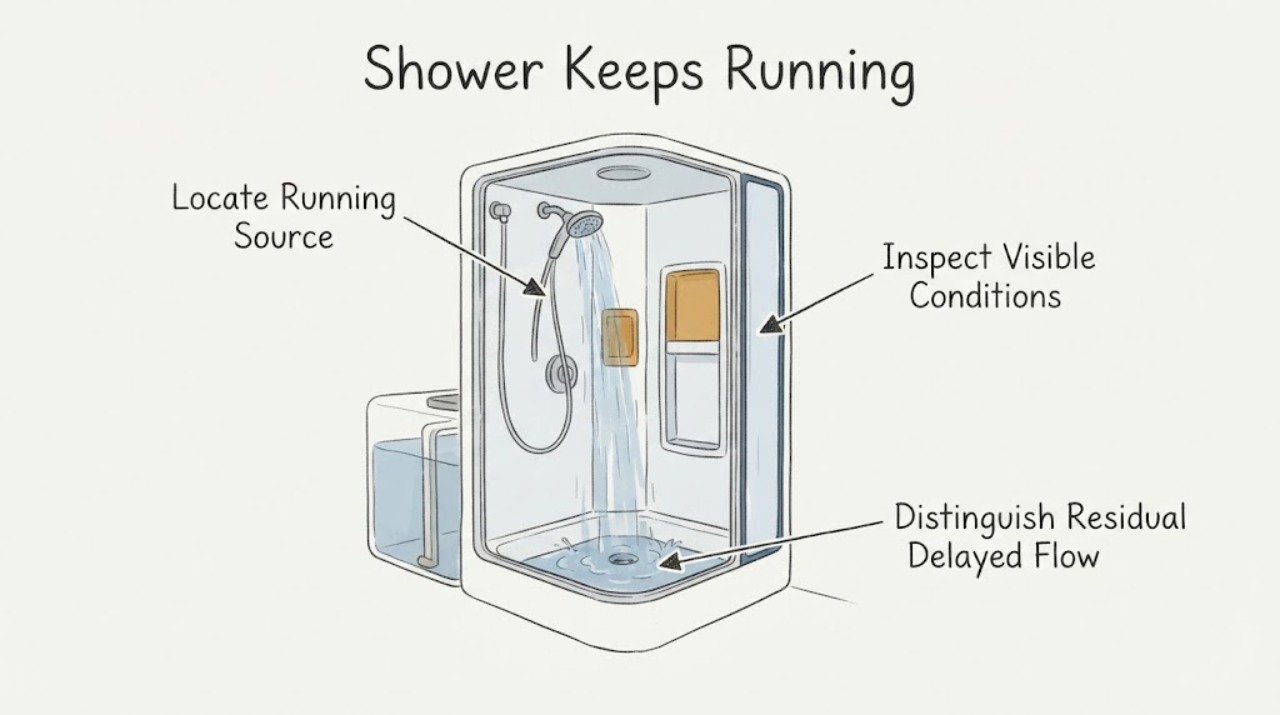
A shower that is described as running can mean water continues from the showerhead after the handle is off, the shower keeps flowing because a valve or local supply stop is not closing, or the sound is actually a water-heater tank refilling, a relief discharge, or a drain. First identify where water or noise is coming from and whether it stops when the shower control and, only if safely accessible, the local or main water shutoff are closed. A short drip after shutoff can be residual water or delayed flow in some installations, but a steady stream, a tank that keeps refilling, a wet floor or ceiling, or water from a relief or drain area needs prompt plumbing assessment. Keep away from scalding water, flooding, gas odor, smoke, and wet electrical equipment. Do not force a seized valve, open a wall, disturb a water-heater relief device, or dismantle a cartridge without isolating water and following the exact model instructions; call a licensed plumber when the flow continues or the source is uncertain.
Before you begin
Safety first
- This article supports safe source observation and a clearly identified shutoff only when it can be operated without force or exposure. It does not authorize valve disassembly, concealed-pipe access, pressure-relief manipulation, water-heater panel removal, gas work, live electrical work, chemical drain treatment, or improvised heat.
Work through in order
Diagnostic checks
Use only checks that match the exact appliance or system and its official guide.
-
Check 1
From a dry, safe position, identify whether the continuing water or sound comes from the showerhead, tub spout, handle or trim, the wall or ceiling, the water-heater tank, a relief discharge, or the drain. Record whether the shower handle is fully off and whether the flow is a steady stream, a brief drip, or a delayed trickle.
Expected result: A steady stream continues at the outlet, only a few drops appear, water emerges from the valve or wall, or the tank is humming, filling, or discharging.
Next step: Follow the matching branch below. If the source is hidden, the water is hot, or water is reaching the floor, ceiling, electrical equipment, or gas appliance, stop and call a plumber or emergency service.
Stop if: Stop for scalding water, active flooding, a hidden leak, water near electrical equipment, gas odor, smoke, or a damaged or seized valve.
Why this matters
Why: A steady outlet stream points to valve or supply control; a brief drip can be residual water or delayed flow; water at the wall or tank raises a leak concern; tank noise or discharge is not fixed by replacing a showerhead.
-
Check 2
Turn the shower control to its normal off position without force and observe the outlet from a safe distance. If the model has an external, clearly identified local stop that is safely reachable, note whether closing it stops the flow; do not remove trim, loosen fittings, or force a stuck stop.
Expected result: The flow stops immediately, changes to a short drip, continues steadily, moves between the showerhead and tub spout, or the stop will not operate normally.
Next step: Leave a continuing-flow or failed-stop condition isolated if safely possible and arrange licensed plumbing service. Do not try to repair a cartridge or valve while pressurized or without the model instructions.
Stop if: Stop for a seized handle or shutoff, uncontrolled flow, water escaping behind trim, scalding water, or any need to open the wall or use force.
Why this matters
Why: Immediate stop makes a permanently open valve less likely. A brief drip can be residual or delayed flow. Continued steady flow, cross-flow, or a failed stop suggests a valve, cartridge, seal, supply, or installation fault and can waste water or damage the building.
-
Check 3
If the outlet changes from a stream to a brief drip after shutoff, observe from a safe position without repeatedly cycling the valve. Note how long the residual water lasts, whether it comes from only the showerhead or tub spout, and whether it stops without water appearing at the wall or ceiling.
Expected result: The drip ends on its own, returns as a steady stream, appears at both outlets, or is accompanied by back-pressure, wall moisture, or a ceiling stain.
Next step: If the drip ends and no damage is visible, record the pattern and monitor without disassembly. If it persists, returns, or reaches the wall or ceiling, keep the supply closed if safe and call a plumber.
Stop if: Stop for a steady stream, active wall or ceiling leak, scalding water, or any need to remove a cartridge or trim under pressure.
Why this matters
Why: A short, self-ending drip can be water remaining in the riser or a model-specific thermal or back-pressure effect. A renewed stream, cross-flow, or building moisture is not normal residual drainage and needs valve or leak diagnosis.
-
Check 4
If the running sound or water is near the water-heater tank, inspect only its dry, external, accessible area for water at top fittings, the bottom, the drain outlet, or the temperature-and-pressure relief discharge. Do not touch the relief lever, remove panels, or reach around hot or gas-fired equipment.
Expected result: The tank area is dry, water is at a fitting or drain, water is coming from a relief discharge, the tank body appears wet, or the tank is refilling after normal shower use.
Next step: If water is present, shut off the water or fuel only when the control is safely reachable and the exact manual permits it, stay clear of hot surfaces, and call a licensed plumber. If dry but the tank runs continuously or hot water is abnormal, arrange water-heater service.
Stop if: Do not cap or operate the relief device, drain the tank, open covers, touch wiring, relight gas equipment, or continue with a gas odor, smoke, hot discharge, or flooding.
Why this matters
Why: Normal recovery after a draw is different from an active leak. Water at fittings, a relief discharge, or the tank body can indicate pressure, connection, valve, condensation, or tank failure; those possibilities cannot be separated safely by forcing a test.
-
Check 5
Record whether the sound continues only while the shower is in use or continues after all fixtures are off. Observe the shower drain and nearby floor for standing water, slow drainage, or water returning from another fixture; do not pour chemicals or open a drain trap as a response to a tank sound.
Expected result: The sound ends after the shower stops, continues with no water use, water drains normally, water backs up, or the floor becomes wet.
Next step: Leave the affected fixture or heater off if water is backing up or the source is uncertain and arrange plumbing service. Do not use drain chemicals, force a cleanout, or keep the tank firing to reproduce the sound.
Stop if: Stop for sewage backup, active flooding, water near electrical equipment, hot discharge, gas odor, or any need to access concealed plumbing.
Why this matters
Why: A sound tied to a draw may be demand or normal tank recovery, while a continuing sound with no use points to a leak, valve, relief, recirculation, or water-heater condition. Drain backup can make water appear to be running even when the supply valve is closed.
-
Check 6
Record the shower brand, model, valve type, and whether any cartridge, mixer cap, pressure-balancing unit, or trim was recently installed or serviced. Compare the symptom only with that exact manufacturer's support or manual; do not treat another valve family's seal or installation detail as universal.
Expected result: The model matches an official constant-run or delayed-flow instruction, recent valve work preceded the symptom, or no exact model guidance is available.
Next step: Follow only the exact model's visible, water-isolated instruction. If the flow persists, the model is unknown, or repair requires cartridge or wall access, call a licensed plumber.
Stop if: Do not dismantle a pressurized valve, substitute parts, force a stop, or continue operation with a leak or water behind the trim.
Why this matters
Why: Kohler's official examples tie constant running after service to specific seal and mixer-cap placement conditions, while delayed dripping can depend on installation materials and thermal behavior. A nonmatching model remains unresolved.
-
Check 7
Prepare a service record with the outlet or tank source, steady versus delayed flow, whether the control or local stop closed it, fixture and tank observations, water temperature, model information, recent work, and any leak, gas, or electrical symptom. Stop testing once a service trigger exists.
Expected result: The record points to a shower valve, residual or delayed flow, tank leak or discharge, drain backup, hidden supply issue, or an unresolved combination.
Next step: Keep the relevant fixture, supply, or water heater out of service as directed and contact a licensed plumber. Use emergency gas, electrical, fire, or medical response first for the associated hazard.
Stop if: Do not force valves, open walls, remove panels, touch relief devices, relight gas equipment after odor, or keep running water to test the diagnosis.
Why this matters
Why: The first wet point and timing help a plumber distinguish a valve seal problem from tank demand, pressure, relief, leak, or drain behavior without asking the resident to reproduce a flood or hot discharge.
Use your observations
Decision map
Find the observation that best matches what you see, then follow the next safe action.
-
PATH 01Safety boundary
What you see
A steady stream continues from the showerhead or tub spout after the control is placed in its normal off position.
Do this next
Close a clearly identified local or main shutoff only if safely reachable, leave it isolated, and call a licensed plumber for model-specific valve diagnosis.
Why this path and its safety boundary
Why it matters: The shower valve, cartridge, seal, local stop, or supply control may not be closing; this is different from residual dripping.
Safety stop: Do not force a seized stop, open the wall, dismantle trim under pressure, or continue with scalding water or flooding.
-
PATH 02Safety boundary
What you see
Flow becomes a brief drip or delayed trickle and then stops, with no wall, ceiling, or floor moisture.
Do this next
Record the pattern and use the exact valve manual if the symptom changes. Call a plumber if the drip becomes steady, increases, or returns with damage.
Why this path and its safety boundary
Why it matters: Residual water or a model-specific back-pressure or thermal effect may explain it; Kohler documents delayed flow as dependent on particular installation conditions.
Safety stop: Stop for a renewed stream, hidden moisture, scalding water, or any need to open or force the valve.
-
PATH 03Safety boundary
What you see
The noise is at the water-heater tank or water appears at tank fittings, the drain, relief discharge, or tank body.
Do this next
Stay clear of hot surfaces and relief hardware, isolate water or fuel only when safely reachable and model-authorized, and call a licensed plumber or water-heater technician.
Why this path and its safety boundary
Why it matters: The tank may be recovering after a draw, but persistent refill, relief discharge, or wetness can indicate a plumbing leak, pressure condition, condensation, or tank fault.
Safety stop: Do not lift the relief lever, cap the discharge, drain the tank, remove panels, or operate with hot discharge, gas odor, smoke, or flooding.
-
PATH 04Safety boundary
What you see
Water backs up at the drain, returns from another fixture, or the first wet point is a wall, ceiling, floor, or concealed pipe.
Do this next
Stop using the affected fixtures, close the main or local water supply if safely reachable, keep away from wet electrical areas, and arrange urgent plumbing service.
Why this path and its safety boundary
Why it matters: Drainage or a hidden supply leak can make a shower appear to keep running and can cause structural or electrical damage.
Safety stop: Do not pour chemical drain cleaner, open concealed plumbing, enter unsafe areas, or touch wet electrical equipment.
-
PATH 05Safety boundary
What you see
A gas odor, soot, unusual flame, smoke, burning smell, shock, arcing, hot equipment, or water near electrical parts accompanies the running symptom.
Do this next
Leave the area, avoid switches and ignition sources, and contact emergency, gas, or electrical responders from a safe location. Keep the plumbing or water heater off until cleared.
Why this path and its safety boundary
Why it matters: This is an immediate gas, fire, or electrical safety event, not a shower-valve or tank troubleshooting branch.
Safety stop: Do not relight, reset, open panels, touch wet equipment, or return to inspect the appliance until qualified responders say it is safe.
Helpful context
Understand the symptom
Define what is actually running
Look and listen from a dry, safe position. A steady stream from the showerhead or tub spout after the handle is off is a valve or supply-control symptom. A brief drip or delayed trickle may be water left in the riser or a model-specific back-pressure effect. A humming, filling, or relief discharge at the water-heater tank is a different problem, and a drain or pump can sound like continuing supply. Do not assume that the word running identifies a cartridge or tank failure.
Trace the first wet point without creating a flood
Note whether water comes from the showerhead, tub spout, handle trim, ceiling or wall, tank fittings, relief discharge, drain, or an appliance area. If the water is hot, let it cool and avoid touching it. If a safely reachable shutoff stops the stream, leave it closed when leakage or uncontrolled flow is present and arrange service. A shutoff that will not turn normally is a service boundary; do not force it or remove trim while water is pressurized.
Treat the tank as a pressure and heat hazard
A water-heater tank may refill or heat after a draw, but persistent running, water on the floor, a relief discharge, unusual noise, or a gas-control or vent symptom needs diagnosis. Do not cap, plug, lift, or adjust a temperature-and-pressure relief device, open heater panels, touch wiring, or relight gas equipment after an odor. A shower valve and a tank can be related through demand, but they require different isolation and professional checks.
Safety boundary
Stop conditions
- Stop immediately for a steady uncontrolled stream, active flooding, a burst or hidden pipe, scalding water, a leaking tank or relief discharge, water near electrical equipment, gas odor, smoke, soot, abnormal flame, burning odor, shock, or arcing.
- Do not force a shower handle or shutoff, open a wall or ceiling, dismantle a cartridge under pressure, lift or cap a water-heater relief device, remove heater panels, or touch wet equipment.
- Do not use drain chemicals, open flame, improvised heat, or repeated water-use tests to locate the source. A short delayed drip is not permission to disassemble the valve.
- Keep the affected fixture or tank out of service and call a licensed plumber when flow continues, the source is uncertain, a tank is wet or persistently running, or a hidden leak or drain backup is possible.
When checks do not resolve it
Need a professional?
Call a licensed plumber for a shower that continues to stream after shutoff, a failed or seized local stop, persistent or increasing drip, water behind trim, a hidden leak, drain backup, or any tank leak, relief discharge, or persistent refill sound. Call a qualified water-heater technician for gas-control, vent, heating, pressure, or electrical symptoms. Use emergency gas, electrical, fire, or medical response first for gas odor, smoke, carbon-monoxide symptoms, shock, arcing, active flooding, or water near energized equipment.
Safety scope: This article supports safe source observation and a clearly identified shutoff only when it can be operated without force or exposure. It does not authorize valve disassembly, concealed-pipe access, pressure-relief manipulation, water-heater panel removal, gas work, live electrical work, chemical drain treatment, or improvised heat.
Common questions
FAQ
Why does my shower keep running after I turn it off?
A steady stream suggests the shower valve, cartridge, seal, or local supply stop is not closing. A short drip may be residual or model-specific delayed flow. Record the pattern and call a plumber if it continues, returns, or creates wall, ceiling, or floor moisture.
Could the water-heater tank be the thing that is running?
A tank can refill or heat after a shower, but persistent noise, water at the tank, relief discharge, or a tank that continues running with no water use needs water-heater or plumbing diagnosis. Do not touch the relief device or open the heater.
What if water runs briefly after the shower is shut off?
A brief, self-ending drip can be residual water or a documented installation back-pressure effect on some valve families. It should not become a steady stream or produce hidden moisture; if it does, isolate the supply if safe and call a plumber.
When is a running shower or tank an emergency?
Leave the area and use the appropriate emergency response for flooding, a burst pipe, scalding discharge, gas odor, smoke, carbon-monoxide symptoms, shock, arcing, or water near electrical equipment. Do not use flame or indoor fuel-burning equipment to locate or solve the problem.
Read the exact guide
Official sources
- What to Do to Protect Yourself During a Power OutageCenters for Disease Control and Prevention · CDC emergency guidance for outages during storms; it does not replace local emergency instructions or an exact water-heater manual.
- Water Continues to Run After Mixer Cap and PBU InstallationKohler Assist · Kohler guidance only for the listed Rite-Temp valve families and installation context; it must not be generalized to another model.
- Safety Guidelines: During & After a Winter StormCenters for Disease Control and Prevention · CDC public-health guidance for winter storms and extreme cold; local plumbing codes and professional instructions control site-specific work.
- Is Your Hot Water Not Getting Hot? Common Causes & What To Do About ThemA. O. Smith · A. O. Smith homeowner guidance; exact water-heater model, fuel, region, and installation manual control any status or service procedure.
- Delayed Flow, Dripping or Back Pressure from Shower Head and/or Tub SpoutKohler Assist · Kohler guidance for the listed Rite-Temp valve families; installation materials and exact model control applicability.
Community feedback
Share a repair observation
Share a plain-text repair observation. Accepted observations are published automatically; this page may take a moment to update.